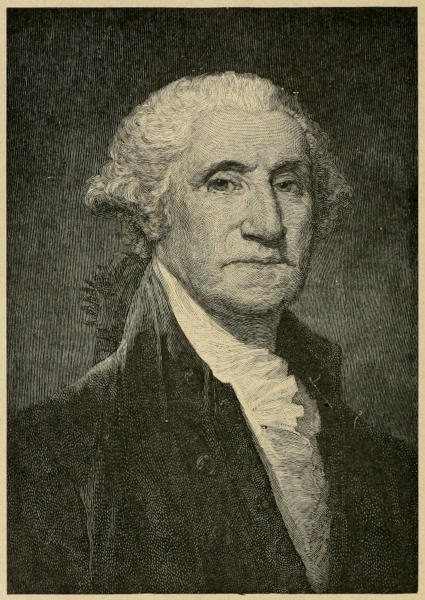
GEORGE WASHINGTON
[i]
A HISTORY OF
THE AMERICAN PEOPLE
BY
WOODROW WILSON, Ph.D., Litt.D., LL.D.
IN FIVE VOLUMES
Vol. II.
Colonies and Nation
[ii]
GEORGE WASHINGTON
[iii]
A HISTORY OF
THE AMERICAN PEOPLE
BY
WOODROW WILSON, Ph.D., Litt.D., LL.D.
PRESIDENT OF PRINCETON UNIVERSITY
ILLUSTRATED WITH PORTRAITS, MAPS,
PLANS, FACSIMILES, RARE PRINTS,
CONTEMPORARY VIEWS, ETC.
IN FIVE VOLUMES
Vol. II.
NEW YORK AND LONDON
HARPER & BROTHERS PUBLISHERS
MCMVII
[iv]
Copyright, 1901, 1902, by Woodrow Wilson.
Copyright, 1901, 1902, by Harper & Brothers.
All rights reserved.
[v]
| CHAPTER | PAGE | |
| I. | Common Undertakings | 1 |
| II. | The Parting of the Ways | 98 |
| III. | The Approach of Revolution | 172 |
| IV. | The War for Independence | 223 |
| APPENDIX | 331 |
[vi]
[vii]
| PAGE | |
| George Washington | Frontispiece. |
| Plan of Charleston, South Carolina, about 1732.—From plate 12 of Henry Popple’s Map of the British Empire in America. London, 1733 | 3 |
| New Orleans in 1719.—Redrawn from an old print | 5 |
| Samuel de Champlain.—Redrawn from an old print | 7 |
| An early view of Quebec.—Redrawn from a view published at London in 1760 | 12 |
| Cour du Bois, xvii. century.—From a drawing by Frederic Remington | 14 |
| An English fleet about 1732.—From plate 11 of Henry Popple’s Map of the British Empire in America | 16 |
| Moale’s sketch of Baltimore, Maryland, in 1752.—Drawn from the original in the Maryland Historical Society | 19 |
| Charleston, from the harbor, 1742.—Redrawn from an old print | 22 |
| Lord Bellomont.—From an old engraving | 25 |
| William and Mary College before the fire, 1723.—Redrawn from an old print | 27 |
| John Churchill, Duke of Marlborough.—From an engraving by R. Cooper in the Emmet Collection, New York Public Library (Lenox Building) | 29 |
| Prince Eugene.—From an old engraving | 31[viii] |
| French Huguenot Church, New York, 1704.—Redrawn from an old print | 32 |
| Old Swedes church, Wilmington, Delaware.—From a drawing by Howard Pyle | 34 |
| New York slave market about 1730.—Redrawn from an old print | 36 |
| Broad Street, New York, in 1740.—Redrawn from an old print | 37 |
| Old State House at Annapolis, Maryland.—Redrawn from an old lithograph by Weber | 39 |
| New York, from the harbor, about 1725.—Redrawn from an old print | 41 |
| Alexander Spotswood.—Redrawn from the frontispiece in the Official Letters of Alexander Spotswood, published by the Virginia Historical Society | 42 |
| Brenton church, where Governor Spotswood worshipped.—From Lossing’s Field-Book of the Revolution | 43 |
| Governor Spotswood’s expedition to the Blue Ridge.—From a painting by F. Luis Mora | 45 |
| Colonel Rhett and the pirate Stede Bonnet.—From a painting by Howard Pyle | 46 |
| Portrait of the pirate Edward Thatch (or Teach).—From Capt. Charles Johnson’s General History of the Highwaymen [etc.]. London, 1736. In the New York Public Library (Lenox Building) | 48 |
| Sir Robert Walpole.—From an old engraving | 50 |
| Map of the coast settlements, 1742.—From an old English map | 53 |
| Pohick church, Virginia, where Washington worshipped.—From a sketch by Benson J. Lossing in 1850 | 55 |
| Title-page of the proceedings against the negroes.—Title-page of the original edition of Daniel Horsmanden’s Journal of the so-called “Negro Plot” of 1741. From an original in the New York Public Library (Lenox Building) | 57[ix] |
| Oswego in 1750.—Redrawn and extended from a folded view in William Smith’s History of the Province of New York. London, 1757 | 60 |
| James Oglethorpe.—From an old engraving | 63 |
| Oglethorpe’s order for supplies.—From Winsor’s America | 65 |
| Savannah in 1734.—From an original engraving in the New York Public Library (Lenox Building) | 66 |
| Alexander Hamilton.—From the bust by Palmer in possession of the Honorable Nicholas Fish, of New York | Facing p. 66 |
| John Wesley.—From an old engraving | 68 |
| Oglethorpe’s expedition against St. Augustine.—From a painting by F. Luis Mora | 69 |
| George Whitefield.—From an old engraving | 70 |
| The action at Cartagena.—From Green’s History of the English People | 72 |
| William Pepperrell.—Sir William Pepperrell. The original painting is in the Essex Institute, at Salem, Mass.; the artist’s name is not known | 74 |
| Facsimile of the New York Weekly Journal.—First page of the second number of John Peter Zenger’s newspaper, from an original in the New York Public Library (Lenox Building) | 78 |
| Robert Dinwiddie.—After a phototype by F. Gutekunst which forms the frontispiece to vol. ii. of the Dinwiddie Papers, published by the Virginia Historical Society | 80 |
| Merchants’ Exchange, New York, 1752-1799.—From Reminiscences of an Old New-Yorker. Emmet: New York Public Library (Lenox Building) | 83 |
| The Plains of Abraham on the morning of the battle.—From a painting by Frederic Remington | 86 |
| Map of Braddock’s defeat.—Redrawn from plate 6 of Winthrop Sargent’s History of Braddock’s Expedition, published by the Historical Society of Pennsylvania | 88 |
| William Pitt.—From an old engraving | 91[x] |
| Signature of James Abercrombie | 92 |
| The Capitulation of Louisbourg.—From a painting by Howard Pyle | 93 |
| Jeffrey Amherst.—From an old engraving | 94 |
| James Wolfe.—From a mezzotint by Richard Houston in the Emmet Collection, No. 3217, New York Public Library (Lenox Building) | 95 |
| William Byrd.—From Wilson’s Washington | 101 |
| Plan of the city of New York, 1767.—From Janvier’s Old New York, p. 48 | 103 |
| Edmund Burke.—From an engraving after the painting by Romney | 106 |
| View of the buildings belonging to Harvard College, Cambridge, New England, 1726.—Partial reproduction of the earliest print of Harvard College. What is believed to be the only extant copy of this old engraving is owned by the Massachusetts Historical Society | 109 |
| Nassau Hall, Princeton College, 1760.—Redrawn from an old print | 111 |
| King’s College New York, 1758.—Redrawn from an old print | 112 |
| Benjamin Franklin.—From the portrait by Duplessis in the Museum of Fine Arts, Boston, Mass. | Facing p. 112 |
| The birthplace of Benjamin Franklin, Milk Street, Boston.—Redrawn from an old print | 113 |
| Benjamin Franklin.—From an old engraving | 115 |
| A page of “Poor Richard’s” Almanac.—From an original of this almanac for 1767, in the New York Public Library (Lenox Building) | 117 |
| Benjamin Franklin in a colonial drawing room.—From a painting by H. C. Christy | 119 |
| Mrs. Benedict Arnold and child.—From the portrait by Sir Thomas Lawrence, in the Historical Society of Pennsylvania | 121 |
| Franklin’s old book-shop, next to Christ’s Church, Philadelphia.—Redrawn from an old print | 123[xi] |
| George Grenville.—From an old print | 125 |
| Boundary monument on the St. Croix.—From a lithograph by L. Haghe after a sketch by Joseph Bouchette, made in July, 1817, and included in his British Dominions in North America. London, 1832 | 127 |
| Pontiac, chief of the Ottawas.—Redrawn from an old print | 129 |
| Henry Bouquet.—From a process-plate in New York Public Library (Lenox Building) | 131 |
| Bouquet’s redoubt at Pittsburg.—Redrawn from an old print | 132 |
| Patrick Henry.—From an old engraving | 133 |
| Signature of Isaac Barré | 134 |
| Facsimile of poster placed on the doors of public buildings.—From Lamb’s History of New York | 135 |
| John Dickinson.—From an old engraving | 137 |
| Thomas Hutchinson.—From the painting attributed to Copley, in the Massachusetts Historical Society | 138 |
| Thomas Hutchinson’s mansion, Boston.—Redrawn from an old print | 139 |
| Table of stamp charges on paper.—From an original of this broadside, in the Emmet Collection, No. 1802, in the New York Public Library (Lenox Building) | 141 |
| Lord Rockingham.—From an engraving after a painting by Wilson | 142 |
| James Otis.—Redrawn from an old print | 144 |
| Stamps forced on the colonies.—From a photograph of an old document | 145 |
| Old capitol at Williamsburg, Virginia.—From a painting by Howard Pyle | 147 |
| George Wythe.—From a painting by Weir, after Trumbull, in Independence Hall, Philadelphia | 149 |
| George Washington, 1772.—From a portrait painted in 1772, by C. W. Peale, now owned by General George Washington Custis Lee, of Lexington, Virginia | 155[xii] |
| Landing troops at Boston, 1768.—From a heliotype in Winsor’s Boston, after the engraving by Paul Revere | 157 |
| List of names of those who would not conform.—This is a page from the North American Almanack for 1770, published at Boston by Edes and Gill | 159 |
| Hand-bill of True Sons of Liberty.—From Winsor’s America. The Massachusetts Historical Society possesses a copy of the original broadside | 162 |
| The Boston massacre.—From a painting by F. Luis Mora | 163 |
| After the massacre. Samuel Adams demanding of Governor Hutchinson the instant withdrawal of British troops.—From a painting by Howard Pyle | 165 |
| Interior of council chamber, old State House, Boston.—From a photograph | 166 |
| Protest against the landing of tea.—Facsimile of a Boston broadside, from Winsor’s America. An original is in the Massachusetts Historical Society | 167 |
| Entry John Adams’s diary.—From Winsor’s Boston | 168 |
| Call for meeting to protest against the landing of tea.—A Philadelphia poster, from Winsor’s America. There is an original in the Historical Society of Pennsylvania | 168 |
| The Boston tea party.—From a painting by Howard Pyle | 169 |
| Boycotting poster.—From the original hand-bill in the Massachusetts Historical Society | 173 |
| Circular of the Boston Committee of Correspondence.—From the original in the Boston Public Library | 175 |
| George III.—From an engraving by Benoit | 177 |
| George Mason.—From a painting by Herbert Walsh, in Independence Hall, Philadelphia | 179 |
| Seal of Dunmore.—Redrawn from an impression of the seal | 181 |
| Earl of Dunmore.—Redrawn from an old print | 182 |
| The attack on the Gaspee.—From a painting by Howard Pyle | 184 |
| Lord North.—From the engraving by Mote, after Dance | 186[xiii] |
| Title-page of Hutchinson’s History.—From an original in the New York Public Library (Lenox Building) | 188 |
| General Gage.—Redrawn from an old print | 190 |
| Stove in the House of the Burgesses, Virginia.—From a photograph of the original in the State Library of Virginia | 191 |
| John Adams.—From the portrait by Gilbert Stuart, in Harvard University | Facing p. 192 |
| Roger Sherman.—Redrawn from an old print | 195 |
| Joseph Galloway.—Redrawn from an old print | 197 |
| John Dickinson.—From an engraving after a drawing by Du Simitier | 198 |
| Peyton Randolph.—From an engraving after a painting by C. W. Peale | 200 |
| Washington stopping at an inn on his way to Cambridge.—From a painting by F. Luis Mora | 203 |
| The Liberty Song.—From The Writings of John Dickinson, edited by Paul Leicester Ford, published by the Historical Society of Pennsylvania | 205 |
| Signature of Joseph Hawley | 210 |
| The House of Commons as it appeared in 1741.—From a drawing by Gavelot | 214 |
| Page from the diary of Josiah Quincy, Jr.—From Winsor’s America. The original diary, kept while he was in London in 1774, is preserved in the Massachusetts Historical Society | 216 |
| Proclamation of the King for the suppression of the rebellion.—From an original of this broadside in the Emmet Collection, No. 1496, in the New York Public Library (Lenox Building) | 218 |
| Gage’s order permitting inhabitants to leave Boston.—From Winsor’s Boston. The handwriting is that of James Bowdoin | 220 |
| Notice to militia.—From an original in the Massachusetts Historical Society | 224 |
| An account of the Concord fight.—From Winsor’s America. The original is in the Arthur Lee Papers, preserved at Harvard College Library | 225[xiv] |
| Signature of Ethan Allen | 226 |
| Ruins of Fort Ticonderoga.—Redrawn from an old print | 227 |
| Watching the fight at Bunker Hill.—From a painting by Howard Pyle | 228 |
| From Beacon Hill, 1775, no. 1. (Looking towards Dorchester Heights.)—From Winsor’s America | 230 |
| From Beacon Hill, 1775, no. 2. (Looking towards Roxbury.)—From Winsor’s America | 231 |
| Order of Committee of Safety.—From Winsor’s America | 232 |
| Boston and Bunker Hill, from a print published in 1781.—Redrawn from a plan in An Impartial History of the War in America | 234 |
| Richard Montgomery.—From an old engraving | 238 |
| Benjamin Franklin as a politician.—From a painting by Stephen Elmer | 240 |
| R. H. Lee’s resolution for independence.—From McMaster’s School History of the United States | 241 |
| State House, Philadelphia, 1778.—From a photograph of the original drawing | 242 |
| Signature of Thomas Jefferson | 243 |
| Jefferson’s original draft of the Declaration of Independence.—This facsimile of Jefferson’s original rough draft, with interlineations by Adams and Franklin, is from an artotype by Edward Bierstadt, made from the original in the Department of State, Washington, D. C. | 244, 245, 246, 247 |
| Rear view of Independence Hall.—From a photograph | 248 |
| The President’s chair in the Constitutional Convention.—From a photograph | 249 |
| Map of Sullivan’s Island.—Redrawn from a plan in Johnson’s Traditions and Reminiscences of the American Revolution in the South. Charleston, S. C., 1851 | 250[xv] |
| Wllliam Moultrie.—From an old engraving | 251 |
| Sir William Howe.—From an old engraving | 253 |
| Howe’s proclamation preparatory to leaving Boston.—From the original in the Massachusetts Historical Society | 255 |
| Evacuation of Brooklyn Heights.—From a painting by F. Luis Mora | 257 |
| Circular of Philadelphia Council of Safety.—From the original in the Historical Society of Pennsylvania | 259 |
| Operations around Trenton and Princeton. Numbers 76 represent the camps of General Cornwallis and 77 that of General Knyphausen on the 23d of June, 1777.—Redrawn from a sketch map by a Hessian officer | 261 |
| Hessian boot.—From a photograph | 263 |
| Letter concerning British outrages.—From the original in the Historical Society of Pennsylvania | 265 |
| Recruiting poster.—From Smith’s American Historical and Literary Curiosities | 267 |
| John Burgoyne.—From an old engraving | 269 |
| Arthur St. Clair.—From an engraving after the portrait by C. W. Peale | 271 |
| Samuel Adams.—From the portrait by Copley in the Museum of Fine Arts, Boston, Mass. | Facing p. 272 |
| Benjamin Lincoln.—From the portrait in the Massachusetts Historical Society | 273 |
| Sir William Johnson.—From a mezzotint by Spooner in the Emmet Collection, No. 36, New York Public Library (Lenox Building) | 274 |
| Sir John Johnson.—From an engraving by Bartolozzi | 275 |
| Joseph Brant.—From an engraving after the original painting by G. Romney | 276 |
| Peter Gansevoort.—From Lossing’s Field-Book of the Revolution. | 277[xvi] |
| Facsimile of closing paragraphs of Burgoyne’s surrender.—From the original in the New York Historical Society | 279 |
| Scene of the battle of the Brandywine.—From an old engraving in the Emmet Collection, New York Public Library (Lenox Building) | 281 |
| Washington’s proclamation.—From the original in the Historical Society of Pennsylvania | 283 |
| Baron de Steuben.—From an old engraving | 285 |
| Facsimile of play bill.—From Smith’s American Historical and Literary Curiosities | 287 |
| Charles Lee.—From a mezzotint after the painting by Thomlinson, in Emmet Collection, No. 1902, New York Public Library (Lenox Building) | 289 |
| Reduced facsimile of instructions from Congress to privateers.—From Maclay’s History of American Privateers | 291 |
| Continental lottery book.—From a photograph | 292 |
| Reduced facsimile of the first and last parts of Patrick Henry’s letter of instructions to George Rogers Clark.—From the Conquest of the Northwest, by William E. English | 294 |
| George Rogers Clark.—From a portrait by Jarvis in the Wisconsin Historical Society | 295 |
| George Clark’s final summons to Colonel Hamilton to surrender.—From Winsor’s America | 297 |
| Charles James Fox.—From an engraving after the portrait by Opie | 299 |
| John Sullivan.—From a mezzotint by Will | 301 |
| Casimir Pulaski.—From an engraving by Hall, in Emmet Collection, No. 3852, New York Public Library (Lenox Building) | 302 |
| John Paul Jones.—From a painting by C. W. Peale, in Independence Hall, Philadelphia | 304 |
| The fight between Bon Homme Richard and Serapis.—From a painting by Howard Pyle | 305[xvii] |
| Washington and Rochambeau in the trenches at Yorktown.—From a painting by Howard Pyle | 307 |
| Horatio Gates.—From an engraving by C. Tiebout, after the painting by Gilbert Stuart, Emmet Collection, New York Public Library (Lenox Building) | 309 |
| Benedict Arnold’s oath of allegiance | 310 |
| Benedict Arnold.—From a mezzotint in the Emmet Collection, No. 1877, New York Public Library (Lenox Building) | 311 |
| John André.—From an engraving in the New York Public Library (Lenox Building) | 312 |
| Major André’s watch.—From a photograph | 313 |
| Benedict Arnold’s pass to Major André.—From Lossing’s Field-Book of the Revolution | 314 |
| Major André’s pocket-book.—From a photograph | 315 |
| Virginia colonial currency.—From a photograph | 316 |
| Lord Cornwallis.—From an old print | 317 |
| William Washington.—From an engraving after a portrait by C. W. Peale | 318 |
| Banastre Tarleton.—From a mezzotint in the Emmet Collection, New York Public Library (Lenox Building) | 319 |
| Francis Marion.—From an engraving in the Emmet Collection, New York Public Library (Lenox Building) | 320 |
| Daniel Morgan.—From a miniature in Yale College Library, New Haven | 321 |
| Count Rochambeau.—From an old engraving | 322 |
| Nathanael Greene.—From the original portrait in possession of Mrs. William Benton Greene, Princeton, N. J. | 323 |
| Facsimile of the last article of capitulation at Yorktown.—From a facsimile in Smith’s American Historical and Literary Curiosities | 324 |
| Parole of Cornwallis.—From the original in the Library of the University of Virginia | 325 |
| Order permitting the illumination of Philadelphia.—From Smith’s American Historical and Literary Curiosities. Second series. New York | 326[xviii] |
| Nelson house. Cornwallis’s headquarters, Yorktown.—From a sketch by Benson J. Lossing in 1850 | 327 |
| Evolution of the American flag.—Compiled from Preble’s History of the Flag of the United States. Boston, 1880 | 328 |
| LIST OF MAPS | |
| English colonies, 1700 | Facing p. 80 |
| North America, 1750. Showing claims arising out of exploration | Facing p. 176 |
| English colonies, 1763-1775 | Facing p. 320 |
The Appendix in this volume is taken by permission from Mr. Howard W. Preston’s Documents Illustrative of American History.
[1]
There had been some noteworthy passages in the reports which Colonel Francis Nicholson sent to the government at home when he was first governor of Virginia (1690); for he studied his duties in those days with wide-open eyes, and had sometimes written of what he saw with a very statesmanlike breadth and insight. It was very noteworthy, among other things, that he had urged a defensive confederation of the colonies against the French and Indians, under the leadership of Virginia, the most loyal of the colonies. He had made it his business to find out what means of defence and what effective military force there were in the other colonies, particularly in those at the north, conferring with their authorities with regard to these matters in person when he could not get the information he wished by deputy. The King and his ministers in England saw very clearly, when they read his careful despatches, that they could not wisely act upon such suggestions yet; but they knew that what Colonel [2]Nicholson thus openly and definitely advised was what must occur to the mind of every thoughtful and observant man who was given a post of authority and guidance in the colonies, whether he thought it wise to advise action in the matter or not. It was evident, indeed, even to some who were not deemed thoughtful at all. Even the heedless, negligent Lord Culpeper, little as he really cared for the government he had been set to conduct, had suggested eight years ago that all questions of war and peace in the colonies should be submitted for final decision to the governor and council of Virginia, where it might be expected that the King’s interests would be loyally looked after and safeguarded.
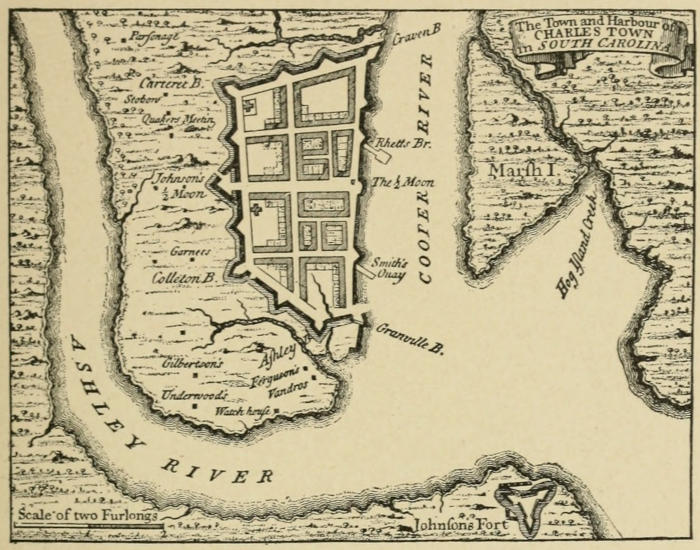
PLAN OF CHARLESTON, SOUTH CAROLINA, 1732
No doubt the colonies would have objected to and resisted such an arrangement with a very hot resentment, and no one in authority in London dreamed for a moment of taking either Lord Culpeper’s or Colonel Nicholson’s advice in the matter; but it was none the less obvious that the King and his officers must contrive some way, if they could, by which they might use the colonies as a single power against the French in America, if England was indeed to make and keep an empire there. If King James, who leaned upon France as an ally and prayed for the dominion of the Church of Rome, had seen this, it was not likely that William of Orange, who was the arch-enemy of France and the champion of Protestantism against Rome, would overlook it. He was no sooner on the throne than England was plunged into a long eight years’ war with the French. And so it happened that the colonies seemed to reap little advantage from the “glorious revolution” which had put out a tyrant and brought in a constitutional [3]King. William of Orange, it presently appeared, meant to unite groups of colonies under the authority of a single royal governor, particularly at the north, where the French power lay, as James before him had done; giving to the governors of the principal colonies the right to command the military forces of the colonies about them even if he gave them no other large gift of power. He did more than James had done. Being a statesman and knowing the value of systematic administration, he did systematically what James had done loosely and without consistent plan. The Board of Trade and Plantations, which he organized to oversee and direct the government of the colonies, did more to keep their affairs under the eye and hand of the King [4]than any group of James’s ministers had been able to do. The great Dutch King was determined to wield England and her possessions as a single imperial power in the game of politics he was playing in Europe.
The French power, which he chiefly feared, had really grown very menacing in America; was growing more so every year; and must very soon indeed be faced and overcome, if the English were not to be shut in to a narrow seaboard, or ousted altogether. It was not a question of numbers. It was a question of territorial aggrandizement, rather, and strategic advantage. Probably there were not more than twelve thousand Frenchmen, all told, in America when William became King (1689); whereas his own subjects swarmed there full two hundred thousand strong, and were multiplying by the tens of thousands from decade to decade. But the French were building military posts at every strategic point as they went, while the English were building nothing but rural homes and open villages. With the French it did not seem a matter of settlement; it seemed a matter of conquest, rather, and of military occupation. They were guarding trade routes and making sure of points of advantage. The English way was the more wholesome and the more vital. A hardy, self-dependent, crowding people like the English in Massachusetts and Virginia, and the Dutch in New York, took root wherever they went, spread into real communities, and were not likely to be got rid of when once their number had run into the thousands. Their independence, too, and their capable way of managing their own affairs without asking or wanting or getting any assistance from government, made them as hard to handle as if they had been themselves an established [5]continental power. But the French had an advantage, nevertheless, which was not to be despised. They moved as they were ordered to move by an active and watchful government which was in the thick of critical happenings where policies were made, and which meant to cramp the English, if it could not actually get rid of them. They extended and organized the military power of France as they went; and they were steadily girdling the English about with a chain of posts and settlements which bade fair to keep all the northern and western regions of the great continent for the King of France, from the mouth of the St. Lawrence round about, two thousand miles, to the outlets of the Mississippi at the Gulf.
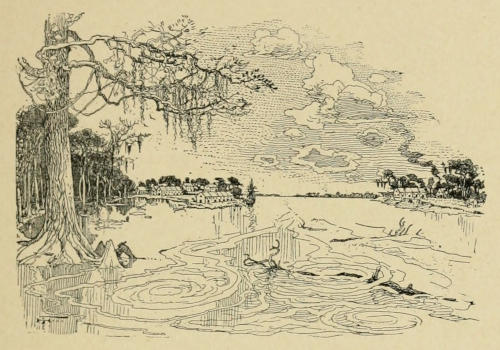
NEW ORLEANS IN 1719
Their movement along the great rivers and the lakes had been very slow at first; but it had quickened from generation to generation, and was now rapid enough to fix the attention of any man who could hear news and had his eyes abroad upon what was happening [6]about him. Jacques Cartier had explored the noble river St. Lawrence for his royal master of France a long century and a half ago, in the far year 1535, fifty years before the English so much as attempted a settlement. But it was not until 1608, the year after Jamestown was begun, that Samuel de Champlain established the first permanent French settlement, at Quebec, and there were still but two hundred lonely settlers there when nearly thirty years more had gone by (1636). It was the quick growth and systematic explorations of the latter part of the century that made the English uneasy. The twelve thousand Frenchmen who were busy at the work of occupation when William of Orange became King had not confined themselves to the settlements long ago made in the Bay of Fundy and at Montreal, Quebec, and Tadousac, where the great river of the north broadened to the sea. They had carried their boats across from the upper waters of the Ottawa to the open reaches of Lake Huron; had penetrated thence to Lake Michigan, and even to the farthest shores of Lake Superior, establishing forts and trading posts as they advanced. They had crossed from Green Bay in Lake Michigan to the waters of the Wisconsin River, and had passed by that easy way into the Mississippi itself. That stout-hearted pioneer Père Marquette had descended the Father of Waters past the Ohio to the outlet of the Arkansas (1673); and Robert La Salle had followed him and gone all the long way to the spreading mouths of the vast river and the gates of the Gulf (1682), not by way of the Wisconsin, but by crossing from the southern end of Lake Michigan to the stream of the Illinois, and passing by that way to the Mississippi.
[7]
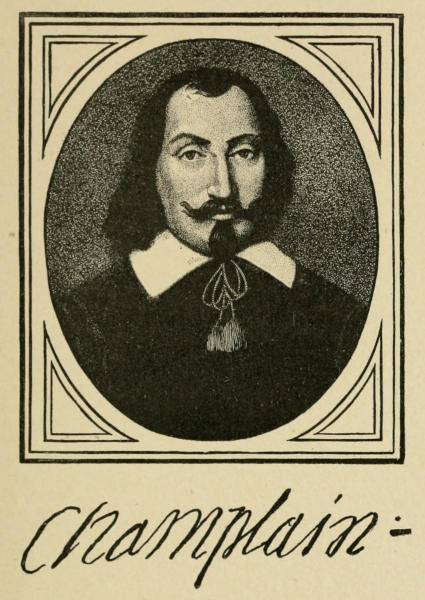
SAMUEL DE CHAMPLAIN
And so the lakes and the western rivers and the Mississippi itself saw the French; and French posts sprang up upon their shores to mark the sovereignty of the King of France. Frenchmen easily enough learned the ways of the wilderness and became the familiars of the Indians in their camps and wigwams; and they showed themselves of every kind,—some rough and [8]lawless rovers, only too glad to throw off the restraints of the orderly life to which they had been bred and live as they pleased in the deep, secluded forests, trading without license, seeking adventure, finding a way for the civilization which was to follow them, but themselves anxious to escape it; others regular traders, who kept their hold upon the settlements behind them and submitted when they were obliged to official exactions at Montreal; some intrepid priests, who preached salvation and the dominion of France among the dusky tribes, and lived or died with a like fortitude and devotion, never willingly quitting their sacred task or letting go their hold upon the hearts of the savage men they had come to enlighten and subdue; some hardy captains with little companies of drilled men-at-arms from the fields of France:—at the front indomitable explorers, far in the rear timid farmers clearing spaces in the silent woodland for their scanty crops, and little towns slowly growing within their walls where the river broadened to the sea.
This stealthy power which crept so steadily southward and westward at the back of the English settlements upon the coast was held at arm’s-length throughout that quiet age of beginnings, not by the English, but by a power within the forests, the power of the great confederated Iroquois tribes, who made good their mastery between the Hudson and the lakes: the Senecas, Cayugas, Onondagas, Oneidas, and Mohawks. They were stronger, fiercer, more constant and indomitable, more capable every way, than the tribes amidst whom the French moved; and Champlain had unwittingly made them the enemies of the French forever. Long, long ago, in the year 1609, which white men had forgotten, [9]he had done what the Iroquois never forgot or forgave. He had come with their sworn foes, the Algonquins, to the shores of that lake by the sources of the Hudson which the palefaces ever afterwards called by his name, and had there used the dread fire-arms of the white men, of which they had never heard before, to work the utter ruin of the Mohawks in battle. They were always and everywhere ready after that fatal day to be any man’s ally, whether Dutch or English, against the hated French; and the French found it necessary to keep at the back of the broad forests which stretched from the eastern Lakes to the Hudson and the Delaware, the wide empire of these dusky foes, astute, implacable. They skirted the domains of the Iroquois when they were prudent, and passed inland by the lakes and the valley of the Mississippi.
But, though they kept their distance, they advanced their power. The colonists in New England had been uneasy because of their unwelcome neighborhood from the first. Once and again there had been actual collisions and a petty warfare. But until William of Orange made England a party to the great war of the Protestant powers against Louis XIV. few men had seen what the struggle between French and English held in store for America. The English colonies had grown back not a little way from the sea, steadily pushed farther and farther into the thick-set forests which lay upon the broad valleys and rising slopes of the interior by mere increase of people and drift of enterprise. Before the seventeenth century was out adventurous English traders had crossed the Alleghenies, had launched their canoes upon the waters of the Ohio, and were fixing their huts here and there within the vast wilderness as men do [10]who mean to stay. Colonel Dongan, the Duke’s governor in New York (1683), like many another officer whose duties made him alert to watch the humors and keep the friendship of the Iroquois, the masters of the northern border, had been quick to see how “inconvenient to the English” it was to have French settlements “running all along from our lakes by the back of Virginia and Carolina to the Bay of Mexico.” There was keen rivalry in trade, and had been these many years, between the men of the English and Dutch colonies and the men of the French for the profitable trade in furs which had its heart at the north; and it was already possible for those who knew the forest commerce to reason right shrewdly of the future, knowing, as they did, that the English gave better goods and dealt more fairly for the furs than the French, and that many of the very Frenchmen who ranged the forests in search of gain themselves preferred to send what they had to Albany for sale. But, except for a few lonely villages in far-away Maine, there was nowhere any close contact between French and English in America. Few, except traders and thoughtful governors and border villagers, who feared the tribes whom the French incited to attack and massacre, knew what France did or was planning.
King William’s War (1689-1697), with its eight years of conscious peril, set new thoughts astir. It made America part of the stage upon which the great European conflict between French and English was to be fought out; and immediately a sort of continental air began to blow through colonial affairs. Colonial interests began to seem less local, more like interests held in common, and the colonies began to think of themselves as part of an empire. They had no great part in the war, it [11]is true. Hale Sir William Phips, that frank seaman adventurer, led an expedition against Acadia in 1690, took Port Royal, and stripped the province of all that could be brought away; but that had hardly had the dignity of formal war. He had chiefly relished the private gain got out of it as a pleasant reminder of that day of fortune when he had found the Spanish treasure-ship sunk upon a reef in far Hispaniola. His second expedition, made the same year against Quebec, no doubt smacked more of the regular business, for he undertook it as an accredited officer of the crown; but when it failed it is likely he thought more of the private moneys subscribed and lost upon it than of the defeat of the royal arms. There was here the irritation, rather than the zest, of great matters, and the colonial leaders were not becoming European statesmen of a sudden. Their local affairs were still of more concern to them than the policies of European courts. Nevertheless the war made a beginning of common undertakings. The colonies were a little drawn together, a little put in mind of matters larger than their own.
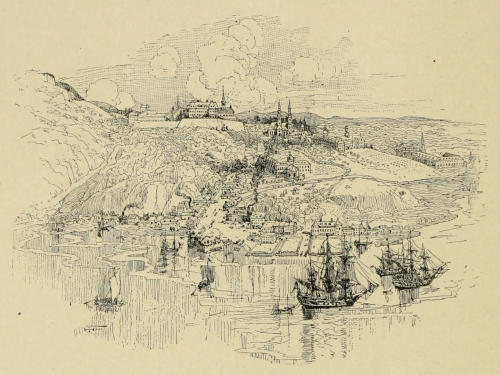
AN EARLY VIEW OF QUEBEC
New York felt herself no less concerned than Massachusetts and Maine in the contest with the French, with its inevitable accompaniment of trouble with the Indians; and Jacob Leisler, plebeian and self-constituted governor though he was, had made bold to take the initiative in forming plans for the war. Count Louis de Frontenac had been made governor of New France the very year William established himself as king in England (1689), and had come instructed, as every Englishman in America presently heard rumor say, to attack the English settlements at their very heart,—at New York itself. It was this rumor that had made Leisler hasten [12]to seize the government in King William’s name, seeing King James’s governor hesitate, and hearing it cried in the streets that the French were in the very Bay. He had thought it not impossible that James’s officers might prove traitors and friends of King Louis in that last moment of their power. And then, when the government was in his hands, this people’s governor called a conference of the colonies to determine what should be done for the common defence. Massachusetts, Plymouth, and Connecticut responded, and sent agents to the conference (1690), the first of its kind since America was settled. It was agreed to attempt the conquest of New France. Sir William Phips should lead an expedition by sea against Quebec; and another force should go by land out of Connecticut and New York [13]to attack Montreal, the only other stronghold, taking their Iroquois allies with them. But the land expedition was every way unfortunate, and got no farther than Lake Champlain. Frontenac was able to devote all his strength to the defence of Quebec; and Sir William Phips came back whipped and empty-handed. The first effort at a common undertaking had utterly miscarried.
But that was not the end of the war. Its fires burned hot in the forests. Frontenac prosecuted the ugly business to the end as he had begun it. He had begun, not by sending a fleet to New York, for he had none to send, but by sending his Indian allies to a sudden attack and savage massacre at Schenectady, where sixty persons, men and women, old and young, saw swift and fearful death (1689); and year by year the same hideous acts of barbarous war were repeated,—not always upon the far-away border, but sometimes at the very heart of the teeming colony,—once (1697) at Haverhill, not thirty-five miles out of Boston itself. Such a war was not likely to be forgot in the northern colonies, at any rate, and in New York. Its memories were bitten into the hearts of the colonists there as with the searings of a hot iron; and they knew that the French must be overcome before there could be any lasting peace, or room enough made for English growth in the forests.
They would rather have turned their thoughts to other things. There were home matters of deep moment which they were uneasy to settle. But these larger matters, of England’s place and power in the world, dominated them whether they would or no. King William’s War was but the forerunner of many more, of the same meaning and portent. Wars vexed and disciplined [14]them for half a century, and their separate interests had often to stand neglected for years together in order that their common interests and the interests of English empire in America might be guarded.
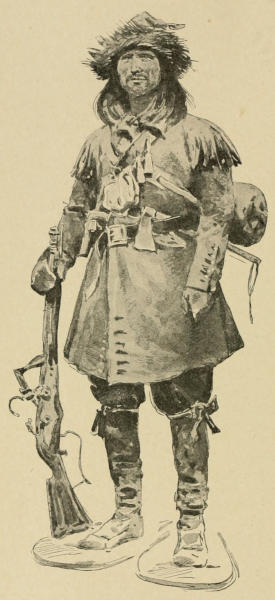
COURIER DU BOIS, XVII. CENTURY
And yet those who were thoughtful did not lose sight of the great, though subtle, gain which came with the vexing losses of war, to offset them. They had not failed to notice and to take to heart what had happened in England when William and Mary were brought to the throne. They were none the less Englishmen for being out of England, and what Parliament did for English liberty deeply concerned them. Parliament, as all the world knew, had done a great deal during those critical days in which it had consummated the “glorious revolution” by which the Stuarts were once [15]for all put from the seat of sovereignty. It had reasserted the ancient rights named in Magna Charta; it had done away with the King’s arrogated right to tax; it had destroyed his alleged right to set laws aside, or alter them in any way; it had reduced him from being master and had made him a constitutional king, subject to his people’s will, spoken through their legal representatives in Parliament. The new King, too, had shown himself willing to extend these principles to America. In the charters which he granted or renewed, and in the instructions which he gave to the governors whom he commissioned, he did not begrudge an explicit acknowledgment of the right of the colonies to control their own taxation and the expenditures of their own colonial establishments.
War embarrassed trade. It made hostile territory of the French West Indies, whence New England skippers fetched molasses for the makers of rum at home; and that was no small matter, for the shrewd New England traders were already beginning to learn how much rum would pay for, whether among the Indians of the forest country, among the savages of the African slave coast, or among their own neighbors at home, where all deemed strong drink a capital solace and defence against the asperities of a hard life. But it needed only a little circumspection, it turned out, to keep even that trade, notwithstanding the thing was a trifle difficult and hazardous. There was little cause for men who kept their wits about them to fear the law on the long, unfrequented coasts of the New World; and there was trade with the French without scruple whether war held or ceased. Buccaneers and pirates abounded in the southern seas, and legitimate traders knew as [16]well as they did how confiscation and capture were to be avoided.
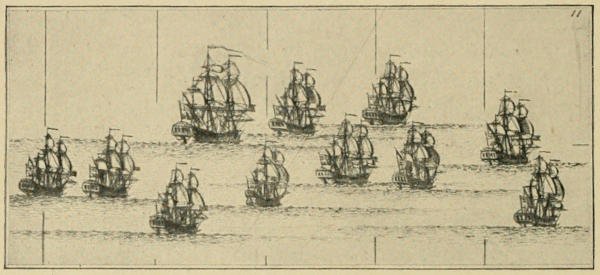
AN ENGLISH FLEET IN 1732
The main lines of trade ran, after all, straight to the mother country, and were protected when there was need by English fleets. Both the laws of Parliament and their own interest bound the trade of the colonies to England. The Navigation Act of 1660, in force now these forty years, forbade all trade with the colonies except in English bottoms; forbade also the shipment of their tobacco and wool anywhither but to England itself; and an act of 1663 forbade the importation of anything at all except out of England, which, it was then once for all determined, must be the entrepôt and place of staple for all foreign trade. It was determined that, if there were to be middlemen’s profits, the middlemen should be English, and that the carrying trade of England and her colonies should be English, not Dutch. It was the Dutch against whom the acts were aimed. Dutch ships cost less in the building than ships built in England; the Dutch merchantmen [17]could afford to charge lower rates of freight than English skippers; and the statesmen of King Charles, deeming Holland their chief competitor upon the seas and in the markets of the world, meant to cut the rivalry short by statute, so far as the English realm was concerned.
Fortunately the interests of the colonists themselves wore easily enough the harness of the acts. For a while it went very hard in Virginia, it is true, to pay English freight rates on every shipment of tobacco, the colony’s chief staple, and to sell only through English middlemen, to the exclusion of the accommodating Dutch and all competition. Trade touched nothing greater than the tobacco crop. Virginia supplied in that alone a full half of all the exports of the colonies. Her planters sharply resented “that severe act of Parliament which excludes us from having any commerce with any nation in Europe but our own”; for it seemed to put upon them a special burden. “We cannot add to our plantation any commodity that grows out of it, as olive trees, cotton, or vines,” complained Sir William Berkeley very bluntly to the government in 1671. “Besides this, we cannot procure any skilful men for one now hopeful commodity, silk: for it is not lawful for us to carry a pipe stave or a barrel of corn to any place in Europe out of the King’s dominions. If this were for his Majesty’s service or the good of his subjects, we should not repine, whatever our sufferings are for it; but on my soul, it is the contrary for both.” But the thing was eased for them at last when they began to see how their interest really lay. They had almost a monopoly of the English market, for Spanish tobacco was kept out by high duties, the planting of tobacco in [18]England, begun on no mean scale in the west midland counties in the days of the Protectorate, was prohibited by law, and a rebate of duties on all tobacco re-exported to the continent quickened the trade with the northern countries of Europe, the chief market in any case for the Virginian leaf. Grumbling and evasion disappeared in good time, and Virginia accommodated herself with reasonable grace to what was, after all, no ruinous or unprofitable arrangement.
New England, where traders most abounded, found little in the acts that she need complain of or seek to escape from. No New England commodity had its route and market prescribed as Virginian tobacco had; New England ships were “English” bottoms no less than ships built in England itself; they could be built as cheaply as the Dutch, and the long coast of the continent was clear for their skippers. If laws grew inconvenient, there were unwatched harbors enough in which to lade and unlade without clearance papers. English capital quickened trade as well as supplied shipping for the ocean carriage, and the King’s navy made coast and sea safe. If it was irritating to be tied to the leading-strings of statutes, it was at least an agreeable thing that they should usually pull in the direction merchants would in any case have taken. Though all products of foreign countries had to be brought through the English markets and the hands of English middlemen, the duties charged upon them upon their entrance into England were remitted upon their reshipment to America, and they were often to be had more cheaply in the colonies than in London.
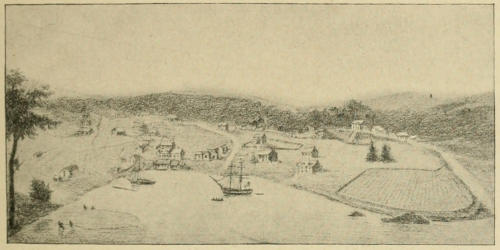
MOALE’S SKETCH OF BALTIMORE, MARYLAND, IN 1752
In 1699, when the war was over, Parliament laid a new restriction upon the colonies, forbidding them to [19]manufacture their own wool for export, even for export from colony to colony. Good housewives were not to be prevented from weaving their own wool into cloth for the use of their own households; village weavers were not to be forbidden their neighborhood trade; but the woollen weavers of England supplied more than half of all the exports to the colonies, and had no mind to let woollen manufacture spring up in America if Parliament could be induced to prohibit it. It made no great practical difference to the colonies, though it bred a bitter thought here and there. Manufactures were not likely to spring up in America. “No man who can have a piece of land of his own, sufficient by his labor to subsist his family in plenty,” said Mr. Franklin long afterwards, “is poor enough to be a manufacturer and work for a master. Hence, while there is land enough in America for our people, there can be no manufactures to any amount or value.” But the woollen manufacturers in England meant to take no chances in the matter; and the colonists did no more [20]than grumble upon occasion at the restraints of a law which they had no serious thought of breaking.
It was not breaches of the Acts of Navigation and the acts concerning woollen manufacture that the ministers found it necessary to turn their heed to when the war ended, but, rather, the open piracies of the southern seas. By the treaty of Ryswick, which brought peace (1697), France, England, Holland, and Spain, the high contracting parties, solemnly bound themselves to make common cause against buccaneering. Spain and England had been mutually bound since 1670 to abolish it. Buccaneering abounded most on the coasts of America. The lawless business had begun long ago. Spain had provoked it. She had taken possession of all Central and South America and of the islands of the West Indies, and had bidden all other nations stand off and touch nothing, while her fleets every year for generations together came home heavy with treasure. She had denied them the right of trade; she had forbidden their seamen so much as to get stores for their own use anywhere within the waters of Spanish America. She treated every ship as an intruder which she found in the southern seas, and the penalties she inflicted for intrusion upon her guarded coasts went the length of instant drowning or hangings at the yard-arm. It was a day when there was no law at sea. Every prudent man supplied his ship with arms, and was his own escort; and since Spain was the common bully, she became the common enemy. English and French and Dutch seamen were not likely very long to suffer themselves to be refused what they needed at her ports; and after getting what they needed, they went on to take whatever they wanted. They [21]were intruders, anyway, for whatever purpose they came, and they might as well, as a witty Frenchman among them said, “repay themselves beforehand” for the losses they would suffer should Spanish cruisers find and take them.
The spirit of adventure and of gain grew on them mightily. At first they contented themselves with an illicit trade at the unguarded ports of quiet, half-deserted islands like Hispaniola, where they could get hides and tallow, smoked beef and salted pork, in exchange for goods smuggled in from Europe. But they did not long stop at that. The exciting risks and notable profits of the business made it grow like a story of adventure. The ranks of the lawless traders filled more and more with every sort of reckless adventurer and every sort of unquiet spirit who found the ordinary world stale and longed for a change of luck, as well as with hosts of common thieves and natural outlaws. Such men, finding themselves inevitably consorting, felt their comradeship, helped one another when they could, and made a common cause of robbing Spain, calling themselves “Brethren of the Coast.” They took possession, as their numbers increased, of the little twin islands of St. Christopher and Nevis for rendezvous and headquarters, and fortified distant Tortuga for a stronghold; and their power grew apace through all the seventeenth century, until no Spanish ship was safe on the seas though she carried the flag of an admiral, and great towns had either to buy them off or submit to be sacked at their pleasure. They mustered formidable fleets and counted their desperate seamen by the thousands.
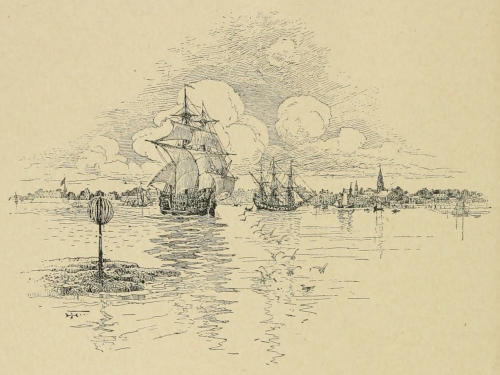
CHARLESTON, FROM THE HARBOR, 1742
They were most numerous, most powerful, most to [22]be feared at the very time the English colony was begun at Charleston (1670). All the English sea-coast at the south, indeed, was theirs in a sense. They were regulars, not outlaws, when France or Holland or England was at war with Spain, for the great governments did not scruple to give them letters of marque when they needed their assistance at sea. English buccaneers had helped Sir William Penn take Jamaica for Cromwell in 1655. And when there was no war, the silent, unwatched harbors of the long American sea-coast were their favorite places of refuge and repair. New Providence, England’s best anchorage and most convenient port of rendezvous in the Bahamas, became their chief place of welcome and recruiting. The coming of settlers did not disconcert them. It pleased them, rather. The settlers did not molest them,—had secret [23]reasons, as they knew, to be glad to see them. There were the English navigation laws, as well as the Spanish, to be evaded, and the goods they brought to the closed markets were very cheap and very welcome,—and no questions were asked. They were abundantly welcome, too, to the goods they bought. For thirty years their broad pieces of gold and their Spanish silver were almost the only currency the Carolinas could get hold of. Governors winked at their coming and going,—even allowed them to sell their Spanish prizes in English ports. Charleston, too, and the open bays of Albemarle Sound were not more open to them than New York and Philadelphia and Providence, and even now and again the ports of Massachusetts. They got no small part of their recruits from among the lawless and shiftless men who came out of England or Virginia to the Carolinas for a new venture in a new country where law was young.
Richard Coote, the Earl of Bellomont, came out in 1698 to be Governor General of New York, New Jersey, Massachusetts, and New Hampshire, specially instructed to stamp out the piracy of the coasts; but he found it no light task. His predecessor in the government of New York, Benjamin Fletcher, had loved the Brethren of the Coast very dearly: they had made it to his interest to like them; and the merchants of New York, as of the other seaport towns, were noticeably slow to see the iniquity of the proscribed business. Lord Bellomont bitterly complained that the authorities of Rhode Island openly gave notorious pirates countenance and assistance. Mr. Edward Randolph, whose business it was to look after the King’s revenues, declared in his anger that North Carolina was peopled by [24]nobody but smugglers, runaway servants, and pirates. South Carolina, fortunately, had seen the folly of harboring the outlaws by the time Lord Bellomont set about his suppression in the north. Not only had her population by that time been recruited and steadied by the coming in of increasing numbers of law-abiding and thrifty colonists to whom piracy was abhorrent, but she had begun also to produce great crops of rice for whose exportation she could hardly get ships enough, and had found that her whilom friends the freebooters did not scruple to intercept her cargoes on their way to the profitable markets of Holland, Germany, Sweden, Denmark, and Portugal. She presently began, therefore, to use a great pair of gallows, set up very conspicuously on “Execution Dock” at Charleston, for the diligent hanging of pirates. But the coast to the northward still showed them hospitality, and Lord Bellomont made little headway at New York,—except that he brought the notorious Captain Kidd to justice. William Kidd, a Scotsman, had made New York his home, and had won there the reputation of an honest and capable man and an excellent ship captain; but when he was given an armed vessel strongly manned, and the King’s commission to destroy the pirates of the coast, the temptation of power was too great for him. He incontinently turned pirate himself, and it fell to Lord Bellomont to send him to England to be hanged.
[25]
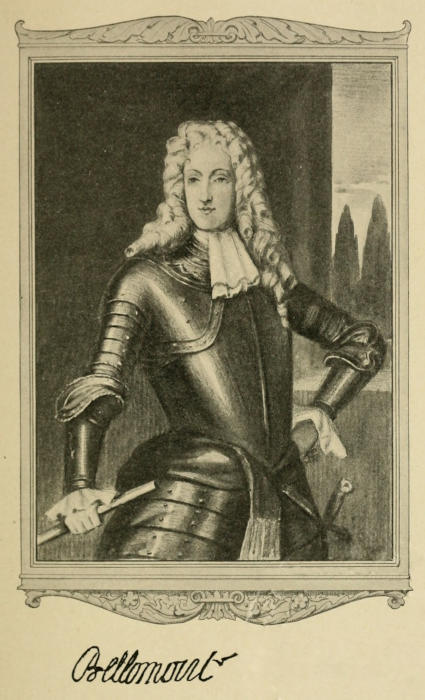
LORD BELLOMONT
[26]
The interval of peace during which English governors in America could give their thoughts to the suppression of piracy proved all too short. “Queen Anne’s War” followed close upon the heels of King William’s, and the French and Indians became once again more threatening than the buccaneers. Nevertheless some important affairs of peace were settled before the storm of war broke again. For one thing, Mr. Penn was able once more to put in order the government of Pennsylvania. For two years (1692-1694) he had been deprived of his province, because, as every one knew, he had been on very cordial terms of friendship with James Stuart, the discredited King, and it was charged that he had taken part in intrigues against the new sovereign. But it was easy for him to prove, when the matter was dispassionately looked into, that he had done nothing dishonorable or disloyal, and his province was restored to him. In 1699 he found time to return to America and reform in person the administration of the colony. Bitter jealousies and sharp factional differences had sprung up there while affairs were in confusion after the coming in of William and Mary, and the two years Mr. Penn spent in their correction (1699-1701) were none too long for the work he had to do. He did it, however, in his characteristic healing fashion, by granting privileges, more liberal and democratic than ever, in a new charter. One chief difficulty lay in the fact that the lower counties by the Delaware chafed because of their enforced union with the newer counties of Pennsylvania; and Mr. Penn consented to an arrangement by which they should within three years, if they still wished it, have a separate assembly of their own, and the right to act for themselves in all matters of local government. Self-government, indeed, was almost always his provident cure for discontent. He left both Pennsylvania and the Delaware counties free to choose their own courts,—and Philadelphia free to select her own officers as an [27]independently incorporated city. Had he been able to give his colony governors as wise and temperate as himself, new troubles might have been avoided as successfully as old troubles had been healed.
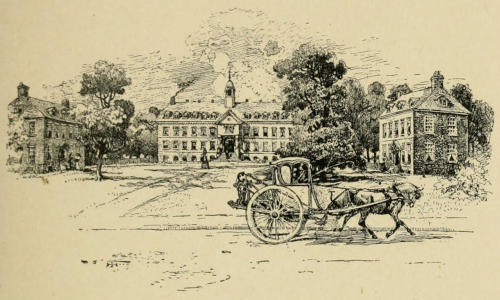
WILLIAM AND MARY COLLEGE BEFORE THE FIRE, 1723
While Mr. Penn lingered in America the rights of the proprietors of West Jersey, his own first province, passed finally to the crown. In 1702 all proprietary rights, alike in East and in West Jersey, were formally surrendered to the crown, and New Jersey, once more a single, undivided province, became directly subject to the King’s government. For a generation, indeed, as it turned out, she was to have no separate governor of her own. A separate commission issued from the crown to the governor of New York to be also governor of New Jersey, upon each appointment in the greater province. But New Jersey kept her own government, nevertheless, and her own way of life. She suffered no merger into the larger province, her neighbor, whose governor happened to preside over her affairs.
[28]
Many things changed and many things gave promise of change in the colonies as Mr. Penn looked on. In 1700 Virginia had her population enriched by the coming of seven hundred French Huguenots, under the leadership of the Marquis de la Muce,—some of them Waldenses who had moved, in exile, through Switzerland, Alsace, the Low Countries, and England ere they found their final home of settlement in Virginia,—all of them refugees because of the terror that had been in France for all Protestants since the revocation of the Edict of Nantes (1685). That same year, 1700, Williamsburg, the new village capital of the “Old Dominion,” grew very gay with company come in from all the river counties, from neighboring colonies, too, and even from far-off New England, to see the first class graduated from the infant college of William and Mary. The next year (1701) Connecticut, teeming more and more with a thrifty people with its own independent interests and resources, and finding Harvard College at Cambridge too far away for the convenience of those of her own youth who wished such training as ministers and professional men in general needed, set up a college of her own,—the college which half a generation later she called Yale, because of Mr. Elihu Yale’s gift of eight hundred pounds in books and money.
Then King William died (1702,—Mary, his queen and consort, being dead these eight years), and Anne became queen. It was a year of climax in the public affairs of Europe. In 1701, Louis XIV. had put his grandson, Philip of Anjou, on the throne of Spain, in direct violation of his treaty obligations to England, and to the manifest upsetting of the balance of power in Europe, openly rejoicing that there were no longer [29]any Pyrenees, but only a single, undivided Bourbon power from Flanders to the Straits of Gibraltar; and had defied England, despite his promises made at Ryswick, by declaring James’s son the rightful heir to the English throne. Instantly England, Holland, and [30]Austria drew together in grand alliance against the French aggression, and for eleven years Italy, Germany, and the Netherlands rang with the War of the Spanish Succession. The storm had already broken when Anne became queen.
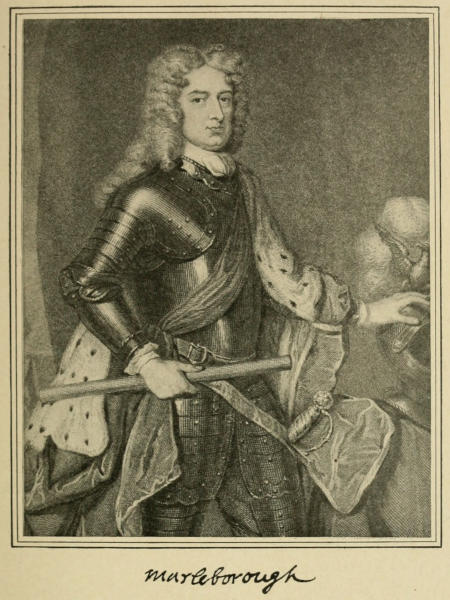
JOHN CHURCHILL, DUKE OF MARLBOROUGH
England signalized the war by giving a great general to the world. It was the day of John Churchill, Duke of Marlborough, of whose genius soldiers gossiped to their neighbors and their children for half a century after the great struggle was over. The English took Gibraltar (1704). Prince Eugene of Savoy helped great Marlborough to the famous victory of Blenheim (1705),—and Virginians were not likely to forget that it was Colonel Parke, of Virginia, who took the news of that field to the Queen. Marlborough won at Ramillies and Eugene at Turin (1706). The two great captains triumphed together at Oudenarde (1708) and at Malplaquet (1709). The crowns of France and Spain were separated, and France was lightened of her overwhelming weight in the balance of power.
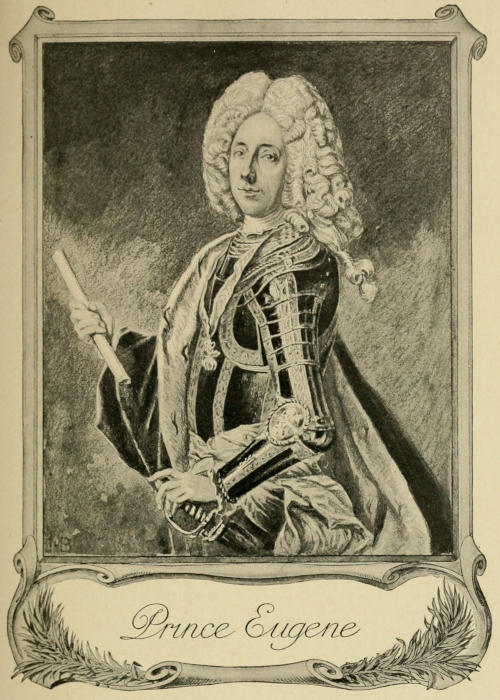
PRINCE EUGENE
But for the colonies in America it was only “Queen Anne’s War,” full of anxiety, suffering, and disappointment,—massacres on the border, expeditions to the north blundered and mismanaged, money and lives spent with little to show for the sacrifice. The ministers at home had made no preparation in America for the renewal of hostilities. There had been warnings enough, and appeals of deep urgency, sent out of the colonies. Every observant man of affairs there saw what must come. But warnings and appeals had not been heeded. Lord Bellomont, that self-respecting gentleman and watchful governor, had told the ministers at home very plainly that there ought to be a line of [31]frontier posts at the north, with soldiers for colonists, and that simply to pursue the Indians once and again to the depths of the forests was as useless “as to pursue birds that are on the wing.” An English prisoner in the hands of the French had sent word what he [32]heard they meant to do for the extension of their boundaries and their power. The deputy governor of Pennsylvania had proposed a colonial militia to be kept at the frontier. Certain private gentlemen of the northern settlements had begged for a common governor “of worth and honor,” and for some system of common defence. Mr. Penn, looking on near at hand, had advised that the colonists be drawn together in intercourse and interest by a common coinage, a common rule of citizenship, a common system of justice, and by duties on foreign timber which would in some degree offset the burdens of the Navigation Acts,—as well as by common organization and action against the French and against the pirates of the coast. But nothing had been done.
FRENCH HUGUENOT CHURCH, NEW YORK, 1704
Even the little that had been gained in King William’s War had now to be gained all over again. Sir William Phips had taken Port Royal very handily at the outset of that war (1690), and Acadia with it, and there had been no difficulty in holding the conquered province until the war ended; but the treaty of Ryswick had handed back to the French everything the English had taken, the statesmen of England hardly heeding America at all in the terms they agreed to,—and so a beginning was once more to be made.
[33]
The war began, as every one knew it must, with forays on the border: the Indians were the first afoot, and were more to be feared than the French. The first movement of the English was made at the south, where, before the first year (1702) of the war was out, the Carolinians struck at the power of Spain in Florida. They sent a little force against St. Augustine, and easily swept the town itself, but stood daunted before the walls of the castle, lacking cannon to reduce it, and came hastily away at sight of two Spanish ships standing into the harbor, leaving their very stores and ammunition behind them in their panic. They had saddled the colony with a debt of six thousand pounds and gained nothing. But they at least kept their own borders safe against the Indians and their own little capital at Charleston safe against reprisals by the Spaniards. The Apalachees, who served the Spaniards on the border, they swept from their forest country in 1703, and made their border quiet by fire and sword, driving hundreds of the tribesmen they did not kill to new seats beyond the Savannah. Three years went by before they were in their turn attacked by a force out of Florida. Upon a day in August, 1706, while the little capital lay stricken with yellow fever, a fleet of five French vessels appeared off the bar at their harbor mouth, bringing Spanish troops from Havana and St. Augustine. There was a quick rally to meet them. Colonial militia went to face their landing parties; gallant Colonel Rhett manned a little flotilla to check them on the water; and they were driven off, leaving two hundred and thirty prisoners and a captured ship behind them. The southern coast could take care of itself.
[34]
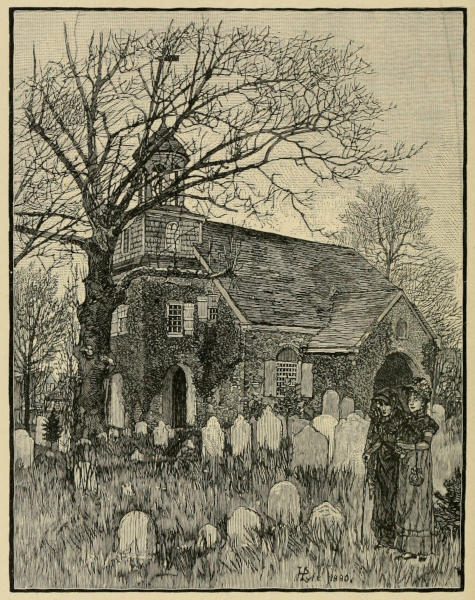
OLD SWEDES CHURCH, WILMINGTON, DELAWARE
Nothing had been done meanwhile in the north. The first year of the war (1702) had seen Boston robbed of three hundred of her inhabitants by the scourge of small-pox, and New York stricken with a fatal fever brought out of the West Indies from which no man [35]could rally. That dismal year lingered for many a day in the memory of the men of the middle colonies as “the time of the great sickness.” The northernmost border had been harried from Wells to Casco by the French Indians (1703); Deerfield, far away in the wilderness by the Connecticut, had been fearfully dealt with at dead of night, in the mid-winter of 1704, by a combined force of French and Indians; in 1705 the French in Acadia had brought temporary ruin upon the English trading posts in Newfoundland; and a French privateer had insolently come in open day into the Bay at New York, as if to show the English there how defenceless their great harbor was, with all the coast about it (1705). And yet there had been no counterstroke by the English,—except that Colonel Church, of Massachusetts, had spent the summer of 1704 in destroying as he could the smaller and less defended French and Indian villages upon the coasts which lay about the Penobscot and the Bay of Fundy. In 1707 a serious attempt was made to take Port Royal. Colonel March took a thousand men against the place, in twenty-three transports, convoyed by a man-of-war, and regularly laid siege to it; but lacked knowledge of the business he had undertaken and failed utterly.
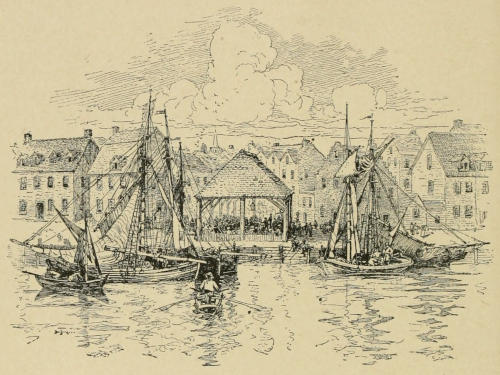
NEW YORK SLAVE MARKET ABOUT 1730
Another three years went by before anything was accomplished; and the French filled them in, as before, with raids and massacres. Again Haverhill was surprised, sacked, and burned (1708). The English were driven from the Bahama islands. An expedition elaborately prepared in England to be sent against the French in America was countermanded (1709), because a sudden need arose to use it at home. Everything attempted seemed to miscarry as of course. And then [36]at last fortune turned a trifle kind. Colonel Francis Nicholson, governor of Virginia till 1705, had gone to England when he saw things stand hopelessly still in America, and, being a man steadfast and hard to put by, was at last able, in 1710, to obtain and bring assistance in person from over sea. He had recommended, while yet he was governor of Virginia, it was recalled, that the colonies be united under a single viceroy and defended by a standing army for which they should themselves be made to pay. The ministers at home had been too prudent to take that advice; but they listened now to his appeal for a force to be sent to America. By the 24th of September, 1710, he lay off Port Royal with a fleet of thirty-five sail, besides hospital and store ships, with four regiments of New [37]England militia aboard his transports and a detachment of marines. On the 1st of October he opened the fire of three batteries within a hundred yards of the little fort that guarded the place, and within twenty-four hours he had brought it to its capitulation, as Sir William Phips had done twenty years before. Acadia was once more a conquered province of England. Colonel Nicholson renamed its port Annapolis Royal, in honor of the Queen whom he served. The name of the province itself the English changed to Nova Scotia.
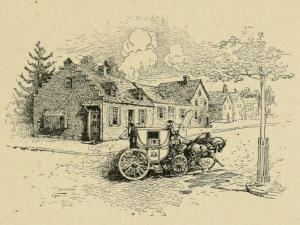
BROAD STREET, NEW YORK, IN 1740
Two years more, and the war was practically over; but no victories had been added to that lonely achievement at Port Royal. Colonel Nicholson went from his triumph in Acadia back to England again, to solicit a yet stronger force to be taken against Quebec, and once more got what he wanted. In midsummer of 1711 Sir Hovenden Walker arrived at Boston with a great fleet of transports and men-of-war, bringing Colonel Hill and seven of Marlborough’s veteran regiments to join the troops of New England in a decisive onset upon the stronghold of New France. Colonel Nicholson was to lead the colonial levies through the forests to Quebec; Sir Hovenden Walker was to ascend the St. Lawrence and strike from the river. But neither force reached Quebec. The admiral blundered in the [38]fogs which beset him at the mouth of the great stream, lost eight ships and almost a thousand men, and then put about in dismay and steered straightway for England, to have his flag-ship blow up under him at Spithead. Colonel Nicholson heard very promptly of the admiral’s ignoble failure, and did not make his march. The next year, 1712, the merchants of Quebec subscribed a fund to complete the fortifications of their rock-built city, and even women volunteered to work upon them, that they might be finished ere the English came again. But the English did not come. That very summer brought a truce; and in March, 1713, the war ended with the peace of Utrecht. The treaty gave England Hudson’s Bay, Acadia, Newfoundland, and the little island of St. Christopher alongside Nevis in the Lesser Antilles.
“Queen Anne’s War” was over; but there was not yet settled peace in the south. While the war lasted North Carolina had had to master, in blood and terror, the fierce Iroquois tribe of the Tuscaroras, who mustered twelve hundred warriors in the forests which lay nearest the settlements. And when the war was over South Carolina had to conquer a whole confederacy of tribes whom the Spaniards had stirred up to attack her. The Tuscaroras had seemed friends through all the first years of the English settlement on their coast; but the steady, ominous advance of the English, encroaching mile by mile upon their hunting grounds, had at last maddened them to commit a sudden and awful treachery. In September, 1711, they fell with all their natural fury upon the nearer settlements, and for three days swept them with an almost continuous carnage. The next year the awful butchery was repeated. Both [39]times the settlements found themselves too weak to make effective resistance; both times aid was sent from South Carolina, by forced marches through the long forests; and finally, in March, 1713, the month of the peace of Utrecht, an end was made. The Tuscaroras were attacked and overcome in their last stronghold. The remnant that was left migrated northward to join their Iroquois kinsmen in New York,—and Carolina was quit of them forever.
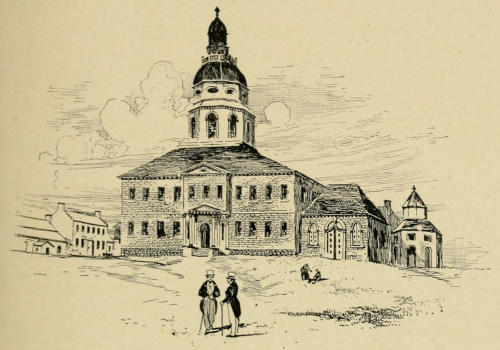
OLD STATE HOUSE AT ANNAPOLIS, MARYLAND
The strong tribes which held sway in the forests of South Carolina,—the Yamassees, Creeks, Catawbas, and Cherokees,—were no kinsmen of these alien Iroquois out of the north, and had willingly lent their aid to the English to destroy them. But, the war over, the Spaniards busied themselves to win these tribes also to a conspiracy against the English settlements, and [40]succeeded only too well. They joined in a great confederacy, and put their seven or eight thousand braves on the war-path to destroy the English. For almost a whole year (April, 1715, to February, 1716) they kept to their savage work unsubdued, until full four hundred whites had lost their lives at their hands. Then the final reckoning came for them also, and the shattered remnants of their tribes sought new homes for themselves as they could. The savages had all but accomplished their design against the settlements. The awful work of destroying them left the Carolinas upon the verge of utter exhaustion, drained of blood and money, almost without crops of food to subsist upon, quite without means to bear the heavy charges of government in a time of war and sore disorder. There were some among the disheartened settlers who thought of abandoning their homes there altogether and seeking a place where peace might be had at a less terrible cost. But there was peace at least, and the danger of absolute destruction had passed.
New York had had her own fright while the war lasted. A house blazed in the night (1712), and certain negroes who had gathered about it killed some of those who came to extinguish the flames. It was rumored that there had been a plot among the negroes to put the whole of the town to the torch; an investigation was made, amidst a general panic which rendered calm inquiry into such a matter impossible; and nineteen blacks were executed.
But in most of the colonies domestic affairs had gone quietly enough, the slow war disturbing them very little. Connecticut found leisure of thought enough, in 1708, to collect a synod at Saybrook and formulate [41]a carefully considered constitution for her churches, which her legislature the same year adopted. In 1707 New York witnessed a notable trial which established the freedom of dissenting pulpits. Lord Cornbury, the profligate governor of the province, tried to silence the Rev. Francis Mackemie, a Presbyterian minister,—pretending that the English laws of worship and doctrine were in force in New York; but a jury made short work of acquitting him. Massachusetts endured Joseph Dudley as governor throughout the war (1702-1715), checking him very pertinaciously at times when he needed the assistance of her General Court, but no longer refusing to live with reasonable patience under governors not of her own choosing.
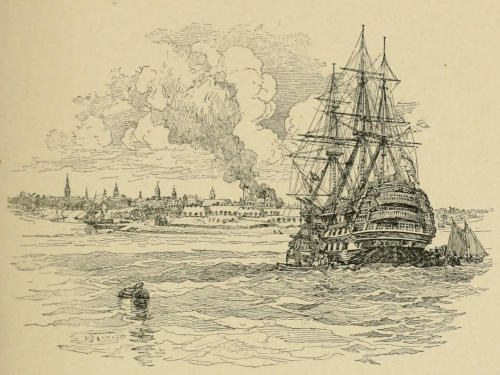
NEW YORK, FROM THE HARBOR, ABOUT 1725
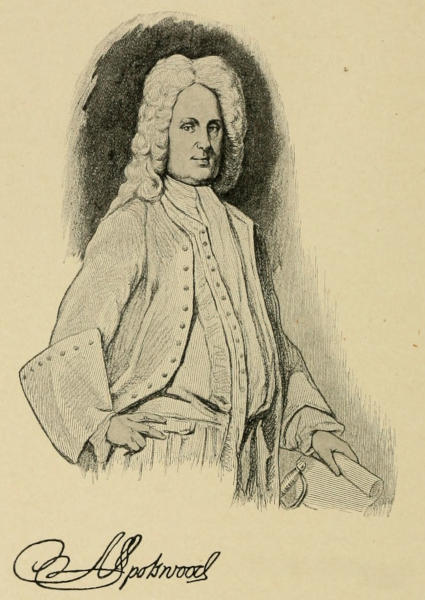
ALEXANDER SPOTSWOOD
Fortunately for the Carolinas, a very notable man [42]had become governor of Virginia ere the Tuscaroras took the war-path. There were tribes at the border,—Nottoways, Meherrins, and even a detached group of the Tuscaroras themselves,—who would have joined in the savage conspiracy against the whites had not Colonel Spotswood been governor in Virginia and shown himself capable of holding them quiet with a steady hand of authority,—a word of conciliation and a hint of force. Alexander Spotswood was no ordinary man. [43]He added to a gentle breeding a manly bearing such as Virginians loved, and the administrative gifts which so many likable governors had lacked. His government was conducted with clear-eyed enterprise and steady capacity. It added to his consequence that he had borne the Queen’s commission in the forces of the great Marlborough on the field of Blenheim, and came to his duty in Virginia (1710) bearing a wound received on that famous field. His blood he took from Scotland, where the distinguished annals of his family might be read in many a public record; and a Scottish energy entered with him into the government of Virginia,—as well as a Scottish candor and directness in speech,—to the great irritation presently of James Blair, as aggressive a Scotsman as he, and more astute and masterful.
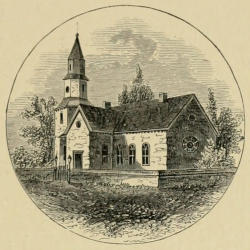
BRENTON CHURCH, WHERE GOVERNOR SPOTSWOOD WORSHIPPED
It was Colonel Spotswood who, in 1716, gathered a company of gentlemen about him for a long ride of discovery into the Alleghanies. They put their horses through the very heart of the long wilderness, and won their way despite all obstacles to a far summit of the Blue Ridge, whence, first among all their countrymen, they looked forth to the westward upon the vast slopes which fell away to the Ohio and the great basin of the Mississippi. Colonel Spotswood, standing there the leader of the little group, knew that it was this [44]way the English must come to make conquest of the continent. He urged his government at home to stretch a chain of defensive posts beyond the mountains from the lakes to the Mississippi, to keep the French from those inner valleys which awaited the coming of the white man; but he did not pause in the work he could do himself because the advice went unheeded. He kept the Indians still; he found excellent lands for a thrifty colony of Germans, and himself began the manufacture of iron in the colony, setting up the first iron furnace in America. The debts of the colony were most of them discharged, and a good trade in corn, lumber, and salt provisions sprang up with the West Indies. He rebuilt the college, recently destroyed by fire, and established a school for Indian children. He improved as he could the currency of the colony. His works were the quiet works of peace and development,—except for his vigorous suppression of the pirates of the coast,—and his administration might have outrun the year 1722, which saw him removed, had he been a touch less haughty, overbearing, unused to conciliating or pleasing those whose service he desired. He made enemies, and was at last ousted by them.
[45]
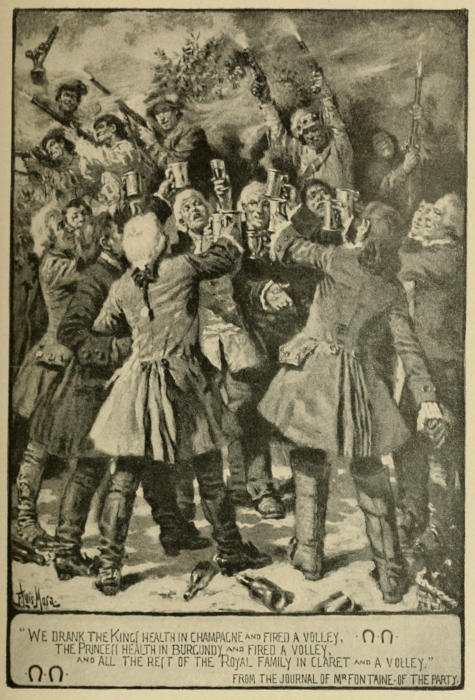
GOVERNOR SPOTSWOOD’S EXPEDITION TO THE BLUE RIDGE
[46]
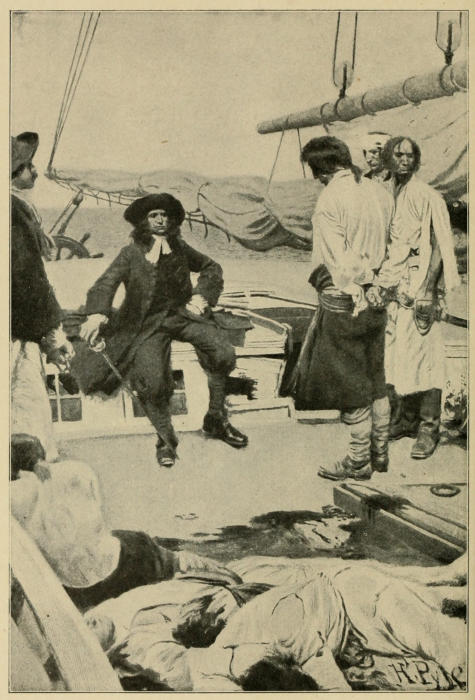
COLONEL RHETT AND THE PIRATE STEDE BONNET
[47]
Some of the best qualities of the soldier and administrator came out in him in the long struggle to put the pirates down once and for all. Queen Anne’s War had turned pirates into privateers and given pause to the stern business for a little, but it began again in desperate earnest when the war was over and peace concluded at Utrecht. It was officially reported by the secretary of Pennsylvania in 1717 that there were still fifteen hundred pirates on the coasts, making their headquarters at the Cape Fear and at New Providence in the Bahamas, and sweeping the sea as they dared from Brazil to Newfoundland. But the day of their reckoning was near at hand. South Carolina had cleared her own coasts for a little at the beginning of the century, but the robbers swarmed at her inlets again when the Indian massacres had weakened and distracted her, and the end of the war with France set many a roving privateersman free to return to piracy. The crisis and turning-point came in the year 1718. That year an English fleet crossed the sea, took New Providence, purged the Bahamas of piracy, and made henceforth a stronghold there for law and order. That same year Stede Bonnet, of Barbadoes, a man who had but the other day held a major’s commission in her Majesty’s service, honored and of easy fortune, but now turned pirate, as if for pastime, was caught at the mouth of the Cape Fear by armed ships under redoubtable Colonel Rhett, who had driven the French out of Charleston harbor thirteen years ago, and was taken and hanged on Charleston dock, all his crew having gone before him to the ceremony. “This humour of going a-pyrating,” it was said, “proceeded from a disorder in his mind, which had been but too visible in him some time before this wicked undertaking; and which is said to have been occasioned by some discomforts he found in a married state”; but the law saw nothing of that in what he had done. While Bonnet awaited his condemnation, Edward Thatch, the famous “Blackbeard,” whom all the coast dreaded, went a like just way to death, trapped within Ocracoke Inlet by two stout craft sent against him out of Virginia by Colonel Spotswood. And so, step by step, the purging went on. South Carolina had as capable a governor as Virginia in Robert Johnson; and the work done by these and like men upon the coasts, and by the English ships in the West Indies, presently wiped piracy out. By 1730 there was no longer anything for ships to fear on those coasts save the Navigation Acts and stress of sea weather.
[48]
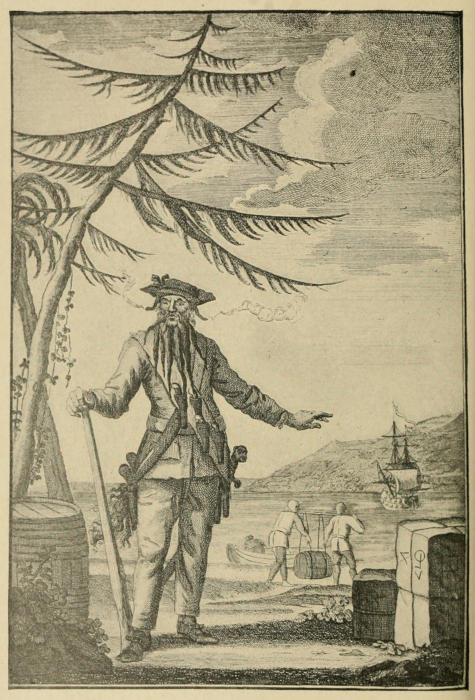
PORTRAIT OF THE PIRATE EDWARD THATCH
[49]
It was a long coast, and it took a long time to carry law and order into every bay and inlet. But every year brought increase of strength to the colonies, and with increase of strength power to rule their coasts as they chose. Queen Anne’s War over, quiet peace descended upon the colonies for almost an entire generation (1712-1740). Except for a flurry of Indian warfare now and again upon the borders, or here and there some petty plot or sudden brawl, quiet reigned, and peaceful progress. Anne, the queen, died the year after peace was signed (1714); and the next year Louis XIV. followed her, the great king who had so profoundly stirred the politics of Europe. An old generation had passed away, and new men and new measures seemed now to change the whole face of affairs. The first George took the throne, a German, not an English prince, his heart in Hannover; and presently the affairs of England fell into the hands of Sir Robert Walpole. Sir Robert kept his power for twenty-one years (1721-1742), and conducted the government with the shrewd, hard-headed sense and administrative capacity of a steady country squire,—as if governing were a sort of business, demanding, like other businesses, peace and an assured and equable order in affairs. It was a time of growth and recuperation, with much to do, but little to record.
[50]
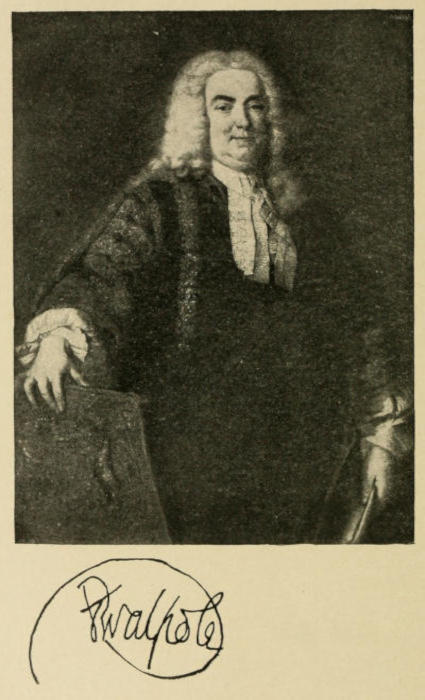
SIR ROBERT WALPOLE
[51]
The colonies, while it lasted, underwent in many things a slow transformation. Their population grew in numbers not only, but also in variety. By the end of the war there were probably close upon half a million people within their borders, counting slave with free; and with the return of peace there came a quickened increase. New England slowly lost its old ways of separate action as a self-constituted confederacy; and Massachusetts, with her new system of royal governors and a franchise broadened beyond the lines of her churches, by degrees lost her leadership. She was losing her old temper of Puritan thought. It was impossible to keep her population any longer of the single strain of which it had been made up at the first. New elements were steadily added; and new elements brought new ways of life and new beliefs. She was less and less governed by her pulpits; turned more and more to trade for sustenance; welcomed new-comers with less and less scrutiny of their ways of thinking; grew less suspicious of change, and more like her neighbors in her zest for progress.
Scots-Irish began to make their appearance in the colony, some of them going to New Hampshire, some remaining in Boston; and they were given a right willing welcome. The war had brought sore burdens of expense and debt upon the people, and these Scots-Irish knew the profitable craft of linen-making which the Boston people were glad to learn, and use to clothe themselves; for poverty, they declared, “is coming upon us as an armed man.” These new immigrants brought with them also the potato, not before used in New England, and very acceptable as an addition to the colony’s bill of fare. Small vessels now began to venture out from Cape Cod and Nantucket, moreover, [52]in pursuit of the whales that came to the northern coasts, and it was not long before that daring occupation began to give promise of wealth and of the building up of a great industry. Population began slowly to spread from the coasts into the forests which lay at the west between the Connecticut and the Hudson. In 1730 a Presbyterian church was opened in Boston,—almost as unmistakable a sign of change as King’s Chapel itself had been with its service after the order of the Church of England.
The middle colonies and the far south saw greater changes than these. South Carolina seemed likely to become as various in her make-up as were New York and Pennsylvania with their mixture of races and creeds. Scots-Irish early settled within her borders also; she had already her full share of Huguenot blood; and there followed, as the new century advanced through the lengthened years of peace, companies of Swiss immigrants, and Germans from the Palatinate. Charleston, however, seemed English enough, and showed a color of aristocracy in her life which no one could fail to note who visited her. Back from the point where the rivers met, where the fortifications stood, and the docks to which the ships came, there ran a fine road northward which Governor Archdale, that good Quaker, had twenty years ago declared more beautiful and pleasant than any prince in Europe could find to take the air upon when he drove abroad. From it on either side stretched noble avenues of live oaks, their strong lines softened by the long drapery of the gray moss,—avenues which led to the broad verandas of country residences standing in cool and shadowy groves of other stately trees. In summer the odor of jasmine filled the air; and even in winter the winds were soft. It was here that the ruling men of the colony lived, the masters of the nearer plantations,—men bred and cultured after the manner of the Old World. The simpler people, who made the colony various with their differing bloods, lived inland, in the remoter parishes, or near other harbors above or below Charleston’s port. It was on the nearer plantations round about Charleston that negro slaves most abounded; and there were more negroes by several thousand in the colony than white folk. Out of the 16,750 inhabitants of the colony in 1715, 10,500 were slaves. But the whites were numerous enough to give their governors a taste of their quality.
[53]
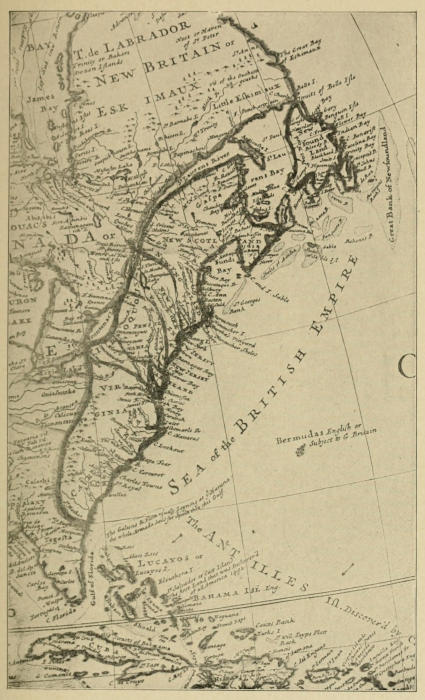
MAP OF THE COAST SETTLEMENTS, 1742
[54]
There were well-developed political parties in South Carolina, for all she was so small; and astute and able men to lead them, like Colonel Rhett, now soldier, now sailor, now statesman, and Mr. Nicholas Trott, now on one side and again on the other in the matter of self-government as against the authority of the proprietors or the crown, but always in a position to make his influence felt. The province practically passed from the proprietors to the crown in 1719, because the people’s party determined to be rid of their authority, and ousted their governor, exasperated that in their time of need, their homes burned about their ears by the savages, their coasts ravaged by freebooters, they should have been helped not a whit, but left to shift desperately for themselves. In 1729 the proprietors formally surrendered their rights. Colonel Francis Nicholson acted as provisional governor while the change was being effected (1719-1725), having been meantime governor of Acadia, which he had taken for the crown. In 1720 [55]he was knighted; and he seems to have acted as soberly in this post in Carolina as he had acted in Virginia. He was truculent and whimsical in the north; but in the south his temper seemed eased and his judgment steadied. The change of government in South Carolina was really an earnest of the fact that the people’s representatives had won a just and reasonable ascendency in the affairs of the colony; and Sir Francis did not seriously cross them, but served them rather, in the execution of their purposes.
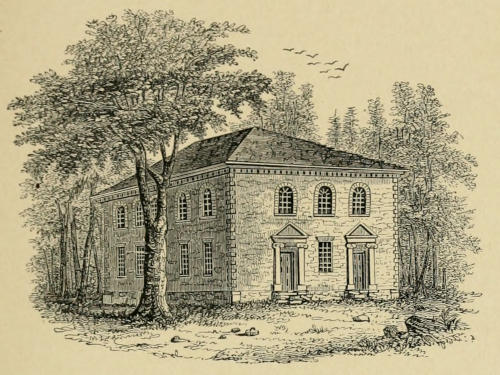
POHICK CHURCH, VIRGINIA, WHERE WASHINGTON WORSHIPPED
Every colony had its own movements of party. Everywhere the crown desired the colonial assemblies to provide a permanent establishment for the governor, the judges, and the other officers who held the King’s commission,—fixed salaries, and a recognized authority to carry out instructions; but everywhere the people’s representatives persistently refused to grant either salaries or any additional authority which they [56]could not control in the interest of their own rights from session to session. They would vote salaries for only a short period, generally a year at a time; and they steadily denied the right of the crown to extend or vary the jurisdiction of the courts without their assent. Sometimes a governor like Mr. Clarke, of New York, long a resident in his colony and acquainted with its temper and its ways of thought, got what he wanted by making generous concessions in matters under his own control; and the judges, whatever their acknowledged jurisdiction, were likely to yield to the royal wishes with some servility: for they were appointed at the King’s pleasure, and not for the term of their good behavior, as in England. But power turned, after all, upon what the people’s legislature did or consented to do, and the colonists commonly spoke their minds with fearless freedom.
In New York the right to speak their minds had been tested and established in a case which every colony promptly learned of. In 1734 and 1735 one John Peter Ziegler, a printer, was brought to trial for the printing of various libellous attacks on the governor and the administration of the colony,—attacks which were declared to be highly “derogatory to the character of his Majesty’s government,” and to have a tendency “to raise seditions and tumults in the province”; but he was acquitted. The libel was admitted, but the jury deemed it the right of every one to say whatever he thought to be true of the colony’s government; and men everywhere noted the verdict.
[57]
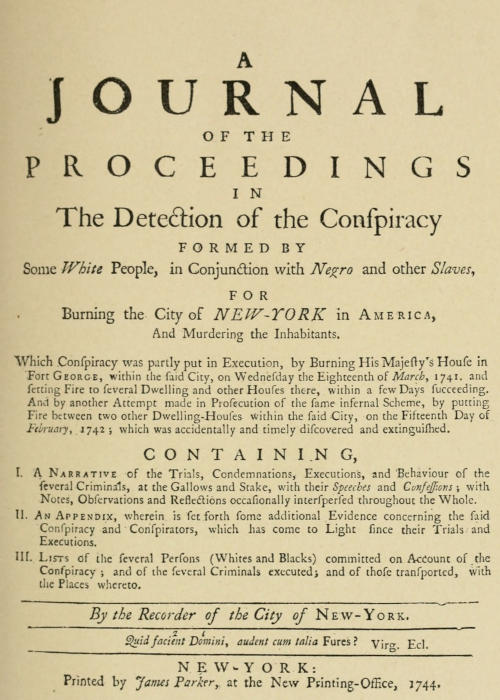
TITLE-PAGE OF THE PROCEEDINGS AGAINST THE NEGROES
[58]
A second negro plot startled New York in 1741, showing itself, as before, in sudden incendiary fires. It was thought that the slaves had been incited to destroy the town; and there was an uneasy suspicion that these disturbing occurrences were in some way connected with the slave insurrections in the south. Uprisings of the slaves had recently occurred in the West Indies. South Carolina had suffered such an outbreak a little more than two years before. In 1738 armed insurgent negroes had begun there, in a quiet parish, the execution of a terrible plot of murder and burning which it had taken very prompt and summary action to check and defeat. Such risings were specially ominous where the slaves so outnumbered the whites; and it was known in South Carolina whence the uneasiness of the negroes came. At the south of the province lay the Spanish colonies in Florida. Negroes who could manage to run away from their masters and cross the southern border were made very welcome there; they were set free, and encouraged in every hostile purpose that promised to rob the English settlements of their ease and peace. Bands of Yamassees wandered there, too, eager to avenge themselves as they could for the woful defeat and expulsion they had suffered at the hands of the Carolinians, and ready to make common cause with the negroes. When bands of negroes, hundreds strong, began their sudden work of burning, plunder, and murder where the quiet Stono runs to the sea no one doubted whence the impulse came. And though a single rising was easily enough put down, who could be certain that that was the end of the ominous business? No wonder governors at Charleston interested themselves to increase the number of white settlers and make their power of self-defence sure.
Such things, however, serious as they were, did not check the steady growth of the colonies. It was not [59]yet questions of self-government or of the preservation of their peace that dominated their affairs; and only those who observed how far-away frontiers were being advanced and two great nations being brought together for a reckoning face to face saw what was the next, the very near, crisis in store for the English in America. Through all that time of peace a notable drama was in fact preparing. Slowly, but very surely, English and French were drawing nearer and nearer within the continent,—not only in the north, but throughout all the length of the great Mississippi. Step by step the French had descended the river from their posts on the lakes; and while peace reigned they had established posts at its mouth and begun to make their way northward from the Gulf. So long ago as 1699 they had built a stockade at Biloxi; in 1700 they had taken possession of Mobile Bay; by 1716 they had established posts at Toulouse (Alabama) and at Natchez. In 1718 they began to build at New Orleans. In 1719 they captured and destroyed the Spanish post at Pensacola. By 1722 there were five thousand Frenchmen by the lower stretches of the great river; and their trading boats were learning all the shallows and currents of the mighty waterway from end to end. Meantime, in the north, they advanced their power to Lake Champlain, and began the construction of a fort at Crown Point (1721). That same year, 1721, French and English built ominously near each other on Lake Ontario, the English at Oswego, the French at Niagara among the Senecas. In 1716, the very year Governor Spotswood rode through the western forests of Virginia to a summit of the Blue Ridge, the French had found a short way to the Ohio by following the Miami and the [60]Wabash down their widening streams. It was while they thus edged their way towards the eastern mountains and drew their routes closer and closer to their rivals on the coast that that adventurous, indomitable people, the Scots-Irish, came pouring of a sudden into the English colonies, and very promptly made it their business to pass the mountains and take possession of the lands which lay beyond them, as if they would deliberately go to meet the French by the Ohio.
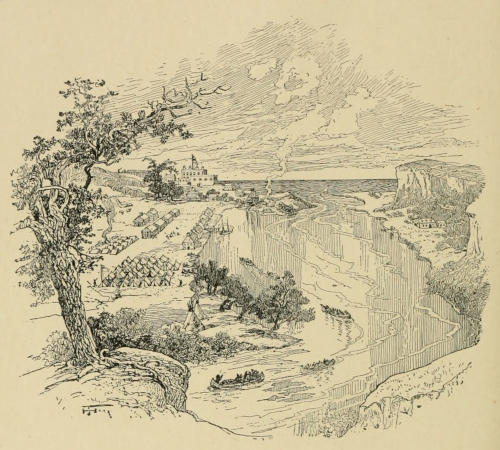
OSWEGO IN 1750
For several years after the first quarter of the new century had run out immigrants from the north of Ireland came crowding in, twelve thousand strong by the year. In 1729 quite five thousand of them entered [61]Pennsylvania alone: and they pressed without hesitation and as if by preference to the interior. From Pennsylvania they passed along the broad, inviting valleys southward into the western parts of Virginia. By 1730 a straggling movement of settlers had begun to show itself even upon the distant lands of Kentucky. Still farther south traders from the Carolinas went constantly back and forth between the Indian tribes of the country by the Mississippi and the English settlements at the coast. Nine thousand redskin warriors lay there in the forests. Some traded with the French at the river, some with the English at the coast. They might become foes or allies, might turn to the one side or the other, as passion or interest led them.
In 1739 the French at the north put an armed sloop on Champlain. The same year the English built a fortified post at Niagara. Everywhere the two peoples were converging, and were becoming more and more conscious of what their approach to one another meant. So long ago as 1720 orders had come from France bidding the French commanders on the St. Lawrence occupy the valley of the Ohio before the English should get a foothold there. The places where the rivals were to meet it was now easy to see, and every frontiersman saw them very plainly. The two races could not possess the continent together. They must first fight for the nearer waterways of the West, and after that for whatever lay next at hand.
It was no small matter, with threat of such things in the air, that the English chose that day of preparation for the planting of a new colony, and planted it in the south between Carolina and the Florida settlements,—a barrier and a menace both to French and Spaniard. [62]It was James Oglethorpe, a soldier, who planned the new undertaking; and he planned it like a soldier,—and yet like a man of heart and elevated purpose, too, for he was a philanthropist and a lover of every serviceable duty, as well as a soldier. He came of that good stock of country gentlemen which has in every generation helped so sturdily to carry forward the work of England, in the field, in Parliament, in administrative office. He had gone with a commission into the English army in the late war a mere lad of fourteen (1710); and, finding himself still unskilled in arms when England made peace at Utrecht, he had chosen to stay for six years longer, a volunteer, with the forces of Prince Eugene in the East. At twenty-two he had come back to England (1718), to take upon himself the responsibilities which had fallen to him by reason of the death of his elder brothers; and in 1722 he had entered the House of Commons, eager as ever to learn his duty and do it. He kept always a sort of knightly quality, and the power to plan and hope and push forward that belongs to youth. He was a Tory, and believed that the Stuarts should have the throne from which they had been thrust before he was born; but that did not make him disloyal. He was an ardent reformer; but that did not make him visionary, for he was also trained in affairs. His clear-cut features, frank eye, erect and slender figure bespoke him every inch the high-bred gentleman and the decisive man of action.
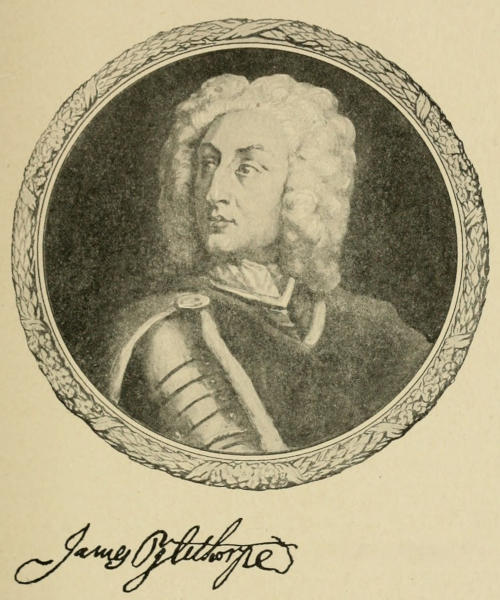
JAMES OGLETHORPE
In Parliament he had been made one of a committee to inspect prisons; and he had been keenly touched by the miserable plight of the many honest men who, through mere misfortune, were there languishing in hopeless imprisonment for debt. He bethought himself [63]of the possibility of giving such men a new chance of life and the recovery of fortune in America; and the thought grew into a plan for a new colony. He knew how the southern coast lay vacant between Charleston and the Spaniards at St. Augustine. There were good lands there, no doubt; and his soldier’s eye showed him, by a mere glance at a map, how fine a point of vantage it might be made if fortified against the alien power in Florida. And so he made his plans. It should be a military colony, a colony of fortified [64]posts; and honest men who had fallen upon poverty or misfortune at home should have a chance, if they would work, to profit by the undertaking, though he should take them from debtors’ prisons. Both King and Parliament listened very willingly to what he proposed. The King signed a charter, giving the undertaking into the hands of trustees, who were in effect to be proprietors (June, 1732); and Parliament voted ten thousand pounds as its subscription to the enterprise; while men of as liberal a spirit as Oglethorpe’s associated themselves with him to carry the humane plan out, giving money, counsel, and service without so much as an expectation of gain to themselves, or any material return for their outlay. Men had ceased by that time to dream that colonization would make those rich who fathered it and paid its first bills. By the end of October, 1732, the first shipload of settlers was off for America, Oglethorpe himself at their head; and by February, 1733, they were already busy building their first settlement on Yamacraw Bluff, within the broad stream of the Savannah.
The colony had in its charter been christened Georgia, in honor of the King, who had so cordially approved of its foundation; the settlement at Yamacraw, Oglethorpe called by the name of the river itself, Savannah. His colonists were no mere company of released debtors and shiftless ne’er-do-wells. Men had long ago learned the folly of that mistake, and Oglethorpe was too much a man of the world to repeat the failures of others. Every emigrant had been subjected to a thorough examination regarding his antecedents, his honesty, his character for energy and good behavior, and had been brought because he had been deemed fit. [65]Italians skilled in silk culture were introduced into the colony. Sober German Protestants came from Moravia and from Salzburg, by Tyrol, and were given their separate places of settlement,—as quiet, frugal, industrious, pious folk as the first pilgrims at Plymouth. Clansmen from the Scottish Highlands came, and were set at the extreme south, as an outpost to meet the Spaniard. Some of the Carolina settlers who would have liked themselves to have the Highlanders for neighbors tried to dissuade them from going to the spot selected for their settlement. They told them that the Spaniards were so near at hand that they could shoot them from the windows of the houses that stood within the fort. “Why, then, we shall beat them out of their fort, and shall have houses ready built to live in!” cried the men in kilts, very cheerily, and went on to their settlement.
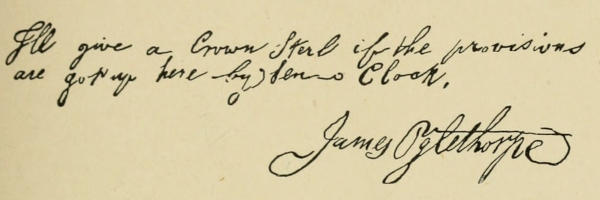
OGLETHORPE’S ORDER FOR SUPPLIES
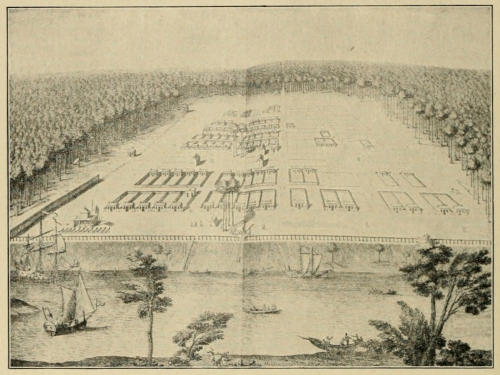
SAVANNAH IN 1754
Fortunately it was seven years before the war with Spain came which every one had known from the first to be inevitable; and by that time the little colony was ready enough. Georgia’s territory stretched upon the coast from the Savannah to the Altamaha, and from the coast ran back, west and northwest, to the sources of those rivers; from their sources due westward “to [66]the South Seas.” Savannah was thus planted at the very borders of South Carolina. New settlers were placed, as they came, some in Savannah, many by the upper reaches of the river. The Highlanders had their post of danger and honor upon the Altamaha; and before war came new settlers, additional arms and stores, and serviceable fortifications had been placed at St. Simon’s Island at the mouth of the Altamaha. Every settlement was in some sort a fortified military post. The first settlers had been drilled in arms by sergeants of the Royal Guards in London every day between the time of their assembling and the time of their departure. Arms and ammunition were as abundant almost as agricultural tools and food stores in the cargoes carried out. Negro slavery [67]was forbidden in the colony, because it was no small part of Oglethorpe’s purpose in founding it to thrust a solid wedge of free settlers between Carolina and the country to the south, and close the border to fugitive slaves. Neither could any liquor be brought in. It was designed that the life of the settlements should be touched with something of the rigor of military discipline; and so long as Oglethorpe himself was at hand laws were respected and obeyed, rigid and unacceptable though they were; for he was a born ruler of men.
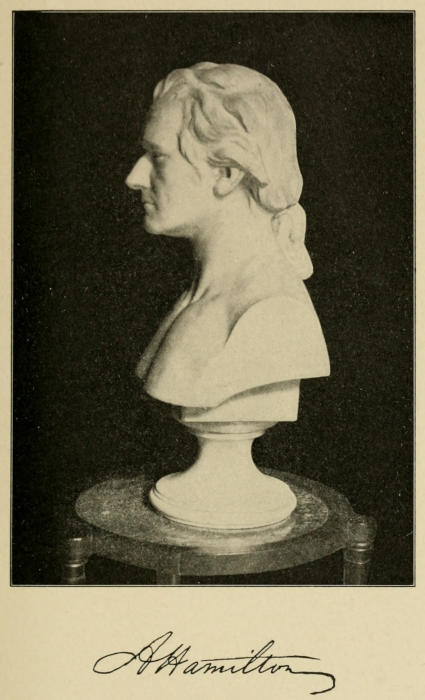
ALEXANDER HAMILTON
He had not chosen very wisely, however, when he brought Charles and John Wesley out as his spiritual advisers and the pastors of his colony. They were men as inapt at yielding and as strenuous at prosecuting their own way of action as he, and promoted diversity of opinion quite as successfully as piety. They stayed but three or four uneasy years in America, and then returned to do their great work of setting up a new dissenting church in England. George Whitefield followed them (1738) in their missionary labors, and for a little while preached acceptably enough in the quiet colony; but he, too, was very soon back in England again. The very year Oglethorpe brought Charles Wesley to Georgia (1734) a great wave of religious feeling swept over New England again,—not sober, self-contained, deep-currented, like the steady fervor of the old days, but passionate, full of deep excitement, agitated, too like a frenzy. Enthusiasts who saw it rise and run its course were wont to speak of it afterwards as “the Great Awakening,” but the graver sort were deeply disturbed by it. It did not spend its force till quite fifteen years had come and gone. Mr. Whitefield returned to America in 1739, [68]to add to it the impulse of his impassioned preaching, and went once more to Georgia also. Again and again he came upon the same errand, stirring many a colony with his singular eloquence; but Georgia was busy with other things, and heeded him less than the rest.
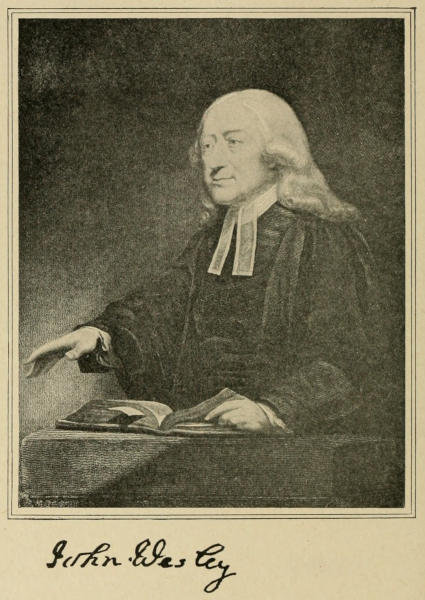
JOHN WESLEY
[69]
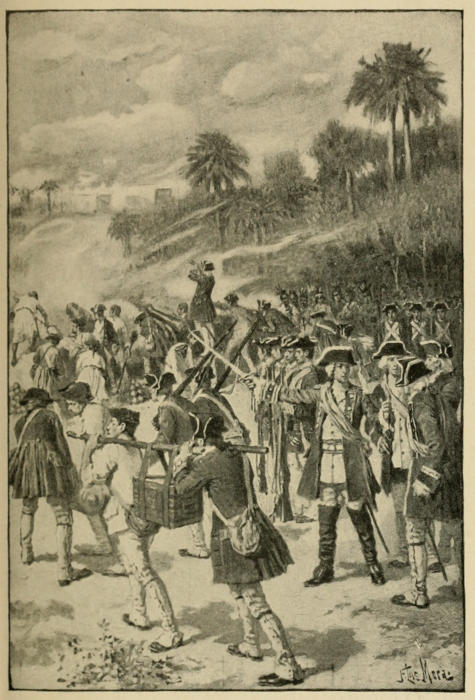
OGLETHORPE’S EXPEDITION AGAINST ST. AUGUSTINE
[70]
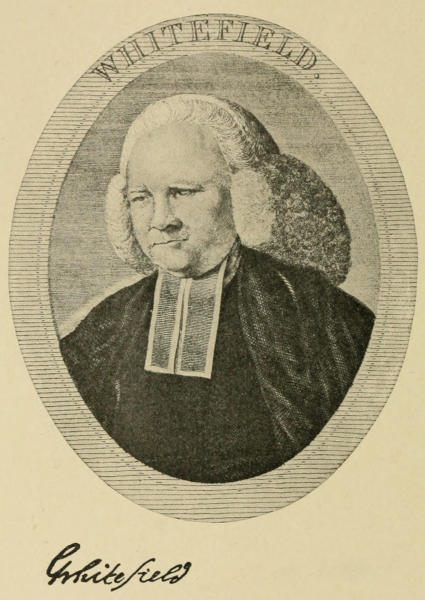
GEORGE WHITEFIELD
When the inevitable war came with Spain, in 1739,—inevitable because of trade rivalries in the West Indies and in South America, and because of political rivalry at the borders of Florida,—Oglethorpe was almost the first to strike. Admiral Vernon had been despatched in midsummer, 1739, before the declaration of war, to destroy the Spanish settlements and distress Spanish commerce in the West Indies; and had promptly taken Porto Bello in November, scarcely a month after war had been formally declared. Oglethorpe struck next, at St. Augustine. It was this he had looked forward [71]to in founding his colony. In May, 1740, he moved to the attack with a mixed army of redskins and provincial militia numbering a little more than two thousand men,—supported at sea by a little fleet of six vessels of war under Sir Yelverton Peyton. But there had been too much delay in getting the motley force together. The Spaniards had procured reinforcements from Havana; the English ships found it impracticable to get near enough to the Spanish works to use their guns with effect; Oglethorpe had no proper siege pieces; and the attack utterly failed. It had its effect, nevertheless. For two years the Spaniards held nervously off, carefully on the defensive; and when they did in their turn attack, Oglethorpe beat them handsomely off, and more than wiped out the disrepute of his miscarriage at St. Augustine. In June 1742, there came to St. Simon’s Island a Spanish fleet of fifty-one sail, nearly five thousand troops aboard, and Oglethorpe beat them off with six hundred and fifty men,—working his little forts like a master, and his single guard-schooner and few paltry armed sloops as if they were a navy. Such a deliverance, cried Mr. Whitefield, could not be paralleled save out of Old Testament history.
Meanwhile Vernon and Wentworth had met with overwhelming disaster at Cartagena. With a great fleet of ships of the line and a land force of nine thousand men, they had made their assault upon it in March, 1741; but because Wentworth bungled everything he did with his troops the attack miserably failed. He was caught by the deadly wet season of the tropics; disease reduced his army to a wretched handful; and thousands of lives were thrown away in his dismal [72]disgrace. Both New England and Virginia had sent troops to take their part with that doomed army; and the colonies knew, in great bitterness, how few came home again. The war had its issues for them, they knew, as well as for the governments across the water. It meant one more reckoning with the Spaniard and the Frenchman, their rivals for the mastery of America. And in 1745 New England had a triumph of her own, more gratifying even than Oglethorpe’s astonishing achievement at St. Simon’s Island.
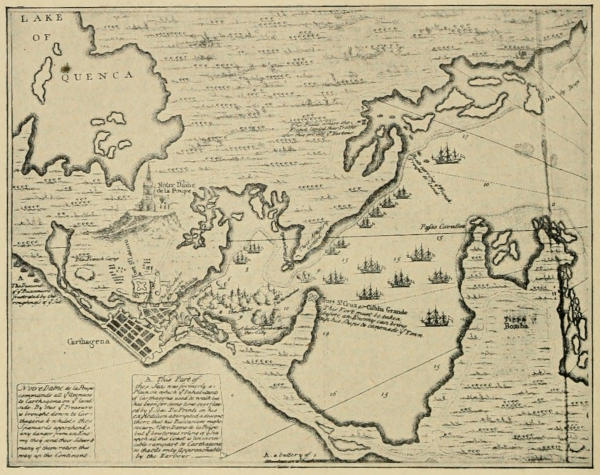
THE ACTION AT CARTAGENA
Only for a few months had England dealt with Spain alone upon a private quarrel. In 1740 the male line of the great Austrian house of Hapsburg had run out: Maria Theresa took the throne; rival claimants disputed [73]her right to the succession; and all Europe was presently plunged into the “War of the Austrian Succession” (1740-1748). “King George’s War” they called it in the colonies, when France and England became embroiled; but the name did not make it doubtful what interests, or what ambitions, were involved; and New England struck her own blow at the power of France. A force of about four thousand men, levied in Massachusetts, New Hampshire, and Connecticut, moved in the spring of 1745 against the French port of Louisbourg on Cape Breton Island. Commodore Warren, the English naval commander in the West Indies, furnished ships for their convoy, and himself supported them in the siege; and by the 16th of June the place had been taken. For twenty-five years the French had been slowly building its fortifications, covering with them an area two and a half miles in circumference. They had made them, they supposed, impregnable. But the English had struck quickly, without warning, and with a skill and ardor which made them wellnigh irresistible; and their triumph was complete. Provincial troops had taken the most formidable fortress in America. William Pepperrell, the gallant gentleman who had led the New Englanders, got a baronetcy for his victory. Warren was made an admiral.
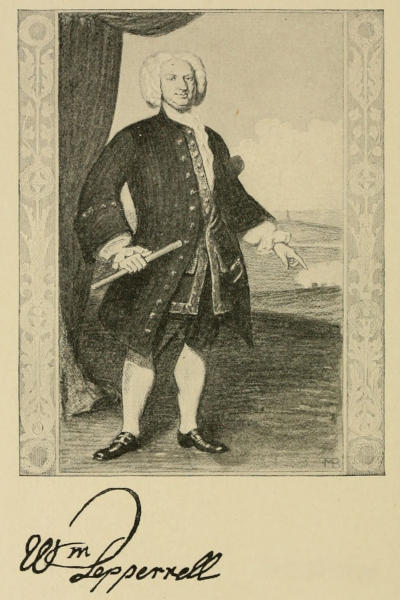
WILLIAM PEPPERRELL
The next year an attack was planned against the French at Crown Point on Champlain, but nothing came of it. The war almost stood still thenceforth, so far as the colonies were concerned, till peace was signed at Aix-la-Chapelle in October, 1748. That peace brought great chagrin to New England. By its terms Louisbourg and all conquests everywhere were restored. The whole work was to do over again, as after King [74]William’s War and the restoration of Port Royal, which Sir William Phips had been at such pains to take. The peace stood, however, little longer than that which had separated King William’s War from the War of the Spanish Succession. Seven years, and France [75]and England had once more grappled,—this time for a final settlement. All the seven years through the coming on of war was plainly to be seen by those who knew where to look for the signs of the times. The French and English in that brief interval were not merely to approach; they were to meet in the western valleys, and the first spark of a war that was to embroil all Europe was presently to flash out in the still forests beyond the far Alleghanies.
It was on the borders of Virginia this time that the first act of the drama was to be cast. The French determined both to shorten and to close their lines of occupation and defence from the St. Lawrence to the Mississippi and the Gulf. They knew that they could do this only by taking possession of the valley of the Ohio; and the plan was no sooner formed than it was attempted. And yet to do this was to come closer than ever to the English and to act under their very eyes. A few German families had made their way far to the westward in Pennsylvania, and hundreds of the indomitable Scots-Irish had been crowding in there for now quite twenty years, passing on, many of them, to the beautiful valley of the Shenandoah below, and pressing everywhere closer and closer to the passes which led down but a little way beyond into the valleys of the Alleghany, the Monongahela, and the Ohio. These men, at the frontiers of Pennsylvania and Virginia, were sure to observe what was going forward in front of them, and to understand what they saw. Traders crossed those mountains now by the score from the English settlements,—three hundred in a year, it was said. They knew the waters that ran to the Ohio quite as well as any Frenchman did. Their canoes had followed [76]the turnings of the broad Ohio itself, and had found it a highway to the spreading Mississippi, where French boats floated slowly down from the country of the Illinois, carrying their cargoes of meat, grain, tobacco, tallow, hides, lead, and oil to the settlements on the Gulf. In 1748, the year of the last peace, certain leading gentlemen in Virginia had organized an Ohio Land Company,—among the rest Mr. Augustus Washington, who had served with Vernon and Wentworth at Cartagena and had lost his health in the fatal service. He had named his estate by the Potomac, his home of retirement, Mount Vernon, as his tribute of admiration to the gallant sailor he had learned to love during those fiery days in the South. In 1750 the English government had granted to the Company six hundred thousand acres of land on the coveted river. Virginian officials themselves had not scrupled meanwhile also to issue grants and titles to land beyond the mountains. The English claim to the Ohio country was unhesitating and comprehensive.
The English had seized French traders there as unlicensed intruders, and the French in their turn had seized and expelled Englishmen who trafficked there. French and English matched their wits very shrewdly to get and keep the too fickle friendship of the Indians, and so make sure of their trade and their peace with them; and the Indians got what they could from them both. It was a sharp game for a great advantage, and the governments of the two peoples could not long refrain from taking a hand in it.
The French authorities, it turned out, were, as usual, the first to act. In 1752 the Marquis Duquesne became governor of Canada, an energetic soldier in his [77]prime; and it was he who took the first decisive step. In the spring of 1753 he despatched a force to Presque Isle, on the southern shore of Lake Erie, built a log fort there, and thence cut a portage for his boats southward a little way through the forest to a creek (French Creek the English called it afterwards) whose waters, when at flood, would carry his boats to the Alleghany, and by that open stream to the Ohio. It was the short and straight way from the St. Lawrence to the Mississippi and the Gulf. At the creek’s head he placed another log fort (Le Bœuf), and upon the Alleghany a rude outpost.
The same year that saw the Marquis Duquesne made governor of Canada saw Robert Dinwiddie come out as governor of Virginia, and no one was likelier than he to mark and comprehend the situation on the border. Mr. Dinwiddie had been bred in a counting house, for he was the son of a well-to-do merchant of Glasgow; but business had long since become for him a matter of government. He had gone in his prime to be collector of customs in Bermuda; and after serving in that post for eleven years he had been made surveyor general of customs in the southern ports of America,—a post in which he served most acceptably for another ten years. For twenty years he had shown singular zeal and capacity in difficult, and, for many men, demoralizing, matters of administration. He had lived in Virginia when surveyor general of customs. During the two years which immediately preceded his appointment to the governorship of the Old Dominion he had engaged in business on his own account in London, and had become by purchase one of the twenty stockholders of the Ohio Land Company. He came to his new office, therefore, acquainted in more than one way with the leading men of the colony,—especially with Mr. Augustine Washington, now the Ohio Company’s president, and the little group of influential gentlemen,—Lees, Fairfaxes, and the rest,—often to be found gathered at Mount Vernon. He came, therefore, with his eyes on the western lands where the company and his government were alike bound to see to it that the French were checked.
[78]
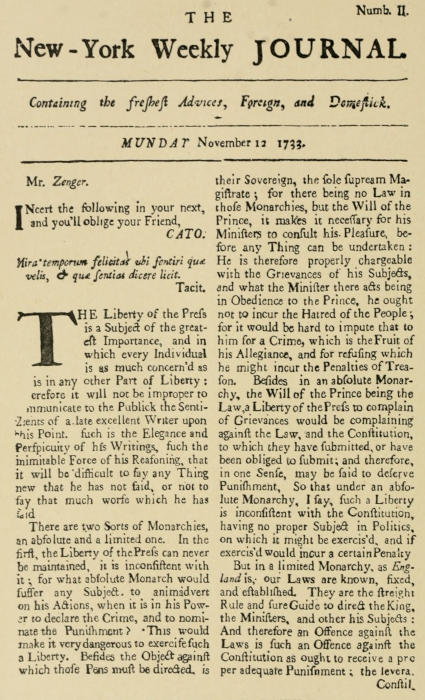
FACSIMILE OF THE NEW YORK WEEKLY JOURNAL
[79]
He saw Duquesne’s movement, consequently, at its very outset, warned the government at home, and was promptly instructed to require the French “peaceably to depart,” and if they would not go for the warning, “to drive them off by force of arms.” He chose as his messenger to carry the summons Mr. George Washington, half-brother to Mr. Augustine Washington, of Mount Vernon. George Washington was only a lad of twenty-one; but he had hardened already to the work of a man. He had received no schooling in England such as Augustine had had, but had gone from the simple schools and tutors of the Virginian country-side to serve as a surveyor for Lord Fairfax in the rough country of the Shenandoah,—whither Fairfax, heir of the old Culpeper grants, had come to seek a life away from courts in the picturesque wilderness of America. Augustine Washington died the very year Mr. Dinwiddie became governor, though he was but thirty-four; and he had left George, lad though he was, to administer his estate and serve in his stead as commander of the militia of eleven counties. Governor Dinwiddie knew whom he was choosing when he sent this drilled and experienced youngster, already a frontiersman, to bid the French leave the Ohio.
[80]
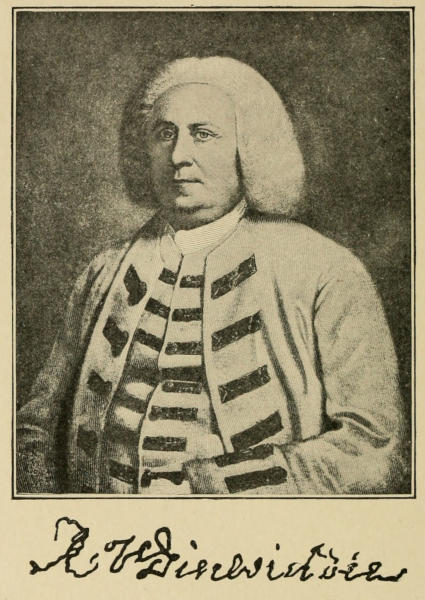
ROBERT DINWIDDIE
The message was carried in the dead of winter to the grave and courteous soldier who commanded at Fort Le Bœuf; and Washington tried the endurance even of the veteran frontiersman who accompanied him by the forced marches he made thither and back again through the dense and frosted woods, across [81]frozen streams, and through the pathless, storm-beaten tangles of deep forests, where there was hardly so much as the track of a bison for their horses to walk in. He reported that the French had received him very graciously; but had claimed the Ohio as their own, had made no pretence that they would abandon it because the English bade them, and clearly meant to establish themselves where they were. Juniors among their officers had told him so very plainly as he sat with them after dinner in a house which they had seized from an English trader.
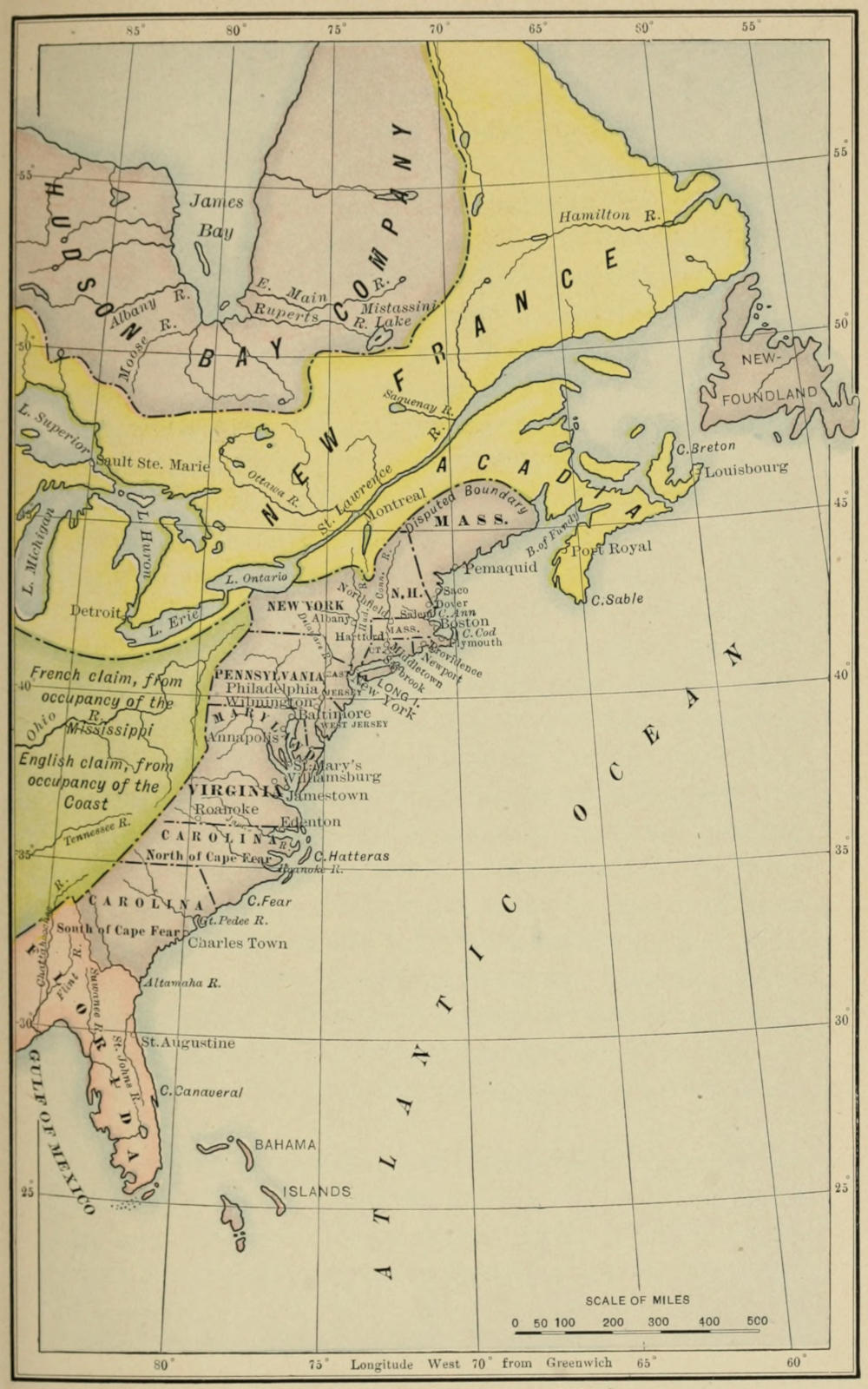
ENGLISH COLONIES, 1700.
BORMAY & CO., N. Y.
He was back at Williamsburg with his report by the middle of January, 1754; and the next month a small body of frontiersmen was hurried forward to make a clearing at the forks of the Ohio and begin the construction of fortifications there ere spring came, and the French. The French came, nevertheless, all too soon. By the 17th of April their canoes swarmed there, bearing five hundred men and field ordnance, and the forty Englishmen who held the rude, unfinished defences of the place had no choice but to retire or be blown into the water. The French knew the importance of the place as a key to the western lands, and they meant to have it, though they should take it by an open act of war. Their force there numbered fourteen hundred before summer came. They built a veritable fort, of the rough frontier pattern, but strong enough, as it seemed, to make the post secure, and waited to see what the English would do.
Dinwiddie had acted with good Scots capacity, as efficiently and as promptly as he could with the power he had. He was obliged to deal with a colonial assembly,—the French governors were not; and the Virginian [82]burgesses thought of domestic matters when Dinwiddie’s thought was at the frontier. While Washington was deep in the forests, bearing his message, they quarrelled with the governor about the new fees which were charged since his coming for grants of the public land; and they refused him money because he would not yield in the matter. But when they knew how things actually stood in the West, and saw that the governor would levy troops for the exigency whether they acted with him or not, and pay for them out of his own pocket if necessary, they voted supplies.
There was no highway of open rivers for the Virginians, as for the French, by which they could descend to the forks of the Ohio; and Virginia had no troops ready as the French had. Raw levies of volunteers had first to be got together; and when they had been hastily gathered, clothed, and a little drilled, the first use to which it was necessary to put them was to cut a rough, mountainous road for themselves through the untouched forests which lay thick upon the towering Blue Ridge. It was painfully slow work, wrought at for week after week, and the French were safely intrenched at their fort “Duquesne” before the tired Virginian recruits had crossed the crest of the mountains. By midsummer they were ready to strike and drive the English back.
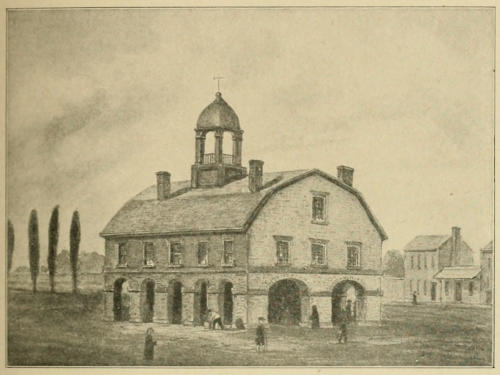
MERCHANTS’ EXCHANGE, NEW YORK, 1752-1799
Blood had been spilled between the rivals ere that. Washington was in command of the little force which had cut its way through the forest, and he did not understand that he had been sent into the West this time merely to bear a message. When, therefore, one day in May (28 May, 1754) he found a party of French lurking at his front in a thicketed glade, he did not hesitate [83]to lead an attacking party of forty against them. The young commander of the French scouts was killed in the sharp encounter, and his thirty men were made prisoners. Men on both sides of the sea knew, when they heard that news, that war had begun. Young Washington had forced the hands of the statesmen in London and Paris, and all Europe presently took fire from the flame he had kindled. In July, Washington was obliged to retire. He had only three hundred and fifty men, all told, at the rudely intrenched camp which he had constructed in the open glade of “Great Meadows” as the best place to await reinforcements; and in July the French were upon him with a force of seven hundred. All day he fought (3 July, 1754), and in a drenching rain, the French firing from the [84]edges of the woods, his own men in their shallow, flooded trenches in the open; but by night he knew he must give way. The French offered him an honorable capitulation, and the next day let him go untouched, men and arms, with such stores as he could carry.
It was a bad beginning at winning the West from the French; and all the worse because it showed how weak the English were at such work. The danger was not Virginia’s alone; it touched all the English in America; but the colonies could not co-operate, and, when they acted at all, acted sluggishly, as if war would wait for both parties to get ready. The assemblies of Pennsylvania and New York declared very coldly that they did not see what right the English crown had to the valley of the Ohio. Maryland had been about to raise a force, but had not yet done so when the fatal day at Great Meadows came. Two “independent companies” in the King’s pay had been ordered from New York, and a like company from South Carolina; and North Carolina had sent forward three hundred and fifty men; but only the single company from South Carolina had reached Great Meadows, where Washington was, before the French were upon him.
Dinwiddie and every other governor who heeded or wrote of the business told the ministers in England that they must act, and send the King’s own troops; and happily the ministers saw at last the importance of what should be won or lost in America. Troops were sent. For Europe it was the beginning of the Seven Years’ War (1755-1763), which was to see the great Frederick of Prussia prove his mastery in the field; which was to spread from Europe to Asia and to Africa; which was to wrest from the French for England [85]both India and America. But for the colonists in America it was only “the French and Indian War.” Their own continent was the seat of their thoughts.
The beginnings the home government made were small and weak enough; but it did at least act, and it was likely that, should it keep long enough at the business, it would at last learn and do all that was necessary to make good its mastery against a weaker rival. By the 20th of February, 1755, transports were in the Chesapeake, bringing two regiments of the King’s regulars, to be sent against Duquesne. The French, too, were astir. Early in the spring eighteen French ships of war sailed for Canada, carrying six battalions and a new governor; and though the English put an equal fleet to sea to intercept them, the Frenchmen got into the St. Lawrence with a loss of but two of their ships, which had strayed from the fleet and been found by the English befogged and bewildered off the American coast. The scene was set for war both north and south.
[86]
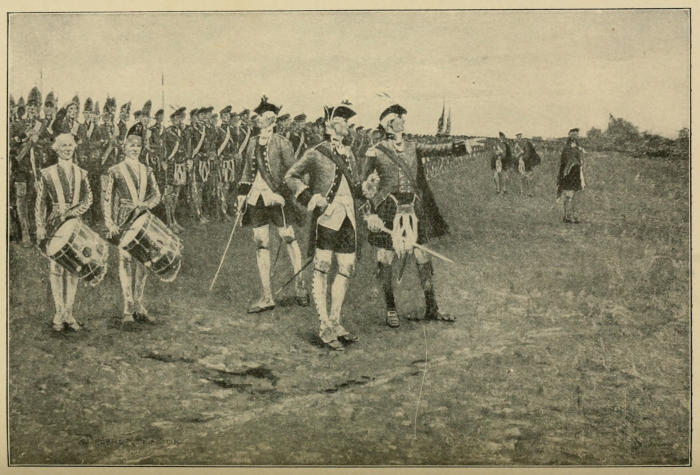
THE PLAINS OF ABRAHAM ON THE MORNING OF THE BATTLE
[87]
Major General Edward Braddock commanded the regiments sent to Virginia, and was commissioned to be commander-in-chief in America. He therefore called the principal colonial governors to a conference at Alexandria, his headquarters. By the middle of April five had come: Robert Dinwiddie, of course, the governor of Virginia; Robert Hunter Morris, whose thankless task it was to get war votes out of the Pennsylvanian assembly of Quakers and lethargic German farmers; Horatio Sharpe, the brave and energetic gentleman who was governor of Maryland; James DeLancey, the people’s governor, of New York; and William Shirley, governor of Massachusetts, past sixty, but as strenuous as Dinwiddie, and eager for the field though he had been bred a lawyer,—every inch “a gentleman and politician,” it was said. It was he who had done most to organize and expedite the attack on Louisbourg which had succeeded so handsomely ten years ago (1745). He would at any rate not fail for lack of self-confidence. The conference planned an attack on Niagara, to be led by Shirley himself, to cut the French off from Duquesne; an attack on Crown Point, to be led by Colonel William Johnson, of New York, whom the Mohawks would follow, to break the hold of the French on Champlain; an attack upon Beauséjour, in Acadia, under the leadership of Lieutenant-Colonel Monckton, of the King’s regulars; and a movement, under the command of General Braddock himself straight through the forests against Duquesne, by the way Washington had cut to Great Meadows.
It would have been much better had General Braddock chosen a route farther to the north, where the Pennsylvanian farmers of the frontier had begun to make roads and open the forests for the plough; but it made little difference, after all, which way he went: his temper and his training doomed him to fail. He lacked neither courage nor capacity, but he sadly lacked discretion. He meant to make his campaign in the wilderness by the rules of war he had learned in Europe, where the forests were cleared away and no subtile savages could dog or ambush an army; and he would take no advice from provincials. Few but Washington cared to volunteer advice, for the commander-in-chief was “a very Iroquois in disposition.” He took two thousand men into the wilderness, with artillery trains and baggage: fourteen hundred regulars, nearly five hundred Virginians, horse and foot, two [88]independent companies from New York, and sailors from the transports to rig tackle to get his stores and field-pieces out of difficulties in the rough road. Washington went with the confident commander, by special invitation, to act as one of his aides, and was the only provincial officer whose advice was given so much as consideration during all the weary weeks in which the little army widened and levelled its way with axe and spade through the dense woods. And then the fatal day came which filled all the colonies with dismay.
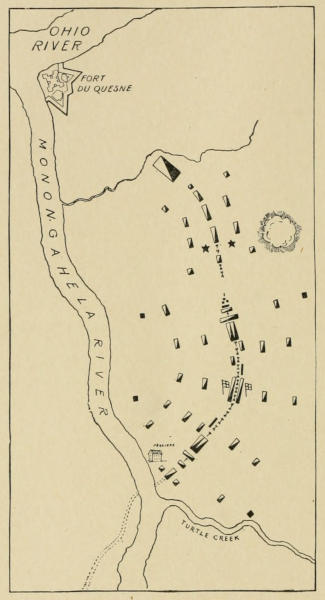
MAP OF BRADDOCK’S DEFEAT
The French commander at Duquesne had no such force as Braddock was bringing against him. He expected to be obliged to retire. But on the 9th of July the English general, with his advance force of twelve hundred [89]men, forded the shallow Monongahela but eight miles from Duquesne, and striking into the trail which led to the fort, walked into an ambush. A thousand men,—Indians, chiefly, and Canadian provincials,—poured a deadly fire upon him from the thick cover of the woods on either hand. He would not open his order and meet the attack in forest fashion, as Washington begged him to do, but kept his men formed and crowded in the open spaces of the road, to be almost annihilated, and driven back, a mere remnant, in utter rout. It was shameful, pitiful. Washington and his Virginian rangers could with difficulty keep the rear when the rout came, and bring the stricken commander off, to die in the retreat. Dinwiddie could not persuade the officers left in command even to stay upon the Virginian frontier to keep the border settlements safe against the savages. It was Washington’s impossible task for the rest of the war to guard three hundred and fifty miles of frontier with a handful of half-fed provincial militia, where the little huts and tiny settlements of the Scots-Irish immigrants lay scattered far and wide among the foothills and valleys of the spreading mountain country, open everywhere to the swift and secret onset of the pitiless redskins.
Braddock’s papers, abandoned in the panic of the rout, fell into the hands of the French, and made known to them all the English plans. They were warned what to do, and did it as promptly as possible. Shirley gave up the attempt to take Niagara before reaching the lake. Johnson, assisted by Lyman, of Connecticut, met the French under Dieskau at Lake George, and drove them back (September 8, 1755),—the commander and part of the force the French had so hastily despatched [90]to America in the spring,—and Dieskau himself fell into their hands; but they did not follow up their success or shake the hold of the French upon the line of lakes and streams which ran from the heart of New York, like a highway, to the valley of the St. Lawrence. The attack upon Beauséjour alone accomplished what was planned. A force of two thousand New England provincials, under Colonel Monckton and Colonel John Winslow, found the half-finished fortifications of the French on Beauséjour hill in their hands almost before their siege was fairly placed; and Acadia was more than ever secure.
There followed nearly three years of unbroken failure and defeat. In 1756 the Marquis Montcalm succeeded Dieskau as commander in Canada, and the very year of his coming took and destroyed the English forts at Oswego. That same year the Earl of Loudon came over to take charge of the war for the English; but he did nothing effective. The government at home sent reinforcements, but nothing was done with them that counted for success. “I dread to hear from America,” exclaimed Pitt. In 1757 Loudon withdrew the best of his forces to the north, to make an attack on Louisbourg. Montcalm took advantage of the movement to capture Fort William Henry, the advanced post of the English on Lake George; and Loudon failed in his designs against Louisbourg. Even the stout and wily English frontiersmen of the northern border found themselves for a little while overmatched. In March, 1758, Robert Rogers, the doughty New Hampshire ranger whose successful exploits of daring all the northern border knew, was beaten by a scouting party from Ticonderoga, and barely came off with his life. The [91]pouring in of troops, even of regulars from over sea, seemed to count for nothing. General James Abercrombie led an army of fifteen thousand men, six thousand of them regulars, against Ticonderoga, where Montcalm had less than four thousand; blundered at [92]every critical point of the attack; lost two thousand men; and retired almost as if in flight (July, 1758).
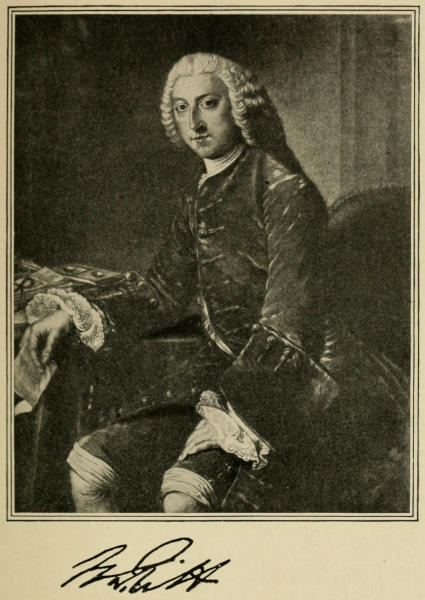
WILLIAM PITT

SIGNATURE OF JAMES ABERCROMBIE
[93]
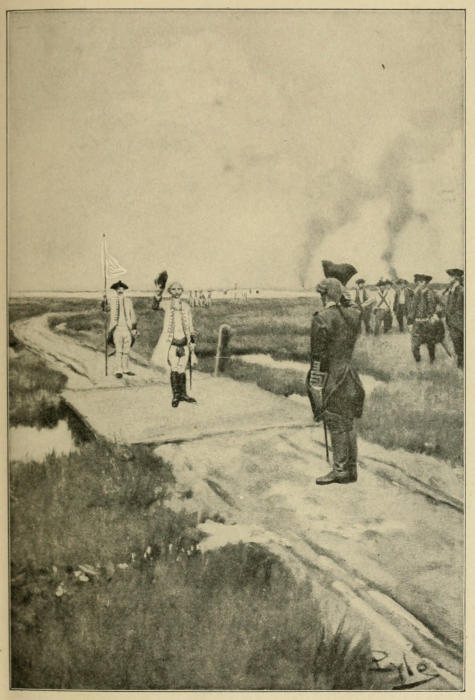
THE CAPITULATION OF LOUISBOURG
[94]
But that was the end of failure. The year 1757 had seen the great Pitt come into control of affairs in England, and no more incompetent men were chosen to command in America. Pitt had been mistaken in regard to Abercrombie, whom he had retained; but he made no more mistakes of that kind, and a war of failure was transformed into a war of victories, quick and decisive. Two more years, and the French no longer had possessions in America that any nation need covet. Pitt saw to it that the forces, as well as the talents, used were adequate. In July, 1758, a powerful fleet under Admiral Boscawen, and twelve thousand troops under General Jeffrey Amherst, whom Pitt had specially chosen for the command, invested and took Louisbourg. In August, Colonel John Bradstreet, with three thousand of Abercrombie’s men, drove the French from Fort Frontenac at Oswego. In November the French abandoned Fort Duquesne, upon the approach of a force under General Forbes and Colonel Washington. In June, 1759, Johnson captured the French fort at Niagara and cut the route to the Ohio,—where Fort Duquesne gave place to Fort Pitt. At midsummer General Amherst, after his thorough fashion, led eleven thousand men against Ticonderoga, and had the satisfaction of seeing the French retire before him. He cleared Lake George and captured and strengthened Crown Point upon Champlain. The French needed all their power in the north, for Pitt had sent Wolfe against Quebec. They had concentrated quite fourteen thousand men in and about the towering city ere Wolfe came with scarcely nine thousand (June 21, 1759), and their fortifications stood everywhere ready to defend the place. For close upon three months the English struck at their strength in vain, first here and then there, in their busy efforts to find a spot where [95]to get a foothold against the massive stronghold,—Montcalm holding all the while within his defences to tire them out; until at last, upon a night in September which all the world remembers, Wolfe made his way by [96]a path which lay within a deep ravine upward to the heights of Abraham, and there lost his life and won Canada for England (September 13, 1759).
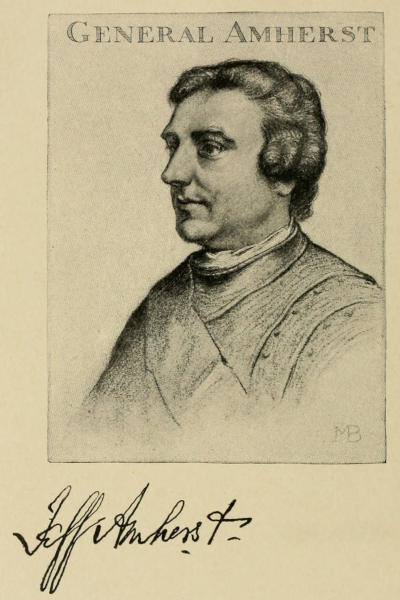
JEFFREY AMHERST
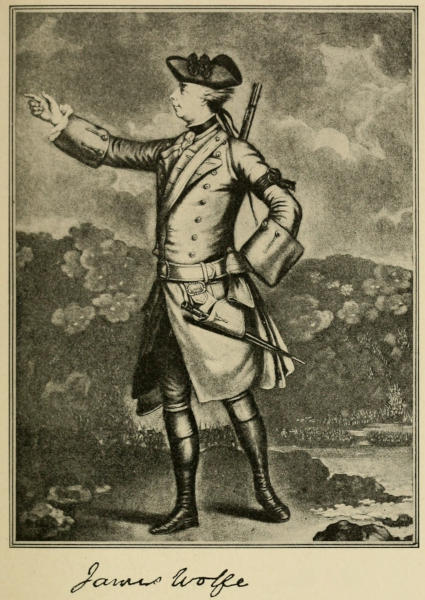
JAMES WOLFE
After that the rest of the task was simple enough. The next year Montreal was yielded up, all Canada passed into the hands of the English, and the war was practically over. There were yet three more years to wait before formal peace should be concluded, because the nations of Europe did not decide their affairs by the issue of battles and sieges in America; but for the English colonies the great struggle was ended. By the formal peace, signed in 1763, at Paris, England gained Canada, Nova Scotia, Cape Breton Island, and all the islands of the Gulf of St. Lawrence, the river and harbor of Mobile, and all the disputed lands of the continent, north and south, between the eastern mountain ranges and mid-stream of the Mississippi, except New Orleans,—besides the free navigation of the great river. From Spain she got Florida. France had the year before (1762) ceded to Spain her province of “Louisiana,” the great region beyond the Mississippi, whose extent and boundaries no man could tell. She was utterly stripped of her American possessions, and the English might look forward to a new age in their colonies.
The general authorities for the condition of the country and the movement of affairs during this period are the well known histories of Bancroft, Hildreth, and Bryant; the third volume of J. A. Doyle’s English Colonies in America; the third volume of J. G. Palfrey’s Compendious History of New England; W. B. Weeden’s Economic and Social History of New England; Mr. Barrett Wendell’s Cotton Mather; Mr. Eben G. Scott’s Development of Constitutional Liberty in the English Colonies of America; C. W. Baird’s Huguenot Emigration to America; James Russell Lowell’s New England Two Centuries Ago, in his Among My Books; Mr. Brooks Adams’s [97]Emancipation of Massachusetts; Madame Knight’s Journal (1704); John Fontaine’s Diary, in the Memoirs of a Huguenot Family; and Benjamin Franklin’s Autobiography.
A more particular account of many of the transactions that fell within the period may be found in Justin Winsor’s New England, 1689-1763, in the fifth volume of Winsor’s Narrative and Critical History of America; Berthold Fernow’s Middle Colonies, Justin Winsor’s Maryland and Virginia, and William J. Rivers’s The Carolinas, in the same volume of Winsor; Charles C. Smith’s The Wars on the Seaboard: Acadia and Cape Breton, and Justin Winsor’s Struggle for the Great Valleys of North America, in the same volume of Winsor.
The chief authorities for the settlement and early history of Georgia are Bancroft, Hildreth, and Bryant; Charles C. Jones’s History of Georgia and English Colonization of Georgia in the fifth volume of Winsor’s Narrative and Critical History of America; W. E. H. Lecky’s History of England in the Eighteenth Century; Alexander Hewatt’s Historical Account of the Rise and Progress of the Colonies of South Carolina and Georgia, in Carroll’s Historical Collections of South Carolina; the first and second volumes of Peter Force’s Tracts and Other Papers relating to the Colonies in North America; and the Colonial Acts of Georgia.
[98]
No one who marked how the English colonies had grown, and how the French had lagged in the effectual settlement and mastery of the regions they had taken, could wonder that in the final struggle for supremacy the English had won and the French lost everything there was to fight for. The French had been as long on the continent as the English, and yet they did not have one-tenth the strength of the English, either in population or in wealth, when this war came. There were fifty-five thousand white colonists in Canada, all told; and only twenty-five thousand more in all the thin line of posts and hamlets which stretched from the St. Lawrence through the long valley of the Mississippi to the Gulf,—eighty thousand in all. In the English settlements there were more than a million colonists (1,160,000), not scattered in separated posts set far apart in the forested wilderness, but clustered thick in towns and villages, or in neighborly plantations, where the forest had been cleared away, roads made, and trade and peace established. The English had been seeking, not conquest, but comfort and wealth in busy centres and populous country-sides, where their life now ran as strong and as calm, almost, as if they were still in the old lands of England itself. The French, [99]on the contrary, were placed where their government wished them to be; could hardly be said to have formed independent communities at all; and were glad if they could so much as eke out a decent subsistence from the soil, or from food brought by ship from France over sea. The English spread very slowly, considering how fast they came, and kept in some sort a solid mass; but the result was that they thoroughly possessed the country as they went, and made homes, working out a life of their own. The French merely built frontier posts, the while, on the lakes and rivers, as they were bidden or guided or exhorted by their governors; took up such land as was assigned them by royal order; did their daily stint of work, and expected nothing better. They were, moreover, painfully, perilously isolated. Ships could come from England to any part of the English coasts of America in five weeks, whereas it was a good six months’ journey from France to the frontier posts upon the lakes or by the far-away western rivers. The St. Lawrence was closed for nearly half the year by ice; and it was a weary task to get any boat up the stream of the endless Mississippi against its slow tide of waters and through the puzzling, shifting channels of its winding course.
The Marquis Duquesne had called the Iroquois to a council in 1754, ere he left his governorship, and had commended his sovereign’s government to them because of this very difference between French and English. “Are you ignorant,” he said, “of the difference between the King of England and the King of France? Go, see the forts that our King has established, and you will see that you can still hunt under their very walls. They have been placed for your advantage [100]in places which you frequent. The English, on the contrary, are no sooner in possession of a place than the game is driven away. The forest falls before them as they advance, and the soil is laid bare so that you can scarce find the wherewithal to erect a shelter for the night.” Perhaps Duquesne, being a soldier and no statesman, did not realize all that this difference meant. The French posts, with the forests close about them, were not self-supporting communities such as everywhere filled the English dominion. Their governors were soldiers, their inhabitants a garrison, the few settlers near at hand traders, not husbandmen, or at best mere tenants of the crown of France. No doubt it was easier for the savages to approach and trade with them; but it would turn out to be infinitely harder for the French to keep them. Their occupants had struck no deep rootage into the soil they were seated upon, as the English had.
Englishmen themselves had noted, with some solicitude, how slow their own progress was away from the sea-coast. It was not until 1725 that settlers in Massachusetts had ventured to go so far away from the Bay as the Berkshire Hills. “Our country has now been inhabited more than one hundred and thirty years,” exclaimed Colonel Byrd, of Virginia, in 1729, “and still we hardly know anything of the Appalachian Mountains, that are nowhere above two hundred and fifty miles from the sea. Whereas the French, who are later comers, have ranged from Quebec southward as far as the mouth of the Mississippi, in the Bay of Mexico, and to the west almost as far as California, which is either way above two thousand miles.” But Colonel Byrd was thinking of discovery, not of settlement; [101]the search for minerals and the natural wealth of the forests, not the search for places to which to extend permanent homes and government. The difference arose out of the fundamental unlikeness of French and English, both in life and in government.
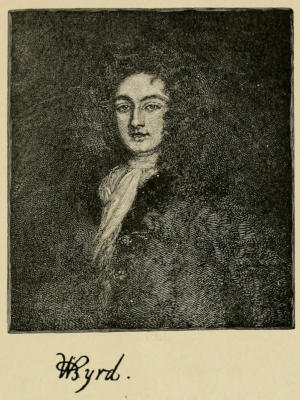
WILLIAM BYRD
The statesmen of both France and England accepted the same theory about the use colonies should be put to,—the doctrine and practice everywhere accepted in their day. Colonies were to be used to enrich the countries which possessed them. They should send their characteristic native products to the country which had established them, and for the most part to her alone, and should take her manufactures in exchange; trade nowhere else to her disadvantage; and do and make nothing which could bring them into competition with her merchants and manufacturers. But England applied this theory in one way, France in another. It was provoking enough to the English colonists in America to have, in many a petty matter, to evade the exacting Navigation Acts, which restricted their trade and obliged them to buy manufactured goods [102]at prices fixed by the English merchants. It a little cramped and irritated them that they were forbidden to manufacture now this and now that, though the material lay at their very doors, because English manufacturers wished their competition shut out. Restriction was added to restriction. In 1706, naval stores and rice, which the Carolinas were learning to produce to their increasing profit, were added to the list of products which must be sent to England only; and in 1722 copper and furs. In 1732 the manufacture of beaver hats was forbidden, and in 1750 the maintenance of iron furnaces or slit mills. But there was always an effort made at reciprocal advantage. Though the colonies were forbidden to manufacture their iron ores, their bar and pig iron was admitted into England free of duty, and Swedish iron, which might have undersold it, was held off by a heavy tariff, to the manifest advantage of Maryland and Virginia. Though the rice of the Carolinas for a time got admission to market only through the English middlemen, their naval stores were exported under a heavy bounty; and in 1730, when the restriction laid on the rice trade pinched too shrewdly, it was removed with regard to Portugal, the chief European market open to it. Parliament had generally an eye to building up the trade of the colonies as well as to controlling it.
[103]
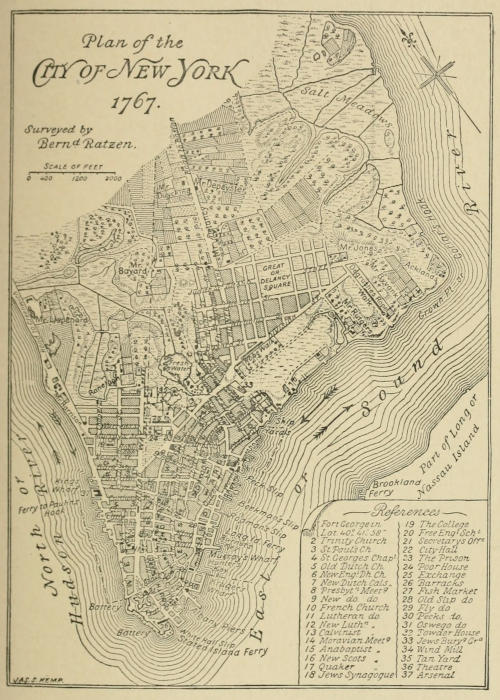
Plan of the City of New York 1767.
[104]
The home government, moreover, though it diligently imposed restrictions, was by no means as diligent in enforcing them. An ill-advised statute of 1733 laid prohibitory duties on the importation of sugar, molasses, and rum out of the French West Indies, in the hope that the sales of sugar and molasses in the islands owned by England might be increased. To enforce the act would have been to hazard the utter commercial ruin of New England. Out of the cheap molasses of the French islands she made the rum which was a chief source of her wealth,—the rum with which she bought slaves for Maryland, Virginia, and the Carolinas, and paid her balances to the English merchants. But no serious attempt was made to enforce it. Customs officers and merchants agreed in ignoring it, and officers of the crown shut their eyes to the trade which it forbade. Smuggling upon that long coast was a simple matter, and even at the chief ports only a little circumspection was needed about cargoes out of the Indies.
Moreover, the men who governed in England contented themselves with general restrictions and did not go on to manage the very lives of the colonists in the colonies themselves. That was what the French did. They built their colonies up by royal order; sent emigrants out as they sent troops, at the King’s expense and by the King’s direction; could get only men to go, therefore, for the most part, and very few women or families. For the English there was nothing of the sort, after the first. Rich men or great mercantile companies might help emigrants with money or supplies or free gifts of land in order to fill up the colonies which the crown had given them the right to establish and govern; but only those went out who volunteered. Emigrants went, moreover, in families, after the first years were passed and the colonies fairly started, if not at the very outset of the enterprise,—in associated groups, congregations, and small volunteer communities. When they reached the appointed place of settlement they were left to shift for themselves, as they had expected, exactly as they would have been at home; [105]and they insisted upon having the same rights and freedom they would have had there. They were making homes, without assistance or favor, and for their own use and benefit.
It was inevitable in the circumstances that their colonial governments should be like themselves, home-made and free from control in the management of what chiefly concerned their own lives. They were just as hard to supervise and regulate when the settlements were small as when they grew large and populous,—a little harder, indeed, because the colonists were the more anxious then about how the new life they were beginning was to go, and the less sure of their power or influence to resist the efforts of the crown to manage and interfere with them. By the time the French war came there was no mistaking the fact that the English colonies had grown to be miniature states, proud, hard-fibred, independent in temper, practised in affairs. They had, as Edmund Burke said, “formed within themselves, either by royal instruction or royal charter, assemblies so exceedingly resembling a parliament, in all their forms, functions, and powers, that it was impossible they should not imbibe some opinion of a similar authority.” At first, no doubt, their assemblies had been intended to be little more than the managing bodies of corporations. “But nothing in progression can rest on its original plan. We may as well think of rocking a grown man in the cradle of an infant. Therefore, as the colonies prospered and increased to a numerous and mighty people, spreading over a very great tract of the globe, it was natural that they should attribute to assemblies so respectable in their formal constitution some part of the dignity of the great nations [106]which they represented.” They “made acts of all sorts and in all cases whatsoever. They levied money upon regular grants to the crown, following all the rules and principles of a parliament, to which they approached every day more and more nearly.” And Burke saw how inevitable, as well as how natural, the whole growth [107]had been. “Things could not be otherwise,” he said; “English colonies must be had on these terms, or not had at all.”
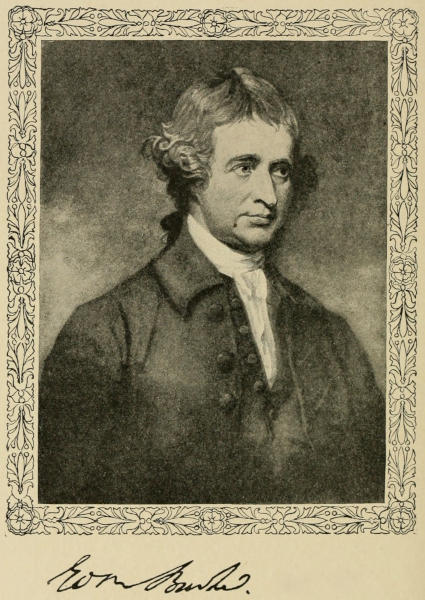
EDMUND BURKE
They had used their governments for their own purposes, and rather like independent states than like dependent communities. In every colony the chief point of conflict between governor and assembly, whether in the proprietary or in the crown colonies, had always been connected with the subject of salaries. Again and again governors had been instructed to insist upon an adequate income, charged permanently upon some regular source of public revenue; but again and again, as often as made, their demand had been refused. They could get only annual grants, which kept all officers of the crown dependent upon the people’s assemblies for maintenance while in office. There had long been signs that the ministers of the King and the proprietors at home were tired of the contest, and meant, for the mere sake of peace, to let the colonial assemblies alone, to rule, as Parliament ruled, by keeping control of the moneys spent upon their own governments.
There was, too, more and more money in the colonies as the years went by. New England, where, except in the rich valley of the Connecticut, the soil yielded little beyond the bare necessaries of life, led the rest of the colonies in the variety of her industries. Though parliamentary statutes forbade the making of woollen goods or hats or steel for export, the colonists were free to make anything they might need for use or sale within a single colony or in their own homes; and the thrifty New England farmers and villagers made most of their own furniture, tools, and household utensils, while their women or the village weavers wove the linen and [108]woollen stuffs of which their clothes were made. They lived upon their own resources as no other colonists did. And their trade kept six hundred vessels busy plying to and fro to English and foreign ports. Almost every sea-coast hamlet was a port and maintained its little fleet. A thousand vessels, big and little, went every year to the fisheries, or up and down the coasts carrying the trade between colony and colony. A great many of these vessels the colonists had built themselves, out of the splendid timber which stood almost everywhere at hand in their forests; and every one knew who knew anything at all about New England that her seamen were as daring, shrewd, and hardy as those bred in past generations in the Devonshire ports of old England. Their boats flocked by the hundreds every year to the misty, perilous banks of Newfoundland, where the cod were to be caught. They beat up and down the long seas in search of the whale all the way from “the frozen recesses of Hudson’s Bay and Davis’s Straits” to the coasts of Africa and Brazil, far in the south. “Neither the perseverance of Holland, nor the activity of France, nor the dexterous and firm sagacity of English enterprise,” exclaimed Burke, “ever carried this most perilous mode of hardy industry to the extent to which it has been pushed by this recent people,—a people who are still, as it were, but in the gristle, and not yet hardened into the bone, of manhood.”
Massachusetts had been known, while peace held and men breathed freely, between Queen Anne’s and King George’s wars, to complete one hundred and fifty ships in a single year, every town upon the coast and even little villages far within the rivers launching vessels [109]from busy shipyards. Ship building became New England’s chief industry; and in 1724 the master builders of the Thames prayed Parliament for protection against the competition of the colonies. The annual catch of whale and cod by the New Englanders was worth two hundred and fifty thousand pounds sterling; and, besides fish and fish-oil, they shipped their fine timber, and not a little hay and grain even, across the sea or to the other colonies. Everywhere in America the forests yielded splendid timber, as his Majesty’s ministers well knew: for they sent into the northern forests of pine and had the tallest, straightest trees there marked with the royal arms, as a notice that they were reserved to be used as masts for his Majesty’s war-ships,—as if the King had a right to take what he would.
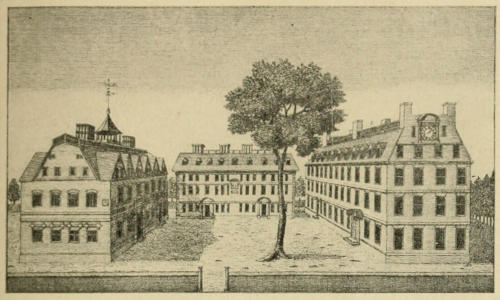
VIEW OF THE BUILDINGS BELONGING TO HARVARD COLLEGE, CAMBRIDGE, NEW ENGLAND, 1726
“New England improved much faster than Virginia,” Colonel Byrd admitted; and yet Virginia had her own rich trade, of which tobacco was the chief staple; and [110]all the colonies busied themselves as they could, and visibly grew richer year by year. The middle colonies were scarcely less industrious than those of the bleaker north, and prospered even more readily with their kindlier climate and their richer soil. Pennsylvania, with her two hundred and twenty thousand colonists, with her thrifty mixture of Germans, Quakers, Scots, and Scots-Irishmen, needed a fleet of four hundred sail to carry each season’s spare produce from the docks at Philadelphia; and New York had her separate fleet of close upon two hundred sail.
England depended upon the colonies for much of the naval stores, of the potash, and of the pearlash which she needed every year. Mines of iron and of copper had been opened both in the middle colonies and in the south. The colonists made their own brick for building, and their own paper and glass, as well as their own coarse stuffs for clothing, and many of their own hats of beaverskin. Substantial houses and fine, sightly streets sprang up in the towns which stood at the chief seaports; and in the country spacious country seats, solidly built, roomy, full of the simpler comforts of gentlefolk. The ships which took hides and fish and provisions to the West Indies brought sugar and molasses and wine and many a delicacy back upon their return, and the colonists ate and drank and bore themselves like other well-to-do citizens the world over. They were eager always to know what the London fashions were; there was as much etiquette to be observed upon quiet plantations in Virginia as in English drawing rooms. It was, indeed, touched with a certain beauty of its own, because of the provincial simplicity and frank neighborliness which went [111]along with it; but it was grave and punctilious, and intended to be like London manners. There was as much formality and gayety “in the season” at Williamsburg, Virginia’s village capital, as in Philadelphia, the biggest, wealthiest, most stately town in the colonies.
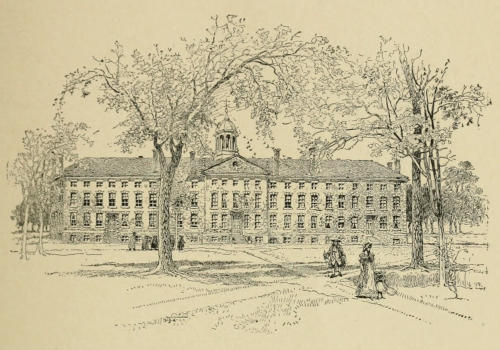
NASSAU HALL, PRINCETON COLLEGE, 1760
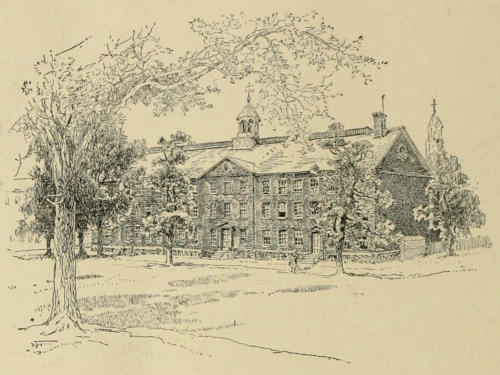
KING’S COLLEGE, NEW YORK, 1758
There were many ways in which the colonies finished and filled out their lives which showed that they regarded themselves as in a sense independent communities and meant to provide for themselves everything they needed for their life alone on a separate continent. They had no thought of actually breaking away from their allegiance to the home government over sea; but no man could possibly overlook the three thousand miles of water that stretched between England and America. At that immense distance they were obliged in great measure to look out for themselves and contrive [112]their own ways of sustenance and development, and their own way of culture. Before the French war began, two more colleges, in addition to Harvard in Massachusetts and William and Mary in Virginia, had been established to provide the higher sort of training for youths who were to enter the learned professions. Besides Yale, the College of New Jersey had been founded. At first set up in 1746 as a collegiate school, at Elizabethtown, it was in 1756 given a permanent home and built up into a notable training place for youth at Princeton. In 1754, the year Washington attacked the French in the western forests, King’s College was added to the growing list, in New York, by royal charter. Ten years later (1764), upon the very morrow of the signing of peace, certain public-spirited men of the Baptist communion followed suit in Rhode Island by founding the school which was afterwards to be called Brown University. Here were six colleges for this new English nation at the west of the Atlantic. Many wealthy [113]colonists, particularly in the far south, continued to send their sons to the old country to take their learning from the immemorial sources at Oxford and Cambridge; but more and more the colonies provided learning for themselves.
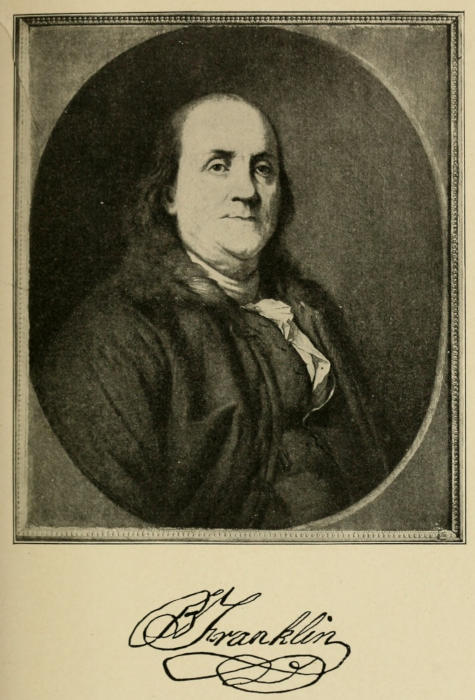
BENJAMIN FRANKLIN
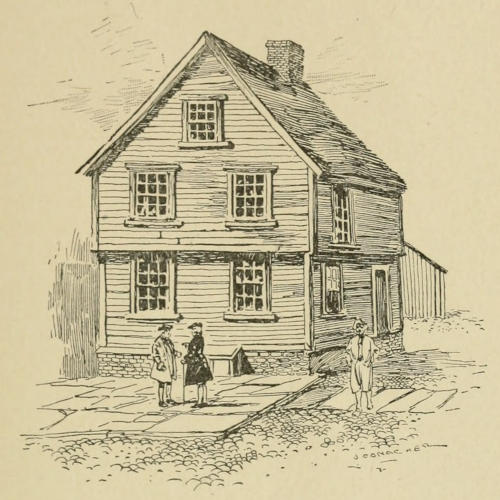
THE BIRTHPLACE OF BENJAMIN FRANKLIN, MILK STREET, BOSTON
Their growing and expanding life, moreover, developed in them the sense of neighborhood to one another, the consciousness of common interests, and the feeling that they ought in many things to coöperate. In 1754, while the first sharp note of war was ringing from the Alleghanies, a conference with the Six Nations was held at Albany, which, besides dealing with the redmen, and binding them once more to be friends and allies of the English against the French, considered [114]nothing less than a plan of union for the colonies. This was the fourth time that the representatives of several colonies at once had come together at Albany to confer with the Iroquois. The first conference had taken place there in 1689, the year King William’s War began. Albany lay nearest the country of the Iroquois. It was necessary when war was afoot to make sure that the redskins should side with the English, and not with the French; and that was now for the fourth time, in 1754, more critically important than ever. The home government had directed that the conference be held, before they knew what Washington had done. It was the ministers in London, too, who had directed that a plan of union be considered, in order that the colonies might act in concert in the coming struggle with the French, and if possible under a single government even. Seven colonies were represented at the conference. Twenty-five delegates were there to take part in the business; and there was no difficulty about securing their almost unanimous assent to a plan of union. They adopted the plan which Mr. Benjamin Franklin, one of Pennsylvania’s delegates, had drawn up as he made the long journey from Philadelphia.
Mr. Franklin had led a very notable life during the thirty eventful years which had gone by since he made his way, a mere lad, from Boston to Philadelphia to earn his livelihood as a journeyman printer; and how shrewd a knowledge he had gained of the practical affairs of the world anybody could see for himself who would read the homely-wise maxims he had been putting forth these twenty-two years in his “Poor Richard’s” Almanacs, begun in 1732. The plan of union he suggested at Albany was, that the colonies should submit [115]to have their common interests cared for by a congress of delegates chosen by their several assemblies, and a “president-general” appointed and paid by the crown; giving to the congress a considerable power of actual law-making and to the president-general the right to veto its acts, subject to the approval of the ministers at [116]home. To all the delegates at Albany except those from Connecticut the plan seemed suitable and excellent; but the ministers at home rejected it because they thought it gave too much power to the proposed congress, and the colonial assemblies rejected it because they thought it gave too much power to the president-general. Mr. Franklin said that the fact that neither the assemblies nor the King’s ministers liked the plan made him suspect that it must be, after all, an excellent half-way measure, the “true medium” between extremes, effecting a particularly fair and equal distribution of power.
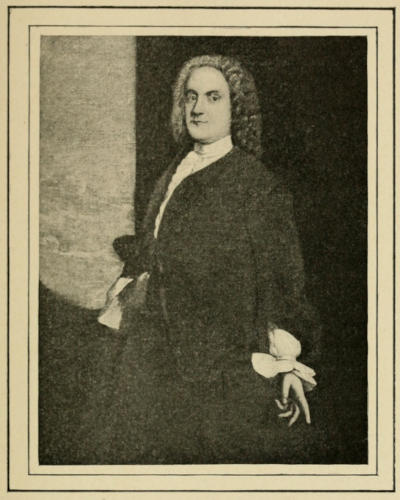
BENJAMIN FRANKLIN
Then the war came, and made many things plain. The colonies did not coöperate. They contributed troops, watched their own frontiers as they could against the redskins, and freely spent both blood and money in the great struggle; but when it was all over, and the French dominion swept from the continent, it was plain that it had not been the power of the colonies but the power of England and the genius of the great Pitt that had won in the critical contest. France could send few reinforcements to Canada because England’s ships commanded the sea. The stout Canadians had had to stand out for themselves unaided, with such troops as were already in the colony. In 1759, the year Wolfe took Quebec, there were more soldiers in the English colonies threatening the St. Lawrence than there were men capable of bearing arms in all Canada,—and quite half of them were regulars, not provincials. Pitt saw to it that enough troops and supplies were sent to America to insure success, and that men capable of victory and of efficient management even in the forested wilderness were put in command of affairs [117]in the field. He did not depend upon the colonies to do what he knew they had no plan or organization for doing, but set himself to redress the balance of power in Europe by decisive victories which should make England indisputable mistress of America. “No man [118]ever entered Mr. Pitt’s closet who did not find himself braver when he came out than when he went in,” said a soldier who had held conference with him and served him; and it was his statesmanship and his use of English arms that had made England’s dominion complete and England’s colonies safe in America.
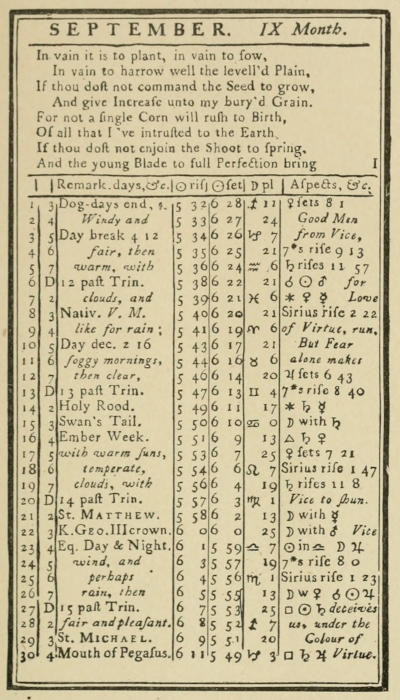
A PAGE OF “POOR RICHARD’S” ALMANAC
[119]
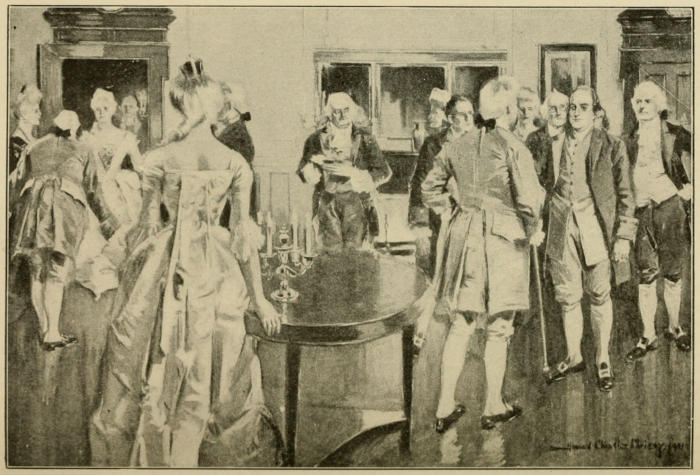
BENJAMIN FRANKLIN IN A COLONIAL DRAWING ROOM
English fleets and armies had not been sent to America, however, and equipped for warfare there, sustained in war season and out of it, without enormous expense; and that expense, which had set the colonies free to live without dread of danger or of confinement at any border, England had borne. It had been part of Mr. Franklin’s plan of union, proposed at Albany, that the congress of the colonies should sustain the armies used in their defence and pay for them by taxes levied in America; but that plan had been rejected, and this war for the ousting of the French had been fought at England’s cost,—much as the colonies had given of their own blood, and of their own substance for the equipment of their provincial levies, and much as they had suffered in all the obscure and painful fighting to protect their frontiers against the redskins, far away from set fields of battle. They had done more, indeed, than pay the costs which inevitably fell to them. They had “raised, paid, and clothed twenty-five thousand men,—a number,” if Mr. Franklin was right, “equal to those sent from Great Britain and far beyond their proportion. They went deeply in debt in doing this; and all their estates and taxes are mortgaged for many years to come in discharging that debt.” Parliament had itself acknowledged their loyal liberality and self-sacrifice, and had even voted them £200,000 a year for five years, when the war was over, by way of just reimbursement. [120]But, though they had made sacrifices, they had, of course, not shared with the royal treasury the chief outlays of the war. Colonial governors, viewing affairs as representatives of the government at home, had again and again urged the ministers in London to tax the colonies, by act of Parliament, for means to pay for frontier forts, armies of defence, and all the business of imperial administration in America. But the ministers had hitherto known something of the temper of the colonists in such matters and had been too wise to attempt anything of the kind. Sir George Keith, who had been governor of Pennsylvania, had suggested to Sir Robert Walpole that he should raise revenue in the colonies; but that shrewd politician and man of affairs had flatly declined. “What,” he exclaimed, “I have old England against me, and do you think I will have New England likewise?” Chatham had held the same tone. What English armies did in America was part of England’s struggle for empire, for a leading station in power and riches in the world, and England should pay for it. The desire of the colonies to control their own direct taxes should be respected. English statesmen, so far, had seen the matter very much as observant Colonel Spotswood had seen it thirty odd years ago. If the ministers should direct moneys to be paid by act of Parliament, he said, “they would find it no easy matter to put such an act into execution”; and he deemed it “against the right of Englishmen,” besides, “to be taxed, but by their representatives,”—new colonist though he was, and only the other day a governor of the crown in Virginia, the oldest and most loyal of the colonies.
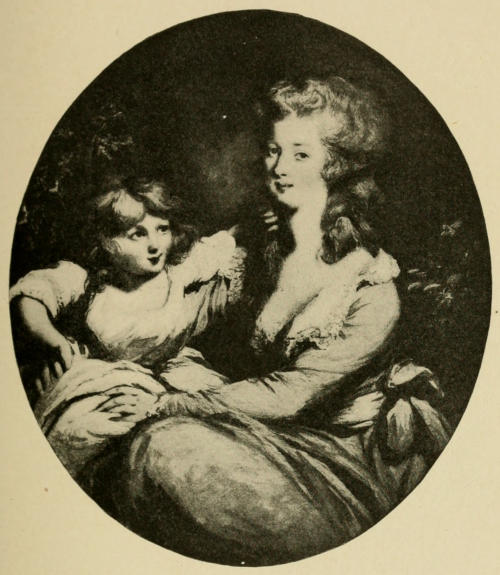
MRS. BENEDICT ARNOLD AND CHILD
It was now more than forty years since Colonel Spotswood, [121]in the days of his governorship, had ridden to the far summit of the Alleghanies and looked down their western slopes towards the regions where England and France were to meet. Since that day he had served the crown very quietly as postmaster general for the colonies. At last he had died (1740) when on [122]the eve of sailing with Virginian troops for Cartagena, about to return at the very end of his days to his old calling of arms. He had lived thirty years in Virginia, all told, and spoke out of abundant knowledge when he expressed a judgment as to what the ministers would find it hard to do in the colonies. He knew, as every man did who had had anything to do with the service of the crown in America, how stubbornly the colonists had resisted every attempt to unite their governments under a single governor or any single system, and how determined they had been to keep their governments in their own hands, notwithstanding they must have seen, as everybody else saw, the manifest advantage of union and a common organization in the face of England’s rivals in America, north and south. The King’s object in seeking to consolidate the more northern colonies under Sir Edmund Andros, whom New England had so hated, was not to attack their liberties, but “to weld them into one strongly governed state,” such as should be able to present a firm front to the encroachments of the French,—a statesmanlike object, which no man who wished to serve the interests of English empire could reasonably criticise. But the colonists had not cared to regard their little commonwealths as pieces of an empire. They regarded them simply as their own homes and seats of self-government; and they feared to have them swallowed up in any scheme of consolidation, whatever its object. The French war, consequently, had been fought by the government in England, and not by any government in America.
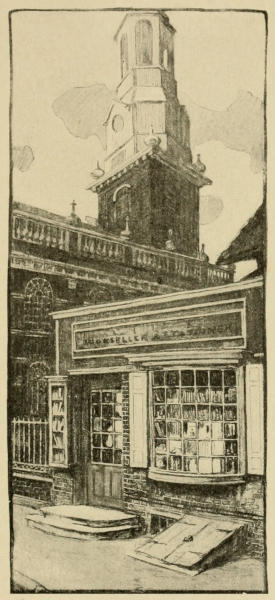
FRANKLIN’S OLD BOOK-SHOP, NEXT TO CHRIST’S CHURCH, PHILADELPHIA
Though a few statesmen like Walpole had had the sagacity to divine it, and all leaders in party counsels [123]had instinctively feared it, very few public men in England understood the temper or the unchangeable resolution of the colonies in such matters. Pitt understood it, but now that the war was over he was no longer suffered to be master in affairs. Burke understood it, but few heeded what he said. Such men knew by instant sympathy that this seemingly unreasonable temper of the colonists in great affairs was nothing else than the common English spirit of liberty. The colonists were simply refusing, as all Englishmen would have refused, to be directly ruled in their own affairs, or directly taxed for any purpose whatever, [124]by a government which they themselves had no part in conducting; and, whether reasonable or unreasonable, so long as they remained Englishmen it was useless to try to argue them out of that refusal. “An Englishman,” cried Burke, “is the unfittest person on earth to argue another Englishman into slavery”; and he knew that to an Englishman it would seem nothing less than slavery to be stripped of self-government in matters of the purse.
Now that the French were driven out, it was more useless than ever to argue the point. The chief and most obvious reason for feeling dependent upon the mother country was gone. Awe of the British was gone, too. The provincial levies raised in the colonies had fought alongside the King’s troops in all the movements of the war, and had found themselves not a whit less undaunted under fire, not a whit less able to stand and fight, not a whit less needed in victory. Braddock had died loathing the redcoats and wishing to see none but the blue cloth of the Virginian volunteers. When the war began, a regular from over sea had seemed to the colonists an unapproachable master of arms; but the provincials knew when the war was over that the redcoats were no better than they were. They had nothing to remember with mortification except the insulting contempt some of the British officers had shown for them, and the inferior rank and consideration their own officers had been compelled to accept.
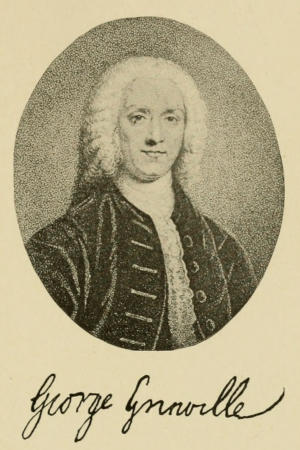
GEORGE GRENVILLE
It was the worst possible time the home government could have chosen in which to change its policy of concession towards the colonies and begin to tax and govern them by act of Parliament; and yet that was exactly [125]what the ministers determined to do. No master of affairs or of men, like Walpole or Pitt, was any longer in a place of guiding authority in London. George Grenville was prime minister: a thorough official and very capable man of affairs, of unquestionable integrity, and with a certain not unhandsome courage as of conviction in what he did, but incapable of understanding those who opposed or resisted him, or of winning from them except by an exercise of power. The late war had been no mere “French and Indian” affair for English statesmen. It had been part of that stupendous “Seven Years’ War” which had fixed Prussia in a place of power under the great Frederick, and had changed the whole balance of power in Europe; had brought India under England’s widening dominion on one side of the world and America on the other,—had been a vast game which the stout little island kingdom had played almost alone against united Europe. It had not been a mere American war. America had reaped the benefits of England’s effort to found an empire and secure [126]it, east and west. And yet the colonists seemed, when this momentous war by which they had so profited was over, to drop into indifference towards everything that remained to be done to finish what had been so well begun, even though it remained to be done at their own very doors.
France had ceded to England as a result of the war all the vast territory which lay upon the St. Lawrence and between the Mississippi and the eastern mountains, north and south. It was possible to provide a government for the province of Quebec and for the lands in the far south, in Florida and beside the mouths of the Mississippi; but between these lay the long regions which stretched, unsettled, along the great streams which ran everywhere into the Mississippi,—the Illinois country, the country round about the Ohio, the regions by the Cumberland,—all the boundless “back country” which lay directly behind the colonies at the west. The Lords Commissioners for Trade and Plantations in London wished to keep settlers out of these lands, in order that they might be left as a great hunting ground for the Indians, and so remain a permanent source of supply for the fur skins which enriched trade between the mother country and her colonies. But, meanwhile, whether settlers made their way thither or not, it was necessary to carry England’s power among the Indians, and make them know that she, and not the King of France, was now sovereign there. This the Indians were slow to believe. They could not know what treaty-makers in Europe had decided: they did not believe that the French would leave and the English come in in their stead at the western forts; and it moved them hotly to think of such a change. The [127]French had made them welcome at their frontier posts, and did not drive off the game, as Duquesne had told them, ere this fatal war began. The French had been willing to be comrades with them, and had dealt with them with a certain gracious courtesy and consideration; while the English treated them, when they dared, like dogs rather than like men, drove them far into the forests at their front as they advanced their settlements, bullied them, and often cheated them in trade. It was intolerable to the northern Indians to think of these men whom they feared and hated being substituted for the French, with whom they found it at least possible to live.
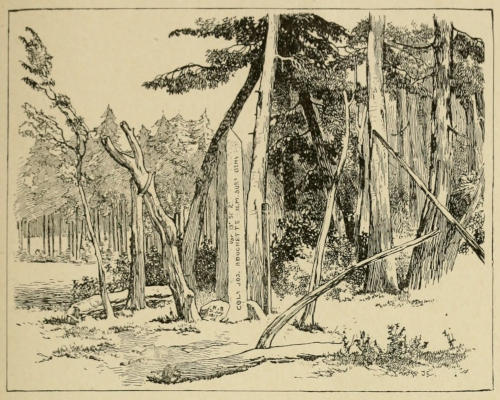
BOUNDARY MONUMENT ON THE ST. CROIX
They were dangerous neighbors, and the danger was near and palpable. The war with the French was [128]hardly over when English settlers began to pour across the Alleghanies from Pennsylvania, Maryland, and Virginia,—men of the stern and sober Scots-Irish breeding for the most part, masterful and imperious, and sure to make the lands they settled upon entirely their own. There were already tribes among the Indians in the northwest who had been driven out of Pennsylvania by the earlier movements of these same people, and who had taken with them to their new homes the distress and the dread of exile. It were fatal, they knew, to wait. If the English were ever to be driven within the barriers of the Alleghanies again, it must be done now, and all the tribes must rally to the desperate business.
They found a leader in Pontiac, a chief of the Ottawas. A dozen powerful tribes heeded him when he counselled secret confederacy, and, when all should be ready, sudden war; and the English presently had reason to know how able an enemy they had to fear,—a man of deep counsel, astute and masterful. In June, 1763, the first blow was struck,—from end to end of the open border,—even the Senecas, one of the Six Nations, joining in the bitter work. Every frontier fort except Detroit, Niagara, and Pitt was in their hands at the first surprise: smoking ruins and the bodies of white men slain marked all the borders where the French had been. The English rallied, stubborn and undaunted. Three forts at least were saved. There were men at hand like Colonel Bouquet, the gallant officer who went to the relief of Fort Pitt, who knew the strategy of the forest as well as the redskins did, and used steadfast English, not fickle savages, in the fighting; and, though the work was infinitely hard [129]and perilous and slow in the doing, within two years it was done. Before the year 1765 was out, Pontiac had been brought to book, had acknowledged himself beaten, and had sued for peace.
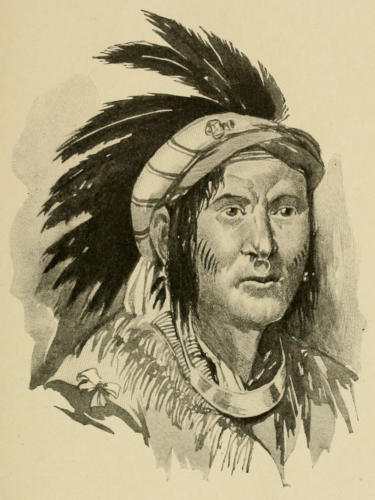
PONTIAC, CHIEF OF THE OTTAWAS
But by that time the English ministers knew the nature of the task which awaited them in America. It was plain that they must strengthen the frontier posts and maintain a force of soldiers in the colonies, if English power was to be safe there, and English [130]lives. Not fewer than twenty thousand men would be needed; and it would be necessary to organize government, civil as well as military, in a more effective way. It might be necessary to pay the colonial judges and even the colonial governors out of the general treasury of the empire, rather than leave them always dependent upon the uncertain grants of the colonial legislatures. The new plans would, taken all together, involve, it was reckoned, the expenditure of at least £300,000 a year. Mr. Grenville, now at the head of the government in England, was a lawyer and a man of business. “He took public business not as a duty which he was to fulfil, but as a pleasure he was to enjoy,” and, unfortunately, he regarded American affairs as ordinary matters of duty and of business. England had spent £60,000,000 sterling to put the French out of America; £140,000,000 had been added to the national debt. Her own sources of revenue were quite run dry. Mr. Grenville and his colleagues did not know where else to turn for another penny, if not to America. They therefore determined that, since heavy additional expenditures must be undertaken for the proper administration and defence of the colonies, America must be made to supply at least a part of the money to meet them. Not all of it. It was the ministers’ first idea to raise only £100,000 out of the £300,000 by taxes directly derived from the colonies: and every farthing of that, with twice as much more, was to be spent, of course, in America. The money was none of it to cross the sea. It was to remain in the colonial treasuries until expended for colonial administration and defence.
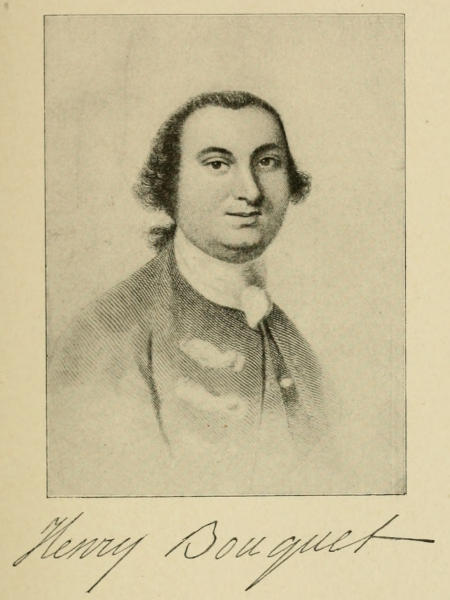
HENRY BOUQUET
Some men there were in England who were far-sighted [131]enough to see what this new policy would lead to; but Grenville did not, and Parliament did not. In March, 1764, therefore, upon the introduction of his annual budget, the prime minister introduced a bill, which was passed, laying fresh and more effective taxes on wines, sugar, and molasses imported into the colonies, tightening and extending the old Navigation Acts, [132]and still further restraining manufactures; and at the same time announced that he would, the next year, propose a moderate direct tax upon the colonies in the form of an act requiring revenue stamps to be used on the principal sorts of documents employed in America in legal and mercantile business.
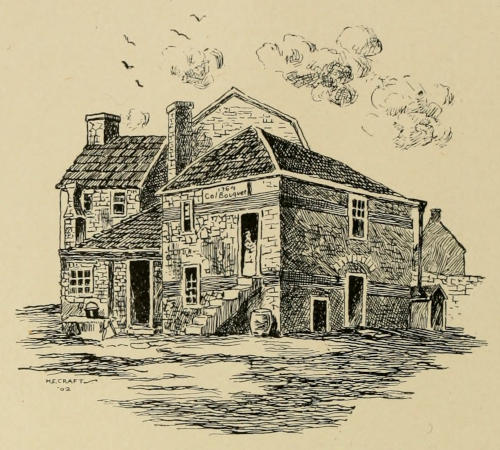
BOUQUET’S REDOUBT AT PITTSBURG
Mr. Grenville had no desire to irritate the Americans. He thought they might protest; he never dreamed they would disobey. He was, no doubt, surprised when he learned how hot their protests were; and when his Stamp Act the next year became law, their anger and flat defiance must have seemed to him mere wanton rebellion. He introduced the Stamp Act with his budget of 1765. The Commons gave only a single sitting to the discussion of its principles; passed it almost without opposition; and by the 22d of March it was law. [133]A few members protested. Colonel Barré, standing there in his place, square, swarthy, a soldier from the field, that staring wound upon his face which he had taken where Wolfe died, on the Plains of Abraham, told the ministers very flatly that the colonists, whom he had seen and fought for, owed to them neither the planting nor the nourishing of their colonies, had a [134]liberty they had made for themselves, were very jealous of that liberty, and would vindicate it. Benjamin Franklin was in London to make protest for Pennsylvania; and the agents of the other colonies were as active as he, and as ready to promise that the colonial legislatures would themselves grant out of their own treasuries more than the Act could yield, if only they were left to do it in their own way. Mr. Franklin had pointed out in very plain terms how sharp a departure there was in such measures from the traditional dealings of the crown with the colonies, how loyal they had been in granting supplies when required, and how ill a new way of taxation would sit upon the spirits of the colonists. But the vote for the bill was five to one. Neither the ministers nor the Commons showed the least hesitation or misgiving.
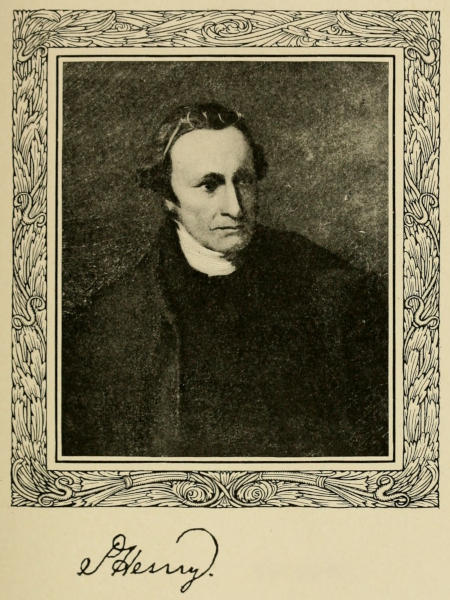
PATRICK HENRY
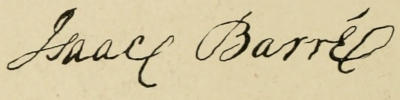
SIGNATURE OF ISAAC BARRÉ
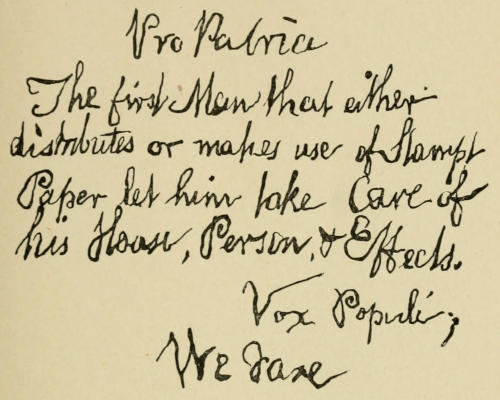
FACSIMILE OF POSTER PLACED ON THE DOORS OF PUBLIC BUILDINGS
The Act operated in America like a spark dropped on tinder. First dismay, then anger, then riot and open defiance, showed what the colonists thought and meant to do. Their own agents in London were as little prepared as the ministers themselves for the sudden passion. They had asked for appointments for their friends as stamp distributers under the Act. Richard Henry Lee, of Virginia, even asked for a place for himself under it, so different a look did things wear in London from that which they wore at home in the Old Dominion. But these gentlemen learned the temper [135]of America, and changed their own, soon enough. The Act was in no way extraordinary or oppressive in its provisions. It required of the colonists only what was already required in respect of business transactions in England: namely, that revenue stamps, of values varying with the character of the transaction or the amount involved, should be attached to all deeds, wills, policies of insurance, and clearance papers for ships, to legal papers of almost every kind, to all written contracts and most of the business papers used by merchants in their formal dealings, and to all periodical publications and advertisements. The colonies themselves had imposed such taxes; in England they had [136]been used since William and Mary, and had proved eminently convenient and easy of collection. Governor Shirley, of Massachusetts, had himself urged that Parliament use them in America, American though he was. Mr. Franklin had taken it for granted, when he saw the Act become law, that they must be submitted to. But America flatly refused obedience, and, except in the newly conquered provinces of Nova Scotia and Canada, the stamps were not used.
The Act was not to go into operation until the 1st of November (1765); but long before the first of November it was evident that it would not go into effect at all. It was universally condemned and made impossible of application. There was instant protest from the colonial assemblies so soon as it was known that the Act was passed; and the assembly of Massachusetts proposed that a congress of delegates from the several colonies be held in October, ere the Act went into effect, to decide what should be done to serve their common interest in the critical matter. The agitations and tumults of that eventful summer were not soon forgot. In August, Boston witnessed an outbreak such as she had never witnessed before. Mr. Andrew Oliver, who had been appointed distributer of the stamps there, was burned in effigy; the house in which it was thought the stamps were to be stored was torn down; Mr. Oliver’s residence was broken into and many of its furnishings were destroyed. He hastily resigned his obnoxious office. Mobs then plundered the house of the deputy registrar of the court of admiralty, destroying his private papers and the records and files of the court,—because the new acts of trade and taxation gave new powers to that court. The house of the comptroller [137]of customs was sacked. Mr. Thomas Hutchinson, the lieutenant-governor of the colony, found himself obliged, on the night of the 26th, to flee for his life; and returned when order was restored to find his home stripped of everything it contained, including nine hundred pounds sterling in money, and manuscripts [138]and books which he had been thirty years collecting. Only the walls and floors of the house remained.
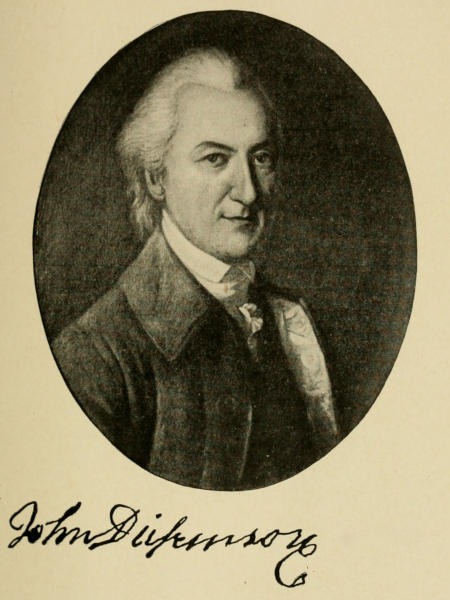
JOHN DICKINSON
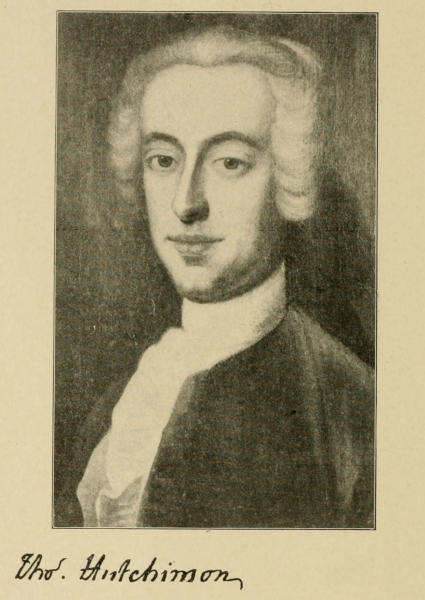
THOMAS HUTCHINSON
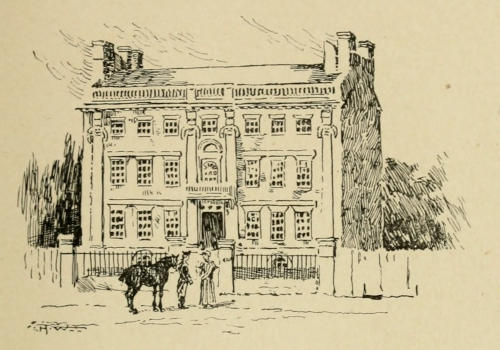
THOMAS HUTCHINSON’S MANSION, BOSTON
There was no violence elsewhere to equal this in Boston. There was tumult everywhere, but in most places the mobs contented themselves with burning the stamp agents in effigy and frightening them into the instant relinquishment of their offices. Not until [139]the autumn came, and the day for the application of the Act, did they show a serious temper again. Then New York also saw a house sacked and its furniture used to feed a bonfire. The people insisted upon having the stamps handed over to their own city officers; and when more came they seized and burned them. At Philadelphia many Quakers and Church of England men, and some Baptists, made as if they would have obeyed the Act; but the mobs saw to it that they should not have the chance. The stamp distributer was compelled to resign, and there was no one from whom stamps could be obtained. Stamp distributers who would not resign found it best to seek safety in flight. There was no one in all the colonies, north or south, who had authority to distribute the hated pieces of stamped paper which the ministers had expected would so conveniently yield them a modest revenue for their colonial expenses. There was a little confusion and [140]inconvenience for a time. The courts hesitated to transact business without affixing the stamps required to their written pleadings; it seemed imprudent to send ships out without stamps on their clearance papers; business men doubted what would come of using no stamps in their transactions. But the hesitation did not last long. Business was presently going forward, in court and out, as before, and never a stamp used!
It was singular and significant how immediately and how easily the colonies drew together to meet the common danger and express a common purpose. Early in October the congress which Massachusetts had asked for came together at New York, the delegates of nine colonies attending. It drew up and sent over sea a statement of the right of the colonies to tax and govern themselves,—as loyal to the King, but not as subject to Parliament,—which arrested the attention of the world. Mr. Grenville and his colleagues were just then, by a fortunate turn of politics at home, most opportunely obliged to resign, and gave place to the moderate Whigs who followed Lord Rockingham (July, 1765), and who thought the protests of the colonies not unreasonable. On the 18th of March, 1766, accordingly, the Stamp Act was repealed,—within a year of its enactment. It was at the same time declared, however, by special declaratory act, that Parliament had sovereign right to tax the colonies, and legislate for them, if it pleased. It was out of grace and good policy, the ministers declared, that the tax was withdrawn; a concession, not of right, but of good feeling; and everybody knew that it was done as much because the London merchants were frightened by the resolution of the American merchants to take no cargoes under the tax as because the colonies had declined to submit. But the results were none the less salutary. The rejoicings in America were as boisterous and as universal as had been the tempest of resentment.
[141]
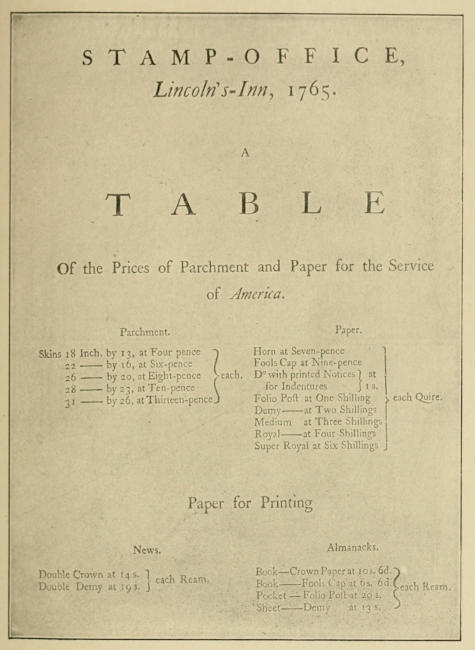
TABLE OF STAMP CHARGES ON PAPER
[142]
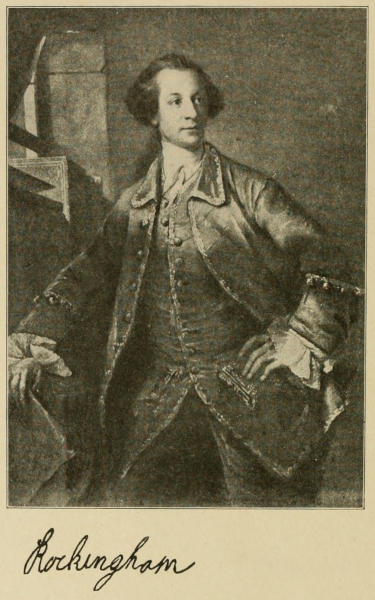
LORD ROCKINGHAM
But that was not the end of the matter. The Stamp Act had suddenly brought to light and consciousness [143]principles and passions not likely to be again submerged, and which it was worth the while of statesmen over sea to look into very carefully. Some there were in England who understood them well enough. Mr. John Adams used to say, long afterwards, that the trouble seemed to him to have begun, not in 1765, but in 1761. It was in that year that all the colonies, north and south, had heard of what James Otis had said in the chief court of the province at Boston against the general warrants, the sweeping writs of assistance, for which the customs officers of the crown had asked, to enable them to search as they pleased for goods brought in from foreign parts in defiance of the acts of trade. The writs were not new, and Mr. Otis’s protest had not put a stop to their issue. It had proved of no avail to say, as he did, that they were an intolerable invasion of individual right, flat violations of principles of law which had become a part of the very constitution of the realm, and that even an act of Parliament could not legalize them. But all the colonies had noted that hot contest in the court at Boston, because Mr. Otis had spoken with a singular eloquence which quickened men’s pulses and irresistibly swung their minds into the current of his own thought, and because it had made them more sharply aware than before of what the ministers at home were doing to fix upon the colonies the direct power of the government over sea. These writs of assistance gave the officers who held them authority to search any place they pleased for smuggled goods, whether private residence or public store-house, with or without reasonable ground of suspicion, and meant that the government had at last seriously determined, at whatever cost, to break up [144]the trade with the West Indies and the Spanish Main. Presently armed cutters were put on the coasts the more effectually to stop it. A vice-admiralty court was set up to condemn the cargoes seized, without a jury. The duties were to be rigorously collected and the trade broken up, for the sake of the sugar growers of the British West Indies and merchants in London.
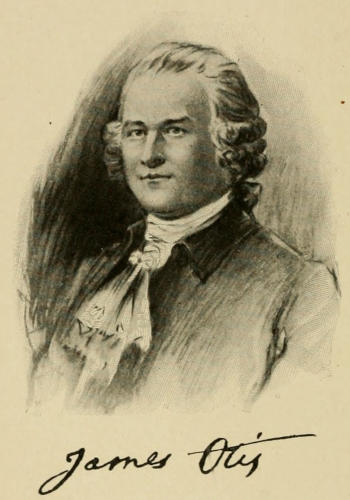
JAMES OTIS
If New England could no longer send her horses, cattle, lumber, casks, and fish to the French islands and the Spanish Main, and bring thence, in exchange for them, sugar and molasses, she must let her ships rot at the wharves and five thousand of her seamen go idle and starve; must seek elsewhere for a market for her chief products; could make no more rum with which to carry on her home trade in spirits or her traffic in slaves on the slave coast; must forego her profits at the southern ports, and go without the convenient bills drawn on exported Virginian tobacco wherewith she had been used to pay her debts to the London merchants. For thirty years and more it had been understood [145]that the duties on that trade were not to be collected; but now, of a sudden, the law was to be carried out by armed vessels, writs of general search, and the summary proceedings of a court of admiralty. In 1764 Mr. Grenville had drawn the lines tighter than ever by a readjustment of duties. That meant ruin; and the Stamp Act was but the last touch of exasperation. The disposition of the ministers seemed all the more obvious because of the obnoxious “Quartering Act” which went along with the Stamp Act. They were authorized by Parliament to quarter troops in the colonies, and by special enactment the colonists were required to provide the troops with lodgings, firewood, bedding, drink, soap, and candles.
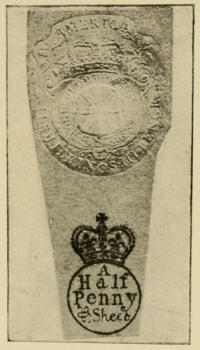
STAMPS FORCED ON THE COLONIES
There were other causes of irritation which touched the colonists almost as nearly. In 1740 the Massachusetts assembly had set up a Land Bank authorized to issue notes based upon nothing but mortgages on land and personal bonds, with surety, given by those who subscribed to its support, and Parliament, at the solicitation of Boston men who knew what certain disaster such a bank would bring upon the business of the colony, had [146]thrust in its hand and suppressed it. The scheme had been in great favor among the men of the country districts, and its suppression by direct act of Parliament had stirred them to a deep resentment. “The Act to destroy the Land Bank scheme,” John Adams declared, had “raised a greater ferment in the province than the Stamp Act did”; and it made the men who had resented it all the readier to take fire at the imposition of the stamp duties. The churches of the province had been deeply alarmed, too, by the effort of English churchmen to establish bishops in America, as if in preparation for a full Establishment; and the clergy were, almost to a man, suspicious of the government. The lumbermen of the forests felt the constant irritation of the crown’s claim to all their best sticks of timber for the royal navy, and were themselves fit fuel for agitation. Each class seemed to have its special reason for looking askance at everything that savored of control from over sea. The measures taken against the trade with the Indies were but the latest item in a growing account.
Massachusetts and the greater trading ports of the south felt the burden of the new policy more than the rest of the country felt it; but thoughtful men everywhere saw what it portended that Parliament should thus lay its hand directly upon the colonies to tax, and in some sort to govern, them. Quite as many men could tell you of the “parson’s case,” tried in quiet Hanover Court House in rural Virginia, as could tell you of Mr. Otis’s speech against the writs of assistance. It meant that the authorities in London were thrusting their hands into the affairs of Virginia just as they were thrusting them into the affairs of Massachusetts. Parson Maury had in that case set up an Order in Council by the ministers at home against an act of the Virginian House of Burgesses determining the value of the currency in which his salary was to be paid, and young Patrick Henry had sprung into sudden fame by declaring to the court very boldly against him that the crown had no right to override the self-government of Virginia.
[147]
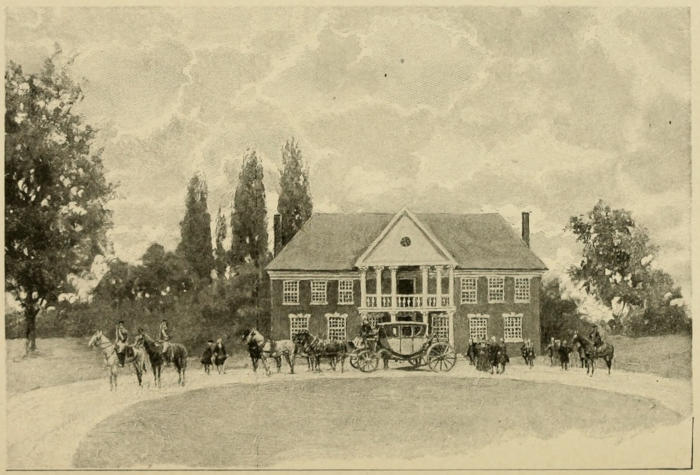
OLD CAPITOL AT WILLIAMSBURG, VIRGINIA
[148]
The eloquence of that famous speech carried the young advocate to the House of Burgesses itself; and it was he who showed the colonies how to speak of the Stamp Act. The burgesses were in session when the news of that hateful law’s enactment reached Virginia. The young member waited patiently for the older members of the House to show the way in the new crisis,—Randolph and Pendleton and Nicholas, Richard Bland and George Wythe,—the men who had framed so weighty a protest and warning and sent so strong a remonstrance over sea only last year against this very measure. But when he saw that they would not lead, he sprang to the task himself, plain, country-bred though he was, and unschooled in that leadership; scribbled his resolutions on the fly-leaf of an old law-book, and carried them with a rush of eloquence that startled and swept the House, and set the tone for all the country.
His resolutions not only declared the right of the colonies to tax themselves to be exclusive, and established beyond recall; they also declared that Virginians were not bound to obey the Parliament when it acted thus against established privilege, and that any one who should advocate obedience was an enemy to the colony. The sober second thought of the burgesses cut that defiant conclusion out at last,—after Mr. Henry [149]had gone home; but the resolutions had already been sent post-haste through the colonies in their first form, unrevised and unsoftened, and had touched the feeling of every one who read them like a flame of fire. They were the first word of revolution; and no man ever thought just the same again after he had read them.
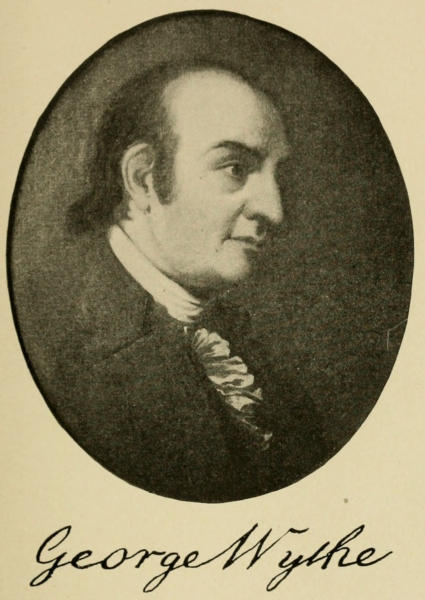
GEORGE WYTHE
[150]
It seemed a strange defiance, no doubt, to come from loyal Virginia. The Stamp Act was not, in fact, oppressive or unreasonable. Why should it so kindle the anger of the colonies that the sovereign Parliament, which had for many a day levied indirect charges upon them by means of the many acts concerning trade and manufactures, now laid a moderate direct tax upon them, the proceeds of which were to be spent upon their own protection and administration? Because, though it might be the sovereign legislature of the empire, Parliament was not in their view the direct sovereign legislature of America. No one could truly say that Parliament had been the sovereign power even of England before 1688, that notable year in which it had, by a revolution, changed the succession to the throne and begun the making and unmaking of governments. The colonies had most of them been set up before that momentous year of change, while the Parliament was still only a body of representatives associated with the crown, with the right to criticise and restrain it, but with no right to usurp its prerogatives; entitled to be consulted, but not licensed to rule. The King, not the Parliament, had chartered the colonies; and they conceived their assemblies to be associated with him as Parliament itself had been in the older days before the Revolution of 1688: to vote him grants, assent to taxation, and with his consent make the laws they were to live under. He stood, they thought, in the same relation to all the legislatures of his realm: to the Parliament in England and to the assemblies in America. It was the fundamental principle of the English constitution, as all agreed, that the King’s subjects should be associated with him in government [151]by representation; and, since the Americans could not be represented in Parliament, and were, by his own authority, represented in local assemblies, he must deal with them, not through Parliament, but through those assemblies.
The law of their view was not very sound or clear; but the common-sense of it was unassailable; and it rested upon unquestionable and long-standing practice, that best foundation of institutions. Their governments were no doubt, in law, subject to the government of Great Britain. Whoever ruled there had the legal right to rule in the colonies also, whether it were the King independent of Parliament, or the ministers dependent upon Parliament. The revolution of 1688 had radically altered the character of the whole structure, and perhaps the colonies could not, in strict constitutional theory, decline their logical part in the change. But no man in America had ever seen that revolution cross the seas. English statesmen might have changed their views, but the colonies had not changed theirs, nor the practice of their governments either. Their governments were from of old, and they meant to keep them intact and uncorrupted. They did not object to the amount or to the form of the tax; they objected only that they had not themselves imposed it. They dissented utterly from the opinion that Parliament had the right to tax them at all. It was that principle, and not the tax itself, which moved them so deeply.
English statesmen claimed that the colonists were as much represented in Parliament as the thousands of Englishmen in England who did not have the right to vote for members of the Commons; and no doubt they were. The franchise was narrow in England, [152]and not the whole population but only a few out of some classes of the people were actually represented in the Houses. Were not the interests represented there which America stood for? Perhaps so. But why govern the colonies through these remote and theoretical representatives when they had, and had always had, immediate and actual representatives of their own in their assemblies,—as ready and accessible an instrument of government as the House of Commons itself? The colonists were accustomed to actual representation, had for a century and more been dealt with by means of it, and were not willing now to reverse their history and become, instead of veritable states, merely detached and dependent pieces of England. This was the fire of principle which the Stamp Act kindled.
And, once kindled, it burned with an increasing flame. Within ten years it had been blown to the full blaze of revolution. Mr. Grenville had not lost his power because he had set the colonies aflame by his hated Stamp Act, but merely because the King intensely disliked his tedious manners, and resented the dictatorial tone used by the ministers in all their dealings with himself. The Marquis of Rockingham and the group of moderate Whigs who stood with him in the new ministry of July, 1765, had repealed the stamp tax, not because they deemed it wrong in legal principle, but because it had bred resistance, had made the colonists resolve not to buy goods of English merchants, or even pay the debts of £4,000,000 sterling already incurred in their business with them,—because they deemed it wise to yield, and so quiet disorders over sea. Their power lasted only a single year. The King liked their liberal principles as little as he liked [153]Grenville’s offensive manners, and in August, 1766, dismissed them, to substitute a ministry under William Pitt, now made Earl of Chatham. Had Pitt retained his mastery, all might have gone well; but his health failed, his leadership became a mere form, real power fell to other men with no wide, perceiving vision like his own, and America was presently put once again in revolutionary mood.
Pitt had said that the colonists were right when they resisted the Stamp Act: that Parliament could lawfully impose duties on commerce, and keep, if it would, an absolute monopoly of trade for the English merchants, because such matters were of the empire and not merely of America; but that the Americans were justified in resisting measures of internal taxation and government, their charters and accustomed liberties no doubt giving them in such matters constitutions of their own. Mr. Burke, whose genius made him the spokesman of the Rockingham Whigs, whether they would or no, had said very vehemently, and with that singular eloquence of his of which only his own words know the tone, that he cared not at all what legal rights might be involved; it was a question of government and of good-will between a king and his subjects; and he would not support any measure, upon whatever right it might be founded, which led to irritation and not to obedience. The new ministry of the Earl of Chatham acted upon its chief’s principles, and not upon Mr. Burke’s,—though they acted rashly because that consummate chief did not lead them. They proceeded (June, 1767), after the great earl’s illness had laid him by, to put upon the statute book two acts for the regulation of colonial trade and the government [154]of the colonies which Charles Townshend, their Chancellor of the Exchequer, had drawn. The first provided for the more effectual enforcement of the acts of trade already in existence; the second imposed duties on wine, oil, lead, glass, paper, painters’ colors, and tea carried to the colonies, and explicitly legalized the use of the hated general search-warrants known as “writs of assistance.” The revenues raised by these duties were to be applied, as the stamp tax would have been had it been collected, to the support of the courts of justice and of the civil establishments of the several colonies, and to the expenses connected with their military defence. Evasions of the revenue acts were to be tried by the admiralty courts without juries.
To the colonists this seemed simply a return to the policy of the Stamp Act. The tax was different, but the object was the same: to make their judges and their governors independent of them, and to compel them to pay for the maintenance of troops not of their own raising. These same ministers had suspended the legislative power of the New York assembly because it refused to make proper provision for the quartering of the King’s troops, as commanded by the act of 1765; and that assembly had felt itself obliged to yield and obey. Several companies of royal artillery had been sent to Boston in the autumn of 1766, and were quartered there at the colony’s expense by order of the governor and council.
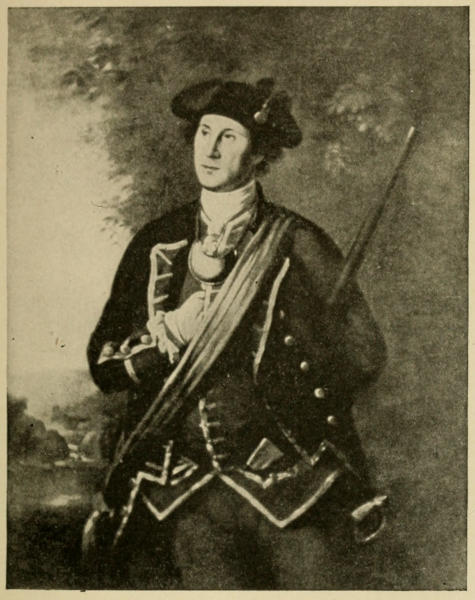
GEORGE WASHINGTON, 1772
The new taxes were laid upon trade, and they could not be attacked on the same grounds upon which the stamps had been objected to. But the trouble was that the new taxes, unlike the old restrictions, were to be enforced, evasion prevented. Mr. Townshend’s [155]first act was to send commissioners to America specially charged and empowered to see to that. The ruinous acts of 1764 were to be carried out, and the West India trade, by which Boston merchants and ship owners lived, put a stop to. These were bitter things to endure. Some grounds must be found from which to [156]fight them,—if not the arguments used against the Stamp Act, then others, if need be more radical. The ministers at home had set their far-away subjects to thinking with the eagerness and uneasiness of those who seek by some means to defend their liberties, and were fast making rebels of them.
Even in the midst of the universal rejoicings over the repeal of the Stamp Act the temper of several of the colonial assemblies had risen at reading the “Declaratory Act” which accompanied the repeal, and which asserted the absolute legal right of Parliament “to bind the colonies in all cases whatsoever.” They had declared very flatly then that Parliament had no legal authority whatever in America except such as it might exercise by the consent of the colonial assemblies,—so far had their thought and their defiant purpose advanced within the year. There were conservative men in the colonies as well as radical, men who hated revolution and loved the just and sober ways of law; and there was as strong a sentiment of loyalty on one side the sea as on the other. But even conservative men dreaded to see Parliament undertake to break down the independence of America. Mr. Thomas Hutchinson, of Massachusetts, whose house the rioters in Boston had wantonly looted when they were mad against the Stamp Act, had been born and bred in the colony, and loved her welfare as honestly as any man; but he was lieutenant-governor, an officer of the crown, and would have deemed it dishonor not to uphold the authority he represented. Mr. Otis, on the other hand, had resigned his office as Advocate General under the crown to resist the writs of assistance. The public-spirited gentlemen who had opposed Mr. Henry’s fiery [157]resolutions in the Virginian House of Burgesses did not fear usurpation or hate tyranny less than he; but they loved the slow processes of argument and protest and strictly legal opposition more than he did, and were patient enough to keep within bounds. They feared to shake an empire by pursuing a right too impetuously. Men of every temper and of every counsel made up the various people of the colonies, and there were men of equal patriotism on both sides of the rising quarrel.
[158]
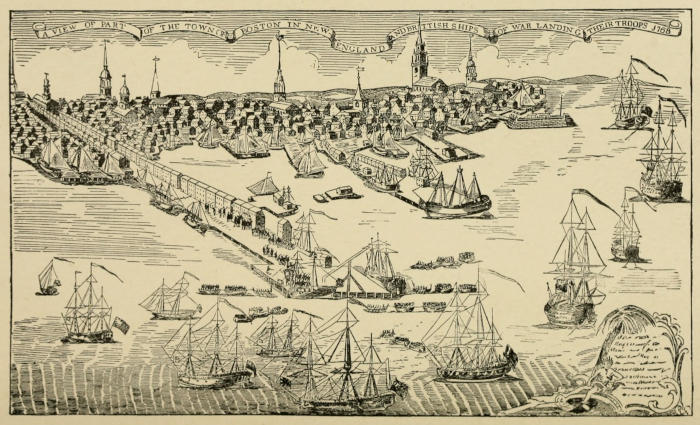
LANDING TROOPS AT BOSTON, 1768
And yet the most moderate and slow-tempered grew uneasy at Mr. Townshend’s measures. Mr. John Dickinson, of Pennsylvania, wrote and published a series of letters,—Letters of a Pennsylvania Farmer, he called them,—which stated as pointedly, as boldly, as earnestly as any man could wish, the constitutional rights of self-government which the colonists cherished and thought imperilled by the new acts of Parliament,—and yet Mr. Dickinson was as steady a loyalist as any man in America, as little likely to countenance rebellion, as well worth heeding by those who wished to compose matters by wise and moderate counsels. His firm-spoken protests were, in fact, read and pondered on both sides the water (1767), and no one could easily mistake their significance.
[159]
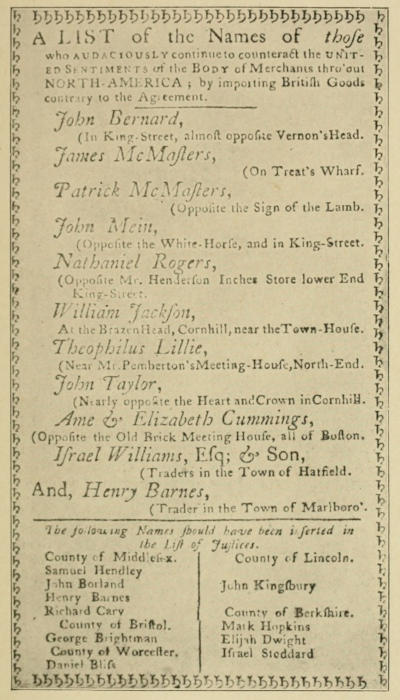
LIST OF NAMES OF THOSE WHO WOULD NOT CONFORM
[160]
The action of the people gave only too grave an emphasis to what their more self-restrained and thoughtful leaders said. Mr. Townshend’s acts were as openly resisted as Mr. Grenville’s had been; and every art of evasion, every trick of infringement, upon occasion even open and forcible violation, set at naught other restrictions of trade as well. It was startling to see how rapidly affairs approached a crisis. Resistance centred, as trade itself did, at Boston. When Mr. Townshend’s commissioners of customs seized the sloop Liberty in Boston harbor for evasion of the duties, rioters drove them to the fort for shelter, and they sent hastily to England for more troops. The Massachusetts assembly, under the masterful leadership of Mr. Samuel Adams, protested that the measures of the new ministry were in violation of colonial rights, and protested in terms which, though dignified and respectful enough, were unmistakably imperative.
The leadership of Samuel Adams was itself a sign of the times. He was a man of the people, passionate in his assertion of rights, and likely to stir and increase passion in those for whom he spoke. Subtle, a born politician; bold, a born leader of men, in assembly or in the street, he was the sort of man and orator whose ascendency may mean revolution almost when he chooses. The assembly, at his suggestion, went beyond the ordinary bounds of protest and sent a circular letter to the other colonies, as if to invite a comparison of views and a general acquiescence in the course of settled opposition it had itself adopted. When the ministers in London demanded a withdrawal of the letter, the assembly of course refused, and the other colonies were more than ever inclined to stand by the stout Bay Colony at whose capital port the fight centred. The ministers, in their desperate purpose to compel submission, declared their intention to remove to England for trial any one who should be charged with treason,—under an almost forgotten statute passed long before Jamestown was settled or English colonies dreamed of in America. That roused the Virginian House of Burgesses once more. They declared, with a sort [161]of quiet passion, in their session of 1769, that no one but their own assemblies had a right to tax the colonies; that they had the inalienable right to petition the government at home upon any matter of grievance whatever, and to petition, if they pleased, jointly, as a body of colonies united in right and interest; and that any attempt to try a colonist for crime anywhere except in the courts of his own colony and by known course of law was “highly derogatory of the right of British subjects,” and not for a moment to be deemed within the lawful power of the crown. There was no need this time for Mr. Henry. All men were now of the same opinion in Virginia, and the action was unanimous.
The Virginian governor at once dissolved the Burgesses; but the members came together again almost immediately at a private house; and there Colonel Washington, whom all the English world had known since Braddock’s day, proposed a general agreement to import no goods at all upon which a tax was laid,—to see what effect it would have if the English tradesmen and manufacturers who looked to America for a market were starved into a true appreciation of the situation and of the state of opinion among their customers. Many of the other colonies followed suit. Trade with England for a few months almost stood still, and there was quick distress and panic among those interested over sea. They promptly demanded of Parliament that the new taxes be taken off and trade allowed to live again. The ministers yielded (April, 1770),—except with regard to the tax on tea. That was the least of the taxes, and the King himself positively commanded that it be retained, to save the principle of the bill and show that Parliament had not reconsidered its [162]right to tax. The taxes had yielded nothing: the single tax on tea would serve to assert a right without the rest.
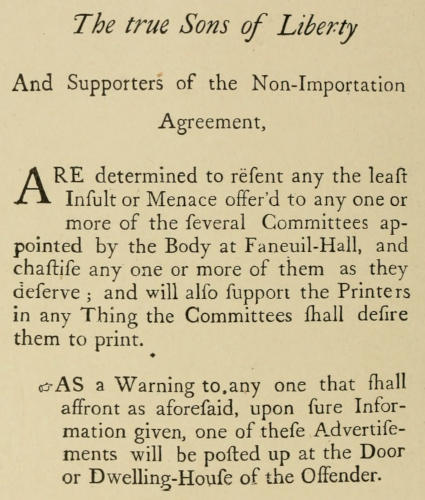
HAND-BILL OF TRUE SONS OF LIBERTY
[163]
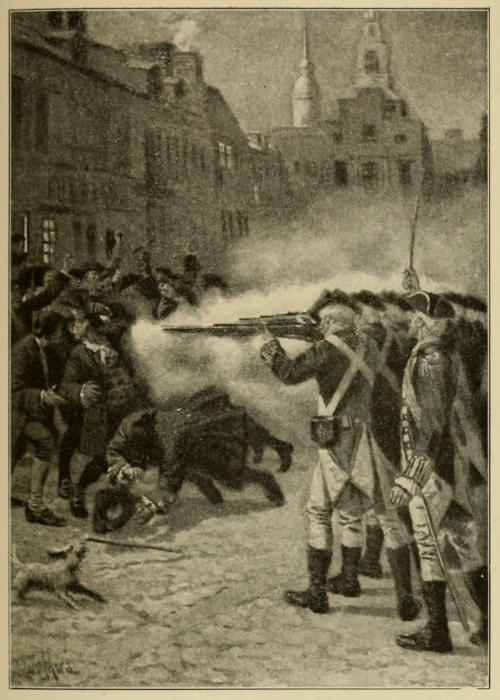
THE BOSTON MASSACRE
[164]
Meanwhile a very ominous thing had happened in Boston,—though the ministers had not yet heard of it when the bill passed to repeal the taxes. Upon an evening in March, 1770, a mob had attacked a squad of the King’s redcoats in King Street, pelting them with sharp pieces of ice and whatever else they could lay their hands on, and daring them derisively to fire; and the troops had fired, being hard pressed and maddened. Five of the mob were killed and six wounded, and a thrill of indignation and horror went through the excited town. The next day a great meeting in Faneuil Hall sent a committee to Mr. Hutchinson, the governor, to demand the instant withdrawal of the troops. Samuel Adams headed the committee, imperious and on fire; told the governor, in the council chamber where they met, that he spoke in the name of three thousand freemen who counted upon being heeded; and won his point. The troops were withdrawn to an island in the bay. The town had hated their “lobster backs” for all the year and a half they had been there, and rejoiced and was quiet when they withdrew.
[165]
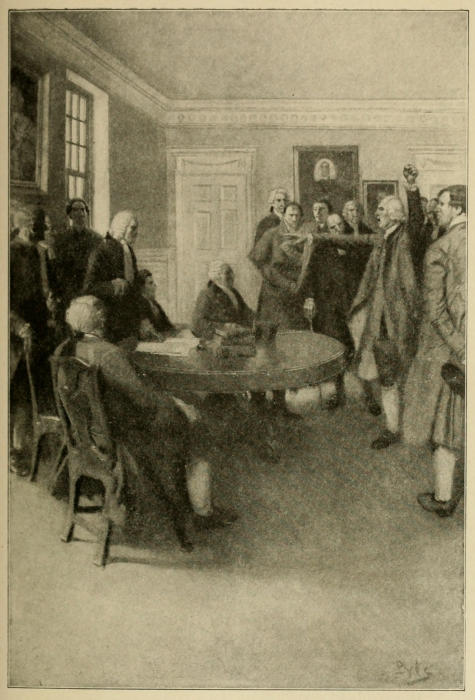
AFTER THE MASSACRE. SAMUEL ADAMS DEMANDING OF GOVERNOR HUTCHINSON THE INSTANT WITHDRAWAL OF BRITISH TROOPS
[166]
But quiet could not last long. The flame was sure somewhere to burst out again whenever any incident for a moment stirred excitement. In North Carolina there was the next year a sudden blaze of open rebellion against the extravagant exactions of William Tryon, the adventurer who was royal governor there; and only blood extinguished it (1771). In Rhode Island, in June, 1772, his Majesty’s armed schooner Gaspee was taken by assault and burned, upon a spit of land where she lay aground. It had been her business to watch against infringements of the navigation laws and the vexatious acts of trade; her commander had grown exceptionally insolent in his work; a sloop which he chased had led him on to the spit, where his schooner stuck fast; and the provincials took advantage of her helplessness to burn her. No one could be found who would inform on those who had done the bold thing; the courageous chief-justice of the little province flatly denied the right of the English authorities to order the perpetrators to England for trial; and the royal commission which was appointed to look into the whole affair stirred all the colonies once more to a deep irritation. The far-away House of Burgesses in Virginia very promptly spoke its mind again. It invited the several colonies to join Virginia in forming committees of correspondence, in order that all might be of one mind and ready for one action against the aggressions of the government in England. The ministers in London had meantime resolved to pay the provincial judges, at any rate in Massachusetts, out of the English treasury, taxes or no taxes; and the Massachusetts towns had formed committees of correspondence of their own, as Mr. Adams bade.
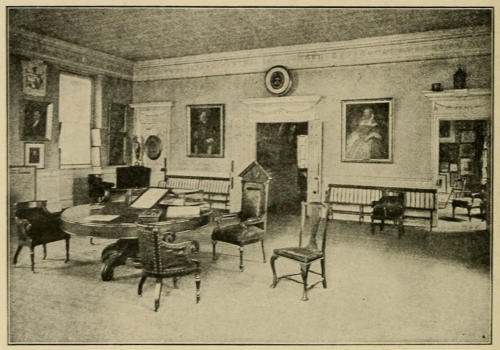
INTERIOR OF COUNCIL CHAMBER, OLD STATE HOUSE, BOSTON
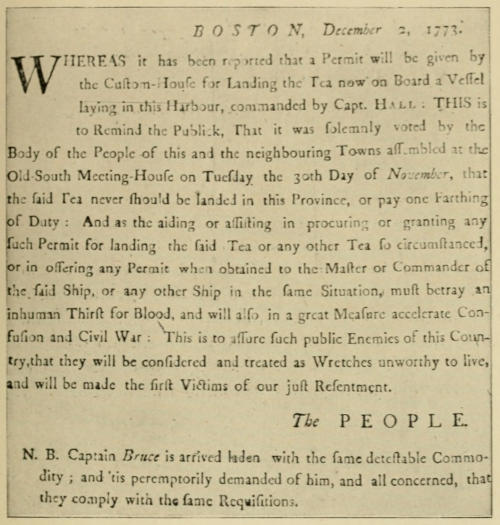
PROTEST AGAINST THE LANDING OF TEA
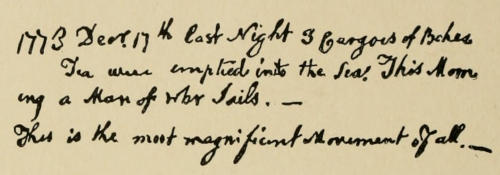
ENTRY JOHN ADAMS’S DIARY
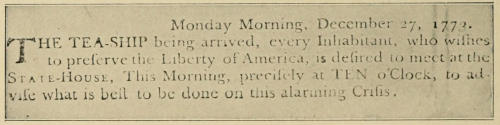
CALL FOR MEETING TO PROTEST AGAINST THE LANDING OF TEA
Such were the signs of the times when the final test [167]came of the tax on tea. The East India company was in straits for money. It had to pay twelvepence into the royal treasury on every pound of tea it imported, whether it sold it in England or not; but the government there offered to relieve it of that tax on every pound it carried on to America, and exact only the threepence to be paid at the colonial ports under Mr. Townshend’s act: so willing were the King’s ministers to help the Company, and so anxious also to test [168]the act and the submissiveness of the colonists. The test was soon made. The colonists had managed to smuggle in from Holland most of the tea they needed; and they wanted none, under the circumstances, from the East India ships,—even though it cost less, with the twelvepence tax off, than the smuggled tea obtained of the Dutch. The East India Company promptly sent tea-laden ships to Boston, New York, Philadelphia, and Charleston; and in the autumn of 1773 they began to come in. In Boston a quiet mob, disguised as Indians, threw the chests overboard into the harbor. At New York and Philadelphia the ships were “permitted” to leave port again without landing their cargoes. At Charleston the tea was landed, but it was stored, not sold, and a public meeting saw to its secure bestowal. The experiment had failed. America was evidently of one mind, and had determined not to buy tea or anything else with a parliamentary tax on it. The colonists would no more submit to Mr. Townshend’s tax than to Mr. Grenville’s, whatever the legal difference between them might be, either in principle or in operation. The issue was squarely made up: the colonies would not obey the Parliament,—would be governed only through their own assemblies. If the ministers persisted, there must be revolution.
[169]
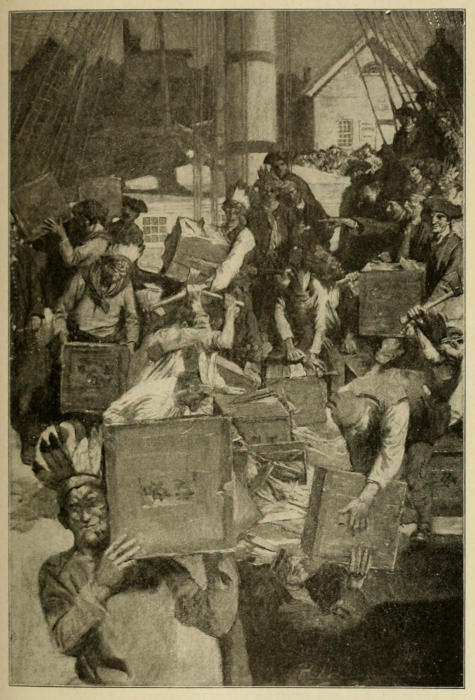
THE BOSTON TEA PARTY
[170]
Here the leading general authorities are the histories of Bancroft, Hildreth, and Bryant; but to these we now add David Ramsay’s History of the American Revolution; the fourth volume of James Grahame’s excellent History of the Rise and Progress of the United States of North America from their Colonization till the Declaration of Independence; Thomas Hutchinson’s History of Massachusetts, one of the most valuable of the contemporary authorities; John S. Barry’s History of Massachusetts; John Fiske’s American Revolution; Mellen Chamberlain’s The Revolution Impending, in the sixth volume of Winsor’s Narrative and Critical History of America; the twelfth chapter of W. E. H. Lecky’s History of England in the Eighteenth Century; Sir J. R. Seeley’s Expansion of England; Richard Frothingham’s Rise of the Republic of the United States; Mr. Edward Channing’s United States of America, 1765-1865; Mr. Henry Cabot Lodge’s Short History of the English Colonies in America; Mr. Horace E. Scudder’s Men and Manners in America One Hundred Years Ago; Moses Coit Tyler’s Life of Patrick Henry; Mr. Horace Gray’s important discussion of Otis’s speech against the writs of assistance, in the Appendix to Quincy’s Reports of Massachusetts Bay, 1761-1772; Moses Coit Tyler’s Literary History of the American Revolution; F. B. Dexter’s Estimates of Population, in the Proceedings of the American Antiquarian Society; and the Lives of the leading American and English statesmen of the time, notably the invaluable series of brief biographies known as The American Statesmen Series.
Abundant contemporary material may be found in the published letters, papers, and speeches of American and English public men of the time, especially in the pamphlets of such men as James Otis, Richard Bland, Stephen Hopkins, John Adams, Samuel Adams, John Dickinson, and their confrères; in Franklin’s Autobiography; [171]Andrew Burnaby’s Travels through the Middle Settlements in North America, in the Years 1759 and 1760; Ann Maury’s Memoirs of a Huguenot Family; and Hezekiah Niles’s Principles and Acts of the Revolution in America.
Lists of the authorities on the several colonies during these years may be found in Edward Channing and Albert Bushnell Hart’s very convenient and careful little Guide to American History.
[172]
The ministers did persist, and there was revolution. Within less than a year from those memorable autumn days of 1773 when the East India Company’s ships came into port with their cargoes of tea, the colonies had set up a Congress at Philadelphia which looked from the first as if it meant to do things for which there was no law; and which did, in fact, within less than two years after its first assembling, cut the bonds of allegiance which bound America to England. The colonists did not themselves speak or think of it as a body set up to govern them, or to determine their relations with the government at home, but only as a body organized for consultation and guidance, a general meeting of their committees of correspondence. But it was significant how rapidly, and upon how consistent and executive a plan, the arrangements for “correspondence” had developed, and how naturally, almost spontaneously, they had come to a head in this “Congress of Committees.” There were men in the colonies who were as quick to act upon their instinct of leadership, and as apt and masterful at organization, as the English on the other side of the water who had checkmated Charles I.; and no doubt the thought of independent action, and even of aggressive resistance, came more readily to the minds of men of initiative in America, where all things were making and to be made, than in old England, where every rule of action seemed antique and venerable. Mr. Samuel Adams had been deliberately planning revolution in Massachusetts ever since 1768, the year the troops came to Boston to hold the town quiet while Mr. Townshend’s acts strangled its trade; and he had gone the straight way to work to bring it about. He knew very well how to cloak his purpose and sedulously keep it hid from all whom it might shock or dismay or alienate. But the means he used were none the less efficacious because those who acted with him could not see how far they led.
[173]
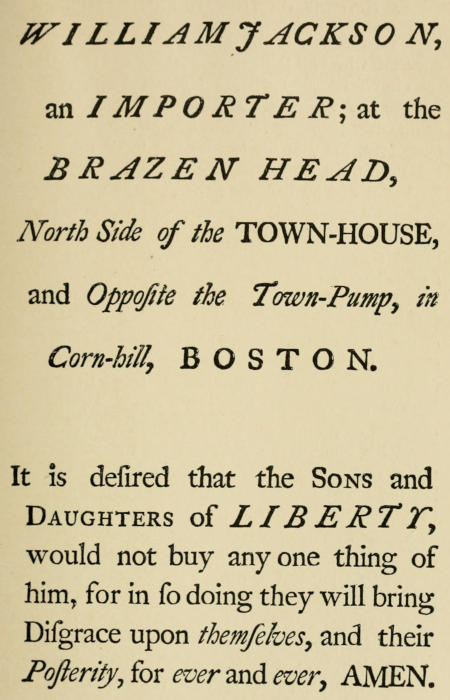
BOYCOTTING POSTER
[174]
It was he who had stood at the front of the opposition of the Massachusetts assembly to the Stamp Act; he who had drafted the circular letter of Massachusetts to the other colonies in 1768 suggesting concert of action against the Townshend acts; he who had gone from the town meeting in Faneuil Hall to demand of Hutchinson the immediate removal of the troops, after the unhappy “massacre” of March, 1770; he who had led the town meeting which took effectual measures to prevent the landing of the tea from the East India Company’s ships. No man doubted that his hand had been in the plan to throw the tea into the harbor. It was he who, last of all, as the troubles thickened, had bound the other towns of Massachusetts to Boston in a common organization for making and propagating opinion by means of committees of correspondence. It was late in 1772 when he proposed to the town meeting in Boston that the other towns of the colony be invited to co-operate with it in establishing committees of correspondence, by means of which they could exchange views, and, if need were, concert action. The end of November had come before he could make Boston’s initiative complete in the matter; and yet the few scant weeks that remained of the year were not gone before more than eighty towns had responded.
[175]
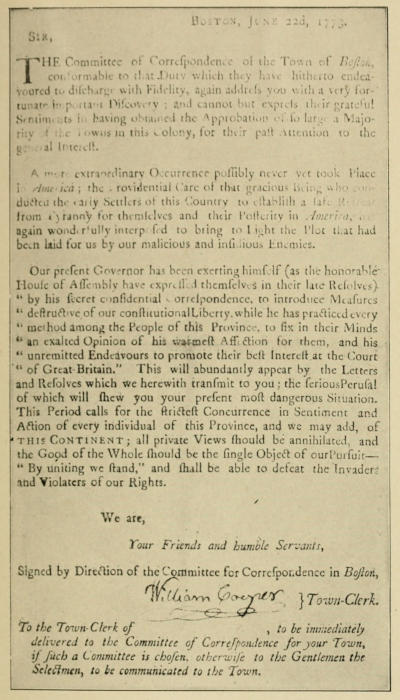
CIRCULAR OF THE BOSTON COMMITTEE OF CORRESPONDENCE
[176]
It turned out that he had invented a tremendously powerful engine of propaganda for such opinions and suggestions of action as he chose to put upon the wind or set afloat in his private correspondence,—as he had, no doubt, foreseen, with his keen appreciation of the most effectual means of agitation. Here was, in effect, a league of towns to watch and to control the course of affairs. There was nothing absolutely novel in the plan, except its formal completeness and its appearance of permanence, as if of a standing political arrangement made out of hand. In the year 1765, which was now seven years gone by, Richard Henry Lee had taken an active part among his neighbors in Virginia in forming the “Westmoreland Association,” which drew many of the leading spirits of the great county of Westmoreland together in concerted resistance to the Stamp Act. Four years later (1769) the Burgesses of Virginia, cut short in their regular session as a legislature by a sudden dissolution proclaimed by their royal governor, met in Mr. Anthony Hay’s house in Williamsburg and adopted the resolutions for a general non-importation association which George Mason had drawn up, and which George Washington, Mr. Mason’s neighbor and confidant, read and moved. There followed the immediate organization of local associations throughout the little commonwealth to see to the keeping of the pledge there taken. Virginia had no town meetings; each colony took its measures [178]of non-importation and resistance to parliamentary taxation after its own fashion; but wherever there were Englishmen accustomed to political action there was always this thought of free association and quick and organized coöperation in the air, which no one was surprised at any time to see acted upon and made an instrument of agitation.
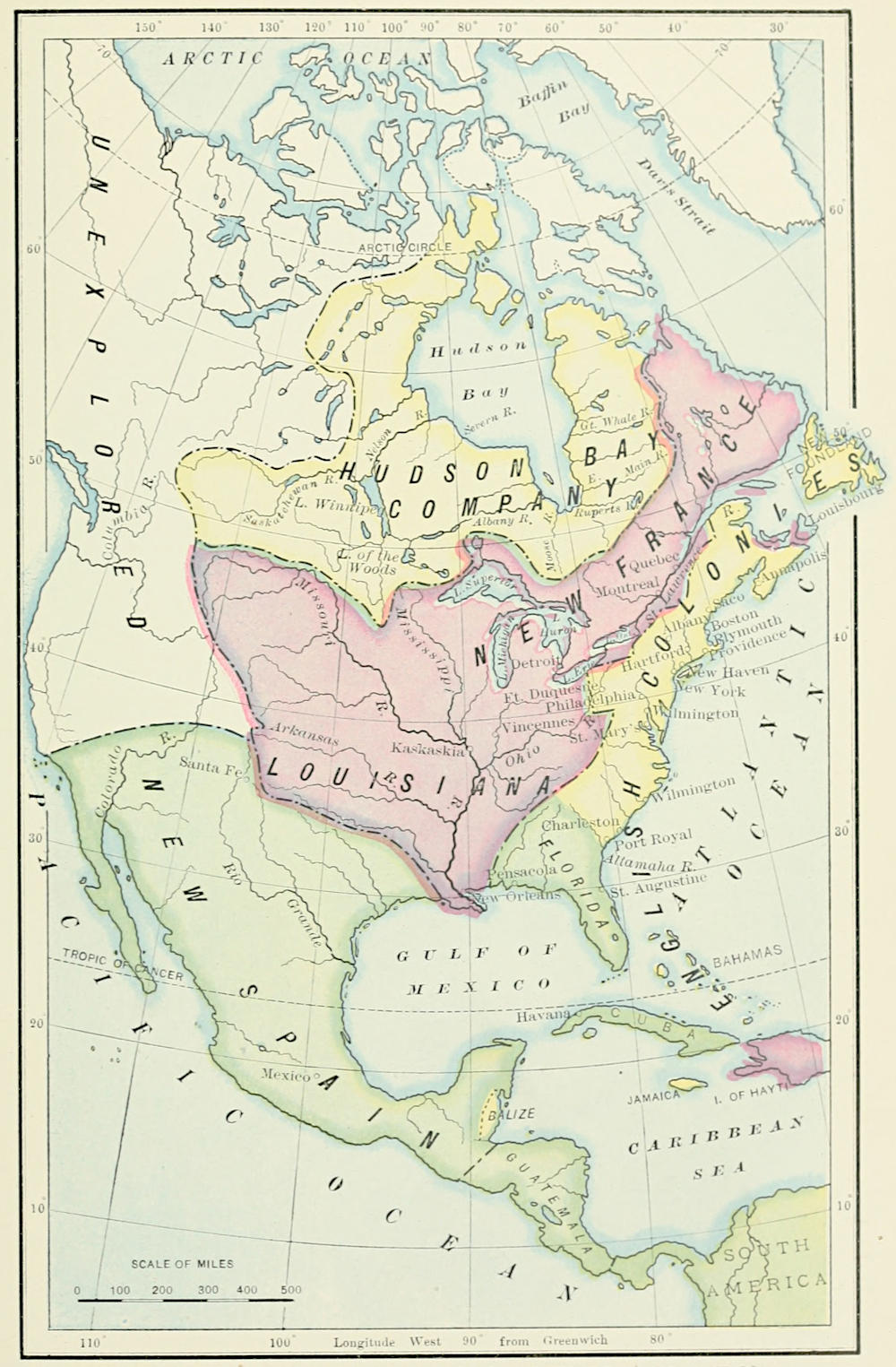
NORTH AMERICA 1750, SHOWING CLAIMS ARISING OUT OF EXPLORATION.
BORMAY & CO., N. Y.
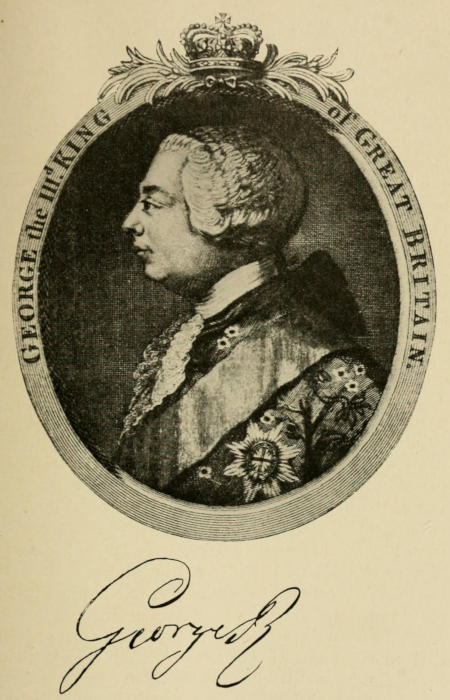
GEORGE III
What made the Massachusetts committees of correspondence especially significant and especially telling in their effect upon affairs was that they were not used, like the “Westmoreland Association” or the non-importation associations of 1769, merely as a means of keeping neighbors steadfast in the observance of a simple resolution of passive resistance, but were employed to develop opinion and originate action from month to month,—dilatory, defensive, or aggressive, as occasion or a change of circumstances might demand. The non-importation associations had been powerful enough, as some men had reason to know. The determination not to import or use any of the things upon which Parliament had laid a tax to be taken of the colonies,—wine, oil, glass, paper, tea, or any of the rest of the list,—was not a thing all men had thought of or spontaneously agreed to. Certain leading gentlemen, like Mr. Mason and Colonel Washington, deemed it a serviceable means of constitutional resistance to the mistaken course of the ministry, induced influential members of the House of Burgesses to indorse it, and formed associations to put it into effect,—to see to it that no one drank wine or tea which had been brought in under Mr. Townshend’s taxes. There was here no command of law,—only a moral compulsion, the “pressure of opinion”; but it was no light matter to be [179]censured and talked about by the leading people in your county as a person who defied the better sort of opinion and preferred wine and tea to the liberties of the colony. Associated opinion, spoken by influential men, proved a tremendous engine of quiet duress, and the unwilling found it prudent to conform. It was harder yet for the timid where active committees of [180]correspondence looked into and suggested opinion. Men could give up their wine, or women their tea, and still keep what opinions they pleased; but committees of correspondence sought out opinion, provoked discussion, forced men to take sides or seem indifferent; more than all, saw to it that Mr. Samuel Adams’s opinions were duly promulgated and established by argument.
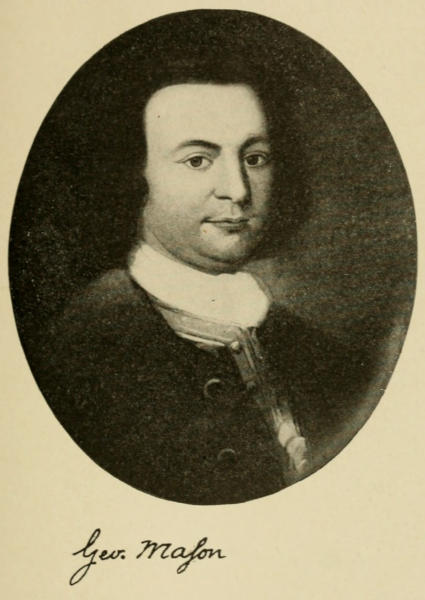
GEORGE MASON
Men thought for themselves in Massachusetts, and Mr. Adams was too astute a leader to seem to force opinions upon them. He knew a better and more certain way. He drew Mr. Hutchinson, the governor, into controversy, and provoked him to unguarded heat in the expression of his views as to the paramount authority of Parliament and the bounden duty of the colonists to submit if they would not be accounted rebels. He let heat in the governor generate heat in those who loved the liberty of the colony; supplied patriots with arguments, phrases, resolutions of right and privilege; watchfully kept the fire alive; forced those who were strong openly to take sides and declare themselves, and those who were weak to think with their neighbors; infused agitation, disquiet, discontent, dissonance of opinion into the very air; and let everything that was being said or done run at once from town to town through the ever talkative committees of correspondence. He sincerely loved the liberty to which America had been bred; loved affairs, and wanted nothing for himself, except the ears of his neighbors; loved the air of strife and the day of debate, and the busy concert of endless agitation; was statesman and demagogue in one, and had now a cause which even slow and thoughtful men were constrained to deem just.
[181]
The ministers supplied fuel enough and to spare to keep alive the fires he kindled; and presently the system of committees which he had devised for the towns of a single colony had been put into use to bring the several colonies themselves together. Opinion began to be made and moved and augmented upon a great scale. Spontaneous, no doubt, at first, at heart spontaneous always, it was elaborately, skilfully, persistently assisted, added to, made definite, vocal, universal,—now under the lead of men in one colony, again under the lead of those in another. Massachusetts, with her busy port and her noisy town meetings, drew the centre of the storm to herself; but the other colonies were not different in temper. Virginia, in particular, was as forward as Massachusetts. Virginia had got a new governor out of England early in 1772, John Murray, Earl of Dunmore, who let more than a year go by from his first brief meeting with the Burgesses before he summoned them again, because he liked their lack of submission as little as they liked his dark brow and masterful temper; but he suffered them to convene at last, in March, 1773, and they forthwith gave him a taste of their quality, as little to his palate as he could have expected.
[182]

SEAL OF DUNMORE
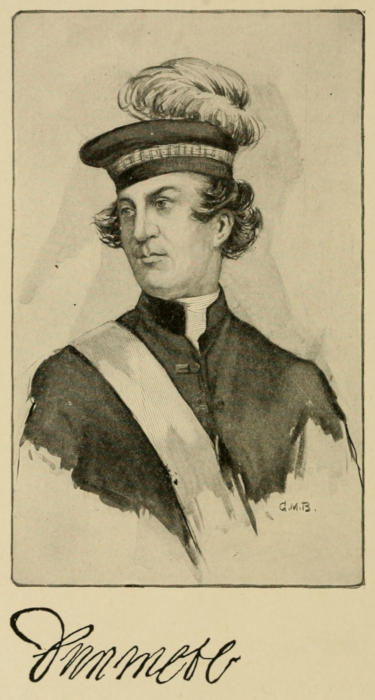
EARL OF DUNMORE
It was in June, 1772, while the Virginian burgesses waited for their tardy summons to Williamsburg that his Majesty’s revenue cutter Gaspee was deliberately boarded and burned by the Rhode Islanders. The Burgesses [183]had but just assembled in the autumn when the ominous news came that a royal commission had been sent over to look sharply into the matter, and see to the arrest and deportation of all chiefly concerned. Dabney Carr, Patrick Henry, Richard Henry Lee, and Thomas Jefferson, young men all, and radicals, members of the House, privately associated themselves for the concert of measures to be taken in the common cause of the colonies. Upon their initiative the Burgesses resolved, when the news from Rhode Island came, to appoint at once a permanent committee of correspondence; instruct it to inquire very particularly into the facts about this royal commission; and ask the other colonies to set up similar committees, for the exchange of information concerning public affairs and the maintenance of a common understanding and concert in action. By the end of the year Massachusetts, Rhode Island, Connecticut, New Hampshire, and South Carolina had adopted the suggestion and set their committees to work.
[184]
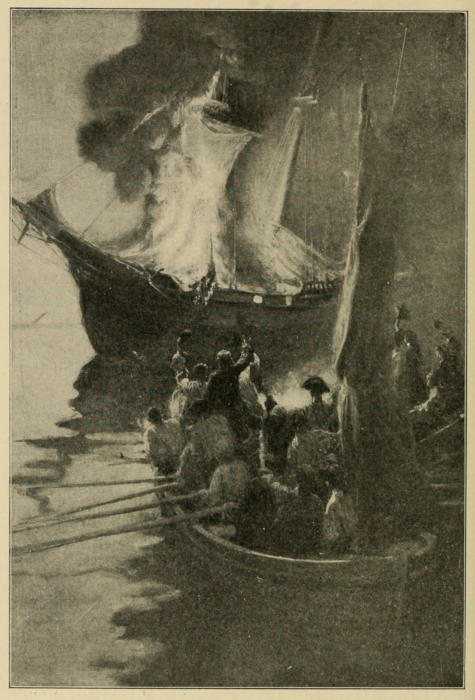
THE ATTACK ON THE “GASPEE”
[185]
Massachusetts, of course. This was Mr. Samuel Adams’s new machinery of agitation upon a larger scale. Adams himself had long cherished the wish that there might be such a connection established between the colonies. In the autumn of 1770 he had induced the Massachusetts assembly to appoint a committee of correspondence, to communicate with Mr. Arthur Lee, of Virginia, the colony’s agent in London, and with the Speakers of the several colonial assemblies; and though the committee had accomplished little or nothing, he had not been discouraged, but had written the next year to Mr. Lee expressing the wish that “societies” of “the most respectable inhabitants” might be formed in the colonies to maintain a correspondence with friends in England in the interest of colonial privilege. “This is a sudden thought,” he said, “and drops undigested from my pen”; but it must have seemed a natural enough thought to Mr. Lee, whose own vast correspondence,—with America, with Englishmen at home, with acquaintances on the continent,—had itself, unaided, made many a friend for the colonies over sea at the same time that it kept the leading men of the colonies informed of the opinions and the dangers breeding in England. But Mr. Adams’s town committees came first. It was left for the little group of self-constituted leaders in the Virginian assembly, of whom Richard Henry Lee, Mr. Arthur Lee’s elder brother, was one, to take the step which actually drew the colonies into active coöperation when the time was ripe. It was, in part, through the systematic correspondence set afoot by the Virginian burgesses that something like a common understanding had been arrived at as to what should be done when the tea came in; and the lawless defiance of the colonists in that matter brought the ministers in England to such a temper that there were presently new and very exciting subjects of correspondence between the committees, and affairs ran fast towards a crisis.
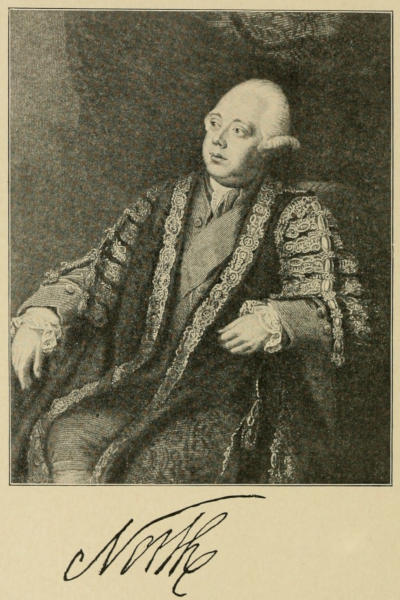
LORD NORTH
Teas to the value of no less than eighteen thousand pounds sterling had been thrown into the harbor at Boston on that memorable night of the 16th of December, 1773, when “Captain Mackintosh,” the redoubtable leader of the South End toughs of the lively little town, was permitted for the nonce to lead his betters; but what aroused the ministers and put Parliament in a heat was not so much the loss incurred by the East [186]India Company or the outcry of the merchants involved as the startling significance of the act, and the unpleasant evidence which every day came to hand that all the colonies alike were ready to resist. After the tea had been sent away, or stored safe against sale or [187]present use, or thrown into the harbor, at Philadelphia, Charleston, New York, and Boston, as the leaders of the mobs or the meetings at each place preferred, there was an instant spread of Virginia’s method of union. Six more colonies hastened to appoint committees of correspondence, and put themselves in direct communication with the men at Boston and at Williamsburg who were forming opinion and planning modes of redress. Only Pennsylvania held off. The tea had been shut out at Philadelphia, as elsewhere, but the leaders of the colony were not ready yet to follow so fast in the paths of agitation and resistance. Members of Parliament hardly noticed the exception. It was Boston they thought of and chiefly condemned as a hot-bed of lawlessness. Not every one, it is true, was ready to speak quite so plainly or so intemperately as Mr. Venn. “The town of Boston ought to be knocked about their ears and destroyed,” he said. “You will never meet with proper obedience to the laws of this country until you have destroyed that nest of locusts.” But, though few were so outspoken, no doubt many found such a view very much to their taste, excellently suited to their temper.
[188]
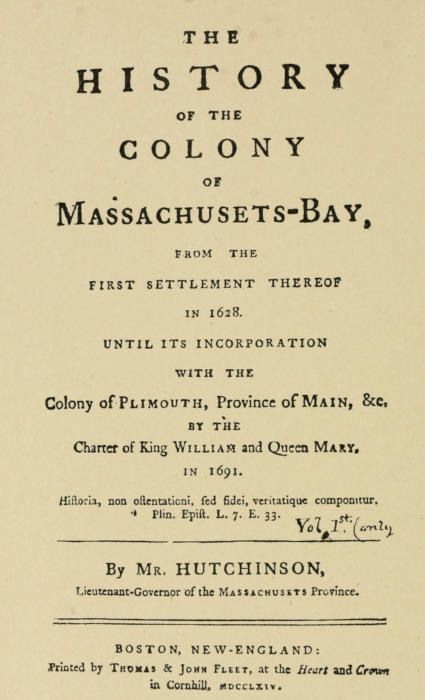
TITLE-PAGE OF HUTCHINSON’S HISTORY
[189]
At any rate, the ministers went a certain way towards acting upon it. In March, 1774, after communicating to the House the despatches from America, the leaders of the government, now under Lord North, proposed and carried very drastic measures. By one bill they closed the port of Boston, transferring its trade after the first of June to the older port of Salem. Since the headstrong town would not have the tea, it should have no trade at all. By another bill they suspended the charter of the colony. By a third they made provision for the quartering of troops within the province; and by a fourth they legalized the transfer to England of trials growing out of attempts to quell riots in the colony. News lingered on the seas in those days, waiting for the wind, and the critical news of what had been done in Parliament moved no faster than the rest. It was the 2d of June before the text of the new statutes was known in Boston. That same month, almost upon that very day, Thomas Hutchinson, the constant-minded governor whom Samuel Adams had tricked, hated, and beaten in the game of politics, left his perplexing post and took ship for England, never to return. Born and bred in Massachusetts, of the stock of the colony itself, he had nevertheless stood steadfastly to his duty as an officer of the crown, deeming Massachusetts best served by the law. He had suffered more than most men would have endured, but his sufferings had not blinded him with passion. He knew as well as any man the real state of affairs in the colony,—though he looked at them as governor, not as the people’s advocate,—and now went to England to make them clear to the ministers. “The prevalence of a spirit of opposition to government in the plantation,” he had already written them, “is the natural consequence of the great growth of colonies so remote from the parent state, and not the effect of oppression in the King or his servants, as the promoters of this spirit would have the world to believe.” It would be of good omen for the settlement of difficulties if he could make the ministers see that the spirit which so angered them was natural, and not born of mere rebellion.
[190]
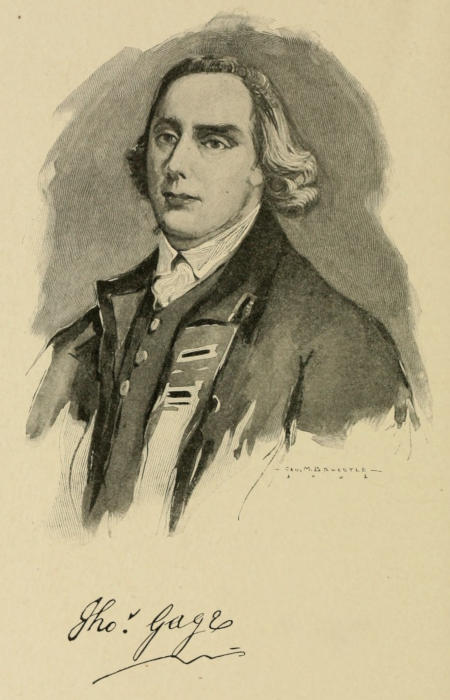
GENERAL GAGE
[191]
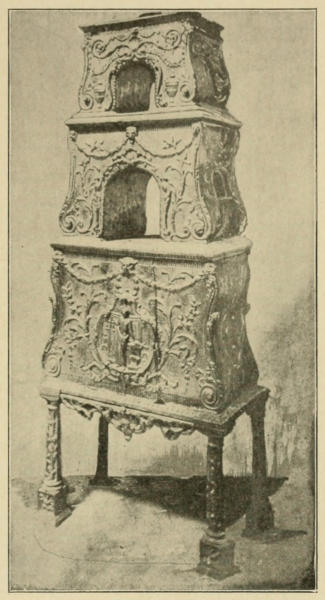
STOVE IN THE HOUSE OF BURGESSES, VIRGINIA
Mr. Hutchinson left General Gage governor in his stead,—at once governor and military commander. Gage was to face a season of infinite trouble, and, as men soon learned, did not know how to face it either with patience or with tact and judgment. The news of Boston’s punishment and of the suspension of the Massachusetts charter, of the arrangements for troops, and of the legal establishment of methods of trial against which all had protested,—and, in the case of the Gaspee affair, successfully protested,—had an instant and most disturbing effect upon the other colonies, as well as upon those who were most directly affected. The ministers could not isolate Massachusetts. They were dealing with men more statesmanlike than themselves, who did not need to see their own liberties directly struck at to recognize danger, though it was not yet their danger. They had protested in the time of the Stamp Act, which affected [192]them all; this time they protested even more emphatically against measures aimed at Massachusetts alone. What was more significant, they had now means at hand for taking action in common.
Virginia, no doubt, seemed to the ministers in England far enough away from Massachusetts, but her Burgesses acted upon the first news of what Parliament was doing,—a month before the text of the obnoxious acts had reached Boston. In May, 1774, they ordered that June 1st, the day the Boston Port bill was to go into effect, be set apart as a day of fasting and prayer,—prayer that civil war might be averted and that the people of America might be united in a common cause. Dunmore promptly dissolved them for their pains; but they quietly assembled again in the long room of the Raleigh Tavern; issued a call thence to the other colonies for a general Congress; and directed that a convention, freely chosen by the voters of the colony as they themselves had been, should assemble there, in that same room of the Raleigh, on the first day of August following, to take final measures with regard to Virginia’s part in the common action hoped for in the autumn. The next evening they gave a ball in honor of Lady Dunmore and her daughters, in all good temper, as they had previously arranged to do,—as if nothing had happened, and as if to show how little what they had done was with them a matter of personal feeling or private intrigue, how much a matter of dispassionate duty. They had not acted singularly or alone. Rhode Island, New York, and Massachusetts herself had also asked for a general “Congress of Committees.” The Massachusetts assembly had locked its doors against the governor’s [193]messenger, sent to dissolve it, until it had completed its choice of a committee “to meet the committees appointed by the several colonies to consult together upon the present state of the colonies.” It was chiefly because Massachusetts called that the other colonies responded, but the movement seemed general, almost spontaneous. Virginia and Massachusetts sent their real leaders, as the other colonies did; and September saw a notable gathering at Philadelphia,—a gathering from which conservatives as well as radicals hoped to see come forth some counsel of wisdom and accommodation.
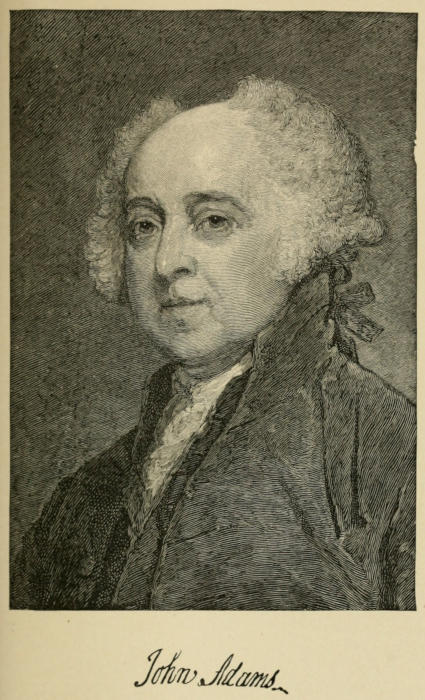
JOHN ADAMS
Every colony but Georgia sent delegates to the Congress. Not all who attended had been regularly elected by the colonial assemblies. The Virginian delegates had been elected by Virginia’s August convention, a body unknown to the law; in some of the colonies there had been no timely sessions of the assemblies at which a choice could be made, and representatives had accordingly been appointed by their committees of correspondence, or elected directly by the voters at the town and county voting places. But no one doubted any group of delegates real representatives,—at any rate, of the predominant political party in their colony. In New York and Pennsylvania the conservatives had had the upper hand, and had chosen men who were expected to speak for measures of accommodation and for obedience to law. In the other colonies, if only for the nonce, the more radical party had prevailed, and had sent representatives who were counted on to speak unequivocally for the liberties of the colonies, even at the hazard of uttering words and urging action which might seem revolutionary and defiant.
[194]
It was noteworthy and significant how careful a selection had been made of delegates. No doubt the most notable group was the group of Virginians: Colonel Washington; that “masterly man,” Richard Henry Lee, as Mr. John Adams called him, as effective in Philadelphia as he had been in the House of Burgesses; Patrick Henry, whose speech was so singularly compounded of thought and fire; Edmund Pendleton, who had read nothing but law books and knew nothing but business, and yet showed such winning grace and convincing frankness withal in debate; Colonel Harrison, brusque country gentleman, without art or subterfuge, downright and emphatic; Mr. Bland, alert and formidable at sixty-four, with the steady insight of the life-long student; and Mr. Peyton Randolph, their official leader and spokesman, whom the Congress chose its president, a man full of address, and seeming to carry privilege with him as a right inherited. Samuel Adams and John Adams had come from Massachusetts, with Mr. Cushing and Mr. Paine. South Carolina had sent two members of the Stamp Act Congress of 1765, Mr. Christopher Gadsden and Mr. John Rutledge, with Mr. Edward Rutledge also, a youth of twenty-five, and plain Mr. Lynch, clad in homespun, as direct and sensible and above ceremony as Colonel Harrison. Connecticut’s chief spokesman was Roger Sherman, rough as a peasant without, but in counsel very like a statesman, and in all things a hard-headed man of affairs. New York was represented by Mr. John Jay, not yet thirty, but of the quick parts of the scholar and the principles of a man of honor. Joseph Galloway, the well-poised Speaker and leader of her House of Assembly, John Dickinson, the thoughtful [195]author of the famous “Farmer’s Letters” of 1768, a quiet master of statement, and Mr. Thomas Mifflin, the well-to-do merchant, represented Pennsylvania. It was, take it all in all, an assembly of picked men, fit for critical business.
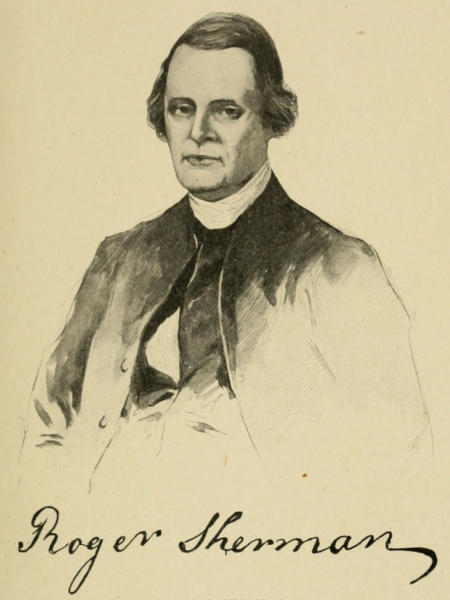
ROGER SHERMAN
Not that there was any talk of actual revolution in the air. The seven weeks’ conference of the Congress disclosed a nice balance of parties, its members acting, [196]for the most part, with admirable candor and individual independence. A good deal was said and conjectured about the “brace of Adamses” who led the Massachusetts delegation,—Samuel Adams, now past fifty-two, and settled long ago, with subtle art, to his life-long business, and pleasure, of popular leadership, which no man understood better; and John Adams, his cousin, a younger man by thirteen years, at once less simple and easier to read, vain and transparent,—transparently honest, irregularly gifted. It was said they were for independence, and meant to take the leadership of the Congress into their own hands. But it turned out differently. If they were for independence, they shrewdly cloaked their purpose; if they were ambitious to lead, they were prudent enough to forego their wish and to yield leadership, at any rate on the floor of the Congress, to the interesting men who represented Virginia, and who seemed of their own spirit in the affair.
[197]
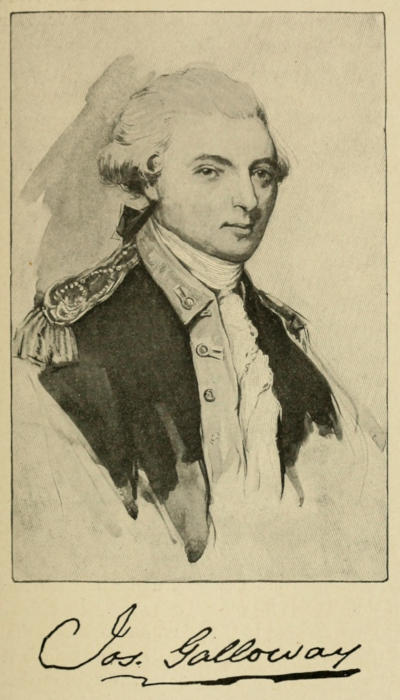
JOSEPH GALLOWAY
[198]
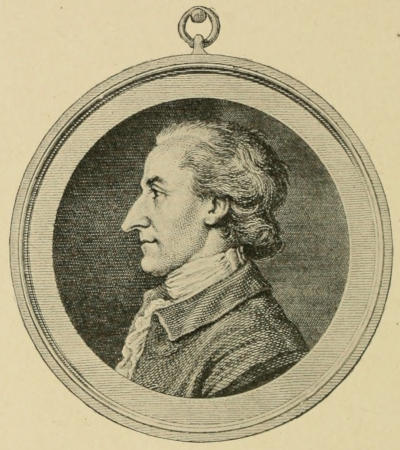
JOHN DICKINSON
There was a marked difference between what the Congress said aloud, for the hearing of the world, and what it did in order quietly to make its purpose of defeating the designs of the ministers effective. At the outset of its sessions it came near to yielding itself to the initiative and leadership of its more conservative members, headed by Joseph Galloway, the trusted leader of the Pennsylvanians, a stout loyalist, but for all that a sincere patriot and thorough-going advocate of the legal rights of the colonies. He proposed a memorial to the crown asking for a confederate government for the colonies, under a legislature of their own choosing, very like the government Mr. Franklin had made a plan for twenty years ago in the congress at Albany; and his suggestion failed of acceptance by only a very narrow margin when put to the vote. Even Edward Rutledge, of South Carolina, who spoke more hotly than most men for the liberties of the colonies, declared it an “almost perfect plan”; and the Congress, rejecting it, substituted no other. It turned, rather, to the writing of state papers, and a closer organization of the colonies for concert of action. Its committees drew up an address to the King, memorials to the people of Great Britain and to the people of British North America, their fellow-subjects, and a solemn declaration of rights, so earnest, so moderate in tone, reasoned and urged with so evident and so admirable a quiet passion of conviction, as to win the deep and outspoken [199]admiration of their friends in Parliament and stir the pulses of liberal-minded men everywhere on both sides of the sea.
So much was for the world. For themselves, they ordered a closer and more effective association throughout the colonies to carry out the policy of a rigorous non-importation and non-consumption of certain classes of British goods as a measure of trade against the English government’s policy of colonial taxation. It recommended, in terms which rang very imperative, that in each colony a committee should be formed in every town or county, according to the colony’s local administrative organization, which should be charged with seeing to it that every one within its area of oversight actually kept, and did not evade, the non-importation agreement; that these committees should act under the direction of the central committee of correspondence in each colony; and that the several colonial committees of correspondence should in their turn report to and put into effect the suggestions of the general Congress of Committees at Philadelphia. For the Congress, upon breaking up at the conclusion of its business in October, resolved to meet again in May of the next year, should the government in England not before that time accede to its prayers for a radical change of policy. Its machinery of surveillance was meanwhile complete. No man could escape the eyes of the local committees. Disregard of the non-importation policy meant that his name would be published, and that he would be diligently talked about as one who was no patriot. The Congress ordered that any colony which declined to enter into the new association should be regarded as hostile to “the [200]liberties of this country.” Samuel Adams himself had not had a more complete system of surveillance or of inquisitorial pressure upon individual conduct and opinion at hand in his township committees of correspondence. In the colonies where sentiment ran warm no man could escape the subtle coercion.
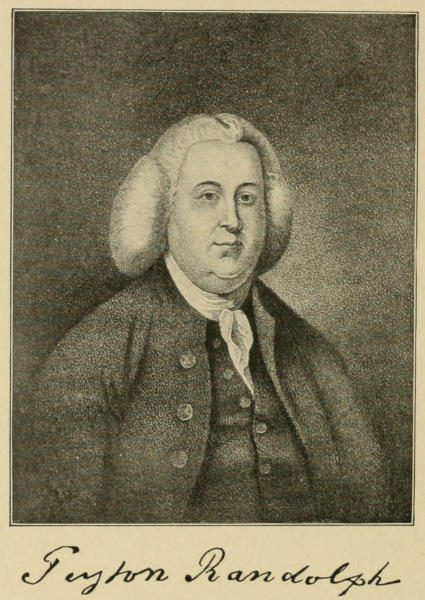
PEYTON RANDOLPH
Such action was the more worthy of remark because taken very quietly, and as if the Congress had of course [201]the right to lead, to speak for the majority and command the minority in the colonies, united and acting like a single body politic. There was no haste, no unusual excitement, no fearful looking for trouble in the proceedings of this new and quite unexampled assembly. On the contrary, its members had minds sufficiently at ease to enjoy throughout all their business the entertainments and the attractive social ways of the busy, well-appointed, cheerful, gracious town, the chief city of the colonies, in which there was so much to interest and engage. Dinings were as frequent almost as debates, calls as committee meetings. Evening after evening was beguiled with wine and tobacco and easy wit and chat. The delegates learned to know and understand each other as men do who are upon terms of intimacy; made happy and lasting friendships among the people of the hospitable place; drank in impressions which broadened and bettered their thinking, almost as if they had actually seen the several colonies with whose representatives they were dealing from day to day; and went home with a cleared and sobered and withal hopeful vision of affairs.
It was well to have their views so steadied. Events moved fast, and with sinister portent. Massachusetts could not be still, and quickly forced affairs to an issue of actual revolution. Before the Congress met again her leaders had irrevocably committed themselves to an open breach with the government; the people of the province had shown themselves ready to support them with extraordinary boldness; and all who meant to stand with the distressed and stubborn little commonwealth found themselves likewise inevitably committed to extreme measures. The Massachusetts men not [202]only deeply resented the suspension of their charter, they denied the legal right of Parliament to suspend it. On the 9th of September, 1774, four days after the assembling of the Congress at Philadelphia, delegates from Boston and the other towns in Suffolk County in Massachusetts had met in convention and flatly declared that the acts complained of, being unconstitutional, ought not to be obeyed; that the new judges appointed under the act of suspension ought not to be regarded or suffered to act; that the collectors of taxes ought to be advised to retain the moneys collected, rather than turn them into General Gage’s treasury; and that, in view of the extraordinary crisis which seemed at hand, the people ought to be counselled to prepare for war,—not, indeed, with any purpose of provoking hostilities, but in order, if necessary, to resist aggression. They declared also for a provincial congress, to take the place of the legislative council of their suspended charter, and resolved to regard the action of the Congress at Philadelphia as law for the common action of the colonies.
It gave these resolutions very grave significance that the Congress at Philadelphia unhesitatingly declared, upon their receipt, that the whole continent ought to support Massachusetts in her resistance to the unconstitutional changes in her government, and that any person who should accept office within the province under the new order of things ought to be considered a public enemy. Moreover, the Suffolk towns did not stand alone. Their temper, it seemed, was the temper of the whole colony. Other towns took action of the same kind; and before the Congress at Philadelphia had adjourned, Massachusetts had actually set up a virtually independent provincial congress. General Gage had summoned the regular assembly of the province to meet at Salem, the new capital under the parliamentary changes, on the 5th of October, but had withdrawn the summons as he saw signs of disaffection multiply and his authority dwindle to a mere shadow outside his military lines at Boston. The members of the assembly convened, nevertheless, and, finding no governor to meet them, resolved themselves into a provincial congress and appointed a committee of safety to act as the provisional executive of the colony. The old government was virtually dissolved, a revolutionary government substituted.
[203]
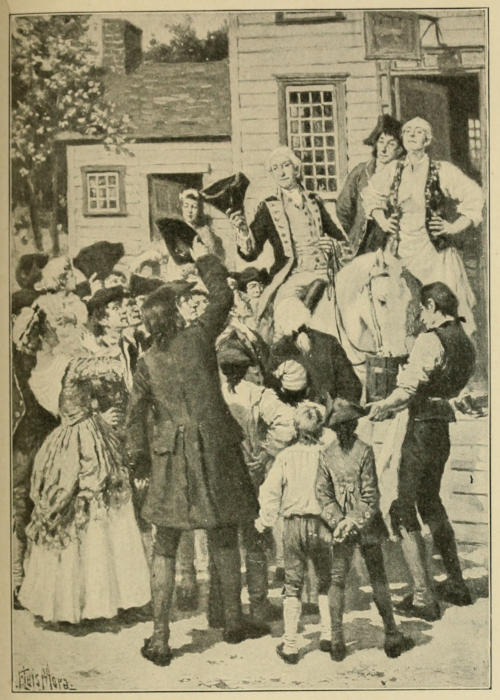
WASHINGTON STOPPING AT AN INN ON HIS WAY TO CAMBRIDGE
[204]
The substitution involved every hazard of license and disorder. A people schooled and habituated to civil order and to the daily practice of self-government, as the people of Massachusetts had been, could not, indeed, suffer utter demoralization or lose wholly and of a sudden its sobriety and conscience in matters of public business. But it was a perilous thing that there was for a time no recognized law outside of the fortifications which General Gage had thrown across Boston Neck, to defend the town against possible attack from its own neighbors. Town meetings and irregular committees took the place of officers of government in every locality. The committees were often self-constituted, the meetings too often disorderly and irregularly summoned. Everything fell into the hands of those who acted first; and inasmuch as the more hot-headed and violent are always at such times the first to act, many sober men who would fain have counselled restraint and prudence and the maintenance so far as might be [205]of the old order, were silenced or overridden. The gatherings at which concerted action was determined upon were too often like mere organized mobs. Men too often obtained ascendency for the time being who had no claim upon the confidence of their followers but such as came from audacity and violence of passion; and many things happened under their leadership which it was afterwards pleasant to forget. No man of consequence who would not openly and actively put himself upon the popular side was treated with so much as toleration. General Gage presently found Boston and all the narrow area within his lines filling up, accordingly, with a great body of refugees from the neighboring towns and country-sides.
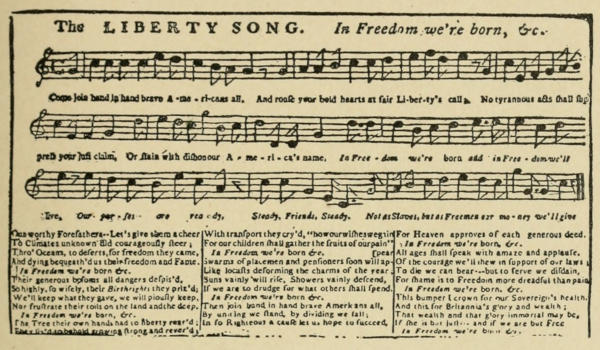
THE LIBERTY SONG
[Listen] | [MusicXML]
Music Transcriber’s Note: In bar 6, a missing quaver rest has been added.
In bar 12, the final quaver has been replaced with a crotchet.
The LIBERTY SONG. In Freedom we’re born, &c.
It gave those who led the agitation the greater confidence and the greater influence that the ministers of the churches were for the most part on their side. The control of Parliament had come, in the eyes of the New [206]England clergy, to mean the control also of bishops and the supremacy of the Establishment. Now, as always before, since the very foundation of the colony, the independence of their little commonwealths seemed but another side of the independence of their churches; and none watched the course of government over sea more jealously than the Puritan pastors.
Not only those who sided with the English power because of fear or interest,—place-holders, sycophants, merchants who hoped to get their trade back through favor, weak men who knew not which side to take and thought the side of government in the long run the safer,—but many a man of dignity and substance also, and many a man of scrupulous principle who revered the ancient English power to which he had always been obedient with sincere and loyal affection, left his home and sought the protection of Gage’s troops. The vigilance of the local committees effectually purged the population outside Boston, as the weeks went by, of those who were not ready to countenance a revolution. There was, besides, something very like military rule outside Boston as well as within it. The provincial congress met, while necessary, from month to month, upon its own adjournment, and, prominent among other matters of business, diligently devoted itself to the enrolment and organization of a numerous and efficient militia. Local as well as general commanders were chosen; there was constant drilling on village greens; fire-arms and ammunition were not difficult to get; and an active militia constituted a very effective auxiliary in the consolidation of local opinion concerning colonial rights and the proper means of vindicating them.
[207]
It is the familiar story of revolution: the active and efficient concert of a comparatively small number controlling the action of whole communities at a moment of doubt and crisis. There was not much difference of opinion among thoughtful men in the colonies with regard to the policy which the ministers in England had recently pursued respecting America. It was agreed on all hands that it was unprecedented, unwise, and in plain derogation of what the colonists had time out of mind been permitted to regard as their unquestioned privileges in matters of local self-government. Some men engaged in trade at the colonial ports had, it is true, found the new policy of taxation and enforced restrictions very much to their own interest. The Sugar Act of 1733, which cut at the heart of the New England trade with the French West Indies, and which Grenville and Townshend had, in these last disturbing years, tried to enforce, had, it was said, been passed in the first instance at the suggestion of a Boston merchant who was interested in sugar growing in the British islands whence the act virtually bade the colonial importers take all their sugar, molasses, and rum; and no doubt there were many in all the American ports who would have profited handsomely by the enforcement of the law. But, however numerous these may have been, they were at most but a small minority. For a vast majority of the merchants the enforcement of the acts meant financial ruin. Merchants as well as farmers, too, were hotly against taxes put upon them in their own ports by an act of Parliament. They were infinitely jealous of any invasion of their accustomed rights of self-government under their revered and ancient charter. Governor Hutchinson himself, [208]though he deemed the commands of Parliament law, and thought it his own bounden duty as an officer of the crown to execute them, declared in the frankest fashion to the ministers themselves that their policy was unjust and mistaken.
But, while men’s sentiments concurred in a sense of wrong, their judgments parted company at the choice of what should be done. Men of a conservative and sober way of thinking; men of large fortune or business, who knew what they had at stake should disorders arise or law be set aside; men who believed that there were pacific ways of bringing the government to another temper and method in dealing with the colonies, and who passionately preferred the ways of peace to ways of violence and threatened revolution, arrayed themselves instinctively and at once against every plan that meant lawlessness and rebellion. They mustered very strong indeed, both in numbers and in influence. They bore, many of them, the oldest and most honored names of the colony in Massachusetts, where the storm first broke, and were men of substance and training and schooled integrity of life, besides. Their counsels of prudence were ignored, nevertheless,—as was inevitable. Opinion formed itself with quick and heated impulse in the brief space of those first critical months of irritation and excitement; and these men, though the natural leaders of the colony, were despised, rejected, proscribed, as men craven and lacking the essential spirit either of liberty or of patriotism.
It was, no doubt, a time when it was necessary that something should be done,—as well as something said. It was intolerable to the spirit of most of the people, when once they were roused, to sit still under a suspension [209]of their charter, a closing of their chief port, the appointment of judges and governors restrained by none of the accustomed rules of public authority among them, and tamely utter written protests only, carrying obedience to what seemed to them the length of sheer servility. It happened that there had gone along with the hateful and extraordinary parliamentary measures of 1774 an act extending the boundaries of the province of Quebec to the Ohio River and establishing an arbitrary form of government within the extended province. It was a measure long ago planned. Its passage at that time had nothing to do with the ministers’ quarrel with the self-governing colonies to the southward. But it was instantly interpreted in America as an attempt to limit the westward expansion of the more unmanageable colonies which, like Massachusetts, arrogated the right to govern themselves; and it of course added its quota of exasperation to the irritations of the moment. It seemed worse than idle to treat ministers who sent such a body of revolutionary statutes over sea as reasonable constitutional rulers who could be brought to a more lawful and moderate course by pamphlets and despatches and public meetings, and all the rest of the slow machinery of ordinary agitation. Of course, too, Samuel Adams and those who acted with him very carefully saw to it that agitation should not lose its zest or decline to the humdrum levels of ordinary excitement. They kept their alarm bells pealing night and day, and were vigilant that feeling should not subside or fall tame. And they worked upon genuine matter. They knew the temper of average men in the colony much better than their conservative opponents did, and touched [210]it with a much truer instinct in their appeals. Their utterances went to the quick with most plain men,—and they spoke to a community of plain men. They spoke to conviction as well as to sentiment, and the minds they touched were thoroughly awakened. Their doctrine of liberty was the ancient tradition of the colony. The principles they urged had been urged again and again by every champion of the chartered liberties of the colonies, and seemed native to the very air.
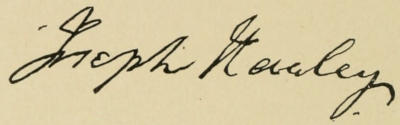
SIGNATURE OF JOSEPH HAWLEY
If not constitutional statesmen, they were at least the veritable spokesmen of all men of action, and of the real rank and file of the colonists about them,—as Patrick Henry was in Virginia. John Adams had read to Henry, while the first Congress was sitting in Philadelphia, Joseph Hawley’s opinion that what the ministers had done made it necessary to fight. “I am of that man’s opinion,” cried the high-spirited Virginian. That was what men said everywhere, unless imperatively held back from action by temperament, or interest, or an unusual, indomitable conviction of law-abiding duty, upon whatever exigency or provocation. It is not certain that there could be counted in Massachusetts so much as a majority for resistance in those first days of the struggle for right; but it is certain that those who favored extreme measures had the more effective spirit of initiative among them, the best concert of action, the more definite purpose, [211]the surest instinct of leadership, and stood with true interpretative insight for the latent conviction of right which underlay and supported every colonial charter in America.
And not only every colonial charter, but the constitution of England itself. The question now raised, to be once for all settled, was, in reality, the question of constitutional as against personal government; and that question had of late forced itself upon men’s thoughts in England no less than in America. It was the burden of every quiet as well as of every impassioned page in Burke’s Thoughts on the Present Discontents, published in 1770. The Parliament of 1774 did not represent England any more than it represented the colonies in America, either in purpose or principle. So ill distributed was the suffrage and the right of representation that great centres of population had scarcely a spokesman in the Commons, while little hamlets, once populous but now deserted, still returned members who assumed to speak for the country. So many voters were directly under the influence of members of the House of Lords, as tenants and dependants; so many members of the House of Lords were willing to put themselves and the seats which they controlled in the Commons at the service of the King, in return for honors and favors received or hoped for; so many elections to the Lower House were corruptly controlled by the court,—so full was Parliament, in short, of placemen and of men who counted upon the crown’s benefactions, that the nation seemed excluded from its own councils, and the King acted as its master without serious let or hinderance.
The Whig party, which stood for constitutional [212]privilege, was utterly disorganized. Some Whigs had followed Chatham to the end, despite his uncertain temper, his failing health, his perverse treatment of his friends; some had followed, rather, the Marquis of Rockingham, whose brief tenure of power, in 1766, had been but long enough to effect the repeal of the odious Stamp Act; but nothing could hold the divergent personal elements of the party together, and there was no place for a party of principle and independence in an unrepresentative Parliament packed with the “King’s friends.” Ministries rose or fell according to the King’s pleasure, and were Whig or Tory as he directed, without change of majority in the Commons. “Not only did he direct the minister” whom the House nominally obeyed “in all matters of foreign and domestic policy, but he instructed him as to the management of debates in Parliament, suggested what motions should be made or opposed, and how measures should be carried.” The Houses were his to command; and when Chatham was gone, no man could withstand him. Persons not of the ministry at all, but the private and irresponsible advisers of the King, became the real rulers of the country. The Duke of Grafton, who became the nominal head of the government in 1768, was not his own master in what he did or proposed; and Lord North, who succeeded him in 1770, was little more than the King’s mouthpiece.
Thoughtful men in England saw what all this meant, and deemed the liberties of England as much jeoparded as the liberties of America. And the very men who saw to the heart of the ominous situation in England were, significantly enough, the men who spoke most fearlessly and passionately in Parliament in defence [213]of America,—statesmen like Chatham and Burke, frank soldiers like Colonel Barré, political free lances like the reckless John Wilkes, and all the growing company of agitators in London and elsewhere whom the government busied itself to crush. It was the group gathered about Wilkes in London who formed, under Horne Tooke’s leadership, the famous “Society for supporting the Bill of Rights,” with which Samuel Adams proposed, in his letter to Arthur Lee in 1771, that similar societies, to be formed in the several colonies in America, should put themselves in active coöperation by correspondence. Those who attacked the prerogative in England were as roundly denounced as traitors as those who resisted Parliament in America. Wilkes was expelled from the House of Commons; the choice of the Westminster electors who had chosen him was arbitrarily set aside and annulled; those who protested with too much hardihood were thrown into prison or fined. But each arbitrary step taken seemed only to increase the rising sense of uneasiness in the country. The London mob was raised; rioting spread through the country, till there seemed to be chronic disorder; writers like “Junius” sprang up to tease the government with stinging letters which no one could successfully answer, because no one could match their wit or point; an independent press came almost suddenly into existence; and because there was no opinion expressed in the House of Commons worthy of being called the opinion of the nation, public opinion formed and asserted itself outside the Houses, and began to clamor uncomfortably for radical constitutional reforms. Mr. Wilkes was expelled the House in 1769, just as the trouble in America was thickening towards [214]storm; and long before that trouble was over it had become plain to every man of enlightened principle that agitation in England and resistance in America had one and the same object,—the rectification of the whole spirit and method of the English government.
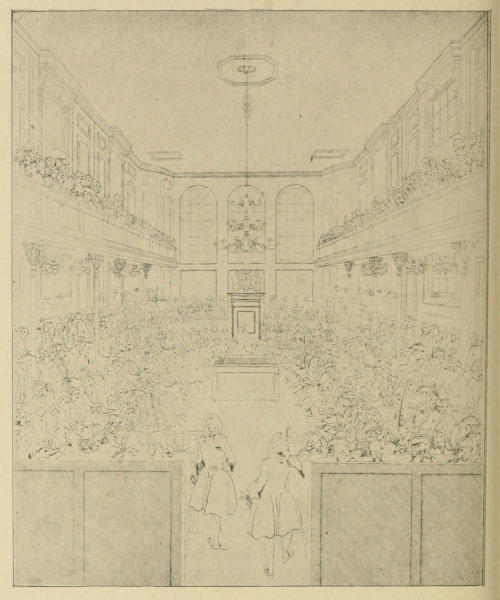
THE HOUSE OF COMMONS
George III. had too small a mind to rule an empire, [215]and the fifteen years of his personal supremacy in affairs (1768-1783) were years which bred a revolution in England no less inevitably than in America. His stubborn instinct of mastery made him dub the colonists “rebels” upon their first show of resistance; he deemed the repeal of the Stamp Act a fatal step of weak compliance, which had only “increased the pretensions of the Americans to absolute independence.” Chatham he called a “trumpet of sedition” because he praised the colonists for their spirited assertion of their rights. The nature of the man was not sinister. Neither he nor his ministers had any purpose of making “slaves” of the colonists. Their measures for the regulation of the colonial trade were incontestably conceived upon a model long ago made familiar in practice, and followed precedents long ago accepted in the colonies. Their financial measures were moderate and sensible enough in themselves, and were conceived in the ordinary temper of law-making. What they did not understand or allow for was American opinion. What the Americans, on their part, did not understand or allow for was the spirit in which Parliament had in fact acted. They did not dream with how little comment or reckoning upon consequences, or how absolutely without any conscious theory as to power or authority, such statutes as those which had angered them had been passed; how members of the Commons stared at Mr. Burke’s passionate protests and high-pitched arguments of constitutional privilege; how unaffectedly astonished they were at the rebellious outbreak which followed in the colonies. And, because they were surprised and had intended no tyranny, but simply the proper government of trade and the adequate support of administration throughout the dominions of the crown, as the ministers had represented these things to them, members of course thought the disturbances at Boston a tempest in a teapot, the reiterated protests of the colonial assemblies a pretty piece of much ado about nothing. The radical trouble was that the Parliament really represented nobody but the King and his “friends,” and was both ignorant and unreflective upon the larger matters it dealt with.
[216]
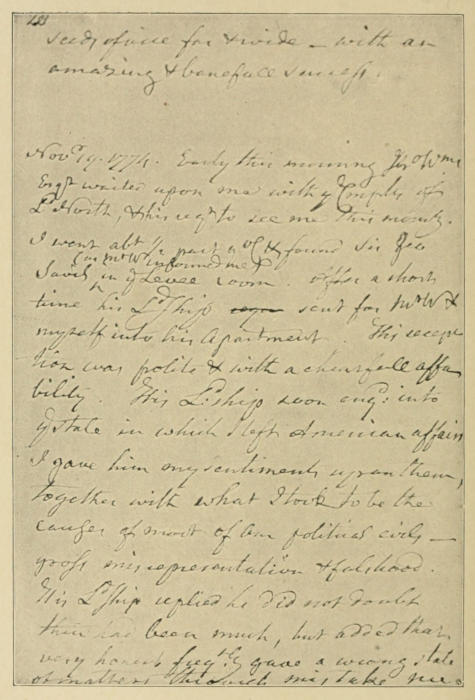
PAGE FROM THE DIARY OF JOSIAH QUINCY
[217]
It was the more certain that the promises of accommodation and peaceful constitutional reform which the supporters of the government in America so freely and earnestly made would be falsified, and that exasperation would follow exasperation. The loyal partisans of the crown in the colonies understood as little as did the radical patriotic party the real attitude and disposition of the King and his ministers. The men with whom they were dealing over sea had not conceived and could not conceive the American point of view with regard to the matters in dispute. They did not know whereof Mr. Burke spoke when he told them that the colonial assemblies had been suffered to grow into a virtual independence of Parliament, and had become in fact, whatever lawyers might say, coördinated with it in every matter which concerned the internal administration of the colonies; and that it was now too late to ask or expect the colonists to accept any other view of the law than that which accorded with long-established fact. Mr. Burke admitted that his theory was not a theory for the strict lawyer: it was a theory for statesmen, for whom fact must often take precedence of law. But the men he addressed were strict legists and not statesmen. There could be no understanding between the two sides of the water; and the loyalists who counselled submission, if only for a time, to the authority of the ministers, were certain to be rejected among their own people. The spirit of American affairs was with the patriots, and would be with them more and more as the quarrel thickened.
[218]
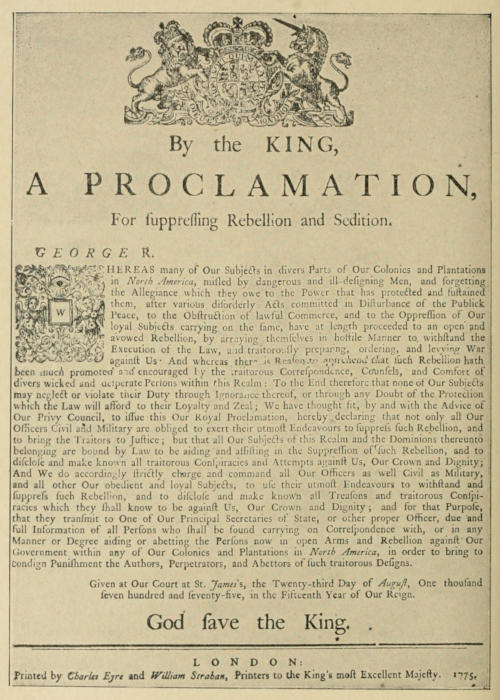
PROCLAMATION OF THE KING FOR THE SUPPRESSION OF THE REBELLION
[219]
It thickened fast enough, and the storm broke before men were aware how near it was. While winter held (1774-1775), affairs everywhere grew dark and uneasy, not only in Massachusetts, where Gage’s troops waited at Boston, but in every colony from Maine to the Gulf. Before the end of 1774 the Earl of Dunmore reported to the government, from Virginia, that every county was “arming a company of men for the avowed purpose of protecting their committees,” and that his own power of control was gone. “There is not a justice of peace in Virginia,” he declared, “that acts except as a committee-man”; and it gave him the graver concern to see the turn affairs were taking because “men of fortune and pre-eminence joined equally with the lowest and meanest” in the measures resorted to to rob him of authority.
[220]
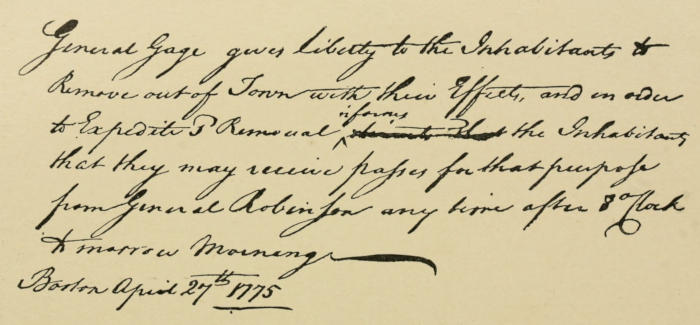
GAGE’S ORDER PERMITTING INHABITANTS TO LEAVE BOSTON
[221]
To the south and north of Virginia, counsels were divided. Those who led against the government in North Carolina had good reason to doubt whether they had even a bare majority of the people of their colony at their back. Every country-side in South Carolina, for all Charleston was as hot as Boston against the ministers, was full of warm, aggressive, outspoken supporters of the King’s prerogative. The rural districts of Pennsylvania, every one knew, were peopled with quiet Quakers whose very religion bade them offer no resistance even to oppressive power, and of phlegmatic Germans who cared a vast deal for peace but very little for noisy principles that brought mischief. Many a wealthy and fashionable family of Philadelphia, moreover, was much too comfortable and much too pleasantly connected with influential people on the other side of the water to relish thoughts of breach or rebellion. Virginians, it might have seemed, were themselves remote enough from the trouble which had arisen in Massachusetts to keep them in the cool air of those who wait and will not lead. But they were more in accord than the men of Massachusetts itself, and as quick to act. By the close of June, 1775, Charles Lee could write from Williamsburg, “Never was such vigor and concord heard of, not a single traitor, scarcely a silent dissentient.” As the men of the several counties armed themselves, as if by a common impulse, all turned as of course to Colonel Washington, of Fairfax, as their natural commander; and no one in Virginia was surprised to learn his response. “It is my full intention,” he said, “to devote my life and fortune to the cause we are engaged in.” On the 20th of March, 1775, the second revolutionary convention of Virginia met at Richmond, not at Williamsburg; and in it Mr. Henry made his individual declaration of war against Great Britain. Older and more prudent men protested against his words; but they served on the committee on the military organization of the colony for which his resolutions called, and Virginia was made ready.
Here our general authorities are still Bancroft, Hildreth, and Bryant; David Ramsay’s History of the American Revolution; the last volume of James Grahame’s Rise and Progress of the United States of North America; John Fiske’s American Revolution; [222]Thomas Hutchinson’s History of Massachusetts; John S. Barry’s History of Massachusetts; Richard Frothingham’s Rise of the Republic of the United States; Justin Winsor’s The Conflict Precipitated, in the sixth volume of Winsor’s Narrative and Critical History of America; and the twelfth chapter of W. E. H. Lecky’s History of England in the Eighteenth Century. To these we now add Frank Moore’s Diary of the American Revolution; George Chalmers’s Introduction to the History of the Revolt; Timothy Pitkin’s Political and Civil History of the United States; and the fourth volume of John Richard Green’s History of the English People. Here, also, the biographies of the chief public men of the period must be the reader’s constant resource for a closer view of affairs, particularly the Lives of such men as John and Samuel Adams, John Dickinson, Franklin, Hamilton, Patrick Henry, John Jay, Jefferson, the Lees, George Mason, James Otis, Timothy Pickering, and Washington.
The chief sources that should be mentioned are the Debates of Parliament; the Annual Register; the Proceedings and Collections of the Historical Societies of the original States; Peter Force’s American Archives; Jared Sparks’s Correspondence of the Revolution; Hezekiah Niles’s Principles and Acts of the Revolution in America; Copy of Letters sent to Great Britain by Thomas Hutchinson, reprinted in Franklin Before the Privy Council; P. O. Hutchinson’s Life and Letters of Thomas Hutchinson; and the published speeches, letters, and papers of the leading American and English statesmen of the time.
[223]
Then, almost immediately, came the clash of arms. General Gage would not sit still and see the country round about him made ready for armed resistance without at least an effort to keep control of it. On the 19th of April he despatched eight hundred men to seize the military stores which the provincials had gathered at Concord, and there followed an instant rising of the country. Riders had sped through the country-side during the long night which preceded the movement of the troops, to give warning; and before the troops could finish their errand armed men beset them at almost every turn of the road, swarming by companies out of every hamlet and firing upon them from hedge and fence corner and village street as if they were outlaws running the gauntlet. The untrained villagers could not stand against them in the open road or upon the village greens, where at first they mustered, but they could make every way-side covert a sort of ambush, every narrow bridge a trap in which to catch them at a disadvantage. Their return to Boston quickened to a veritable rout, and they left close upon three hundred of their comrades, dead, wounded, or prisoners, behind them ere they reached the cover of their lines again. The news of their march and of the attack upon them [224]had spread everywhere, and in every quarter the roads filled with the provincial minute men marching upon Boston. Those who had fired upon the troops and driven them within their lines did not go home again; those who came too late for the fighting stayed to see that there were no more sallies from the town; and the morning of the 20th disclosed a small army set down by the town in a sort of siege.
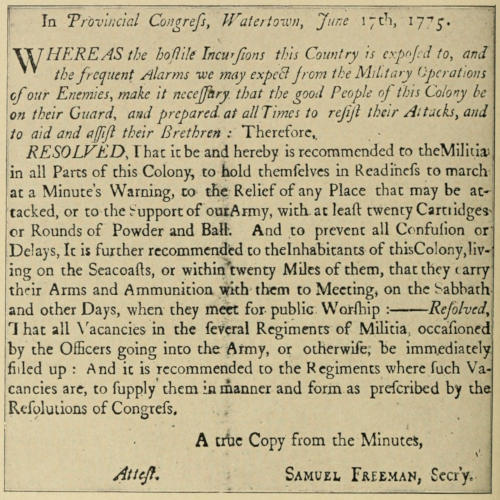
NOTICE TO MILITIA
[225]
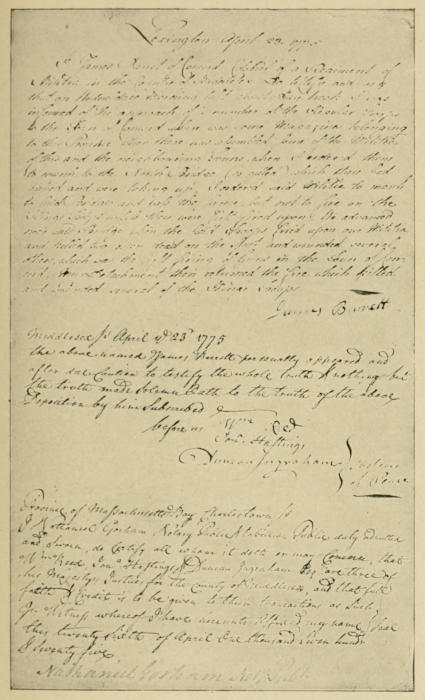
AN ACCOUNT OF THE CONCORD FIGHT
[226]
That same night of the 20th Lord Dunmore, in Virginia, landed a force of marines from an armed sloop in the river and seized the gunpowder stored at Williamsburg. There, too, the country rose,—under Mr. Henry himself as captain. They did not reach the scene soon enough to meet the marines,—there were no thick-set villages in that country-side to pour their armed men into the roads at a moment’s summons,—but they forced the earl, their governor, to pay for the powder he had ordered seized and taken off.
SIGNATURE OF ETHAN ALLEN
The rude muster at Boston expanded into a motley yeoman army of sixteen thousand men within the first week of its sudden rally, and settled in its place to watch the town until the general Congress of the colonies at Philadelphia should give it countenance, and a commander. On the day the Congress met (May 10, 1775), Ethan Allen walked into the unguarded gates of the fort at Ticonderoga, at the head of a little force out of Vermont, and took possession of the stout place “in the name of the Great Jehovah and the Continental Congress,” though he held a commission from neither; and two days later Crown Point, near by, was taken possession of in the same manner. When the Congress met it found itself no longer a mere “Congress of Committees,” assembled for conference and protest. Its appeals for better government, uttered the last autumn, its arguments for colonial privilege, its protestations of loyalty and its prayers for redress, had been, one and all, not so much rejected as put by with contempt by the King and his ministers; and the mere movement of affairs was hurrying the colonies which it represented into [227]measures which would presently put the whole matter of its controversy with the government at home beyond the stage of debate. Its uneasy members did not neglect to state their rights again, in papers whose moderation and temper of peace no candid man could overlook or deny; but they prepared for action also quite as carefully, like practical men who did not deceive themselves even in the midst of hope.
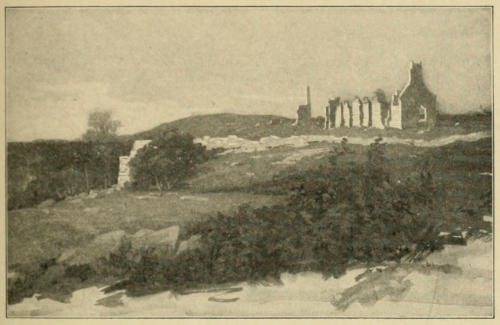
RUINS OF FORT TICONDEROGA
Colonel Washington had come to the Congress in his provincial uniform; and, if no one cared to ask a man with whom it was so obviously difficult to be familiar why he wore such a habit there, all were free to draw their own conclusions. It was, no doubt, his instinctive expression of personal feeling in the midst of all that was happening; and his service in the Congress was from first to last that of a soldier. Its committees consulted him almost every day upon some question of military preparation: the protection of the frontier against the Indians, the organization of a continental force, the management of a commissariat, the gathering of munitions, proper means of equipment, feasible plans of fortification. While they deliberated, his own colony passed openly into rebellion. The 1st of June saw Virginia’s last House of Burgesses assemble. By the 8th of the month Dunmore had fled his capital, rather than see a second time the anger of a Williamsburg mob, and was a fugitive upon one of his Majesty’s armed vessels lying in the river. The colony had thenceforth no government save such as it gave itself; and its delegates at Philadelphia knew that there was for them no turning back.
[228]
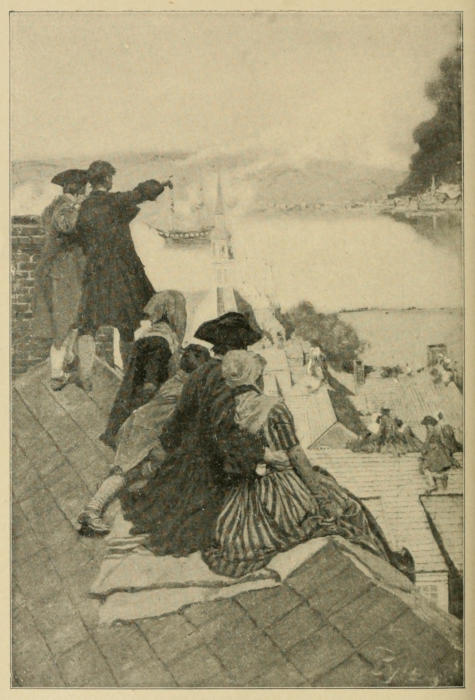
WATCHING THE FIGHT AT BUNKER HILL
[229]
On the 15th of June, on the motion of Mr. John Adams, the Congress chose Colonel Washington commander-in-chief of the American forces, and directed him to repair to Boston and assume command in the field. Two days later the British and the provincials met in a bloody and stubborn fight at Bunker Hill. On the 25th of May heavy reinforcements for General Gage had arrived from over sea which swelled the force of regulars in Boston to more than eight thousand men, and added three experienced general officers to Gage’s council: William Howe, Sir Henry Clinton, and John Burgoyne. The British commanders saw very well, what was indeed apparent enough to any soldier, that their position in Boston could be very effectively commanded to the north and south on either hand by cannon placed upon the heights of Charlestown or Dorchester, and determined to occupy Charlestown heights at once, the nearer and more threatening position. But so leisurely did they go about it that the provincials were beforehand in the project. The early morning light of the 17th of June disclosed them still at work there on trenches and redoubts which they had begun at midnight. The British did not stop to use either the guns of the fleet or any caution of indirect approach to dislodge them, but at once put three thousand men straight across the water to take the hill, whose crest the Americans were fortifying, by direct assault. It cost them a thousand men; and the colonials retired, outnumbered though they were, only because their powder gave out, not their pluck or steadfastness. When the thing was done, the British did not care to take another intrenched position from men who held their fire till they were within a few score yards of them and then volleyed with the definite and deadly aim of marksmen.
[230]
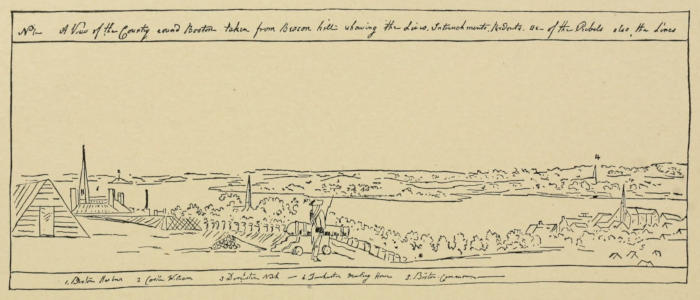
FROM BEACON HILL, 1775, NO. 1. (LOOKING TOWARDS DORCHESTER HEIGHTS)
[231]
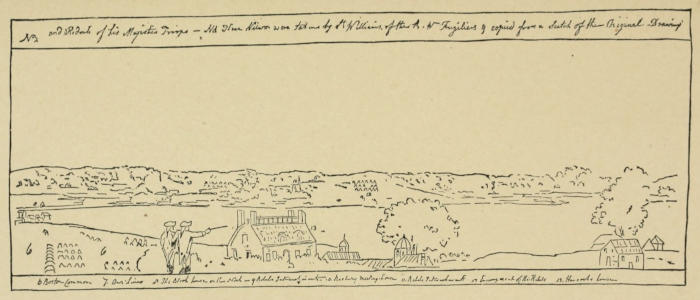
FROM BEACON HILL, 1775, NO. 2. (LOOKING TOWARDS ROXBURY)
[232]
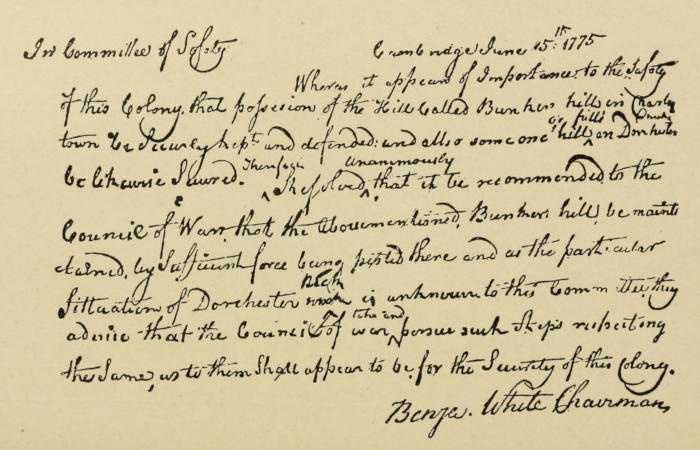
ORDER OF COMMITTEE OF SAFETY
[233]
Colonel Washington received his formal commission on the 19th, and was on horseback for the journey northward by the 21st. On the 3d of July he assumed command at Cambridge. In choosing Washington for the command of the raw levies of Massachusetts, Connecticut, Rhode Island, and New Hampshire set down in impromptu siege before Boston, Mr. John Adams and the other New Englanders who acted with him had meant, not only to secure the services of the most experienced soldier in America, but also, by taking a man out of the South, to give obvious proof of the union and co-operation of the colonies. They had chosen better than they knew. It was no small matter to have so noticeable a man of honor and breeding at the head of an army whose enemies deemed it a mere peasant mob and rowdy assemblage of rebels. Washington himself, with his notions of authority, his pride of breeding, his schooling in conduct and privilege, was far from pleased till he began to see below the surface, with the disorderly array he found of uncouth, intractable plough boys and farmers, one esteeming himself as good as another, with free-and-easy manners and a singular, half-indifferent insolence against authority or discipline.
[234]
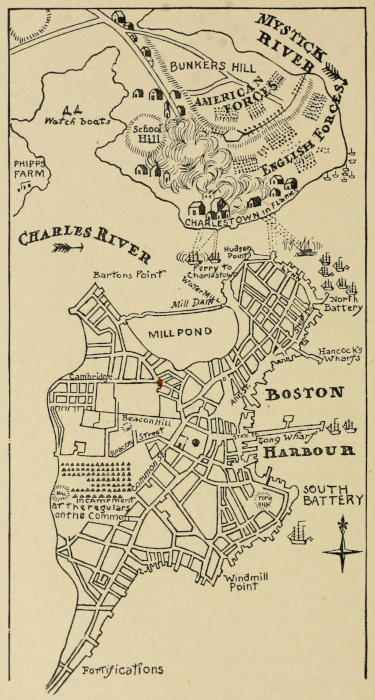
BOSTON AND BUNKER HILL, FROM A PRINT PUBLISHED IN 1781
[235]
“There are some fine fellows come from Virginia,” Joseph Reed, of Pennsylvania, had written of the Virginian delegates to the Congress at Philadelphia; “but they are very high. We understand they are the capital men of the colony.” It was good that one of the masterful group should ride all the public way from Philadelphia to Boston to take command of the army, the most conspicuous figure in the colonies, showing every one of the thousands who crowded to greet or see him as he passed how splendid a type of self-respecting gentlemen was now to be seen at the front of affairs, putting himself forward soberly and upon principle. The leaders of the revolt in Massachusetts were by no means all new men like John Adams or habitual agitators like Samuel Adams; many a man of substance and of old lineage had also identified himself with the popular cause. But new, unseasoned men were very numerous and very prominent there among those who had turned affairs upside down; a very great number of the best and oldest families of the colony had promptly ranged themselves on the side of the government; the revolution now at last on foot in that quarter could too easily be made to look like an affair of popular clamor, a mere rising of the country. It was of signal advantage to have high personal reputation and a strong flavor, as it were, of aristocratic distinction given it by this fortunate choice the Congress had [236]made of a commander. It was no light matter to despise a cause which such men openly espoused and stood ready to fight for.
The British lay still till Washington came, and gave him the rest of the year, and all the winter till spring returned, in which to get his rude army into fighting shape,—why, no one could tell, not even their friends and spokesmen in Parliament. The Americans swarmed busy on every hand. It proved infinitely difficult for them to get supplies, particularly arms and ammunition; but slowly, very slowly, they came in. General Washington was but forty-three, and had an energy which was both imperative and infectious. His urgent, explicit, businesslike letters found their way to every man of influence and to every colonial committee or assembly from whom aid could come. Cannon were dragged all the way from Ticonderoga for his use. The hardy, danger-loving seamen of the coasts about him took very cheerfully to privateering; intercepted supply ships and even transports bound for Boston; brought English merchantmen into port as prizes; cut ships out from under the very guns of a British man-of-war here and there in quiet harbors. Food and munitions intended for the British regiments at Boston frequently found their way to General Washington’s camps instead, notwithstanding Boston harbor was often full of armed vessels which might have swept the coasts. The commanders in Boston felt beset, isolated, and uneasy, and hesitated painfully what to do.
The country at large was open to the insurgent forces, to move in as they pleased. In the autumn Colonel Montgomery, the gallant young Irish soldier who had served under Wolfe at Quebec, led a continental force [237]northward through the wilderness; took the forts which guarded the northern approaches to Lake Champlain; and occupied Montreal, intercepting and taking the little garrison which left the place in boats to make its way down the river. Meanwhile Colonel Benedict Arnold was at the gates of Quebec, and Montgomery pushed forward to join him. Colonel Arnold had forced his way in from the coast through the thick forests of Maine, along the icy streams of the Kennebec and the Chaudière. The bitter journey had cost him quite a third of the little force with which Washington had sent him forth. He had but seven hundred men with whom to take the all but impregnable place, and Montgomery brought but a scant five hundred to assist him. But the two young commanders were not to be daunted. They loved daring, and touched all who followed them with their own indomitable spirit. In the black darkness of the night which preceded the last day of the year (December 31, 1775), amidst a blinding storm of snow, they threw themselves upon the defences of the place, and would have taken it had not Montgomery lost his life ere his men gained their final foothold within the walls. The Congress at Philadelphia had at least the satisfaction of receiving the colors of the Seventh Regiment of his Majesty’s regulars, taken at Fort Chambly, as a visible token of Montgomery’s exploits at the northern outlet of Champlain; and every added operation of the Americans, successful or unsuccessful, added to the feeling of isolation and uneasiness among the British at Boston.
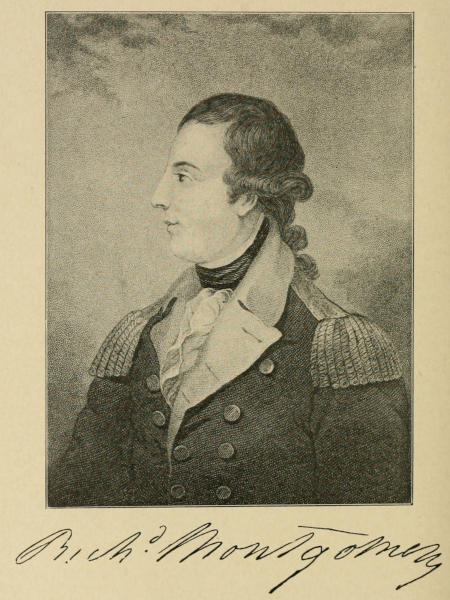
RICHARD MONTGOMERY
October 10, 1775, Sir William Howe superseded General Gage as commander-in-chief in the closely watched and invested town; but the change of commanders [238]made little difference. Every one except the sailors, the foragers, the commissaries, the drill sergeants, the writing clerks, the colonial assemblies, the congressional and local committees, lay inactive till March came, 1776, and Washington was himself ready to [239]take the offensive. At last he had such cannon and such tools and stores and wagons and teams as he had been asking and planning and waiting for the weary, anxious winter through. On the morning of the 5th of March the British saw workmen and ordnance and every sign of a strong force of provincials on Dorchester heights, and were as surprised as they had been, close upon a year before, to see men and trenches on Bunker Hill. Washington had done work in the night which it was already too late for them to undo; a storm beat the waters of the bay as the day wore on and made it impossible to put troops across to the attack in boats; Washington had all the day and another night in which to complete his defences; and by the morning of the 6th the British knew that the heights could not be taken without a risk and loss they could not afford. The town was rendered untenable at a stroke. With deep chagrin, Howe determined upon an immediate evacuation; and by the 17th he was aboard his ships,—eight thousand troops and more than a thousand loyalists who dared not stay. The stores and cannon, the ammunition, muskets, small-arms, gun carriages, and supplies of every kind which he found himself obliged to leave behind enriched Washington with an equipment more abundant than he could ever have hoped to see in his economical, ill-appointed camp at Cambridge.
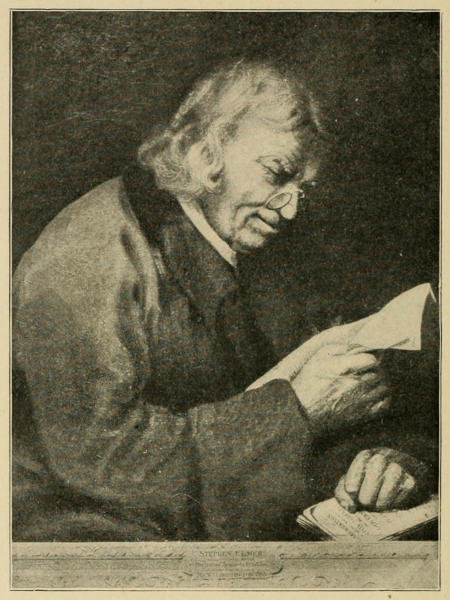
BENJAMIN FRANKLIN AS A POLITICIAN
The only British army in America had withdrawn to Halifax: his Majesty’s troops had nowhere a foothold in the colonies. But that, every one knew, was only the first act in a struggle which must grow vastly greater and more tragical before it was ended. Washington knew very well that there was now no drawing back. [240]Not since the affair at Bunker Hill had he deemed it possible to draw back; and now this initial success in arms had made the friends of revolution very bold everywhere. As spring warmed into summer it was easy to mark the growth in the spirit of independence. One of the first measures of the Continental Congress, after coming together for its third annual session in May, 1776, was to urge the several colonies to provide [241]themselves with regular and permanent governments as independent states, instead of continuing to make shift with committees of safety for executives and provisional “provincial congresses” for legislatures, as they had done since their government under the crown had fallen to pieces; and they most of them promptly showed a disposition to take its advice. The resolution in which the Congress embodied this significant counsel plainly declared “that the exercise of every kind of [242]authority under the crown ought to be totally suppressed,” and all the powers of government exercised under authority from the people of the colonies,—words themselves equivalent to a declaration for entire separation from Great Britain. Even in the colonies where loyalists mustered strongest the government of the crown had in fact almost everywhere been openly thrown off. But by midsummer it was deemed best to make a formal Declaration of Independence. North Carolina was the first to instruct her delegates to take that final and irretrievable step; but most of the other colonies were ready to follow her lead; and on July 4th Congress adopted the impressive Declaration which Mr. Jefferson had drawn up in the name of its committee.
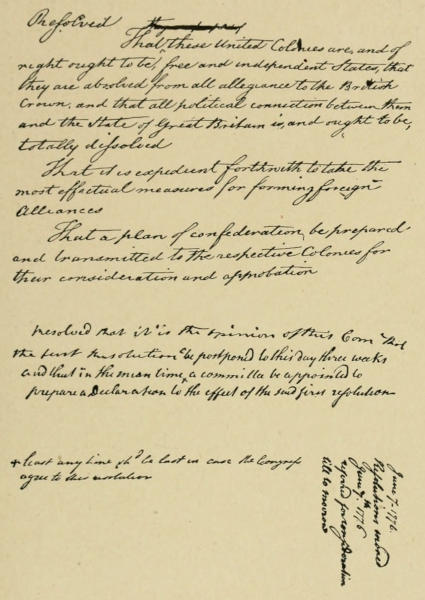
R. H. LEE’S RESOLUTION FOR INDEPENDENCE
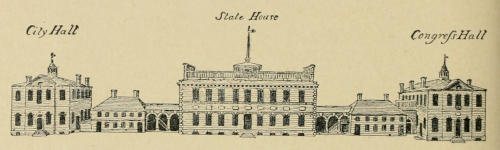
STATE HOUSE, PHILADELPHIA, 1778
Washington himself had urgently prayed that such a step be taken, and taken at once. It would not change, it would only acknowledge, existing facts; and it might a little simplify the anxious business he was about. He had an army which was always making and to be made, because the struggle had been calculated upon a short scale and the colonies which were contributing their half-drilled contingents to it were enlisting their men for only three months at a time. Sometimes the [243]men would consent to re-enlist, sometimes they would not. They did as they pleased, of course, and would time and again take themselves off by whole companies at once when their three months’ term was up. Sir William Howe would come back, of course, with a force increased, perhaps irresistible: would come, Washington foresaw, not to Boston, where he could be cooped up and kept at bay, but to New York, to get control of the broad gateway of the Hudson, whose long valley had its head close to the waters of Lake George and Lake Champlain, and constituted an infinitely important strategic line drawn straight through the heart of the country, between New England, which was no doubt hopelessly rebellious, and the middle colonies, in which the crown could count its friends by the thousand. The Americans must meet him, apparently, with levies as raw and as hastily equipped as those out of which an army of siege had been improvised at Boston, each constituent part of which would fall to pieces and have to be put together again every three months.
SIGNATURE OF THOMAS JEFFERSON
[244]
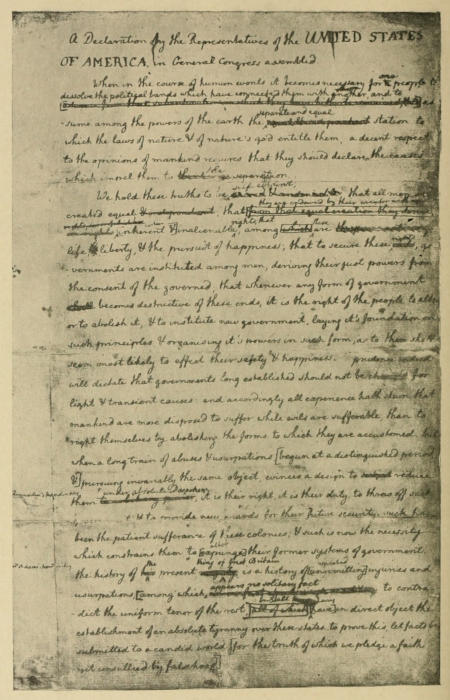
JEFFERSON’S ORIGINAL DRAFT OF THE DECLARATION OF INDEPENDENCE
[245]
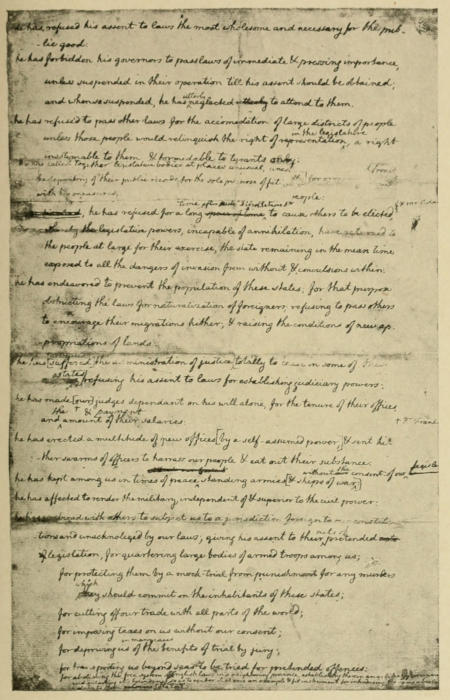
[246]
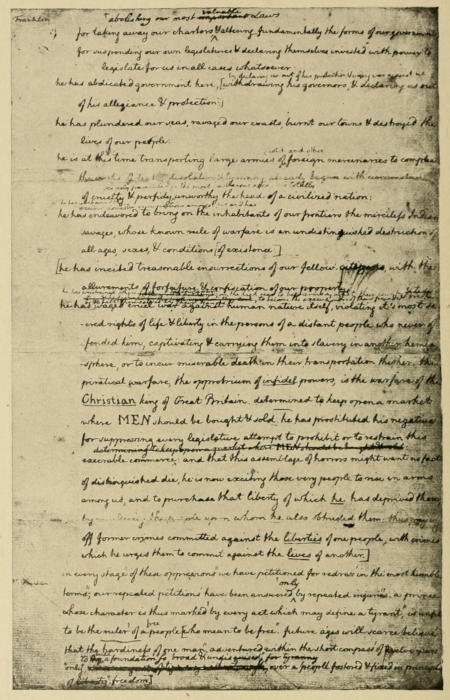
[247]
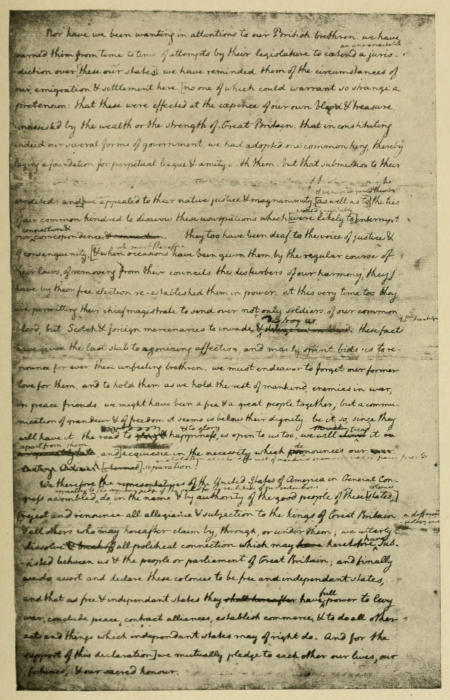
The worst of it was, that the country back of New York had not been, could not be, purged of active loyalists as the country round about Boston had been by the local “committees” of one sort or another and by the very active and masterful young men who had banded themselves together as “Sons of Liberty,” seeing [248]much rich adventure, and for the present little responsibility, ahead of them in those days of government by resolution. Washington transferred his headquarters to New York early in April and set about his almost hopeless task with characteristic energy and fertility of resource; but there were spies without number all about him, and every country-side was full of enemies who waited for General Howe’s coming to give him trouble. The formal Declaration of Independence which the Congress adopted in July hardened the face and stiffened the resolution of every man who had definitely thrown in his lot with the popular cause, as Washington had foreseen that it would, just because it made resistance avowed rebellion, and left no way of retreat or compromise. But it also deeply grieved and alienated many a man [249]of judgment and good feeling, and made party differences within the colonies just so much the more bitter and irreconcilable.
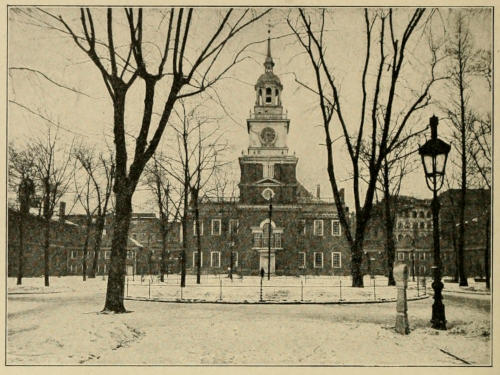
REAR VIEW OF INDEPENDENCE HALL
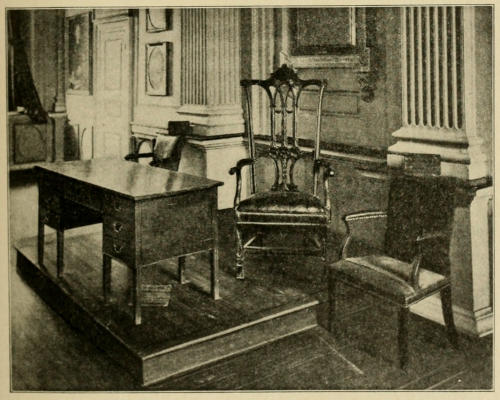
THE PRESIDENT’S CHAIR IN THE CONSTITUTIONAL CONVENTION
The first attempt of the British was made against Charleston in the south. A fleet under Sir Peter Parker came out of England with fresh troops commanded by the Earl of Cornwallis, was joined by transports and men-of-war from Halifax, bearing a force under Sir Henry Clinton, and, as June drew towards its close, delivered a combined attack, by land and sea, upon the fort on Sullivan’s Island, seeking to win its way past to the capture of Charleston itself. But they could not force a passage. Two of the ships,—one of them Sir Peter’s own flag-ship,—never came away again. Colonel Moultrie and Colonel Thompson beat [250]off both the fleet and the troops landed from it; and the British went northward again to concentrate upon New York.
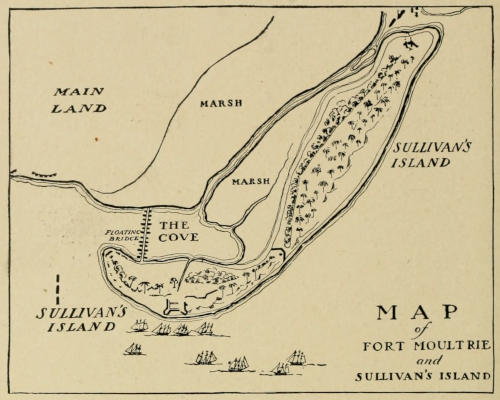
MAP OF SULLIVAN’S ISLAND
On the 28th of June,—the very day of the attack at Charleston,—Howe’s transports began to gather in the lower bay. A few days more, and there were thirty thousand troops waiting to be landed. It was impossible, with the force Washington had, to prevent their being put ashore at their commander’s convenience. It was impossible to close the Narrows, to keep their ships from the inner bay, or even to prevent their passing up the river as they pleased. Washington could only wait within the exposed town or within his trenches on Brooklyn heights, which commanded the town almost [251]as Dorchester and Charlestown heights commanded Boston.
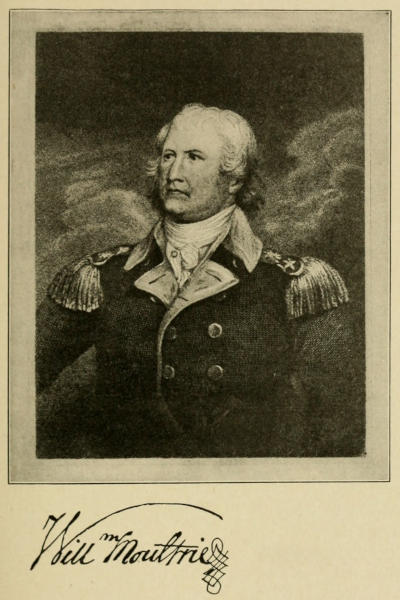
WILLIAM MOULTRIE
For a month and more Sir William waited, his troops most of them still upon the ships, until he should first attempt to fulfil his mission of peace and accommodation. [252]His brother, Admiral Lord Howe, joined him there in July. They were authorized to offer unconditional pardon, even now, to all who would submit. The ministers in England could not have chosen commissioners of peace more acceptable to the Americans or more likely to be heard than the Howes. Not only were they men of honor, showing in all that they did the straightforward candor and the instinctive sense of duty that came with their breeding and their training in arms, but they were also brothers of that gallant young soldier who had come over almost twenty years ago to fight the French with Abercrombie, to be loved by every man who became his comrade, and to lose his life untimely fighting forward through the forests which lay about Ticonderoga, a knightly and heroic figure. But they could offer no concessions,—only pardon for utter submission, and, for all their honorable persistency, could find no one in authority among the Americans who would make the too exacting exchange. Their offers of pardon alternated with the movements of their troops and their steady successes in arms. Lord Howe issued his first overture of peace, in the form of a public proclamation offering pardon, immediately upon his arrival with his fleet at Sandy Hook, and followed it up at once with messages to the Congress at Philadelphia. Sir William Howe put his troops ashore on the 22d of August, and made ready to dislodge Washington from the heights of Brooklyn; but on the 23d he too, in his turn, made yet another offer of general pardon, by proclamation.
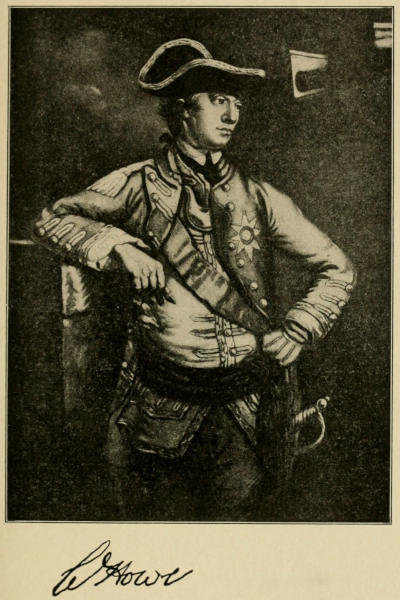
SIR WILLIAM HOWE
On the 27th he drove the American forces on Long Island in on their defences, and rendered the heights at once practically untenable. Washington had but [253]eighteen thousand half-disciplined militiamen with which to hold the town and all the long shores of the open bay and river, and had put ten thousand of them across the river to hold Long Island and the defences on the heights. Sir William had put twenty [254]thousand men ashore for the attack on the heights; and when Washington knew that his advanced guard was driven in, and saw Sir William, mindful of Bunker Hill, bestow his troops, not for an assault, but for an investment of the heights, he perceived at once how easily he might be cut off and trapped there, armed ships lying at hand which might at any moment completely command the river. Immediately, and as secretly as quickly, while a single night held, he withdrew every man and every gun, as suddenly and as successfully as he had seized the heights at Dorchester.
Again Sir William sent a message of conciliation to the Congress, by the hands of General Sullivan, his prisoner. On the 11th of September, before the next movement of arms, Dr. Franklin, Mr. John Adams, and Mr. Edward Rutledge met Lord Howe and Sir William, as commissioners from the Congress, to discuss possible terms of accommodation. Dr. Franklin had been in London until March. During the past winter he had more than once met Lord Howe in earnest conference about American affairs, the ministers wishing to find through him some way, if it were possible, of quieting the colonies. But the ministers had not been willing then to make the concessions which might have ended the trouble, and their commissioners were not authorized to make them now; and the conference with the representatives of the Congress came to nothing, as the conferences in London had come to nothing.
[255]
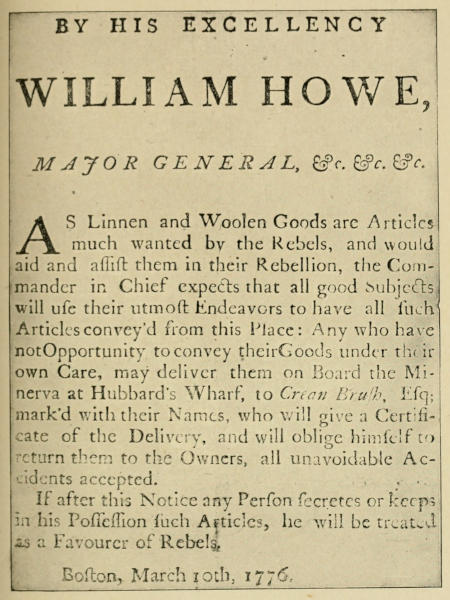
HOWE’S PROCLAMATION PREPARATORY TO LEAVING BOSTON
[256]
Washington could no more hold Manhattan Island with the forces at his command than he could hold Brooklyn heights. He had no choice in the end but to retire. General Howe was cautious, moved slowly, and handled his forces with little energy or decision; Washington made stand and fought at every point at which there was the least promise of success. His men and his commanders were shamefully demoralized by their defeat on Long Island, but he held them together with singular tact and authority: repulsed the enemy at Haarlem heights (September 16th), held his own before them at White Plains (October 28th),—and did not feel obliged to abandon the island until late in November, after General Greene had fatally blundered by suffering three thousand of the best trained men of the scant continental force, with invaluable artillery, small-arms, and stores, to be trapped and taken at Fort Washington (November 16th).
When he did at last withdraw, and leave Howe in complete control of the great port and its approaches, the situation was indeed alarming. He had been unspeakably stung and disquieted, as he withdrew mile by mile up the island, to see how uncertain his men were in the field,—how sometimes they would fight and sometimes they would not at the hot crisis of a critical encounter; and now things seemed to have gone utterly to pieces. He might at any moment be quite cut off from New England. While he still faced Howe on Manhattan Island, General Carleton, moving with a British force out of Canada, had driven Benedict Arnold up Champlain, despite stubborn and gallant resistance (October 11th and 13th), and on the 14th of October had occupied Crown Point. There he had stopped; and later news came that he had withdrawn. But apparently he could strike again almost when he pleased, and threaten all the long line of the Hudson even to where Howe lay at New York itself.
[257]
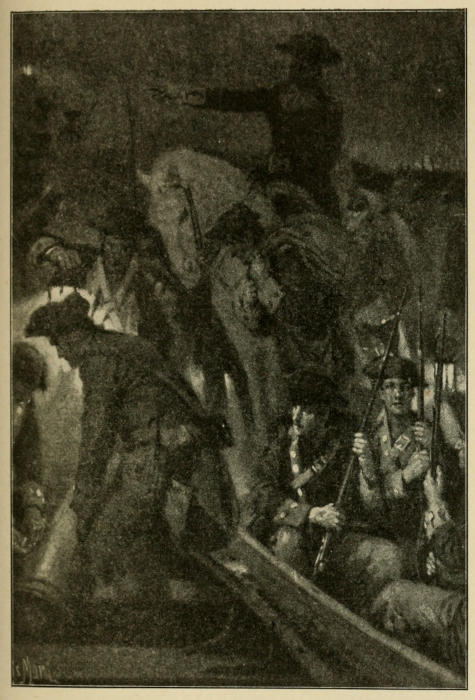
EVACUATION OF BROOKLYN HEIGHTS
[258]
It was not mere defeat, however, that put the cast almost of despair upon affairs as Washington saw them that dismal autumn. His forces seemed to melt away under his very eyes. Charles Lee, his chief subordinate in command, too much a soldier of fortune to be a man of honor, obeyed or disregarded his orders at his own discretion. When once it was known that General Washington had been obliged to abandon the Hudson, consternation and defection spread everywhere. On the 30th of November, when his defeat seemed complete, it might be final, the Howes joined in a fresh proclamation of pardon, inviting all, once again, to submit and be forgiven; and it looked for a little as if all who dared would take advantage of the offer and make their peace with the enemy,—for Washington now moved in a region where opinion had from the first been sharply divided. While defection spread he was in full retreat, with scarcely three thousand men all told in his demoralized force,—that handful ill-clad and stricken with disease, and dwindling fast by desertion,—an overwhelming body of the enemy, under Cornwallis, at his very heels as he went, so that he dared hardly so much as pause for rest until he had put the broad shelter of the Delaware behind him. “These are the times that try men’s souls,” cried Thomas Paine (December, 1776); “the summer soldier and the sunshine patriot” were falling away. One after another, that very summer, the delegates of the several states had put their names to the Declaration of Independence; but already there seemed small prospect of making it good. To not a few it already began to seem a piece of mere bravado, to be repented of.
[259]
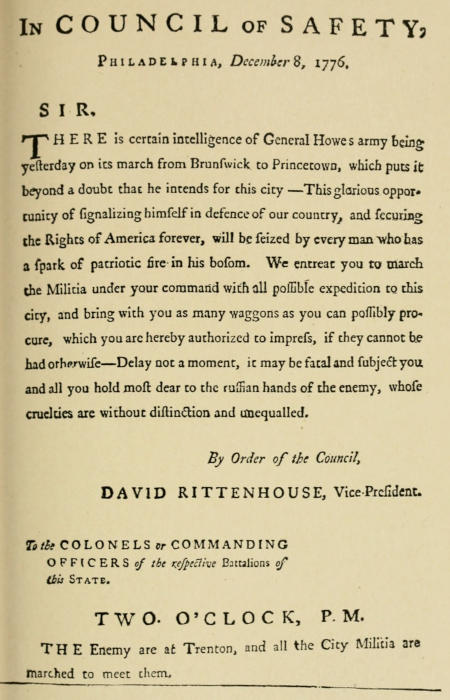
CIRCULAR OF PHILADELPHIA COUNCIL OF SAFETY
[260]
The real strength and hope of the cause lay in the steadfastness and the undaunted initiative of the indomitable Virginian whom the Congress had chosen for the chief command. He proved himself a maker as well as a commander of armies, struck oftenest when he was deemed most defeated, could not by any reverse be put out of the fighting. He was now for the first time to give the British commanders a real taste of his quality. What there was to be done he did himself. The British stopped at the Delaware; but their lines reached Burlington, within eighteen miles of Philadelphia, and from Trenton, which they held in some force, extended through Princeton to New Brunswick and their headquarters at New York. Philadelphia was stricken with utter panic. Sick and ragged soldiers poured in from Washington’s camp, living evidences of what straits he was in, and had to be succored and taken care of; the country roads were crowded with vehicles leaving the town laden with women and children and household goods; the Congress itself incontinently fled the place and betook itself to Baltimore. Washington’s military stores were in the town, but he could get no proper protection for them. It was at that very moment, nevertheless, that he showed all the world with what skill and audacity he could strike. By dint of every resolute and persistent effort he had before Christmas brought his little force to a fighting strength of some six thousand. More than half of these were men enlisted only until the new year should open, but he moved before that.
[261]
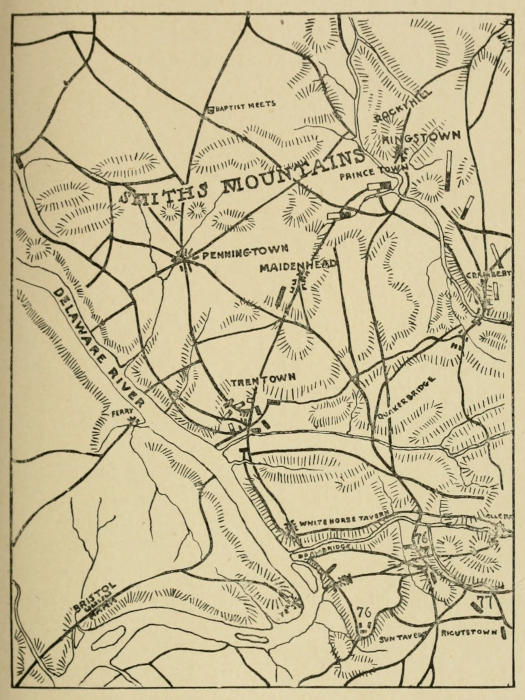
OPERATIONS AROUND TRENTON AND PRINCETON. NUMBERS 76 REPRESENT THE CAMPS OF GENERAL CORNWALLIS AND 77 THAT OF GENERAL KNYPHAUSEN ON THE 23D OF JUNE, 1777
[262]
During the night of Christmas Day, 1776, ferried by doughty fishermen from far Gloucester and Marblehead,—the same hardy fellows who had handled his boats the night he abandoned the heights of Brooklyn,—he got twenty-five hundred men across the river through pitchy darkness and pounding ice; and in the early light and frost of the next morning he took Trenton, with its garrison of nine hundred Hessians, at the point of the bayonet. There he waited,—keeping his unwilling militiamen to their service past the opening of the year by dint of imperative persuasion and a pledge of his own private fortune for their pay,—until Cornwallis came down post-haste out of New York with eight thousand men. Moving only to change his position a little, he dared to wait until his adversary was encamped, at nightfall of the 2d of January, 1777, within ear-shot of his trenches; then slipped northward in the night, easily beat the British detachment posted at Princeton, as the next day dawned and had its morning; and could have taken or destroyed Cornwallis’s stores at New Brunswick had his men been adequately shod to outstrip the British following hard behind them. As it was, he satisfied himself with having completely flanked and thwarted his foe, and withdrew safe to the heights of Morristown. The British had hastily retired from Burlington upon the taking of Trenton,—so hastily that they took neither their cannon nor even their heavier baggage away with them. Now they deemed it unsafe to take post anywhere south of New Brunswick, until spring should come and they could see what Washington meant to do. Once again, therefore, the Americans controlled New Jersey; and Washington ordered all who had accepted General Howe’s offer of pardon either to withdraw to the British lines or take the oath of allegiance to the United States. Daring and a touch of genius had turned despair into hope. Americans did not [263]soon forget that sudden triumph of arms, or that the great Frederick of Prussia had said that that had been the most brilliant campaign of the century.
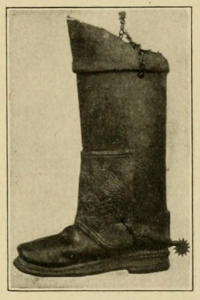
HESSIAN BOOT
A soldier’s eye could see quickly and plainly enough how the whole aspect of the war had been changed by those brief, sudden, unexpected strokes at Trenton and Princeton. Men near at hand, and looking for what a soldier would deem it no business of his to reckon with, saw that it had not only radically altered the military situation, but also the very atmosphere of the times for all concerned. The fighting at Trenton and Princeton had been of no great consequence in itself, but it had in every way put the war beyond its experimental stage. It had taught the British commanders with what sort of spirit and genius they had to deal, and how certain it was that their task must be carried to a finish not only by conquering marches and a mere occupation of the country, but by careful strategy and the long plans of a set campaign. Moreover, they now obviously had a country, and not an insurgent army merely, to conquer,—and a vast country at that. That surprising winter had set men’s sinews to what they had undertaken, on the one side as on the other.
In December (1776) it had looked as if all firmness had been unnerved and all hope turned to foreboding by the success of the British at New York and in the Jerseys. Joseph Galloway, of Pennsylvania, when [264]that crisis came, took advantage of the opportunity to remove within the British lines and cast in his lot there with those who were ready to stake everything upon their loyalty and the success of the British arms. Others followed his example,—some out of panic, but many, it seemed, not out of fear, but out of principle. Only the other day Mr. Galloway had been the chief figure in the Congress of Committees which spoke for the colonies; for many a long day he had been the chief figure in the politics of his own colony; and many of those who made submission when he did were of families of the first dignity and consequence. They, like him, had been champions of colonial rights until it came to the point of rebellion. They would not follow further. Their example was imitated now, moreover, in their act of formal submission, by some who had played the part of patriot more boldly and with less compunction. Mr. Samuel Tucker, even, who until this untoward month had been president of New Jersey’s revolutionary committee of safety, made his submission. It seemed hard to find steadfastness anywhere.
[265]
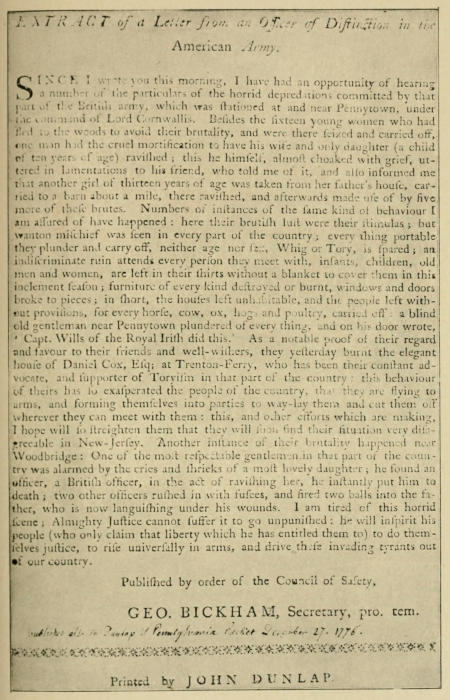
LETTER CONCERNING BRITISH OUTRAGES
[266]
But Washington’s genius and the license of the British soldiery had turned the tide at last, when it seemed upon the very point of becoming overwhelming. The occupation of the British, brief as it had been, had brought upon New York and the Jerseys experiences like those of a country overrun by a foreign soldiery permitted almost every license of conquest. When the ministers in England found themselves, in 1774, face to face with the revolt in the colonies, they could count but 17,547 men all told in the King’s forces; and when it came to sudden recruiting, they could obtain very few enlistments. They dared not risk conscription,—English opinion had never tolerated that, except to meet invasion. They sent to America, therefore, to reinforce General Howe, not only English soldiers as many as they could muster, but a great force of German troops as well, hired by the regiment, their trained officers included, from the Landgrave of Hesse-Cassel and other German princes, neighbors to the German dominions of the House of Hannover. It was close upon a thousand of these “Hessians” (for the colonists knew them all by that single name) that Washington had taken at Trenton, but not until they and their comrades had had time to make every country-side from New York to the Delaware dread and hate them. The British commanders had suffered their men, whether English or foreign, to plunder houses, insult and outrage women, destroy fields of grain, and help themselves to what the towns contained almost as they pleased; and had hardened the faces of ten of the angry colonists against them for every one who made submission and sought to put himself on their side, accordingly. Their marauding parties made little distinction between friend and foe, so they but got what they wanted. Washington could thank them for doing more to check defections from the patriotic party than he could possibly do for himself by carrying out the orders of the Congress to disarm all loyalists and bring recusants to a sharp reckoning.
[267]
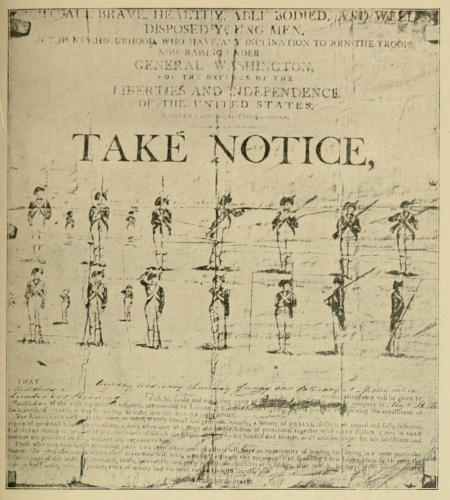
RECRUITING POSTER
Editor’s Note.—The blurred inscription at the bottom of the poster reads as follows:
That tuesday, wednesday, thursday, friday, and saturday, at Spotswood, in Middlesex county, attendance will be given by Lieutenant Reading, with his music and recruiting party of —— company in Major Shute’s Battalion of the 11th regiment of infantry, commanded by Lieutenant-Colonel Aaron Ogden, for the purpose of receiving the enrollment of such youth of spirit as may be willing to enter into this honourable service.
The Encouragement, at this time, to enlist is truly liberal and generous, namely, a bounty of twelve dollars, an annual and fully sufficient supply of good and handsome cloathing, a daily allowance of a large and ample ration of provisions, together with sixty dollars a year in gold and silver money on account of pay, the whole of which the soldier may lay up for himself and friends, as all articles proper for his subsistence and comfort are provided by law, without any expence to him.
Those who may favour this recruiting party with their attendance as above will have an opportunity of hearing and seeing in a more particular manner the great advantages which these brave men will have who shall embrace this opportunity of spending a few happy years in viewing the different parts of this beautiful continent, in the honourable and truly respectable character of a soldier, after which he may, if he pleases, return home to his friends, with his pockets full of money and his head covered with laurels.
GOD SAVE THE UNITED STATES.
[268]
And so the year 1777 dawned like a first year of settled war and revolution. For a little while, at the outset of the year, the Congress made Washington practical dictator in every affair that concerned the prosecution of the war. It authorized long enlistments, moreover, instead of the makeshift enrolments for three months which had hitherto kept Washington’s army always a-making and to be made, dissolving and reforming month by month. The Congress had, it is true, neither the energy nor the authority it needed. It could get little money to pay the troops; its agents seriously mismanaged the indispensable business of supplying the army with stores and clothing; and the men deserted by the score in disgust. Washington declared, in the summer of 1777, that he was losing more men by desertion than he was gaining by enlistment, do what he would. But these were difficulties of administration. In spite of all dangers and discouragements, it was evident that the continent was settling to its task. And the end of the year showed the struggle hopefully set forward another stage.
The military operations of that memorable year were a striking illustration of the magnitude of the task the British generals were set to accomplish, and of their singular lack of the energy, decision, and despatch necessary to accomplish it. They seemed like men who dallied and dreamed and did not mean to succeed. They planned like men of action, but then tarried and bungled at the execution of their plans. It was their purpose that year (1777) to strike from three several directions along the valley of the Hudson, and break once for all the connection between the New England colonies and their confederates. General Burgoyne was to move, with eight thousand men, down Lake Champlain; Colonel St. Leger, with a small but sufficient force, along a converging line down the valley of the Mohawk, from Oswego on Ontario; and General Howe was to meet them from the south, moving in strength up the Hudson. More than thirty-three thousand men would have effectually swept the whole of that great central valley, north and south, when their plan was executed. But it was not executed. The British commanders were to learn that, for their armies, the interior of the country was impracticable.
[269]
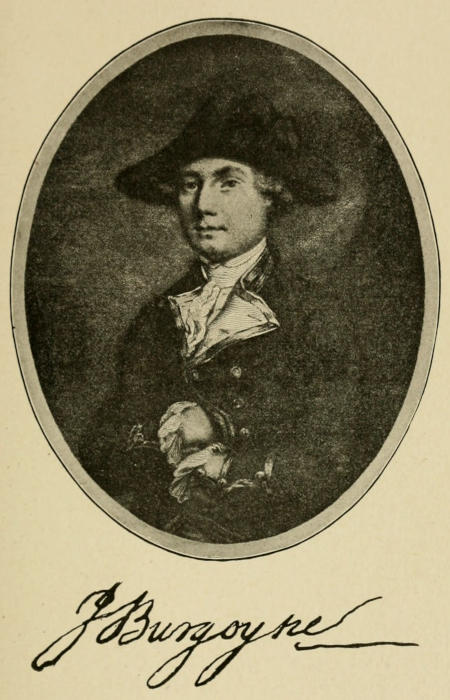
JOHN BURGOYNE
[270]
Both St. Leger and Burgoyne were baffled in that vast wilderness. It was simple enough for Burgoyne to descend the lakes and take once again the forts which guarded them. Even Ticonderoga he took without a blow struck. A precipitous height, which the Americans had supposed inaccessible by any sort of carriage, rose above the strong fortifications of the place beyond a narrow strip of water; the English dragged cannon to its summit; and General St. Clair promptly withdrew in the night, knowing his position to be no longer tenable. But it was another matter to penetrate the forests which lay about Lake George and the upper waters of the Hudson with militiamen out of every country-side within reach swarming thicker and thicker at every step the redcoats took into the depths of the perplexing region. A thousand men Burgoyne felt obliged to leave at Ticonderoga for the sake of his communications; close upon a thousand more he lost (August 16th) at Bennington, whither he had sent them to seize stores; and by the time he had reached the neighborhood of Saratoga with the six thousand left him, fully fourteen thousand provincials beset him. He had been told that the people of the country through which he was to pass would gladly give him aid and succor; that those quiet forests of Vermont and New York would even yield him, it might be, a regiment or two of loyalists wherewith to recruit his ranks when once his presence there should give the secluded settlers [271]heart of grace to declare themselves openly for the King. Instead of that, he presently had a formidable force of provincial yeomanry out of Vermont dogging his steps under General Lincoln; a like levy, hurriedly drawn together out of New Hampshire and Massachusetts, beat and captured his best German troops at Bennington; the country was emptied of its people [272]and of its cattle, was stripped of its forage even, as he advanced; and every step he took threatened to cut him off alike from his sources of supply and from his lines of retreat. It maddened the watchful men of those scattered homes to see him come with half a thousand savages at his front. It had been bad enough to see any invaders on that defenceless border: but the presence of the redskins put their homes and their lives in immediate and deadly peril, and they mustered as they would have mustered to meet a threat of massacre. Burgoyne himself would have checked his savage allies when the mischief had been done and it was too late; but he only provoked them to desert him and leave him without guides in an almost pathless wilderness, without appeasing the men their presence had brought swarming upon his flanks.
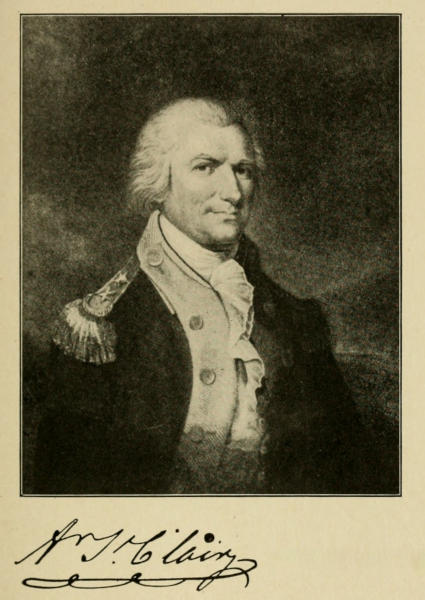
ARTHUR ST. CLAIR
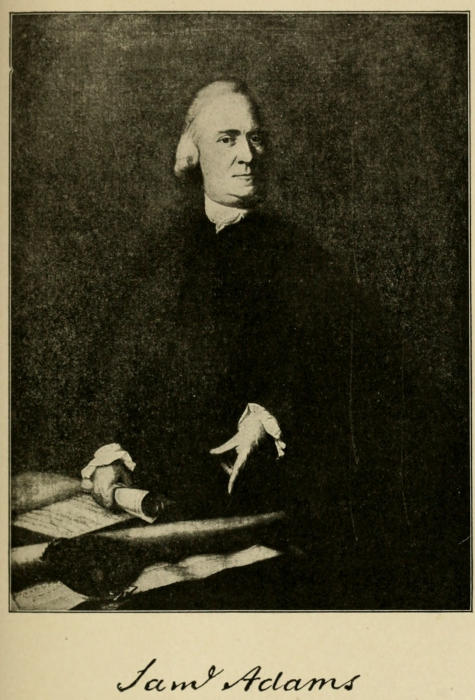
SAMUEL ADAMS
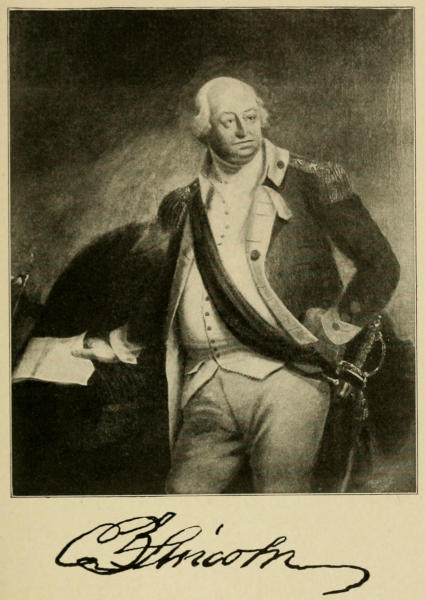
BENJAMIN LINCOLN
He pushed forward nevertheless, dogged, indomitable, determined to risk everything rather than fail of his rendezvous with Howe and St. Leger at the Hudson. And yet close upon the heels of his defeat and heavy loss at Bennington came news that St. Leger had already failed. Late in July, St. Leger had thrust his way cautiously through the forests from Oswego to the upper waters of the Mohawk; and there, on the 3d of August, he had set himself down to take Fort Stanwix, with its little garrison of six hundred men under Colonel Peter Gansevoort. There, if anywhere, in those northern forests by the Mohawk, might men who fought in the name of the King look to be bidden Godspeed and given efficient aid and counsel by the settlers of the country-side through which they moved. There William Johnson (Sir William since the French war) had reigned supreme for a long generation, his [273]energy, subtlety, quick resource, and never failing power over men holding the restless Iroquois always to their loyalty to the English, the English always to their duty to the crown. Sir William had been dead these three years; but his son, Sir John, still held his [274]ancient allies to their fealty and stood at the front of those who would not accept the revolution wrought at Boston and Williamsburg and Philadelphia. This war among the English sadly puzzled the red warriors of the forest. War between the king of the French and the king of the English they understood; it was a war of hostile peoples; but this war of the English [275]against their chiefs? “You are two brothers,” they said, “of one blood.” The Mohawks deemed it some subtile treachery, as their great chief did, the redoubtable Joseph Brant, himself trained with the English boys in Mr. Wheelock’s school at Lebanon and taught to see the white man close at hand; and the Cayugas and Senecas followed them in their allegiance to the mighty sachem who “lived over the great lake,” their friend and ally time out of mind. The Onondagas held off, neutral. The Oneidas and Tuscaroras, among whom Mr. Kirkland was missionary, aided the patriots when they could, because he wished it, but would not take the war-path. There were white loyalists, too, as well as red, on that far frontier. Sir John Johnson was their leader. Their regiment of Royal Greens, together with John Butler’s Tory rangers, constituted the bulk of St. Leger’s motley force of seventeen hundred, red men and white. Scottish highlanders, stubborn Englishmen [276]hot against the revolution, and restless Irishmen, for the nonce on the side of authority, filled their ranks.
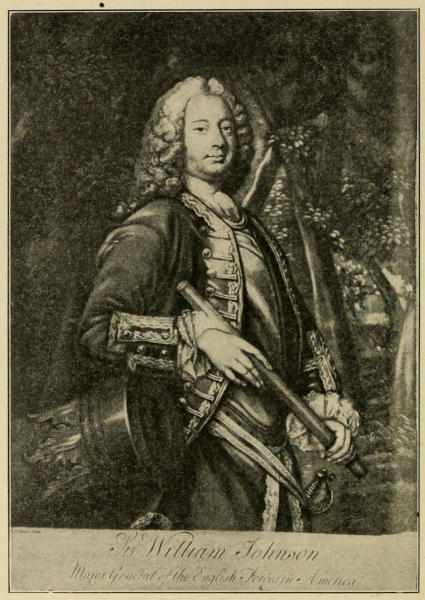
SIR WILLIAM JOHNSON
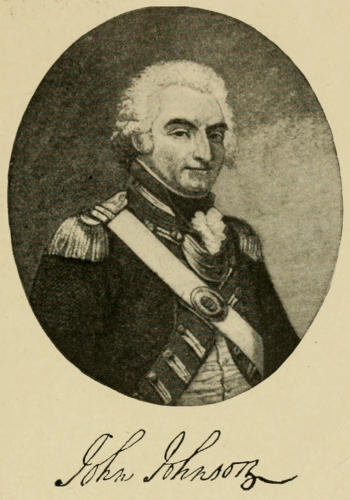
SIR JOHN JOHNSON
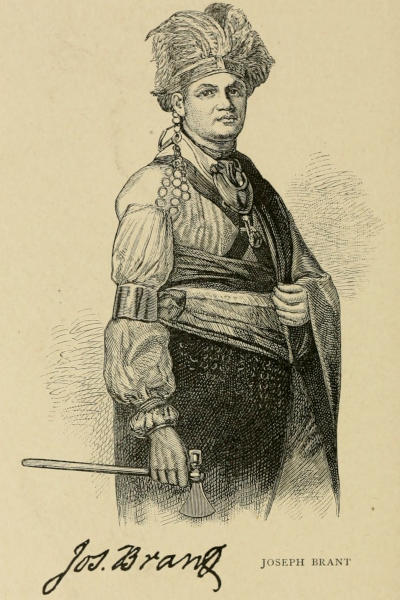
JOSEPH BRANT
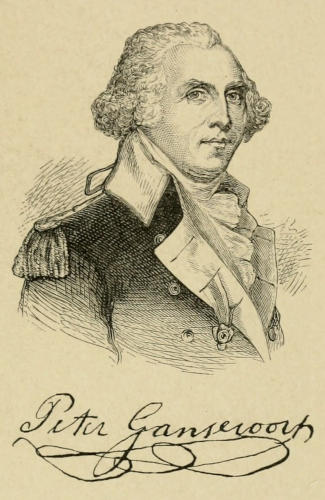
PETER GANSEVOORT
But even there, in Sir William Johnson’s one-time kingdom, enemies of King and Parliament mustered stronger yet, and showed quicker concert, freer, more instant union than the Tories. There were Dutch [277]there, and Germans and Scots-Irish, who recked nothing of the older ties that had bound them when it came to the question whether they should yield in their own affairs to masters over sea. Peter Gansevoort commanded the little garrison at Stanwix; Nicholas Herkimer brought eight hundred men to his succor. Brant and Johnson trapped the stout-hearted German in a deadly ambush close by Oriskany as he came; but he beat them off. While that heroic struggle went forward there in the close ravine the hot morning through (August 6, 1777), Gansevoort made sally and sacked Sir John’s camp. Herkimer could come no further; but there came, instead, rumors that Burgoyne was foiled and taken and the whole American army on the road to Stanwix. It was only Benedict Arnold, with twelve hundred Massachusetts volunteers; but the rumors they industriously sent ahead of them carried the panic they had planned, and when they came there was no army to meet. St. Leger’s men were in full flight to Oswego, the very Indians who had been their allies [278]harrying them as they went, in mere wanton savagery and disaffection.
Though he knew now that St. Leger could not come, though he knew nothing, and painfully conjectured a thousand things, of Sir William Howe’s promised movement below upon the river, Burgoyne pushed forward to the Hudson and crossed it (September 13, 1777), to face the Americans under General Gates upon the western bank. It was as safe to go forward as to turn back. Gates, secure within his intrenchments, would not strike; and he, his supplies instantly threatened behind him, could not wait. On the 19th of September he threw four thousand men forward through the forest to turn, if it were possible, the flank of General Gates’s army where it lay so still upon Bemis’s Heights by Stillwater. But Arnold was too quick for him. With three thousand men Arnold met and checked him, moving with all the quick audacity and impetuous dash of which he had given Guy Carleton a taste upon Champlain and at the gates of Quebec, Daniel Morgan and his Virginian riflemen again at his back as they had been at far Quebec. His stroke having failed, Burgoyne lay still for eighteen tedious days, waiting once more for Sir Henry Clinton, now at last, he knew, actually upon the river. On the 7th of October he struck again. Clinton came too slowly. Burgoyne’s lines of communication by the northern lakes, long threatened by General Lincoln and his Vermonters, were now actually cut off, and it was possible to calculate just how few days’ rations remained to make his campaign upon. He tried an attack with picked men, moving quickly; but overwhelming forces met him, and the inevitable Arnold, coming upon the field when he was already beaten, turned his defeat almost into a rout. He withdrew hopelessly towards Saratoga. Every crossing of the river he found heavily guarded against him. No succor came to him, or could come, it seemed, either from the west or from the south; he could find no safe way out of the wilderness; without aid, the odds were too great against him; and on the 17th of October he capitulated.
[279]
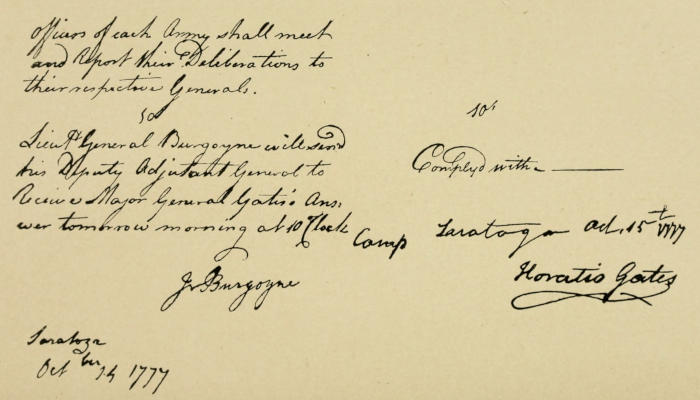
FACSIMILE OF CLOSING PARAGRAPHS OF BURGOYNE’S SURRENDER
[280]
General Howe had moved south instead of north. He fancied that it would bring him no small moral advantage to take Philadelphia, the “capital” of the insurgent confederacy; and he calculated that it ought to be easily possible to do so before Burgoyne would need him in the north. Early in June, accordingly, he attempted to cross the Jerseys; but Washington, striking from Morristown, threatened his flank in a way which made him hesitate and draw back. He returned to New York, and put eighteen thousand men aboard his transports, to get at Philadelphia by water from the south. It was the 25th of August, and Burgoyne was needing him sorely in the northern forests, before he had got ready for his land movement. He had gone all the long way round about into Chesapeake Bay, and had made his landing at the Head of Elk, in Maryland. Washington met him behind the fords of the Brandywine (September 11th), but could not withstand him. He could only delay him. Defeat no longer meant dismay for the Americans; Washington acted in force as steadily and effectively after defeat as after victory. It was the 27th of September before Sir William entered Philadelphia. He was hardly settled there before Washington attacked him again, at his outpost at Germantown, in the thick mist of the morning of [281]the 4th of October, and would have taken the place had not the mist confused and misled his own troops. Meantime Burgoyne was trapped at Saratoga. On October 3d Sir Henry Clinton had begun at last the movement from New York for Burgoyne’s relief which ought to have been begun in midsummer,—carrying northward a strong fleet upon the river and an army of three thousand men. But it was too late. Burgoyne’s surrender was already inevitable. The net result of the campaign was the loss of the northern army and the occupation of Philadelphia. “Philadelphia has taken Howe,” laughed Dr. Franklin, in Paris, when they told him that Howe had taken Philadelphia.
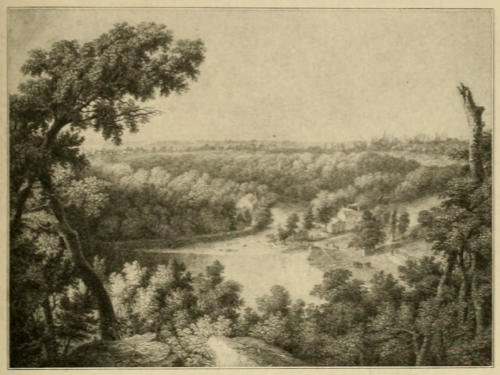
SCENE OF THE BATTLE OF THE BRANDYWINE
The long, slow year had been full of signs both good and bad. International forces were beginning to work in favor of the insurgent colonies. From the outset [282]France and Spain had been willing to give them aid against England, their traditional rival and enemy. Since the summer of 1776 they had been promised French and Spanish assistance through Beaumarchais, acting ostensibly as the firm of “Roderigue Hortalez et Cie.,” but really as the secret agent of the two governments; and early in 1777 the fictitious firm had begun actually to despatch vessels laden with arms and ammunition to America. Private money also went into the venture, but governments were known to be behind it; and on January 5th, 1777, Mr. Franklin had arrived in Paris to assist in bringing France into still closer touch with the war for independence over sea. As the year drew towards its close the great Frederick of Prussia had forbidden troops hired in the other German states to cross Prussian territory to serve the English in America, and so had added his good-will to the French and Spanish money. French, and even German and Polish officers, too, volunteered for service in the American armies. It was the gallant Polish patriot Tadeusz Kosciuszko who had shown General Gates how to intrench himself upon Bemis’s Heights.
[283]
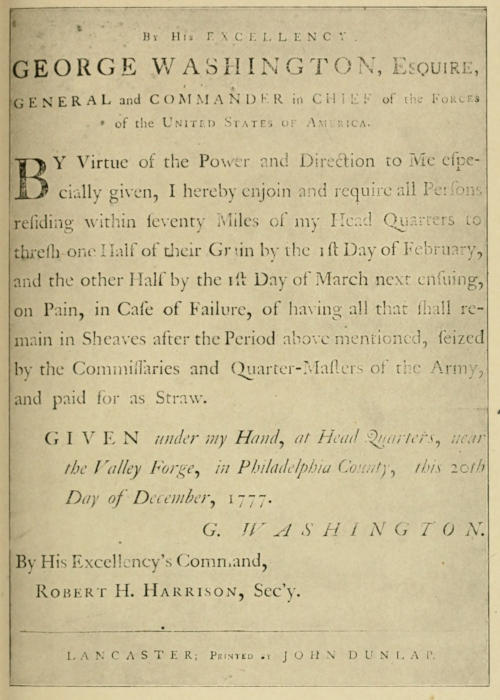
WASHINGTON’S PROCLAMATION
[284]
The winter was deeply disheartening, nevertheless, for Washington. Having failed in the mist at Germantown, he withdrew his army to Valley Forge, whence he could watch Howe at Philadelphia, and move as he moved, and yet himself feel safe against attack; but utter demoralization had fallen upon the Congress, sitting in a sort of exile at York, and his army was brought to such straits of privation and suffering in its exposed camp as he had never been obliged to see it endure before. There was plenty of food in the country; plenty even at the disposal of Congress and in the stores of its commissariat. The British had overrun very little of the fertile country; the crops had been abundant and laborers had not been lacking to gather them in,—especially there in thriving Pennsylvania. But the Congress had lost all vigor alike in counsel and in action. Men of initiative had withdrawn from it to serve their states in the reorganization of their several governments and in the command of forces in the field. Sometimes scarcely a dozen members could be got together to take part in its deliberations. It yielded to intrigue,—even to intrigue against Washington; allowed its executive committees, and most of all the commissary department, upon which the army depended, to fall into disorganization; listened to censures and bickerings rather than to plans of action; lost the respect of the states, upon which its authority depended; and left the army almost to shift for itself for sustenance. Fortunately it was a mild winter. Fortunately Washington was masterful and indomitable, and proved equal to checkmating at a single move those who intrigued in the Congress to displace him. Despite every bitter experience of that dark and anxious season, he had when spring came an army stronger and fitter for service than it had been when he took it into winter quarters. The lengthened term of service had given him at last an army which might be drilled, and foreign officers,—notably the capable Steuben,—had taught him how to drill it.
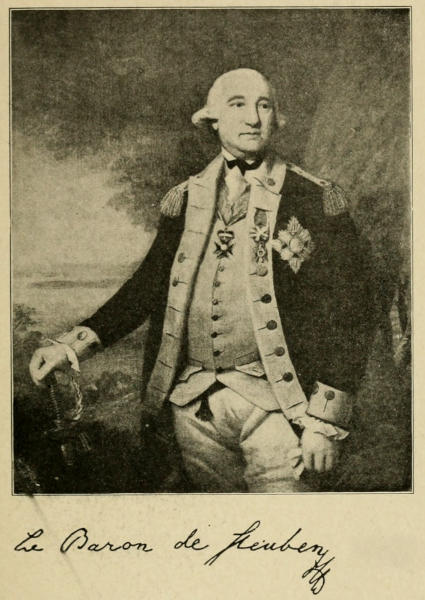
BARON DE STEUBEN
General Howe’s winter passed easily and merrily enough in Philadelphia. The place was full of people of means and influence who hoped as heartily as Mr. Galloway did for the success of the British arms. Some [285]of the leading Quakers of the town, whose influence was all for an accommodation of the quarrel with the mother country, had been arrested the previous summer (1777) and sent south by the patriot leaders; but many more were left who were of their mind, and General Howe met something like a welcome when he came in the autumn. The fashionable young women of [286]the town were delighted to look their best and to use their charms to the utmost at all the balls and social gatherings that marked the gay winter of his stay, and their parents were not displeased to see them shine there. But for the soldiers’ coats one would have thought that peace had come again.
But the minds of the ministers in England were not so much at ease. In February, 1778, Lord North introduced and pressed through Parliament conciliatory measures of the most radical sort, practically retracing every misjudged step taken with regard to the colonies since 1763; and commissioners of peace were sent to America with almost plenipotentiary powers of accommodation. But that very month a formal treaty of alliance was signed between France and the United States; by the time the peace commissioners reached Philadelphia, England had a war with France on her hands as well as a war with the colonies; there was no rejoicing in the camp at Valley Forge over the news of Lord North’s unexpected turn of purpose, but there was very keen rejoicing when news of the French alliance came. The Congress would not treat with the commissioners. Conciliation had come too late; for the colonies the aspect of the war was too hopeful.
When the commissioners reached Philadelphia they found General Clinton about to abandon it. Sir Henry Clinton had succeeded General Howe in chief command in May. His orders were to evacuate Philadelphia and concentrate his forces once more at New York. The town was as full of excitement and dismay at the prospect as it had been but a little more than a year ago at news of the British approach. When the army began to move, three thousand loyalists abandoned the town with it, going with the stores by sea, while Sir Henry took his fifteen thousand men overland through the Jerseys again.
[287]
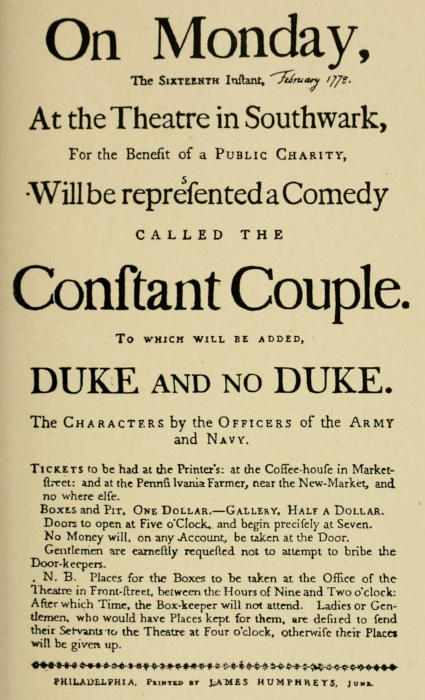
FACSIMILE OF PLAY BILL
[288]
When he moved, Washington moved also; outstripped him; caught him at a disadvantage at Monmouth Court House (June 28, 1778); and would inevitably have beaten him most seriously had not Charles Lee again disobeyed him and spoiled the decisive movement of the day,—Charles Lee, the soldier of fortune whom the Americans had honored and trusted. He had disobeyed before, when Washington was retreating hard pressed from New York. This time he seemed to play the coward. It was not known until afterwards that he had played the traitor, too. Clinton got off, but in a sort of rout, leaving his wounded behind him. “Clinton gained no advantage except to reach New York with the wreck of his army,” was the watchful Frederick’s comment over sea. “America is probably lost for England.”
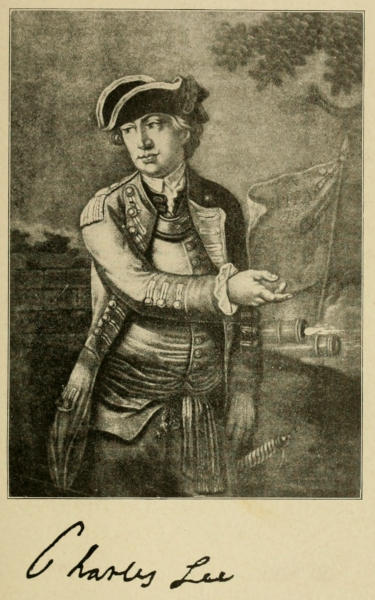
CHARLES LEE
Even the seas were no longer free for the movements of the British fleets, now that France was America’s ally and French fleets were gathering under orders for the American coast. Every month the war had lasted the English had found their commerce and their movement of stores and transports more and more embarrassed by the American privateersmen. There were bold and experienced seamen at every port of the long coast. The little vessels which were so easily set up and finished by skilful carpenters and riggers in almost any quiet inlet were sure to be fast and deftly handled when they got to sea; kept clear of his Majesty’s fleets and of too closely guarded harbors; cruised whithersoever the wits of their sagacious masters took [289]them; and had generally to be heavily overmatched to be beaten. They had taken more than five hundred British soldiers from the transports before the Congress at Philadelphia had uttered its Declaration of Independence. Their prizes numbered more than four hundred and fifty the year of Saratoga and Brandywine [290]and the fight in the morning’s mist at Germantown, though there were seventy ships of war upon the coast. The very coasts of England herself were not safe against them. Mr. Franklin went to France in the autumn of 1776 with his pocket full of blank letters of marque, and American privateersmen from out the French ports caught prizes enough in English waters to keep the commissioners in Paris well found in money for their plans. In January, 1778, Captain Rathburne, in the Providence, actually seized the fort in the harbor of Nassau in New Providence of the Bahamas, and took possession of town and shipping; and in the spring of that same year John Paul Jones performed the same daring feat at Whitehaven by Solway Firth in England itself.
These privateersmen, it turned out, were more to be feared for the present than the fleets of France. The Count d’Estaing was, indeed, despatched to America with twelve ships of the line and six frigates, with four thousand troops aboard; and his fleet appeared off Sandy Hook in midsummer, 1778, while Sir Henry Clinton was still fresh from his fright at Monmouth. But the too cautious admiral came and went, and that was all. He would not attempt an attack upon the English fleet within the bay at New York, though it was of scarcely half his strength. His pilots told him his larger ships could not cross the bar. Newport was the only other harbor the English held; and there he allowed Lord Howe to draw him off. A storm separated the fleets before they could come to terms, and his cruise ended peaceably in Boston harbor. But it was a heavy thing for England to have French fleets to reckon with, and embarrassments thickened very [291]ominously about her. She had absolutely no hold on America, it seemed, outside the lines actually occupied by her armies at Newport and New York; the very sea was beset, for her merchantmen; and France was now kindled into war against her.
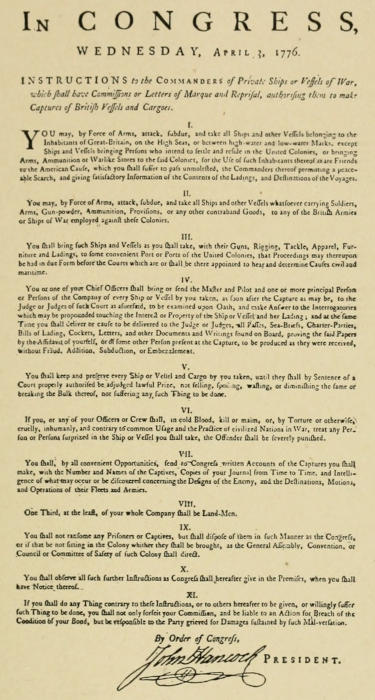
REDUCED FACSIMILE OF INSTRUCTIONS FROM CONGRESS TO PRIVATEERS
[292]
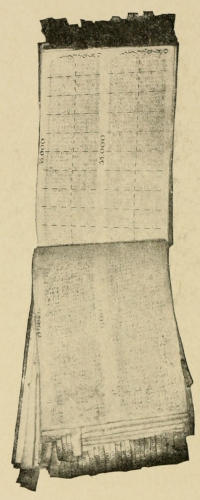
CONTINENTAL LOTTERY BOOK
And yet the Americans, too, were beset. They had not only their long coasts to watch and British armies to thwart and checkmate, but their western borders also to keep, against Tory and savage. The Iroquois country, in particular, and all the long valleys of the Mohawk, the Unadilla, and the Susquehanna, were filled with the terrors of raid and massacre throughout that disappointing and anxious summer of 1778. The stubborn loyalists of the forest country, with their temper still of the untamed highlands of old Scotland or of the intractable country-sides of old England, had been driven into exile by the uncompromising patriots, their neighbors, who outnumbered them. But they had not gone far. They had made their headquarters, the more dogged and determined of them, at Niagara, until this score should be settled. Sir John Johnson was still their leader, for all he had been so discomfited before Fort Stanwix; and John Butler and Walter Butler, father and son, men touched with the savagery of the redmen, their allies. Joseph Brant, that masterful [293]spirit who was a sort of self-appointed king among the savage Mohawks, did not often willingly forget the precepts of that Christian creed to which good Mr. Wheelock had drawn him in his boyhood, and held the redmen back when he could from every wanton deed of blood; but the Butlers stopped at nothing, and white men and red made common cause against the border settlements. Their cruel strokes were dealt both far and near. Upon a day in July, 1778, never to be forgotten, twelve hundred men fell upon the far-away Wyoming Valley upon the Susquehanna and harried it from end to end until it was black and desolate. In November a like terrible fate fell upon peaceful Cherry Valley, close at hand. There could be no peace or quarter until the hands of these men were stayed.
[294]
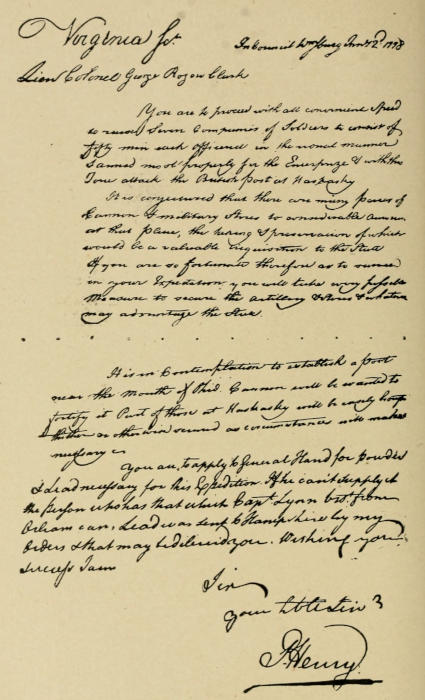
REDUCED FACSIMILE OF THE FIRST AND LAST PARTS OF PATRICK HENRY’S LETTER OF INSTRUCTIONS TO GEORGE ROGERS CLARK
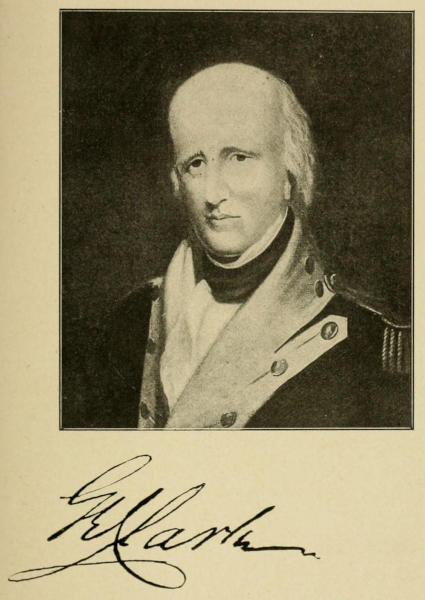
GEORGE ROGERS CLARK
But, though very slowly, the end came. The men who mustered in the patriotic ranks knew the forest and were masters of its warfare. They had only to turn to it in earnest to prevail. There were men upon the border, too, who needed but a little aid and countenance to work the work of pioneer statesmen on the western rivers. Most conspicuous among these was George Rogers Clark, the young Saxon giant who, in 1777, left his tasks as pioneer and surveyor on the lands which lay upon the south of the great river Ohio in far Kentucky, Virginia’s huge western county, and made his way back to the tide-water country to propose to Mr. Henry, now governor of the revolutionized commonwealth, an expedition for the conquest of the “Illinois country” which lay to the north of the river. He was but five-and-twenty, but he had got his stalwart stature where men came quickly into their powers, [295]deep in the forests, where he had learned woodcraft and had already shown his mettle among men. Mr. Henry and Mr. Jefferson and Mr. Wythe and Mr. Madison, whom he consulted, approved his purpose very heartily. It was a thing which must be prepared for very quietly, and pushed, when once begun, with secrecy and quick despatch; but the mustering of men [296]and the gathering of munitions and supplies were incidents which made no stir in those days of familiar war. Clark could bring together what force he pleased at Pittsburgh, and excite only the expectation that a new band of armed men were about to set out for the frontiers of Kentucky. In May, 1778, he was ready. He took but one hundred and eighty picked riflemen, a modest flotilla of small boats, and a few light pieces of artillery, but they sufficed. Before the summer was out he had gained easy mastery of the little settlements which lay to the northward upon the Mississippi and within the nearer valley of the Wabash. He had an infinitely pleasing way of winning the friendship of men upon any border, and the Frenchmen of the settlements of the Illinois country relished the change he promised them, liked well enough the prospect of being quit of the English power. There were few Englishmen to deal with.
When winter came Colonel Hamilton, the British commander at Detroit, came south into the forest with a motley force of five hundred men, mixed of regulars, Tories, and Indians, such as St. Leger had taken against Stanwix, and occupied Vincennes again, upon the Wabash; but Clark struck once more, sending his boats up the river and bringing his picked force straight across the frozen forests from Kaskaskia by the Mississippi; and by the end of February, 1779, Colonel Hamilton and all his levy were his prisoners. The Illinois country was added to Virginia, and the grant of her ancient charter, “up into the land, west and northwest,” seemed made good again by the daring of her frontiersmen. He could have taken Detroit itself, Clark declared, with but a few hundred men. While he cleared the [297]northern rivers of the British arms a force like his own descended the Mississippi, seized Natchez, and cleared the southern reaches of the great stream.
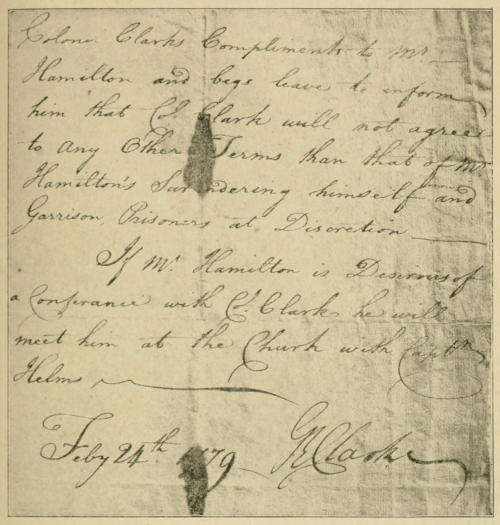
GEORGE CLARK’S FINAL SUMMONS TO COLONEL HAMILTON TO SURRENDER
That winter had witnessed a sharp shifting of the scene of the war in the east. The British commanders there had turned away from General Washington and the too closely guarded reaches of the Hudson to try for better fortune in the far south. In December, 1778, Clinton sent thirty-five hundred men from New [298]York to the southern coasts by sea, and on the 29th Savannah was taken, with comparative ease, there being but a scant six hundred to defend it. The town once taken, it proved an easy matter, at that great remove from the centre of the American strength, to overrun the country back of it during the early weeks of 1779. But after that came delay again, and inaction, as of those who wait and doubt what next to do. The new year saw nothing else decisive done on either side. In April Spain made common cause with France against England; but Washington waited in vain the year through to see the fighting transferred to America. A few strategic movements about New York, where Clinton lay; a few raids by the British; a few sharp encounters that were not battles, and the year was over. The British made sallies here and there, to pillage and burn, to keep the country in awe and bring off whatever they could lay hands upon, striking sometimes along the coast as far as Connecticut and even the Chesapeake at the south; but armed bands were quick to muster to oppose and harass them wherever they went, and it was never safe for them to linger. Clinton thrust his lines out upon the river and fortified Stony Point; but Anthony Wayne stormed the place of a sudden, with twelve hundred men, and took it, with unshotted guns at the point of the bayonet before dawn on the morning of the 15th of July, and brought more than five hundred prisoners away with him, having come with that quick fury of reckless attack which made men call him Mad Anthony, and having as quickly withdrawn again. Harry Lee stormed Paulus Hook in like fashion, and the British were nowhere very easy within their lines. But, for [299]the rest, there was little to break the monotony of waiting for news of the war at England’s door, where the fleets of the allies threatened her. Privateersmen were as busy as ever, and as much to be feared, almost, as the French cruisers themselves; but the formal operations of the war seemed vaguely postponed. Without the co-operation of a naval force it was impossible [300]for Washington to do anything against Sir Henry at New York.
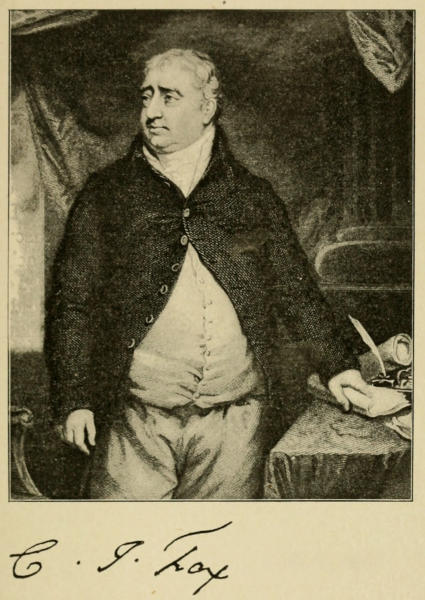
CHARLES JAMES FOX
While he waited, therefore, he despatched General Sullivan with five thousand men into the forest country of the Mohawk and the Susquehanna to make an end of the cruel mischief wrought upon defenceless homes by the bitter Tories and their red allies. The little army, sent forward in divisions, swept through the country it was bidden clear like men who searched stream and valley upon a journey of discovery; converged to meet their hunted foes, but fifteen hundred strong, where they lay at bay within a bend of the Chemung,—the full rally of the forest country, British regulars, Tory rangers, Indian braves, Johnson, the Butlers, Joseph Brant, every leader they acknowledged, united to direct them,—and overwhelmed them; ravaged the seats of Seneca and Cayuga far and near, till neither village nor any growing thing that they could find upon which men could subsist was left this side the Genesee; stopped short only of the final thing they had been bidden attempt, the capture of the stronghold at Niagara itself.
[301]
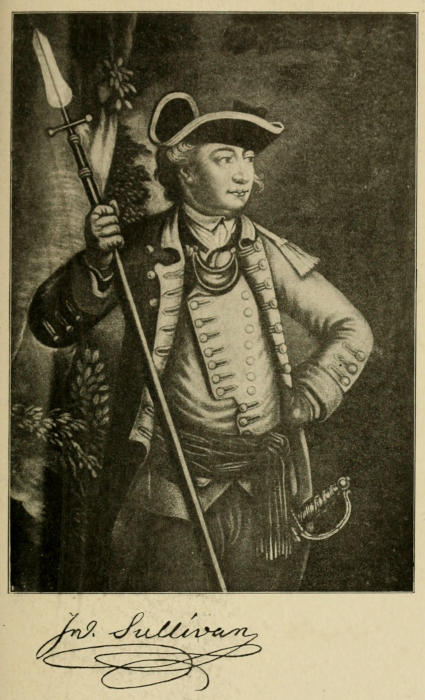
JOHN SULLIVAN
That was a summer’s reckoning which redmen far and near were not likely to forget. In April a little army of frontiersmen under Colonel Evan Shelby, that stout pioneer out of Maryland who brought hot Welsh blood to the task, swept suddenly along the northward reaches of the Tennessee and harried the country of the Chickamaugas, among whom Tories and British alike had been stirring war. In August, Colonel Brodhead, ordered to co-operate with General Sullivan, had taken six hundred men from his post at Fort Pitt, whence Clark had made his exit into the [302]west, and had destroyed the Indian settlements by the Alleghany and upon French Creek, the old routes of the French from the lakes to the Ohio. Such work was never finished. The Indians were for a little dislodged, disconcerted, and put to sad straits to live; but they were not conquered. The terror bred a deeper thirst for vengeance among them, and a short respite of peace was sure to be followed when a new year came in with fresh flashes of war on the border, as lurid and ominous as ever. The danger was lessened, nevertheless. The final conquest of the Indian country was at least begun. The backwoodsmen were within [303]sight of ultimate mastery when once peace should bring settlers crowding westward again.
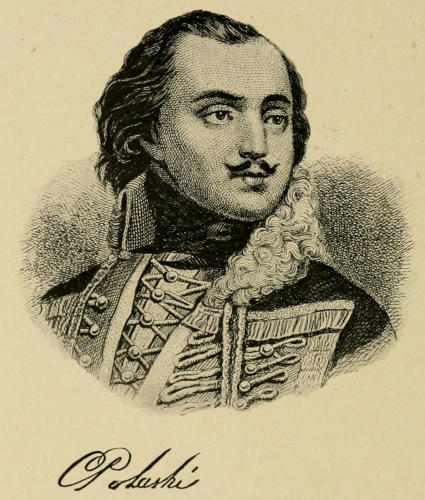
CASIMIR PULASKI
The fighting at sea that memorable year of doubt was of a like import,—full of daring and stubborn courage, planned and carried through with singular initiative and genius, quick with adventure, bright with every individual achievement, but of necessity without permanent consequence. Late in July, 1779, Captain Paul Jones had sailed from a port of France in command of a little squadron, half American, half French, with which the energy of Mr. Franklin had supplied him. His flag-ship, the Bon Homme Richard, was a worn-out French East Indiaman, fitted with forty guns, many of which were unserviceable; his French consorts were light craft, lightly armed; only one ship of the squadron was fully fit for the adventures he promised himself, having come fresh from the stocks in America, and she was intrusted to the command of a French captain who obeyed orders or not, as he pleased. But Jones was a man to work with what he had, and made even that improvised fleet suffice. With it he cruised the whole length of the western coast of Ireland and circled Scotland. Off Flamborough Head he fell in with the Serapis, 44, and the Countess of Scarborough, 20, the convoy of a fleet of merchantmen, and himself took the larger ship almost unassisted in a desperate fight after sunset, in the first watch of the night of the 23d of September. Neither ship survived the encounter forty-eight hours, so completely had they shot each other to pieces, and no man who followed the sea was likely to forget what he heard of that close grapple in the gathering night in the North Sea. “If I fall in with him again, I will [304]make a lord of him,” Jones exclaimed, when he heard that the King had knighted Captain Pearson, of the Serapis, for the gallant fight.
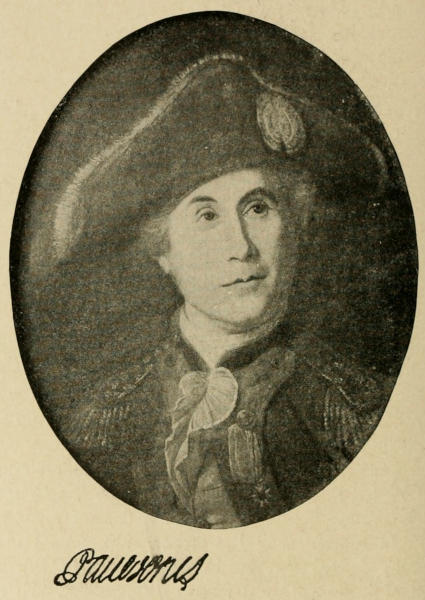
JOHN PAUL JONES
[305]
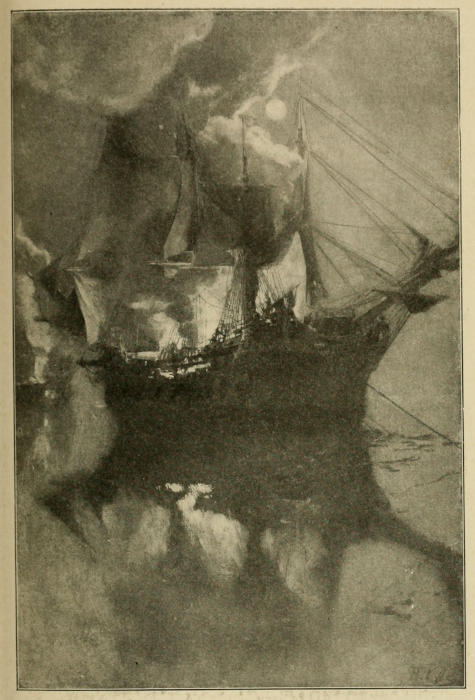
THE FIGHT BETWEEN BON HOMME RICHARD AND SERAPIS
[306]
For a little, in the autumn, it looked as if the naval aid for which General Washington waited had come at last. The Count d’Estaing was in the West Indies with a strong fleet, from an encounter with which the English commander in those waters had drawn off to port again to refit. The count was willing, while his hands were free, to co-operate in an attack upon the southern coast at Savannah. A portion of Washington’s army was sent south to join General Lincoln in South Carolina for the attempt. Count d’Estaing put six thousand troops aboard his fleet, and by the 16th of September was within the harbor. But he did not strike quickly or boldly enough, took the slow way of siege to reduce the place, suffered the English commander to make good both the rally of his scattered force and the fortification of his position, and had done nothing when it was high time for him to be back in the Indies to guard the possessions of his own king against the English. A last assault (October 9th) failed and he withdrew.
The next year a like disappointment was added. In midsummer a French fleet arrived upon the northern coast, but it proved impossible to use it. On the 10th of July a French squadron put in at Newport and landed a force of six thousand men under the Comte de Rochambeau; but a powerful British fleet presently blockaded the port, and Rochambeau could not prudently withdraw while the fleet was threatened. He had been ordered to put himself at General Washington’s disposal; but he could not do so till the blockade was raised. Meanwhile not only Georgia but the entire South seemed lost and given over to British control. In the spring, Clinton had concentrated all his forces once more at New York; and then, leaving that all-important place strong enough to keep Washington where he was, he had himself taken eight thousand men by sea to Charleston. Two thousand more troops, already in the South, joined him there, and by the 12th of May (1780) he had taken not only the place itself, but General Lincoln and three thousand men besides. South Carolina teemed with loyalists. Partisan bands, some serving one side, some the other, swept and harried the region from end to end. Wherever the British moved in force, they moved as they pleased, and were masters of the country. In June General Clinton deemed it already safe to take half his force back to New York, and Cornwallis was left to complete the work of subjugation.
[307]
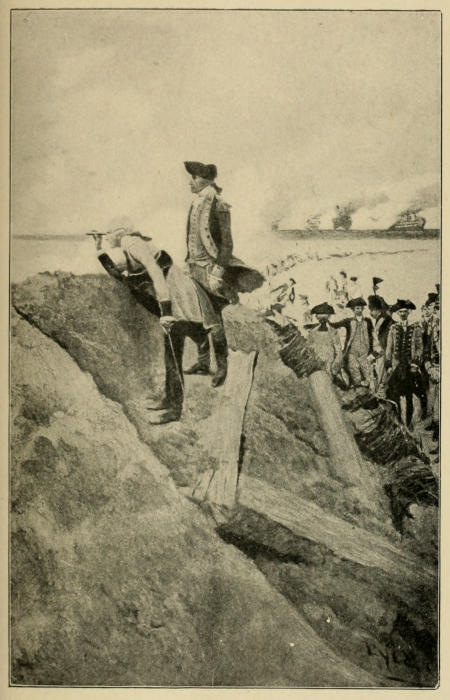
WASHINGTON AND ROCHAMBEAU IN THE TRENCHES AT YORKTOWN
[308]
That same month the Congress conferred the chief command in the South upon General Horatio Gates, who had been in command of the army to which Burgoyne had surrendered at Saratoga,—the army which Schuyler had made ready and which Morgan and Arnold had victoriously handled. Intriguers had sought, while Washington lay at Valley Forge, to substitute Gates for the commander-in-chief; now he was to show how happy a circumstance it was that that selfish intrigue had failed. He met Cornwallis at Camden, in South Carolina, his own force three thousand men, Cornwallis’s but two thousand, and was utterly, even shamefully, defeated (August 16, 1780). “We look on America as at our feet,” said Horace Walpole, complacently, when the news had made its way over sea.
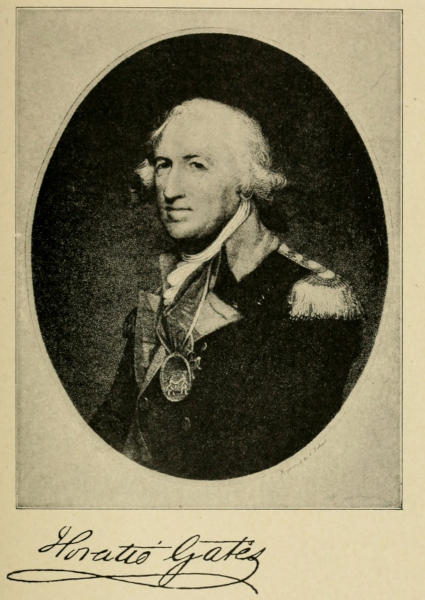
HORATIO GATES
And certainly it seemed as if that dark year brought nothing but disaster upon the Americans. It was now more evident than ever that they had no government worthy of the name. The Congress had no more authority now than it had had in 1774, when it was admitted to be nothing but a “Congress of the Committees of Correspondence”; and it was not now made up, as it had then been, of the first characters in America, [309]the men of the greatest force and initiative in the patriotic party. It could advise, but it could not command; and the states, making their own expenditures, which seemed heavy enough, maintaining their own militia, guarding their own interests in the war, following [310]their own leaders, often with open selfishness and indifference to the common cause, paid less and less heed to what it asked them to do. It could not raise money by taxation; it could raise very little by loan, having no legal power to make good its promises of repayment. Beaumarchais found to his heavy cost that it was next to impossible to recover the private moneys advanced through “Roderigue Hortalez et Cie.” The troops upon whom Washington and his generals depended were paid in “continental” paper money, which, by 1780, had grown so worthless that a bushel of wheat could scarcely be had for a month’s pay. Wholesale desertion began. Enlisted men by the score quit the demoralized camps. It was reckoned that as many as a full hundred a month went over to the enemy, if only to get food and shelter and clothing. Those who remained in the depleted ranks took what they [311]needed from the farms about them, and grew sullen and mutinous. Promises of money and supplies proved as fruitless as promises of reinforcements from France.
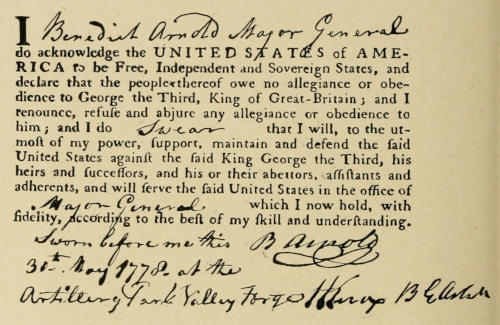
BENEDICT ARNOLD’S OATH OF ALLEGIANCE
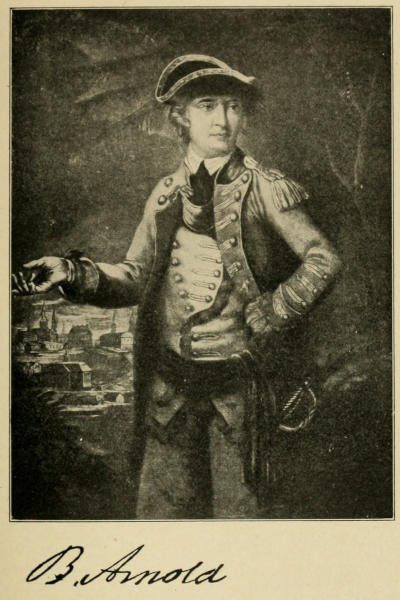
BENEDICT ARNOLD
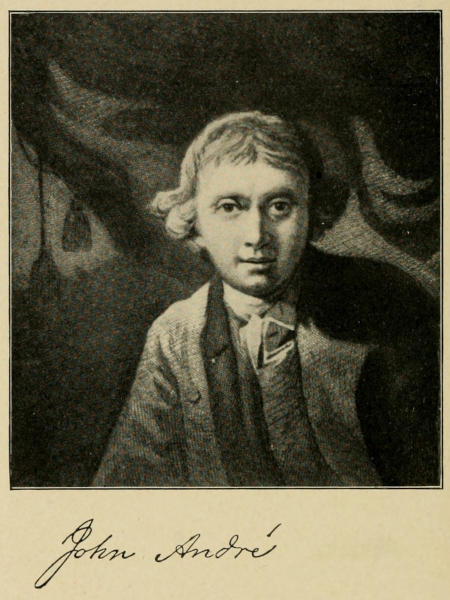
JOHN ANDRÉ
Even deliberate treason was added. Benedict Arnold, [312]whom every soldier in the continental ranks deemed a hero because of the gallant things he had done at Quebec and Saratoga, and whom Washington had specially loved and trusted, entered into correspondence with the enemy, and plotted to give West Point and the posts dependent upon it into the hands of the British. Congress had been deeply unjust to him, promoting his juniors and inferiors and passing him over; a thousand slights had cut him; a thousand subtle forces of discouragement and of social temptation had been at [313]work upon him, and he had yielded,—to pique, to bitter disappointment, to the disorders of a mind unstable, irritable, without nobility. His treason was discovered in time to be foiled, but the heart-breaking fact of it cut Washington to the quick, like a last and wellnigh fatal stroke of bitter dismay. Who could be trusted now? and where was strength to be got wherewith to carry the languishing work to a worthy finish?

MAJOR ANDRÉ’S WATCH
It was the worst of all the bad signs of the times that no government could be agreed upon that would give the young states a real union, or assure them of harmony and co-operation in the exercise of the independence for which they were struggling. Definitive articles of confederation had been suggested as of course at the time the Declaration of Independence was adopted; and the next year (November 15, 1777) the Congress had adopted the plan which Mr. Dickinson had drawn up and which its committee had reported July 12, 1776. But the states did not all accept it, and without unanimous adoption it could not go into operation. All except Delaware and Maryland accepted it before the close of 1778, and Delaware added her ratification in 1779; but Maryland still held out,—waiting until the great states, like Virginia, should forego some part of their too great preponderance and advantage in the prospective partnership by transferring their claims [314]to the great northwestern territories to the proposed government of the confederation; and her statesmanlike scruples still kept the country without a government throughout that all but hopeless year 1780.
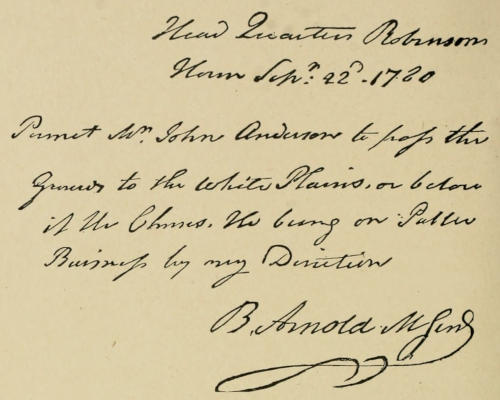
BENEDICT ARNOLD’S PASS TO MAJOR ANDRÉ
But the autumn showed a sudden turning of the tide. Cornwallis had ventured too far from his base of operations on the southern coast. He had gone deep into the country of the Carolinas, north of him, and was being beset almost as Burgoyne had been when he sought to cross the forests which lay about the upper waters of the Hudson. Gates had been promptly superseded after his disgraceful discomfiture and rout at Camden, and the most capable officers the long war had bred were now set to accomplish the task of forcing Cornwallis to a checkmate: Nathanael Greene, whose [315]quality Washington had seen abundantly tested at Trenton and Princeton, at the Brandywine, at Germantown, and at Monmouth; the dashing Henry Lee, whom nature and the hard school of war had made a master of cavalry; the veteran and systematic Steuben; Morgan, who had won with Arnold in the fighting about Saratoga, and had kept his name unstained; and William Washington, a distant kinsman of the commander-in-chief, whom English soldiers were to remember with Lee as a master of light horsemen. The wide forests were full, too, of partisan bands, under leaders whom the British had found good reason to dread.
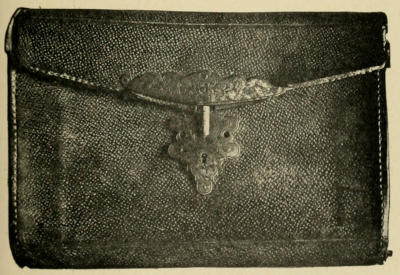
MAJOR ANDRÉ’S POCKET-BOOK
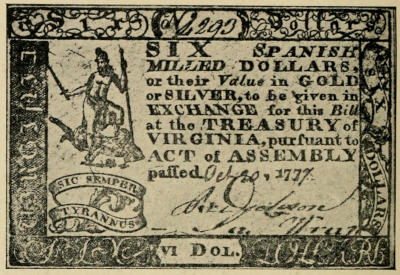
VIRGINIA COLONIAL CURRENCY
The conquest of the back country of the Carolinas was always doing and to be done. The scattered settlements and lonely plantations were, indeed, full of men who cared little for the quarrel with the mother country and held to their old allegiance as of course, giving [316]to the King’s troops ready aid and welcome; and there were men there, as everywhere, who loved pillage and all lawless adventure, upon whom the stronger army could always count to go in its ranks upon an errand of subjugation; but there were also men who took their spirit and their principles from the new days that had come since the passage of the Stamp Act, and, though they were driven from their homes and left to shift for themselves for mere subsistence when the King’s forces were afield, they came back again when the King’s men were gone, and played the part, albeit without Indian allies, that the ousted Tories played in the forest country of New York. The English commanders at Savannah and Charleston had hit at last, nevertheless, upon effective means of holding, not their seaports merely, but the country itself. The forces they sent into the interior were made up, for the most part, of men recruited in America, and were under the command of officers [317]fitted by school and temperament for their irregular duty of keeping a whole country-side in fearful discipline of submission. Many a formidable band of “Whigs” took the field against them, but were without a base of supplies, moved among men who spied upon them, and were no match in the long run for Tarleton and Ferguson,—Tarleton with his reckless, sudden onset and savage thoroughness of conquest, and Ferguson [318]with his subtile gifts at once of mastery and of quiet judgment that made him capable of succeeding either as a soldier who compelled or as a gentleman who won men to go his way and do his will. South Carolina seemed once and again to lie almost quiet under these men.
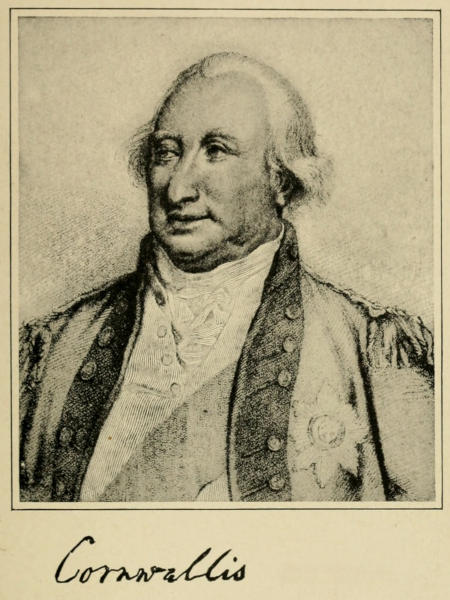
LORD CORNWALLIS
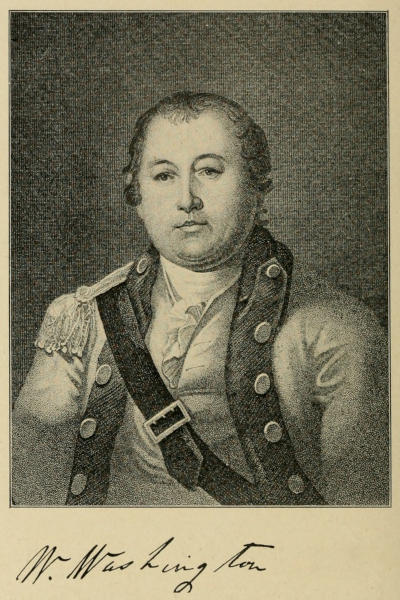
WILLIAM WASHINGTON
[319]
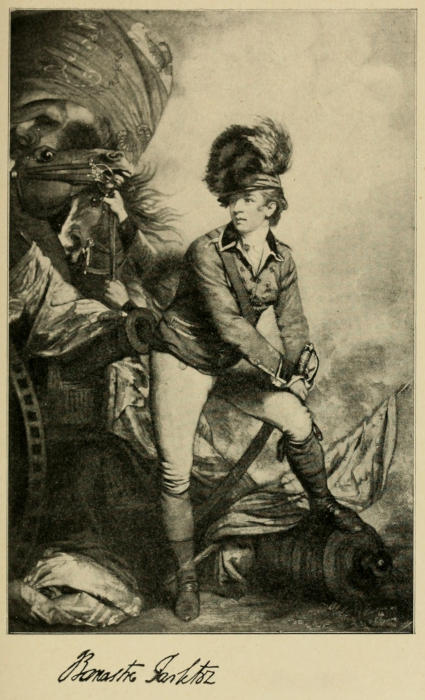
BANASTRE TARLETON
[320]
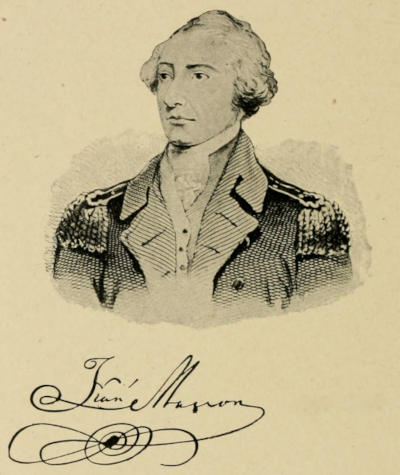
FRANCIS MARION
But Ferguson, for all he had the gifts of a soldier statesman, had gone too far. He had carried his persuasion of arms to the very foothills of the western mountains, and had sent his threats forward into the western country that lay beyond the passes of the mountains, where hardy frontiersmen of whom he knew almost nothing had so far kept their homes against the redmen without thought of turning to the east. His threats had angered and aroused them. They had put their riflemen from the back country of Carolina and Virginia into the saddle hundreds strong, had pushed league upon league through the passes of the mountains, from the far-off waters of the Holston, and had surrounded and utterly overwhelmed him at King’s [321]Mountain (October 7, 1780). There he lost a thousand men and his own life. “A numerous army appeared on the frontier,” reported Lord Rawdon, “drawn from Nolachucky and other settlements beyond the mountains, whose very names had been unknown to us.” The hold of the British upon the inland settlements was of a sudden loosened, and Cornwallis had reason to know at once what a difference that made to him.
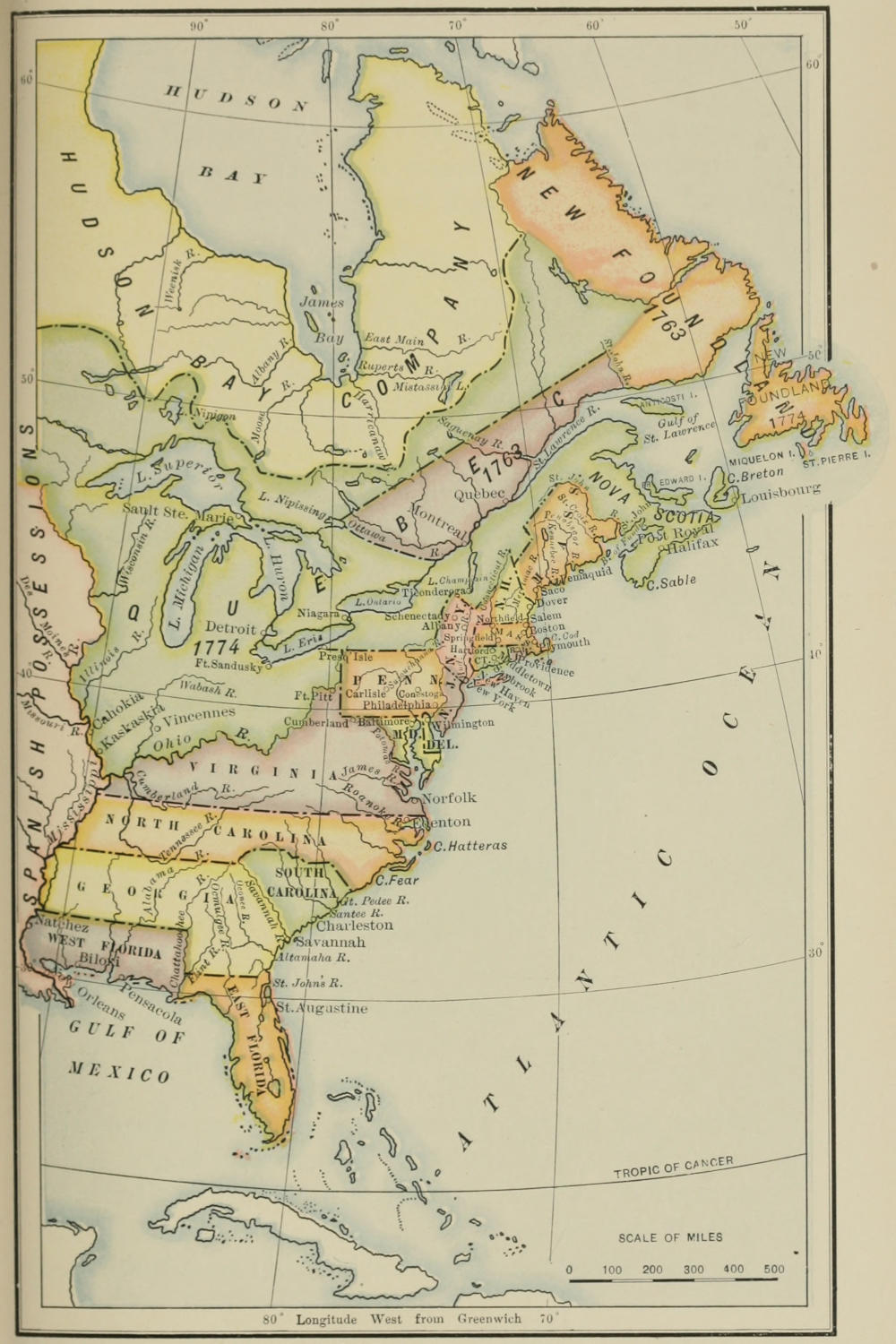
ENGLISH COLONIES, 1763-1775.
BORMAY & CO., N. Y.
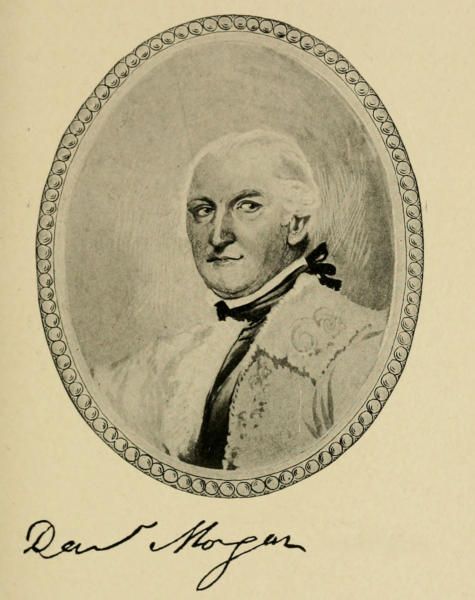
DANIEL MORGAN
[322]
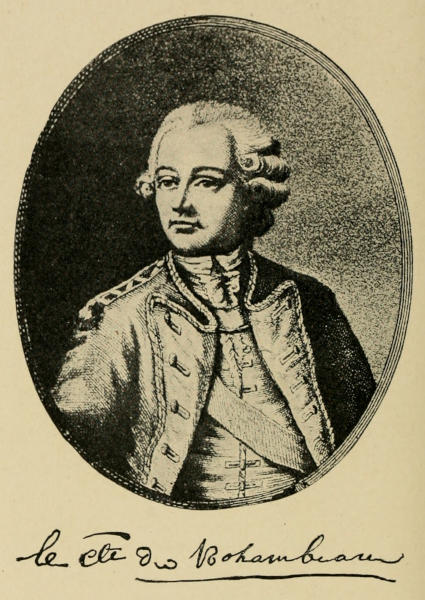
COUNT ROCHAMBEAU
[323]
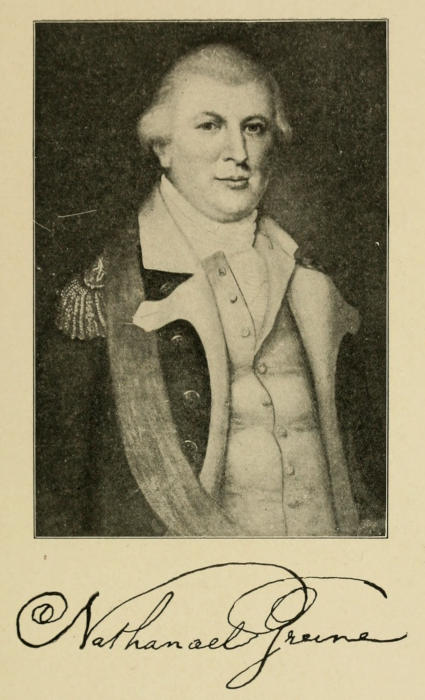
NATHANAEL GREENE
[324]
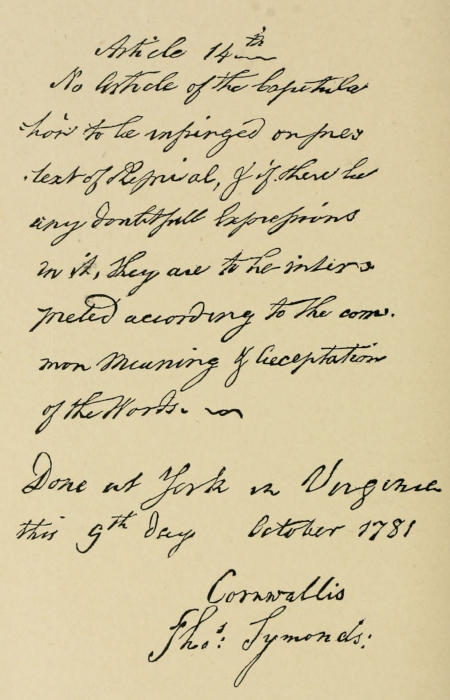
FACSIMILE OF THE LAST ARTICLE OF CAPITULATION AT YORKTOWN
[325]
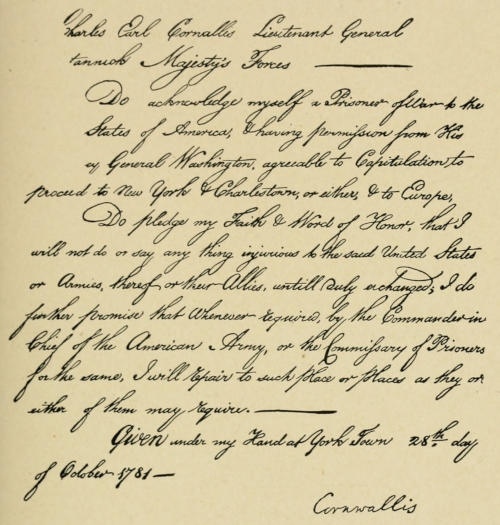
PAROLE OF CORNWALLIS
Early in December came General Greene to take the place of Gates, and new difficulties faced the English commander. Greene kept no single force afield, to be met and checkmated, but sent one part of his little army towards the coast to cut Cornwallis’s communications, and another southward against the inland posts and settlements where scattered garrisons lay between the commander-in-chief and his base at Charleston in the south. With the first detachment went Francis Marion, a man as formidable in strategy and sudden action as Ferguson, and the men who had attached themselves to him as if to a modern Robin Hood. With the second went Daniel Morgan, a man made after the fashion of the redoubtable frontiersmen who had brought Ferguson his day of doom at King’s Mountain. Tarleton [326]was sent after Morgan with eleven hundred men, found him at the Cowpens (January 17, 1781), just within the border upon which King’s Mountain lay, and came back a fugitive, with only two hundred and seventy men. Greene drew his forces together again, [327]and at Guilford Court House Cornwallis beat him, outnumbered though he was (March 15th). But to beat Greene, it seemed, was of no more avail than to beat General Washington. The country was no safer, the communications of the army were as seriously threatened, the defeated army was as steady and as well in hand after the battle as before; and the English withdrew to Wilmington, on the coast.
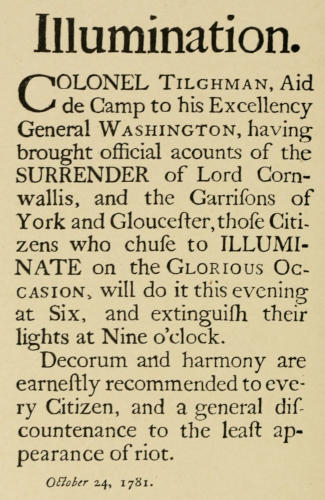
ORDER PERMITTING THE ILLUMINATION OF PHILADELPHIA
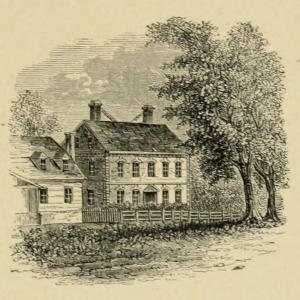
NELSON HOUSE, CORNWALLIS’S HEADQUARTERS, YORKTOWN
It seemed a hazardous thing to take an army thence southward again, with supplies, through the forests where Greene moved; news came that General Arnold was in Virginia with a considerable body of Clinton’s troops from New York, to anticipate what the southern commander had planned to do for the conquest of the Old Dominion when the Carolinas should have been “pacified” from end to end; and Cornwallis determined to move northward instead of southward, and join Arnold in Virginia. Greene moved a little way in his track, and then turned southward again against the garrisons of the inland posts. Lord Rawdon beat him at Hobkirk’s Hill (April 25th) and held him off at Eutaw Springs (September 8th); but both times the English withdrew to save their communications; and, though the work was slow in the doing, before winter came again they were shut within the fortifications [328]of Charleston and the country-sides were once more in American possession, to be purged of loyalist bands at leisure.
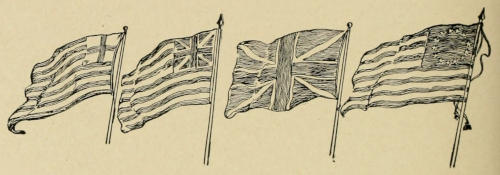
EVOLUTION OF THE AMERICAN FLAG
In Virginia, Lord Cornwallis moved for a little while freely and safely enough; but only for a little while. Baron Steuben had been busy, winter and spring, raising recruits there for an army of defence; General Washington hurried the Marquis de Lafayette southward with twelve hundred light infantry from his own command; and by midsummer, 1781, Lafayette was at the British front with a force strong enough to make it prudent that Cornwallis should concentrate his strength and once more make sure of his base of supplies at the coast. His watchful opponents out-manœuvred him, caught his forces once and again in detail, and made his outposts unsafe. By the first week in August he had withdrawn to the sea and had taken post behind intrenchments at Yorktown, something more than seven thousand strong.
There, upon the peninsula which he deemed his safest coign of vantage, he was trapped and taken. At last the French were at hand. The Comte de Grasse, with twenty-eight ships of the line, six frigates, and [329]twenty thousand men, was in the West Indies. Washington had begged him to come at once either to New York or to the Chesapeake. In August he sent word that he would come to the Chesapeake. Thereupon Washington once again moved with the sudden directness he had shown at Trenton and Princeton. Rochambeau was free now to lend him aid. With four thousand Frenchmen and two thousand of his own continentals, Washington marched all the long four hundred miles straightway to the York River, in Virginia. There he found Cornwallis, as he had hoped and expected, already penned between Grasse’s fleet in the bay and Lafayette’s trenches across the peninsula. His six thousand men, added to Lafayette’s five thousand and the three thousand put ashore from the fleet, made short work enough of the siege, drawn closer and closer about the British; and by the 19th of October (1781) they accepted the inevitable and surrendered. The gallant Cornwallis himself could not withhold an expression of his admiration for the quick, consummate execution of the plans which had undone him, and avowed it with manly frankness to Washington. “But, after all,” he cried, “your Excellency’s achievements in New Jersey were such that nothing could surpass them.” He liked the mastery by which he had been outplayed and taken.
Here our general authorities are the same as for the period covered by the last chapter. But to these we now add Edward J. Lowell’s The United States of America, 1775-1782, in the seventh volume of Winsor’s Narrative and Critical History of America; John Jay’s Peace Negotiations, 1782-1783, in the same volume of Winsor; G. W. Greene’s Historical View of the American Revolution; the second volume of W. B. Weeden’s Economic and Social History of New England; P. O. Hutchinson’s Life and Letters of Thomas [330]Revolution; Lorenzo Sabine’s Biographical Sketches of Adherents to the British Crown; George E. Ellis’s The Loyalists and their Fortunes, in the seventh volume of Winsor; Edward E. Hale’s Franklin in France; George Ticknor Curtis’s Constitutional History of the United States; and William H. Trescot’s Diplomacy of the American Revolution. Abundant references to authorities on the several campaigns of the revolutionary war may be found in Albert B. Hart and Edward Channing’s Guide to American History, an invaluable manual.
The sources for the period may be found in the contemporary pamphlets, speeches, and letters published at the time and since, among which may be mentioned, as of unusual individuality, Thomas Paine’s celebrated pamphlet entitled Common Sense, the writings of Joseph Galloway, some of which are reproduced in Stedman and Hutchinson’s Library of American Literature, and St. John de Crevecœur’s Letters from an American Farmer. Here again we rely, too, on the Journals of Congress and the Secret Journals of Congress; the Debates of Parliament; Peter Force’s American Archives; Hezekiah Niles’s Principles and Acts of the Revolution in America; The Annual Register; Jared Sparks’s Correspondence of the American Revolution and Diplomatic Correspondence of the American Revolution; Francis Wharton’s The Revolutionary Diplomatic Correspondence of the United States; Thomas Anburey’s Travels through the Interior Parts of America (1776-1781); the Marquis de Chastellux’s Travels in North America in the Years 1780, 1781, and 1782; and the Memoirs and Collections of the Historical Societies of the several original states.
[331]
Betweene the plantations vnder the Gouernment of the Massachusetts, the Plantacons vnder the Gouernment of New Plymouth, the Plantacons vnder the Gouernment of Connectacutt, and the Gouernment of New Haven with the Plantacons in combinacon therewith
Whereas wee all came into these parts of America with one and the same end and ayme, namely, to advaunce the kingdome of our Lord Jesus Christ, and to enjoy the liberties of the Gospell in puritie with peace. And whereas in our settleinge (by a wise Providence of God) we are further dispersed vpon the Sea Coasts and Riuers then was at first intended, so that we cannot according to our desire, with convenience communicate in one Gouernment and Jurisdiccon. And whereas we live encompassed with people of seuerall Nations and strang languages which heareafter may proue injurious to vs or our posteritie. And forasmuch as the Natives have formerly committed sondry insolences and outrages vpon seueral Plantacons of the English and have of late combined themselues against vs. And seing by reason of those sad Distraccons in England, which they have heard of, and by which they know [332]we are hindred from that humble way of seekinge advise or reapeing those comfortable fruits of protection which at other tymes we might well expecte. Wee therefore doe conceiue it our bounden Dutye without delay to enter into a present consotiation amongst our selues for mutual help and strength in all our future concernements: That as in Nation and Religion, so in other Respects we bee and continue one according to the tenor and true meaninge of the ensuing Articles: Wherefore it is fully agreed and concluded by and betweene the parties or Jurisdiccons aboue named, and they joyntly and seuerally doe by these presents agreed and concluded that they all bee, and henceforth bee called by the Name of the United Colonies of New-England.
II. The said United Colonies, for themselues and their posterities, do joyntly and seuerally, hereby enter into a firme and perpetuall league of friendship and amytie, for offence and defence, mutuall advise and succour, vpon all just occations, both for preserueing and propagateing the truth and liberties of the Gospel, and for their owne mutuall safety and wellfare.
III. It is futher agreed That the Plantacons which at present are or hereafter shalbe settled within the limmetts of the Massachusetts, shalbe forever vnder the Massachusetts, and shall have peculiar Jurisdiccon among themselues in all cases as an entire Body, and that Plymouth, Connecktacutt, and New Haven shall eich of them haue like peculier Jurisdiccon and Gouernment within their limmetts and in referrence to the Plantacons which already are settled or shall hereafter be erected or shall settle within their limmetts respectiuely; prouided that no other Jurisdiccon shall hereafter be taken in as a distinct head or member of this Confederacon, nor shall any other Plantacon or Jurisdiccon in present being and not already in combynacon or vnder the Jurisdiccon of any of these Confederats be [333]received by any of them, nor shall any two of the Confederats joyne in one Jurisdiccon without consent of the rest, which consent to be interpreted as is expressed in the sixth Article ensuinge.
IV. It is by these Confederats agreed that the charge of all just warrs, whether offensiue or defensiue, upon what part or member of this Confederaccon soever they fall, shall both in men and provisions, and all other Disbursements, be borne by all the parts of this Confederacon, in different proporcons according to their different abilitie, in manner following, namely, that the Commissioners for eich Jurisdiccon from tyme to tyme, as there shalbe occation, bring a true account and number of all the males in every Plantacon, or any way belonging to, or under their seuerall Jurisdiccons, of what quality or condicion soeuer they bee, from sixteene yeares old to threescore, being Inhabitants there. And That according to the different numbers which from tyme to tyme shalbe found in eich Jurisdiccon, upon a true and just account, the service of men and all charges of the warr be borne by the Poll: Eich Jurisdiccon, or Plantacon, being left to their owne just course and custome of rating themselues and people according to their different estates, with due respects to their qualites and exemptions among themselues, though the Confederacon take no notice of any such priviledg: And that according to their differrent charge of eich Jurisdiccon and Plantacon, the whole advantage of the warr (if it please God to bless their Endeavours) whether it be in lands, goods or persons, shall be proportionably deuided among the said Confederats.
V. It is further agreed That if any of these Jurisdiccons, or any Plantacons vnder it, or in any combynacon with them be envaded by any enemie whomsoeuer, vpon notice and request of any three majestrats of that Jurisdiccon so invaded, the rest of the Confederates, without [334]any further meeting or expostulacon, shall forthwith send ayde to the Confederate in danger, but in different proporcons; namely, the Massachusetts an hundred men sufficiently armed and provided for such a service and jorney, and eich of the rest fourty-fiue so armed and provided, or any lesse number, if lesse be required, according to this proporcon. But if such Confederate in danger may be supplyed by their next Confederate, not exceeding the number hereby agreed, they may craue help there, and seeke no further for the present. The charge to be borne as in this Article is exprest: And, at the returne, to be victualled and supplyed with poder and shott for their journey (if there be neede) by that Jurisdiccon which employed or sent for them: But none of the Jurisdiccons to exceed these numbers till by a meeting of the Commissioners for this Confederacon a greater ayd appeare necessary. And this proporcon to continue, till upon knowledge of greater numbers in eich Jurisdiccon which shalbe brought to the next meeting some other proporcon be ordered. But in any such case of sending men for present ayd whether before or after such order or alteracon, it is agreed that at the meeting of the Commissioners for this Confederacon, the cause of such warr or invasion be duly considered: And if it appeare that the fault lay in the parties so invaded, that then that Jurisdiccon or Plantacon make just Satisfaccon, both to the Invaders whom they have injured, and beare all the charges of the warr themselves without requireing any allowance from the rest of the Confederats towards the same. And further, that if any Jurisdiccon see any danger of any Invasion approaching, and there be tyme for a meeting, that in such case three majestrats of that Jurisdiccon may summon a meeting at such convenyent place as themselues shall think meete, to consider and provide against the threatned danger, Provided when they are met they may remoue to what place they please, [335]Onely whilst any of these foure Confederats have but three majestrats in their Jurisdiccon, their request or summons from any two of them shalbe accounted of equall force with the three mentoned in both the clauses of this Article, till there be an increase of majestrats there.
VI. It is also agreed that for the mannaging and concluding of all affairs proper and concerneing the whole Confederacon, two Commissioners shalbe chosen by and out of eich of these foure Jurisdiccons, namely, two for the Mattachusetts, two for Plymouth, two for Connectacutt and two for New Haven; being all in Church fellowship with us, which shall bring full power from their seuerall generall Courts respectively to heare, examine, weigh and determine all affaires of our warr or peace, leagues, ayds, charges and numbers of men for warr, divission of spoyles and whatsoever is gotten by conquest, receiueing of more Confederats for plantacons into combinacon with any of the Confederates, and all thinges of like nature which are the proper concomitants or consequence of such a confederacon, for amytie, offence and defence, not intermeddleing with the gouernment of any of the Jurisdiccons which by the third Article is preserued entirely to themselves. But if these eight Commissioners, when they meete, shall not all agree, yet it is concluded that any six of the eight agreeing shall have power to settle and determine the business in question: But if six do not agree, that then such proposicons with their reasons, so farr as they have beene debated, be sent and referred to the foure generall Courts, vizt. the Mattachusetts, Plymouth, Connectacutt, and New Haven: And if at all the said Generall Courts the businesse so referred be concluded, then to bee prosecuted by the Confederates and all their members. It is further agreed that these eight Commissioners shall meete once every yeare, besides extraordinary meetings (according to the fift Article) to consider, [336]treate and conclude of all affaires belonging to this Confederacon, which meeting shall ever be the first Thursday in September. And that the next meeting after the date of these presents, which shalbe accounted the second meeting, shalbe at Bostone in the Massachusetts, the third at Hartford, the fourth at New Haven, the fift at Plymouth, the sixt and seaventh at Bostone. And then Hartford, New Haven and Plymouth, and so in course successiuely, if in the meane tyme some middle place be not found out and agreed on which may be commodious for all the jurisdiccons.
VII. It is further agreed that at eich meeting of these eight Commissioners, whether ordinary or extraordinary, they, or six of them agreeing, as before, may choose their President out of themselues, whose office and worke shalbe to take care and direct for order and a comely carrying on of all proceedings in the present meeting. But he shalbe invested with no such power or respect as by which he shall hinder the propounding or progresse of any businesse, or any way cast the Scales, otherwise then in the precedent Article is agreed.
VIII. It is also agreed that the Commissioners for this Confederacon hereafter at their meetings, whether ordinary or extraordinary, as they may have commission or opertunitie, do endeavoure to frame and establish agreements and orders in generall cases of a civill nature wherein all the plantacons are interested for preserving peace among themselves, and preventing as much as may bee all occations of warr or difference with others, as about the free and speedy passage of Justice in every Jurisdiccon, to all the Confederats equally as their owne, receiving those that remoue from one plantacon to another without due certefycats; how all the Jurisdiccons may carry it towards the Indians, that they neither grow insolent nor be injured without due satisfaccion, lest warr break in vpon the Confederates through such miscarryage. It is also agreed that [337]if any servant runn away from his master into any other of these confederated Jurisdiccons, That in such Case, vpon the Certyficate of one Majistrate in the Jurisdiccon out of which the said servant fled, or upon other due proofe, the said servant shalbe deliuered either to his Master or any other that pursues and brings such Certificate or proofe. And that vpon the escape of any prisoner whatsoever or fugitiue for any criminal cause, whether breaking prison or getting from the officer or otherwise escaping, upon the certificate of two Majistrats of the Jurisdiccon out of which the escape is made that he was a prisoner or such an offender at the tyme of the escape. The Majestrates or some of them of that Jurisdiccon where for the present the said prisoner or fugitive abideth shall forthwith graunt such a warrant as the case will beare for the apprehending of any such person, and the delivery of him into the hands of the officer or other person that pursues him. And if there be help required for the safe returneing of any such offender, then it shalbe graunted to him that craves the same, he paying the charges thereof.
IX. And for that the justest warrs may be of dangerous consequence, espetially to the smaler plantacons in these vnited Colonies, It is agreed that neither the Massachusetts, Plymouth, Connectacutt nor New-Haven, nor any of the members of any of them shall at any tyme hereafter begin, undertake, or engage themselues or this Confederacon, or any part thereof in any warr whatsoever (sudden exegents with the necessary consequents thereof excepted, which are also to be moderated as much as the case will permit) without the consent and agreement of the forenamed eight Commissioners, or at least six of them, as in the sixt Article is provided: And that no charge be required of any of the Confederats in case of a defensiue warr till the said Commissioners haue mett and approued the justice of the warr, and have agreed vpon the [338]sum of money to be levyed, which sum is then to be payd by the severall Confederates in proporcon according to the fourth Article.
X. That in extraordinary occations when meetings are summoned by three Majistrats of any Jurisdiccon, or two as in the fift Article, If any of the Commissioners come not, due warneing being given or sent, It is agreed that foure of the Commissioners shall have power to direct a warr which cannot be delayed and to send for due proporcons of men out of eich Jurisdiccon, as well as six might doe if all mett; but not less than six shall determine the justice of the warr or allow the demanude of bills of charges or cause any levies to be made for the same.
XI. It is further agreed that if any of the Confederates shall hereafter break any of these present Articles, or be any other wayes injurious to any one of thother Jurisdiccons, such breach of Agreement, or injurie, shalbe duly considered and ordered by the Commissioners for thother Jurisdiccons, that both peace and this present Confederacon may be entirely preserued without violation.
XII. Lastly, this perpetuall Confederacon and the several Articles and Agreements thereof being read and seriously considered, both by the Generall Court for the Massachusetts, and by the Commissioners for Plymouth, Connectacutt and New Haven, were fully allowed and confirmed by three of the forenamed Confederates, namely, the Massachusetts, Connectacutt and New-Haven, Onely the Commissioners for Plymouth, having no Commission to conclude, desired respite till they might advise with their Generall Court, wherevpon it was agreed and concluded by the said court of the Massachusetts, and the Commissioners for the other two Confederates, That if Plymouth Consent, then the whole treaty as it stands in these present articles is and shall continue firme and stable without alteracon: But if Plymouth come not in, yet the other three Confederates [339]doe by these presents confirme the whole Confederacon and all the Articles thereof, onely, in September next, when the second meeting of the Commissioners is to be at Bostone, new consideracon may be taken of the sixt Article, which concernes number of Commissioners for meeting and concluding the affaires of this Confederacon to the satisfaccon of the court of the Massachusetts, and the Commissioners for thother two Confederates, but the rest to stand vnquestioned.
In testymony whereof, the Generall Court of the Massachusetts by their Secretary, and the Commissioners for Connectacutt and New-Haven haue subscribed these presente articles, this xixth of the third month, commonly called May, Anno Domini, 1643.
At a Meeting of the Commissioners for the Confederacon, held at Boston, the Seaventh of September. It appeareing that the Generall Court of New Plymouth, and the severall Towneships thereof have read, considered and approoued these articles of Confederacon, as appeareth by Comission from their Generall Court beareing Date the xxixth of August, 1643, to Mr. Edward Winslowe and Mr. Will Collyer, to ratifye and confirme the same on their behalf, wee therefore, the Comissioners for the Mattachusetts, Conecktacutt and New Haven, doe also for our seuerall Gouernments, subscribe vnto them.
[340]
A Briefe and Plaine Scheam how the English Colonies in the North parts of America, viz.: Boston, Connecticut, Road Island, New York, New Jerseys, Pensilvania, Maryland, Virginia, and Carolina may be made more usefull to the Crowne, and one another’s peace and safty with an universall concurrence.
1st. That the severall Colonies before mentioned do meet once a year, and oftener if need be, during the war, and at least once in two years in times of peace, by their stated and appointed Deputies, to debate and resolve of such measures as are most adviseable for their better understanding, and the public tranquility and safety.
2d. That in order to it two persons well qualified for sence, sobriety and substance be appointed by each Province, as their Representatives or Deputies, which in the whole make the Congress to consist of twenty persons.
3d. That the King’s Commissioner for that purpose specially appointed shall have the chaire and preside in the said Congresse.
4th. That they shall meet as near as conveniently may be to the most centrall Colony for use of the Deputies.
5th. Since that may in all probability, be New York both because it is near the Center of the Colonies and for that it is a Frontier and in the King’s nomination, the Govr. [341]of that Colony may therefore also be the King’s High Commissioner during the Session after the manner of Scotland.
6th. That their business shall be to hear and adjust all matters of Complaint or difference between Province and Province. As, 1st, where persons quit their own Province and goe to another, that they may avoid their just debts, tho they be able to pay them, 2nd, where offenders fly Justice, or Justice cannot well be had upon such offenders in the Provinces that entertaine them, 3dly, to prevent or cure injuries in point of Commerce, 4th, to consider of ways and means to support the union and safety of these Provinces against the publick enemies. In which Congresse the Quotas of men and charges will be much easier, and more equally sett, then it is possible for any establishment made here to do; for the Provinces, knowing their own condition and one another’s, can debate that matter with more freedome and satisfaction and better adjust and ballance their affairs in all respects for their common safty.
7ly. That in times of war the King’s High Commissioner shall be generall or chief Commander of the severall Quotas upon service against a common enemy as he shall be advised, for the good and benefit of the whole.
[342]
Plan of a proposed Union of the several Colonies of Massachusetts-Bay, New Hampshire, Connecticut, Rhode Island, New-York, New-Jersey, Pennsylvania, Maryland, Virginia, North Carolina, and South Carolina for their mutual Defence and Security, and for the extending the British Settlements in North America.
That humble application be made for an act of Parliament of Great Britain, by virtue of which one general government may be formed in America, including all the said Colonies, within and under which government each Colony may retain its present constitution, except in the particulars wherein a change may be directed by the said act, as hereafter follows.
That the said general government be administered by a President-General, to be appointed and supported by the crown; and a Grand Council to be chosen by the representatives of the people of the several Colonies met in their respective assemblies.
It was thought that it would be best the President-General should be supported as well as appointed by the crown, that so all disputes between him and the Grand-Council concerning his salary might be prevented; as such disputes have been frequently of mischievous consequence in particular Colonies, especially in time of public danger. The quit-rents of crown lands in America might in a short time be sufficient for this purpose. The choice of members [343]for the Grand-Council is placed in the House of Representatives of each government, in order to give the people a share in this new general government, as the crown has its share by the appointment of the President-General.
But it being proposed by the gentlemen of the Council of New York, and some other counsellors among the commissioners, to alter the plan in this particular, and to give the governors and councils of the several Provinces a share in the choice of the Grand-Council, or at least a power of approving and confirming, or of disallowing, the choice made by the House of Representatives, it was said,—“That the government or constitution, proposed to be formed by the plan, consists of two branches: a President-General appointed by the crown, and a Council chosen by the people, or by the people’s representatives, which is the same thing.
“That, by a subsequent article, the council chosen by the people can effect nothing without the consent of the President-General appointed by the crown; the crown possesses, therefore, full one half of the power of this constitution.
“That in the British constitution, the crown is supposed to possess but one third, the Lords having their share.
“That the constitution seemed rather more favorable for the crown.
“That it is essential to English liberty that the subject should not be taxed but by his own consent, or the consent of his elected representatives.
“That taxes to be laid and levied by this proposed constitution will be proposed and agreed to by the representatives of the people, if the plan in this particular be preserved.
“But if the proposed alteration should take place, it seemed as if matters may be so managed, as that the crown shall finally have the appointment, not only of the President-General, but of a majority of the Grand-Council; for seven out of eleven governors and councils are appointed by the crown.
“And so the people in all the Colonies would in effect be taxed by their governors.
“It was therefore apprehended, that such alterations of the plan would give great dissatisfaction, and that the Colonies could not be easy under such a power in governors, and such an infringement of what they take to be English liberty.
“Besides, the giving a share in the choice of the Grand Council would not be equal with respect to all the Colonies, as their constitutions differ. In some, both governor and council are appointed by the crown. In others, they are both appointed by the proprietors. [344]In some, the people have a share in the choice of the council; in others, both government and council are wholly chosen by the people. But the House of Representatives is everywhere chosen by the people; and, therefore, placing the right of choosing the Grand Council in the representatives is equal with respect to all.
“That the Grand Council is intended to represent all the several Houses of Representatives of the Colonies, as a House of Representatives doth the several towns or counties of a Colony. Could all the people of a Colony be consulted and unite in public measures, a House of Representatives would be needless, and could all the Assemblies consult and unite in general measures, the Grand Council would be unnecessary.
“That a House of Commons or the House of Representatives, and the Grand Council are alike in their nature and intention. And, as it would seem improper that the King or House of Lords should have a power of disallowing or appointing Members of the House of Commons; so, likewise, that a governor and council appointed by the crown should have a power of disallowing or appointing members of the Grand Council, who, in this constitution, are to be the representatives of the people.
“If the governor and councils therefore were to have a share in the choice of any that are to conduct this general government, it should seem more proper that they should choose the President-General. But this being an office of great trust and importance to the nation, it was thought better to be filled by the immediate appointment of the crown.
“The power proposed to be given by the plan to the Grand Council is only a concentration of the powers of the several assemblies in certain points for the general welfare; as the power of the President-General is of the several governors in the same point.
“And as the choice therefore of the Grand Council, by the representatives of the people, neither gives the people any new powers, nor diminishes the power of the crown, it was thought and hoped the crown would not disapprove of it.”
Upon the whole, the commissioners were of opinion, that the choice was most properly placed in the representatives of the people.
That within ____ months after the passing such act, the House of Representatives that happens to be sitting within that time, or that shall be especially for that purpose [345]convened, may and shall choose members for the Grand Council, in the following proportion, that is to say,
| Massachusetts Bay | 7 |
| New Hampshire | 2 |
| Connecticut | 5 |
| Rhode Island | 2 |
| New York | 4 |
| New Jersey | 3 |
| Pennsylvania | 6 |
| Maryland | 4 |
| Virginia | 7 |
| North Carolina | 4 |
| South Carolina | 4 |
| 48 |
It was thought, that if the least Colony was allowed two, and the others in proportion, the number would be very great, and the expense heavy; and that less than two would not be convenient, as, a single person being by any accident prevented appearing at the meeting, the Colony he ought appear for would not be represented. That, as the choice was not immediately popular, they would be generally men of good abilities for business, and men of reputation for integrity, and that forty-eight such men might be a number sufficient. But, though it was thought reasonable that each Colony should have a share in the representative body in some degree according to the proportion it contributed to the general treasury, yet the proportion of wealth or power of the Colonies is not to be judged by the proportion here fixed: because it was at first agreed, that the greatest Colony should not have more than seven members, nor the least less than two; and the setting these proportions between these two extremes was not nicely attended to, as it would find itself, after the first election, from the sum brought into the treasury by a subsequent article.
—Who shall meet for the first time at the city of Philadelphia in Pennsylvania, being called by the President-General as soon as conveniently may be after his appointment.
[346]
Philadelphia was named as being nearer the centre of the Colonies, where the commissioners would be well and cheaply accommodated. The high roads, through the whole extent, are for the most part very good, in which forty or fifty miles a day may very well be, and frequently are, travelled. Great part of the way may likewise be gone by water. In summer time, the passages are frequently performed in a week from Charleston to Philadelphia and New York, and from Rhode Island to New York through the Sound, in two or three days, and from New York to Philadelphia, by water and land, in two days, by stage boats, and street carriages that set out every other day. The journey from Charleston to Philadelphia may likewise be facilitated by boats running up Chesapeake Bay three hundred miles. But if the whole journey be performed on horseback, the most distant members, viz., the two from New Hampshire and from South Carolina, may probably render themselves at Philadelphia in fifteen or twenty days; the majority may be there in much less time.
That there shall be a new election of the members of the Grand Council every three years; and, on the death or resignation of any member, his place should be supplied by a new choice at the next sitting of the Assembly of the Colony he represented.
Some Colonies have annual assemblies, some continue during a governor’s pleasure; three years was thought a reasonable medium as affording a new member time to improve himself in the business, and to act after such improvement, and yet giving opportunities, frequently enough, to change him if he has misbehaved.
That after the first three years, when the proportion of money arising out of each Colony to the general treasury can be known, the number of members to be chosen for each Colony shall, from time to time, in all ensuing elections, be regulated by that proportion, yet so as that [347]the number to be chosen by any one Province be not more than seven, nor less than two.
By a subsequent article, it is proposed that the General Council shall lay and levy such general duties as to them may appear most equal and least burdensome, etc. Suppose, for instance, they lay a small duty or excise on some commodity imported into or made in the Colonies, and pretty generally and equally used in all of them, as rum, perhaps, or wine; the yearly produce of this duty or excise, if fairly collected, would be in some Colonies greater, in others less, as the Colonies are greater or smaller. When the collector’s accounts are brought in, the proportions will appear; and from them it is proposed to regulate the proportion of the representatives to be chosen at the next general election, within the limits, however, of seven and two. These numbers may therefore vary in the course of years, as the Colonies may in the growth and increase of people. And thus the quota of tax from each Colony would naturally vary with its circumstances, thereby preventing all disputes and dissatisfaction about the just proportions due from each, which might otherwise produce pernicious consequences, and destroy the harmony and good agreement that ought to subsist between the several parts of the Union.
That the Grand Council shall meet once in every year, and oftener if occasion require, at such time and place as they shall adjourn to at the last preceding meeting, or as they shall be called to meet at by the President-General on any emergency; he having first obtained in writing the consent of seven of the members to such call, and sent due and timely notice to the whole.
It was thought, in establishing and governing new Colonies or settlements, or regulating Indian trade, Indian treaties, etc., there would, every year, sufficient business arise to require at least one meeting, and at such meeting many things might be suggested for the benefit of all the Colonies. This annual meeting may either be at a time and place certain, to be fixed by the President-General and Grand Council at their first meeting; or left at liberty, to be at such time and place as they shall adjourn to, or be called to meet at, by the President-General.
[348]
In time of war, it seems convenient that the meeting should be in that colony which is nearest the seat of action.
The power of calling them on any emergency seemed necessary to be vested in the President-General; but, that such power might not be wantonly used to harass the members, and oblige them to make frequent long journeys to little purpose, the consent of seven at least to such call was supposed a convenient guard.
That the Grand Council have power to choose their speaker; and shall neither be dissolved, prorogued, nor continued sitting longer than six weeks at one time, without their own consent or the special command of the crown.
The speaker should be presented for approbation; it being convenient, to prevent misunderstandings and disgusts, that the mouth of the Council should be a person agreeable, if possible, to the Council and President-General.
Governors have sometimes wantonly exercised the power of proroguing or continuing the sessions of assemblies, merely to harass the members and compel a compliance; and sometimes dissolve them on slight disgusts. This it was feared might be done by the President-General, if not provided against; and the inconvenience and hardship would be greater in the general government than in particular Colonies, in proportion to the distance the members must be from home during sittings, and the long journeys some of them must necessarily take.
That the members of the Grand Council shall be allowed for their service ten shillings per diem, during their session and journey to and from the place of meeting; twenty miles to be reckoned a day’s journey.
It was thought proper to allow some wages, lest the expense might deter some suitable persons from the service; and not to allow too great wages, lest unsuitable persons should be tempted to cabal for the employment, for the sake of gain. Twenty miles were set down as a day’s journey, to allow for accidental hindrances on the road, and the greater expenses of travelling than residing at the place of meeting.
[349]
That the assent of the President-General be requisite to all acts of the Grand Council, and that it be his office and duty to cause them to be carried into execution.
The assent of the President-General to all acts of the Grand Council was made necessary in order to give the crown its due share of influence in this government, and connect it with that of Great Britain. The President-General, besides one half of the legislative power, hath in his hands the whole executive power.
That the President-General, with the advice of the Grand Council, hold or direct all Indian treaties, in which the general interest of the Colonies may be concerned, and make peace or declare war with Indian nations.
The power of making peace or war with Indian nations is at present supposed to be in every Colony, and is expressly granted to some by charter, so that no new power is hereby intended to be granted to the Colonies. But as, in consequence of this power, one Colony might make peace with a nation that another was justly engaged in war with; or make war on slight occasion without the concurrence or approbation of neighboring Colonies, greatly endangered by it; or make particular treaties of neutrality in case of a general war, to their own private advantage in trade, by supplying the common enemy, of all which there have been instances, it was thought better to have all treaties of a general nature under a general direction, that so the good of the whole may be consulted and provided for.
That they make such laws as they judge necessary for regulating all Indian trade.
Many quarrels and wars have arisen between the colonies and Indian nations, through the bad conduct of traders, who cheat the Indians after making them drunk, etc., to the great expense of the colonies, both in blood and treasure. Particular colonies are so interested in the trade, as not to be willing to admit such [350]a regulation as might be best for the whole; and therefore it was thought best under a general direction.
That they make all purchases from Indians, for the crown, of lands not now within the bounds of particular colonies, or that shall not be within their bounds when some of them are reduced to more convenient dimensions.
Purchases from the Indians, made by private persons, have been attended with many inconveniences. They have frequently interfered and occasioned uncertainty of titles, many disputes and expensive lawsuits, and hindered the settlement of the land so disputed. Then the Indians have been cheated by such private purchases, and discontent and wars have been the consequence. These would be prevented by public fair purchases.
Several of the Colony charters in America extend their bounds to the South Sea, which may perhaps be three or four thousand miles in length to one or two hundred miles in breadth. It is supposed they must in time be reduced to dimensions more convenient for the common purposes of government.
Very little of the land in these grants is yet purchased of the Indians.
It is much cheaper to purchase of them, than to take and maintain the possession by force; for they are generally very reasonable in their demands for land; and the expense of guarding a large frontier against their incursions is vastly great; because all must be guarded, and always guarded, as we know not where or when to expect them.
That they make new settlements on such purchases by granting lands in the King’s name, reserving a quit-rent to the crown for the use of the general treasury.
It is supposed better that there should be one purchaser than many; and that the crown should be that purchaser, or the Union in the name of the crown. By this means the bargains may be more easily made, the price not enhanced by numerous bidders, future disputes about private Indian purchases, and monopolies of vast tracts to particular persons (which are prejudicial to the settlement and peopling of the country), prevented; and, the land [351]being again granted in small tracts to the settlers, the quit-rents reserved may in time become a fund for support of government, for defence of the country, ease of taxes, etc.
Strong forts on the Lakes, the Ohio, etc., may, at the same time they secure our present frontiers, serve to defend new colonies settled under their protection; and such colonies would also mutually defend and support such forts, and better secure the friendship of the far Indians.
A particular colony has scarce strength enough to exert itself by new settlements, at so great a distance from the old; but the joint force of the Union might suddenly establish a new colony or two in those parts, or extend an old colony to particular passes, greatly to the security of our present frontiers, increase of trade and people, breaking off the French communication between Canada and Louisiana, and speedy settlement of the intermediate lands.
The power of settling new colonies is therefore thought a valuable part of the plan, and what cannot so well be executed by two unions as by one.
That they make laws for regulating and governing such new settlements, till the crown shall think fit to form them into particular governments.
The making of laws suitable for the new colonies, it was thought, would be properly vested in the president-general and grand council; under whose protection they must at first necessarily be, and who would be well acquainted with their circumstances, as having settled them. When they are become sufficiently populous, they may by the crown be formed into complete and distinct governments.
The appointment of a sub-president by the crown, to take place in case of the death or absence of the president-general, would perhaps be an improvement of the plan; and if all the governors of particular provinces were to be formed into a standing council of state, for the advice and assistance of the president-general, it might be another considerable improvement.
That they raise and pay soldiers and build forts for the defence of any of the colonies, and equip vessels of force [352]to guard the coasts and protect the trade on the ocean, lakes, or great rivers; but they shall not impress men in any colony, without the consent of the legislature.
It was thought, that quotas of men, to be raised and paid by the several colonies, and joined for any public service, could not always be got together with the necessary expedition. For instance, suppose one thousand men should be wanted in New Hampshire on any emergency. To fetch them by fifties and hundreds out of every colony, as far as South Carolina, would be inconvenient, the transportation chargeable, and the occasion perhaps passed before they could be assembled; and therefore it would be best to raise them (by offering bounty money and pay) near the place where they would be wanted, to be discharged again when the service should be over.
Particular colonies are at present backward to build forts at their own expense, which they say will be equally useful to their neighboring colonies, who refuse to join, on a presumption that such forts will be built and kept up, though they contribute nothing. This unjust conduct weakens the whole; but, the forts being for the good of the whole, it was thought best they should be built and maintained by the whole, out of the common treasury.
In the time of war, small vessels of force are sometimes necessary in the colonies to scour the coasts of small privateers. These being provided by the Union will be an advantage in turn to the colonies which are situated on the sea, and whose frontiers on the land-side, being covered by other colonies, reap but little immediate benefit from the advanced forts.
That for these purposes they have power to make laws and lay and levy such general duties, imposts or taxes, as to them shall appear most equal and just (considering the ability and other circumstances of the inhabitants in the several colonies), and such as may be collected with the least inconvenience to the people; rather discouraging luxury, than loading industry with unnecessary burdens.
The laws which the president-general and grand council are [353]empowered to make are such only as shall be necessary for the government of the settlements; the raising, regulating, and paying soldiers for the general service; the regulating of Indian trade; and laying and collecting the general duties and taxes. They should also have a power to restrain the exportation of provisions to the enemy from any of the colonies, on particular occasions, in time of war. But it is not intended that they may interfere with the constitution or government of the particular colonies, who are to be left to their own laws, and to lay, levy and apply their own taxes as before.
That they may appoint a General Treasurer, and Particular Treasurer in government when necessary; and, from time to time, may order the sums in the treasuries of each government into the general treasury, or draw on them for special payments, as they find most convenient.
The treasurers here meant are only for the general funds and not for the particular funds of each colony, which remain in the hands of their own treasurers at their own disposal.
Yet no money to issue but by joint orders of the President-General and Grand Council, except where sums have been appointed to particular purposes, and the President-General is previously empowered by an act to draw such sums.
To prevent misapplication of the money, or even application that might be dissatisfactory to the crown or the people, it was thought necessary to join the president-general and grand council in all issues of money.
That the general accounts shall be yearly settled and reported to the several Assemblies.
[354]
By communicating the accounts yearly to each Assembly, they will be satisfied of the prudent and honest conduct of their representatives in the grand council.
That a quorum of the Grand Council, empowered to act with the President-General, do consist of twenty-five members; among whom there shall be one or more from a majority of the Colonies.
The quorum seems large, but it was thought it would not be satisfactory to the colonies in general, to have matters of importance to the whole transacted by a smaller number, or even by this number of twenty-five, unless there were among them one at least from a majority of the colonies, because otherwise, the whole quorum being made up of members from three or four colonies at one end of the union, something might be done that would not be equal with respect to the rest, and thence dissatisfaction and discords might rise to the prejudice of the whole.
That the laws made by them for the purposes aforesaid shall not be repugnant, but, as near as may be, agreeable to the laws of England, and shall be transmitted to the King in Council for approbation, as soon as may be after their passing; and if not disapproved within three years after presentation, to remain in force.
This was thought necessary for the satisfaction of the crown, to preserve the connection of the parts of the British empire with the whole, of the members with the head, and to induce greater care and circumspection in making of the laws, that they be good in themselves and for the general benefit.
That, in case of the death of the President-General, the Speaker of the Grand Council for the time being shall succeed, [355]and be vested with the same powers and authorities, to continue till the King’s pleasure be known.
It might be better, perhaps, as was said before, if the crown appointed a vice-president, to take place on the death or absence of the president-general; for so we should be more sure of a suitable person at the head of the colonies. On the death or absence of both, the speaker to take place (or rather the eldest King’s governor) till his Majesty’s pleasure be known.
That all military commission officers, whether for land or sea service, to act under this general constitution, shall be nominated by the President-General; but the approbation of the Grand Council is to be obtained, before they receive their commissions. And all civil officers are to be nominated by the Grand Council, and to receive the President-General’s approbation before they officiate.
It was thought it might be very prejudicial to the service, to have officers appointed unknown to the people or unacceptable, the generality of Americans serving willingly under officers they know; and not caring to engage in the service under strangers, or such as are often appointed by governors through favor or interest. The service here meant, is not the stated, settled service in standing troops; but any sudden and short service, either for defence of our colonies, or invading the enemy’s country (such as the expedition to Cape Breton in the last war; in which many substantial farmers and tradesmen engaged as common soldiers, under officers of their own country, for whom they had an esteem and affection; who would not have engaged in a standing army, or under officers from England). It was therefore thought best to give the Council the power of approving the officers, which the people will look on as a great security of their being good men. And without some such provision as this, it was thought the expense of engaging men in the service on any emergency would be much greater, and the number who could be induced to engage much less; and that therefore it would be most for the King’s service and the general benefit of the nation, that the prerogative should relax a little in this particular throughout all the colonies in America; [356]as it had already done much more in the charters of some particular colonies, viz.: Connecticut and Rhode Island.
The civil officers will be chiefly treasurers and collectors of taxes; and the suitable persons are most likely to be known by the council.
But, in case of vacancy by death or removal of any officer civil or military, under this constitution, the Governor of the province in which such vacancy happens, may appoint, till the pleasure of the President-General and Grand Council can be known.
The vacancies were thought best supplied by the governors in each province, till a new appointment can be regularly made; otherwise the service might suffer before the meeting of the president-general and grand council.
That the particular military as well as civil establishments in each colony remain in their present state, the general constitution notwithstanding; and that on sudden emergencies any colony may defend itself, and lay the accounts of expense thence arising before the president-general and general council, who may allow and order payment of the same, as far as they judge such accounts just and reasonable.
Otherwise the union of the whole would weaken the parts, contrary to the design of the union. The accounts are to be judged of by the president-general and grand council, and allowed if found reasonable. This was thought necessary to encourage colonies to defend themselves, as the expense would be light when borne by the whole; and also to check imprudent and lavish expense in such defences.
[357]
To all to whom these Presents shall come, we the undersigned Delegates of the States affixed to our Names, send greeting.
Whereas the Delegates of the United States of America in Congress assembled did on the fifteenth day of November in the Year of our Lord One Thousand Seven Hundred and Seventyseven, and in the Second Year of the Independence of America agree to certain articles of Confederation and perpetual Union between the States of Newhampshire, Massachusetts-bay, Rhode-island and Providence Plantations, Connecticut, New York, New Jersey, Pennsylvania, Delaware, Maryland, Virginia, North-Carolina, South-Carolina and Georgia in the Words following, viz.
Articles of Confederation and perpetual Union between the States of Newhampshire, Massachusetts-bay, Rhode-island and Providence Plantations, Connecticut, New-York, New-Jersey, Pennsylvania, Delaware, Maryland, Virginia, North-Carolina, South-Carolina and Georgia.
Article I. The stile of this confederacy shall be “The United States of America.”
Article II. Each State retains its sovereignty, freedom and independence, and every power, jurisdiction and right, which is not by this confederation expressly delegated to the United States, in Congress assembled.
Article III. The said States hereby severally enter [358]into a firm league of friendship with each other, for their common defence, the security of their liberties, and their mutual and general welfare, binding themselves to assist each other, against all force offered to, or attacks made upon them, or any of them, on account of religion, sovereignty, trade, or any other pretence whatever.
Article IV. The better to secure and perpetuate mutual friendship and intercourse among the people of the different States in this Union, the free inhabitants of each of these States, paupers, vagabonds and fugitives from justice excepted, shall be entitled to all privileges and immunities of free citizens in the several States; and the people of each State shall have free ingress and regress to and from any other State, and shall enjoy therein all the privileges of trade and commerce, subject to the same duties, impositions and restrictions as the inhabitants thereof respectively, provided that such restrictions shall not extend so far as to prevent the removal of property imported into any State, to any other State of which the owner is an inhabitant; provided also that no imposition, duties or restriction shall be laid by any State, on the property of the United States, or either of them.
If any person guilty of, or charged with treason, felony, or other high misdemeanor in any State, shall flee from justice, and be found in any of the United States, he shall upon demand of the Governor or Executive power, of the State from which he fled, be delivered up and removed to the State having jurisdiction of his offence.
Full faith and credit shall be given in each of these States to the records, acts and judicial proceedings of the courts and magistrates of every other State.
Article V. For the more convenient management of the general interests of the United States, delegates shall be annually appointed in such manner as the legislature of each State shall direct, to meet in Congress on the first [359]Monday in November, in every year, with a power reserved to each State, to recall its delegates, or any of them, at any time within the year, and to send others in their stead, for the remainder of the year.
No State shall be represented in Congress by less than two, nor by more than seven members; and no person shall be capable of being a delegate for more than three years in any term of six years; nor shall any person, being a delegate, be capable of holding any office under the United States, for which he, or another for his benefit receives any salary, fees or emolument of any kind.
Each State shall maintain its own delegates in a meeting of the States, and while they act as members of the committee of the States.
In determining questions in the United States, in Congress assembled, each State shall have one vote.
Freedom of speech and debate in Congress shall not be impeached or questioned in any court, or place out of Congress, and the members of Congress shall be protected in their persons from arrests and imprisonments, during the time of their going to and from, and attendance on Congress, except for treason, felony, or breach of the peace.
Article VI. No State without the consent of the United States in Congress assembled, shall send any embassy to, or receive any embassy from, or enter into any conference, agreement, alliance or treaty with any king, prince or state; nor shall any person holding any office of profit or trust under the United States, or any of them, accept of any present, emolument, office or title of any kind whatever from any king, prince or foreign state; nor shall the United States in Congress assembled, or any of them, grant any title of nobility.
No two or more States shall enter into any treaty, confederation or alliance whatever between them, without the consent of the United States in Congress assembled, [360]specifying accurately the purposes for which the same is to be entered into, and how long it shall continue.
No State shall lay any imposts or duties, which may interfere with any stipulations in treaties, entered into by the United States in Congress assembled, with any king, prince or state, in pursuance of any treaties already proposed by Congress, to the courts of France and Spain.
No vessels of war shall be kept up in time of peace by any State, except such number only, as shall be deemed necessary by the United States in Congress assembled, for the defence of such State, or its trade; nor shall any body of forces be kept up by any State, in time of peace, except such number only, as in the judgment of the United States, in Congress assembled, shall be deemed requisite to garrison the forts necessary for the defence of such State; but every State shall always keep up a well regulated and disciplined militia, sufficiently armed and accoutred, and shall provide and constantly have ready for use, in public stores, a due number of field-pieces and tents, and a proper quantity of arms, ammunition and camp equipage.
No State shall engage in any war without the consent of the United States in Congress assembled, unless such State be actually invaded by enemies, or shall have received certain advice of a resolution being formed by some nation of Indians to invade such State, and the danger is so imminent as not to admit of a delay, till the United States in Congress assembled can be consulted: nor shall any State grant commissions to any ships or vessels of war, nor letters of marque or reprisal, except it be after a declaration of war by the United States in Congress assembled, and then only against the kingdom or state and the subjects thereof, against which war has been so declared, and under such regulations as shall be established by the United States in Congress assembled, unless such State be infested by pirates, in which case vessels of war may be fitted out for [361]that occasion, and kept so long as the danger shall continue, or until the United States in Congress assembled shall determine otherwise.
Article VII. When land forces are raised by any State for the common defence, all officers of or under the rank of colonel, shall be appointed by the Legislature of each State respectively by whom such forces shall be raised, or in such manner as such State shall direct, and all vacancies shall be filled up by the State which first made the appointment.
Article VIII. All charges of war, and all other expenses that shall be incurred for the common defence or general welfare, and allowed by the United States in Congress assembled, shall be defrayed out of a common treasury, which shall be supplied by the several States, in proportion to the value of all land within each State, granted to or surveyed for any person, as such land and the buildings and improvements thereon shall be estimated according to such mode as the United States in Congress assembled, shall from time to time direct and appoint.
The taxes for paying that proportion shall be laid and levied by the authority and direction of the Legislatures of the several States within the time agreed upon by the United States in Congress assembled.
Article IX. The United States in Congress assembled, shall have the sole and exclusive right and power of determining on peace and war, except in the cases mentioned in the sixth article—of sending and receiving ambassadors—entering into treaties and alliances, provided that no treaty of commerce shall be made whereby the legislative power of the respective States shall be restrained from imposing such imposts and duties on foreigners, as their own people are subjected to, or from prohibiting the exportation or importation of any species of goods or commodities whatsoever—of establishing rules for deciding [362]in all cases, what captures on land or water shall be legal, and in what manner prizes taken by land or naval forces in the service of the United States shall be divided or appropriated—of granting letters of marque and reprisal in times of peace—appointing courts for the trial of piracies and felonies committed on the high seas and establishing courts for receiving and determining finally appeals in all cases of captures, provided that no member of Congress shall be appointed a judge of any of the said courts.
The United States in Congress assembled shall also be the last resort on appeal in all disputes and differences now subsisting or that hereafter may arise between two or more States concerning boundary, jurisdiction or any other cause whatever; which authority shall always be exercised in the manner following. Whenever the legislative or executive authority or lawful agent of any State in controversy with another shall present a petition to Congress, stating the matter in question and praying for a hearing, notice thereof shall be given by order of Congress to the legislative or executive authority of the other State in controversy, and a day assigned for the appearance of the parties by their lawful agents, who shall then be directed to appoint by joint consent, commissioners or judges to constitute a court for hearing and determining the matter in question: but if they cannot agree, Congress shall name three persons out of each of the United States, and from the list of such persons each party shall alternately strike out one, the petitioners beginning, until the number shall be reduced to thirteen; and from that number not less than seven, nor more than nine names as Congress shall direct, shall in the presence of Congress be drawn out by lot, and the persons whose names shall be so drawn or any five of them, shall be commissioners or judges, to hear and finally determine the controversy, so always as a major part of the judges who shall hear the cause shall agree [363]in the determination: and if either party shall neglect to attend at the day appointed, without showing reasons, which Congress shall judge sufficient, or being present shall refuse to strike, the Congress shall proceed to nominate three persons out of each State, and the Secretary of Congress shall strike in behalf of such party absent or refusing; and the judgment and sentence of the court to be appointed, in the manner before prescribed, shall be final and conclusive; and if any of the parties shall refuse to submit to the authority of such court, or to appear or defend their claim or cause, the court shall nevertheless proceed to pronounce sentence, or judgment, which shall in like manner be final and decisive, the judgment or sentence and other proceedings being in either case transmitted to Congress, and lodged among the acts of Congress for the security of the parties concerned: provided that every commissioner, before he sits in judgment, shall take an oath to be administered by one of the judges of the supreme or superior court of the State where the cause shall be tried, “well and truly to hear and determine the matter in question, according to the best of his judgment, without favour, affection or hope of reward:” provided also that no State shall be deprived of territory for the benefit of the United States.
All controversies concerning the private right of soil claimed under different grants of two or more States, whose jurisdiction as they may respect such lands, and the States which passed such grants are adjusted, the said grants or either of them being at the same time claimed to have originated antecedent to such settlement of jurisdiction, shall on the petition of either party to the Congress of the United States, be finally determined as near as may be in the same manner as is before prescribed for deciding disputes respecting territorial jurisdiction between different States.
The United States in Congress assembled shall also [364]have the sole and exclusive right and power of regulating the alloy and value of coin struck by their own authority, or by that of the respective States—fixing the standard of weights and measures throughout the United States—regulating the trade and managing all affairs with the Indians, not members of any of the States, provided that the legislative right of any State within its own limits be not infringed or violated—establishing and regulating post-offices from one State to another, throughout all the United States, and exacting such postage on the papers passing thro’ the same as may be requisite to defray the expenses of the said office—appointing all officers of the land forces, in the service of the United States, excepting regimental officers—appointing all the officers of the naval forces, and commissioning all officers whatever in the service of the United States—making rules for the government and regulation of the said land and naval forces, and directing their operations.
The United States in Congress assembled shall have authority to appoint a committee, to sit in the recess of Congress, to be denominated “a Committee of the States,” and to consist of one delegate from each State; and to appoint such other committees and civil officers as may be necessary for managing the general affairs of the United States under their direction—to appoint one of their number to preside, provided that no person be allowed to serve in the office of president more than one year in any term of three years; to ascertain the necessary sums of money to be raised for the service of the United States, and to appropriate and apply the same for defraying the public expenses—to borrow money, or emit bills on the credit of the United States, transmitting every half year to the respective States an account of the sums of money so borrowed or emitted,—to build and equip a navy—to agree upon the number of land forces, and to make requisitions [365]from each State for its quota, in proportion to the number of white inhabitants in such State; which requisition shall be binding, and thereupon the Legislature of each State shall appoint the regimental officers, raise the men and cloath, arm and equip them in a soldier like manner, at the expense of the United States; and the officers and men so cloathed, armed and equipped shall march to the place appointed, and within the time agreed on by the United States in Congress assembled: but if the United States in Congress assembled shall, on consideration of circumstances judge proper that any State should not raise men, or should raise a smaller number than its quota, and that any other State should raise a greater number of men than the quota thereof, such extra number shall be raised, officered, cloathed, armed and equipped in the same manner as the quota of such State, unless the legislature of such State shall judge that such extra number cannot be safely spared out of the same, in which case they shall raise, officer, cloath, arm and equip as many of such extra number as they judge can be safely spared. And the officers and men so cloathed, armed and equipped, shall march to the place appointed, and within the time agreed on by the United States in Congress assembled.
The United States in Congress assembled shall never engage in a war, nor grant letters of marque and reprisal in time of peace, nor enter into any treaties or alliances, nor coin money, nor regulate the value thereof, nor ascertain the sums and expenses necessary for the defence and welfare of the United States, or any of them, nor emit bills, nor borrow money on the credit of the United States, nor appropriate money, nor agree upon the number of vessels of war, to be built or purchased, or the number of land or sea forces to be raised, nor appoint a commander-in-chief of the army or navy, unless nine States assent to the same: nor shall a question on any other point, except for [366]adjourning from day to day be determined, unless by the votes of a majority of the United States in Congress assembled.
The Congress of the United States shall have power to adjourn to any time within the year, and to any place within the United States, so that no period of adjournment be for a longer duration than the space of six months, and shall publish the journal of their proceedings monthly, except such parts thereof relating to treaties, alliances or military operations, as in their judgment require secresy; and the yeas and nays of the delegates of each State on any question shall be entered on the journal, when it is desired by any delegate; and the delegates of a State, or any of them, at his or their request shall be furnished with a transcript of the said journal, except such parts as are above excepted, to lay before the Legislatures of the several States.
Article X. The committee of the States, or any nine of them, shall be authorized to execute, in the recess of Congress, such of the powers of Congress as the United States in Congress assembled, by the consent of nine States, shall from time to time think expedient to vest them with; provided that no power be delegated to the said committee, for the exercise of which, by the articles of confederation, the voice of nine States in the Congress of the United States assembled is requisite.
Article XI. Canada acceding to this confederation, and joining in the measures of the United States, shall be admitted into, and entitled to all the advantages of this Union: but no other colony shall be admitted into the same, unless such admission be agreed to by nine States.
Article XII. All bills of credit emitted, monies borrowed and debts contracted by, or under the authority of Congress, before the assembling of the United States, in pursuance of the present confederation, shall be deemed [367]and considered as a charge against the United States, for payment and satisfaction whereof the said United States, and the public faith are hereby solemnly pledged.
Article XIII. Every State shall abide by the determinations of the United States in Congress assembled, on all questions which by this confederation are submitted to them. And the articles of this confederation shall be inviolably observed by every State, and the Union shall be perpetual; nor shall any alteration at any time hereafter be made in any of them; unless such alteration be agreed to in a Congress of the United States, and be afterwards confirmed by the Legislatures of every State.
And whereas it has pleased the Great Governor of the world to incline the hearts of the Legislatures we respectively represent in Congress, to approve of, and to authorize us to ratify the said articles of confederation and perpetual union. Know ye that we the undersigned delegates, by virtue of the power and authority to us given for that purpose, do by these presents, in the name and in behalf of our respective constituents, fully and entirely ratify and confirm each and every of the said articles of confederation and perpetual union, and all and singular the matters and things therein contained: and we do further solemnly plight and engage the faith of our respective constituents, that they shall abide by the determinations of the United States in Congress assembled, on all questions, which by the said confederation are submitted to them. And that the articles thereof shall be inviolably observed by the States we re[s]pectively represent, and that the Union shall be perpetual.
In witness whereof we have hereunto set our hands in Congress. Done at Philadelphia in the State of Pennsylvania the ninth day of July in the year of our Lord one thousand seven hundred and seventy-eight, and in the third year of the independence of America.
[368]
On the part & behalf of the State of New Hampshire.
On the part and behalf of the State of Massachusetts Bay.
On the part and behalf of the State of Rhode Island and Providence Plantations.
On the part and behalf of the State of Connecticut.
On the part and behalf of the State of New York.
On the part and in behalf of the State of New Jersey, Novr. 26, 1778.
On the part and behalf of the State of Pennsylvania.
On the part & behalf of the State of Delaware.
On the part and behalf of the State of Maryland.
[369]
On the part and behalf of the State of Virginia.
On the part and behalf of the State of No. Carolina.
On the part and behalf of the State of South Carolina.
On the part and behalf of the State of Georgia.
END OF VOL. II.