Large-size versions of illustrations are available by clicking on them.
![[Cover]](images/cover.jpg)
HISTORY
OF
RECENT DISCOVERIES AT CYRENE.
FRONTISPIECE
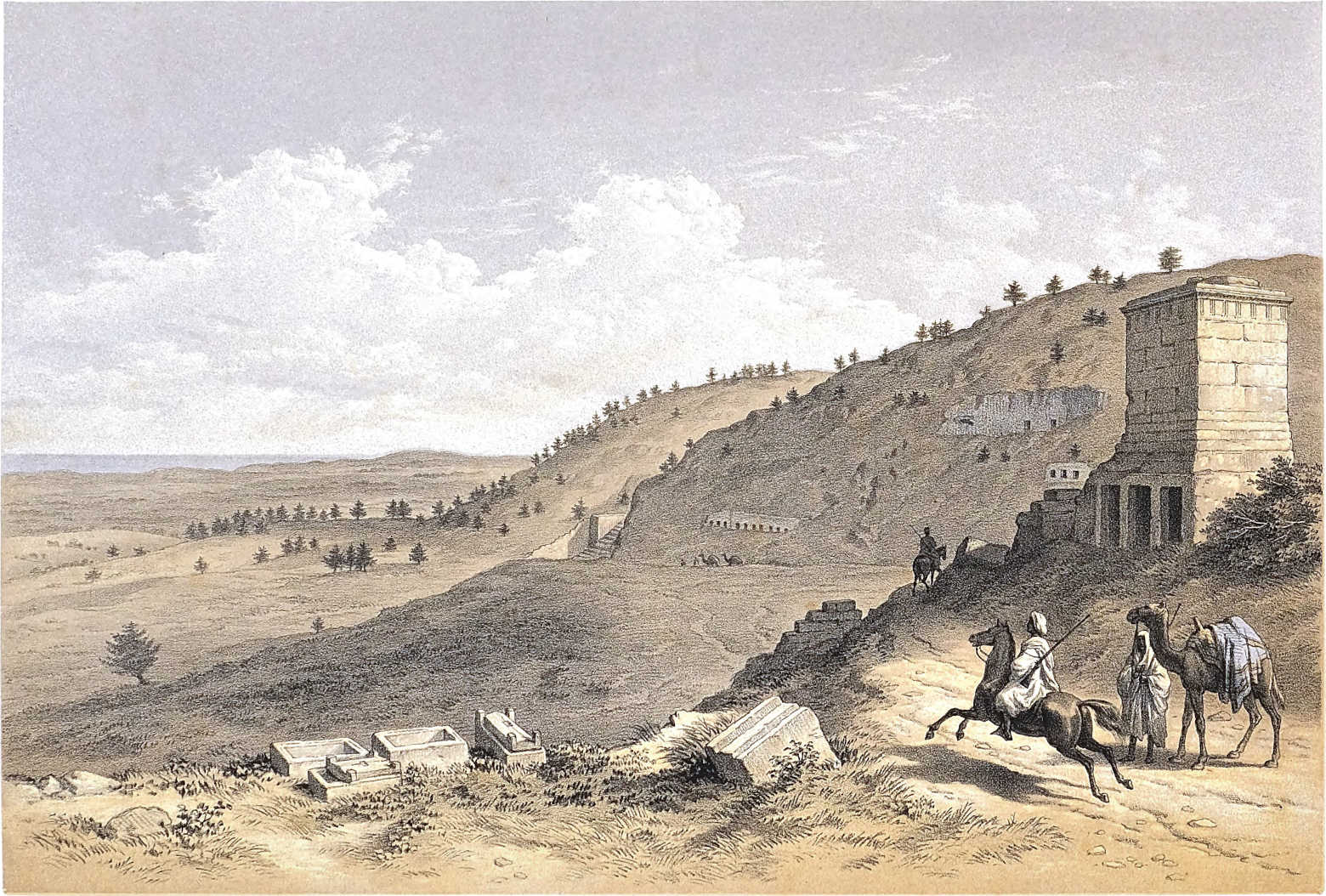
| E. A. Porcher, del., T. Picken, lith. | London. Published July 1st. 1864 by Day & Son, Lithographers to the Queen &c., Gate Street Lincoln’s Inn Fields. | Day & Son, Lithrs. to the Queen |
EASTERN END OF THE NORTHERN NECROPOLIS OF CYRENE
HISTORY
OF THE
RECENT DISCOVERIES AT
CYRENE,
MADE DURING AN
EXPEDITION TO THE CYRENAICA IN
1860-61,
UNDER THE AUSPICES OF HER MAJESTY’S
GOVERNMENT.
BY
Captain R. MURDOCH SMITH, R.E.
AND
Commander E. A. PORCHER. R.N.
DAY &
SON,
LITHOGRAPHERS TO
THE QUEEN AND TO H.R.H. THE PRINCE OF WALES,
6, GATE STREET, LINCOLN’S INN FIELDS, LONDON, W.C.
1864.
[All rights of Translation and Reproduction are reserved.]
TO
HIS GRACE THE DUKE OF SOMERSET, K.G.
FIRST LORD OF THE
ADMIRALTY,
IN ACKNOWLEDGMENT OF THE PROMPT AND VALUABLE ASSISTANCE
AFFORDED TO THE AUTHORS,
DURING THE PROSECUTION OF THEIR LABOURS,
THIS VOLUME
IS RESPECTFULLY AND GRATEFULLY
DEDICATED.
[vii]PREFACE.
THE Cyrenaica, although bordering on the shores of the Mediterranean, and very little removed from the most civilized nations in Europe, has been rarely visited by travellers, either for pleasure or antiquarian research, owing perhaps to the supposed difficulty presented by the country itself, and by the character of the people inhabiting it.
The former, however, is not only beautiful, but fruitful. The number of olive-trees, now entirely neglected, to be seen everywhere, shows that at one time the inhabitants cultivated this plant to a considerable extent, and enjoyed the advantages of superior husbandry; but this is no longer the case, and the ground now only yields scanty crops of wheat and barley, and indifferent pasture for the rearing of cattle, sheep, and goats. Were the character of the people different and any authority acknowledged amongst them, the present desolation would give place to a different state of things; but this change can hardly at present be expected; and so long as the sentence, passed ages ago, “his hand shall be against every man, and every man’s hand against him,” remains unrevoked, the same restlessness under control and indifference to all social comfort, which now exist, will still characterize the inhabitants. The natural beauty of the country, however, is still unaltered, and plains and hills, well wooded in many parts, meet the eye in every direction, and render it one of the finest provinces in Northern Africa.
Another reason perhaps why Cyrene has not been explored so much as other localities, is that there are few remains of its former grandeur visible above the ground. Were the vast piles of magnificent architecture now gathered in confused heaps on the sand-banks at Thebes and Luxor to be seen at Cyrene, travellers, no doubt, would have made it a greater object of attention than they have done. But all the splendour of the ancient Cyrenaica, with few exceptions, lies buried below the surface of the earth; and here, over the palaces of kings and the remains of former magnificence, the Arabs pitch their tents and the camels browse.
Before commencing the narrative recorded in the following pages, it will be[viii] interesting to mention the principal travellers who have visited the country for scientific purposes during the last two centuries.
The first we hear of was Lemaire, who, during the time he was the French Consul at Tripoli, explored the country in 1706, by direction of Louis XIV. He was followed by Paul Lucas, who visited it twice, in 1710 and 1723. After him Doctor Thomas Shaw travelled, in 1738, over those parts, as well as a considerable portion of North Africa, and left an interesting account of his discoveries, and of the manners and customs of the inhabitants.
A French gentleman, Monsieur Granger, a physician by profession, accomplished the overland journey from Egypt to Cyrene in 1760, in company with a robber chief, to whom he promised a high reward on his return. Under this dangerous protection he copied several of the inscriptions that were found there; but these, with his journal, were unfortunately lost before his return to Europe. Our celebrated Abyssinian traveller James Bruce also visited parts of the country 1768-72.
In the present century the first person who visited Cyrene was an Italian, Doctor Cervelli. In 1812, the Pacha of Tripoli, wishing to punish the revolt of his son, the Governor of Derna, sent an armed force into the province, and Doctor Cervelli accompanied the expedition, and collected during his journey some interesting information, which was published by the French Geographical Society. A few years after, in 1817, the same Pacha despatched a second expedition against some turbulent Arabs at Merdj (Barca), and this party was accompanied by another Italian, Della Cella, who travelled as Physician attendant on the Bey, and published an account of his travels, which was translated into English in 1822; but his hurried visit did not allow him sufficient time to collect much valuable information. Cyrene was also visited by P. Pacifique, a missionary from Tripoli, who added some fresh information to that given by Della Cella.
In 1820, a Prussian, General Minutoli, formed a project of making a complete tour of the Cyrenaica, and was accompanied by savants and artists to make his journey of greater importance. As soon as he had arrived at the foot of Mount Catabathmus, which is situated above half-way from Egypt, he lost three of his Europeans, and this misfortune and the obstacles the Arabs opposed to his party so disheartened him that he returned to Alexandria without accomplishing his object.
The ill-success of the Prussian general left the country still insufficiently explored for scientific purposes, and this induced two travellers, Captain Beechey and M. Pacho, to undertake the task.
Captain Beechey and his brother started from Tripoli by land, making the circuit of the Syrtis Major, and explored the whole of the country in 1821-2, drew very correct plans, and fixed the astronomical positions of all the principal towns, and[ix] wrote a detailed account of their travels. A surveying vessel at the same time examined and laid down the coast-line.
This party had hardly returned when Pacho, a French artist, visited the country, in 1824-6, and his travels were published in Paris by M. Didot in 1827, in a quarto volume of text, and another containing 100 well-executed plates in folio. He was not aware, when he started, what discoveries Captain Beechey and his brother had made, as their work was not published for some years afterwards; and therefore it was a matter of great regret to him to find on his return that many of his own researches, which had cost him so much labour and trouble, had been anticipated by his predecessors.
Since these two principal works of Captain Beechey and M. Pacho were published, M. Delaporte, the French Consul at Tangier, has contributed to the Geographical Society of Paris the result of his exploration, and M. Vattier de Bourville, during the time he was French Consular Agent at Benghazi, in 1848-9, collected a large number of vases and terra-cotta ornaments from the tombs at that place, which are now deposited in the Louvre, and also made a short visit to Cyrene.
The intrepid traveller Dr. Barth passed over this country before he commenced his more hazardous expedition to Timbuctoo and the central regions of Africa; and lastly Mr. James Hamilton, in 1855-6, who afterwards proceeded inland from Benghazi, across part of the Sahara, to the oases of Augila and Siwah, on his way to Egypt.
Few of the travellers just mentioned remained any time in the country, and it was quite evident that no attempt at excavation to any extent had ever been made before our arrival, as sculpture in excellent preservation was found a few feet under the surface, on the most promising sites, where people would naturally be led to commence their researches.
The valuable works of Beechey and Pacho before mentioned have left but little for future visitors to record, and as all the principal monuments left standing have been accurately drawn and described, it would be superfluous for us to go over the same ground again. The following pages will therefore be principally devoted to an account of the excavations that were carried on by my companion and myself and will also contain a description of the site of Cyrene, its Necropolis, and the surrounding country, together with a brief notice of the sculptures discovered.
The ten plates of unedited Greek inscriptions have been lithographed in fac-simile from impressions of the originals reduced by photography, and a selection from the sculpture has been photographed by Mr. Francis Bedford.
In the absence of Captain Smith, who is at present professionally employed in Persia, I take this opportunity of thanking the Government authorities and the Trustees[x] of the British Museum for their assistance from the commencement of the undertaking until its close, and also to the officers and crews of the Assurance and Melpomene, who cheerfully and efficiently carried out the orders of the Admiralty in the removal of the sculpture from Cyrene to the place of embarkation.
Also to Mr. C. T. Newton for his useful advice during the time we were in the country, and for his valuable assistance whilst these pages were going through the press; and to Mr. W. S. W. Vaux, of the British Museum.
E. A. PORCHER.
[xi]CONTENTS.
HISTORY OF CYRENE.
Derivation of the names Cyrenaica and Pentapolis — Causes which led to the country being colonized by a body of Dorians from Thera — Battus, the leader of this band, first takes possession of the island of Platea, and afterwards removes to Cyrene — Coalescence of the settlers with the Libyans — The dynasty of the Battiadæ — Constitution drawn up by Demonax, and granted by Battus III. — Attempt to overthrow it by his successor, Arcesilaus III., aided by his mother Pheretime, which is unsuccessful, and ends by his being murdered at Barca — The town is besieged by Aryandes, Satrap of Egypt, and taken by treachery — Brutal revenge of Pheretime on the inhabitants — Extinction of the dynasty — Condition of the new republic, and alliance with Alexander the Great — Becomes subject to Egypt — The names of the towns are changed — The last king of the Egyptian dynasty, Apion, leaves the country to the Romans by his testament, which is afterwards reduced by them to a province — Insurrection of the Jews, and a great massacre of the Romans and Cyrenæans — Sufferings of the population from the attacks of the Libyan barbarians, and by the ravages of locusts, plagues, and earthquakes — The Persian Chosroes overthrows the remains of the Greek colonies, which are finally overrun by the Arabs — Peculiar manner in which the boundary-line was fixed between Carthage and Cyrene — Eminent philosophers who lived at Cyrene — Description of the country and its former products — Recent history of the country. — Page 1.
PREPARATIONS FOR THE EXPEDITION.
Reasons which led to the expedition being undertaken — Peculiar difficulties from the nature of the country — Equipment, with assistance of the Foreign Office and other authorities in England to carry it out — List of the outfit. — Page 7.
TRIPOLI.
Leave Malta in the gunboat Boxer, and arrive at Tripoli — The Meshia — Position of the Castle and the Pacha’s harem — Visit to the artillery and cavalry barracks — Unsuccessful attempt to overthrow the Turkish government by Ghomer during the late Russian war — Notice of Tripoli, by John Ogilby. — Page 10.
BENGHAZI.
Leave Tripoli, and arrive at Benghazi — Adopt it as our base of operations — The wretched state of the town, and the plague of flies — The Castle and the principal buildings — Make friends with the Arab shiekhs, and engage an Arab of Cyrene as an attendant — Buy two horses and other necessaries for the journey — Manner in which auctions are conducted — Camels procured, with the assistance of the Kaimacam — Visit the ancient Necropolis and the river Lethe — The unsafe state of the harbour — The loss of a brig off the entrance of it — The distance where fresh water is procured. — Page 13.
[xii]CHAPTER V.
JOURNEY BETWEEN BENGHAZI AND CYRENE.
Leave Benghazi — Rainy and stormy weather — Arrive at Gŭsr Merdj, and hospitality of the Mudir — Description of the Plain and Castle — Resume our journey through a beautiful country, abounding in game — Encamp at Gŭsr Biligadem — Arrive at Cyrene, and select a tomb near the Fountain of Apollo for our residence — Our workmen try to desert at Merdj. — Page 18.
CYRENE.
The native name of Cyrene — The position of the ruins, with the configuration of the country — The Fountain of Apollo — General description of the Necropolis — A detailed account of the different kinds of tombs — The present aspect of the city — The ancient roads to Apollonia and along the Wady Bil Ghadir — Picturesque grandeur of the Wady Mûchgûn. — Page 25.
COMMENCEMENT OF THE EXCAVATIONS.
Visit from Mohammed El Adouly — Commence the excavations at two tombs in the Wady Bil Ghadir — These not proving successful, remove the men to a temple near the southern gate of the city — Discover the statue of Bacchus — The novel mode of removing it — Subsequent excavations in a building adjoining a theatre, and afterwards in the Temple of Apollo — Discover the colossal statue of Apollo; supposed statue of Hadrian; head of Minerva; the portrait-head of Cnæus Cornelius Lentulus Marcellinus, with its pedestal and inscription; a bronze portrait-head; Jupiter Ammon; a group representing the nymph Cyrene strangling a lion; Diana Venatrix — Description of the temple. — Page 38.
EMBARKATION OF THE STATUES ON BOARD THE ASSURANCE.
Examination of the country between Cyrene and the coast — Arrival of H.M.S. Assurance — Obliged to anchor off Ras El Hilal, on account of the weather — The next day steams to Marsa Sousah, and disembarks the waggons and stores — Several camels collected to take the stores up to Cyrene — Trouble with the Arabs before they start — The waggons are obliged to be taken to pieces, and carried up the Augubah on men’s shoulders — Difficulties of taking the waggons across the country and the descent of the Augubah — They are successively taken to the beach, embarked on board the Assurance, and the vessel leaves for Malta. — Page 44.
DEALINGS WITH THE ARABS.
The position of the Zauyah — Threatening messages sent from the Achwani and their shiekh, “Sidi Mustapha” — The Arabs attempt to prevent our passing, and a number of our stores stolen by them — Appeal to the Mudir of Ghegheb for assistance, and the way it was given — The two culprits are apprehended with great formality, and quietly allowed to escape a few days afterwards — The Mudir is dismissed for his conduct — Osman Aga, the Bash-Cavass, is sent to our assistance — Our reputation as doctors, and the curious application of the fair sex for keteebus — The wandering habits and mode of life of the Bedouins — Forms of salutation — Habit of swearing — Universal use of firearms. — Page 48.
[xiii]CHAPTER X.
VISIT TO THE OTHER TOWNS OF THE PENTAPOLIS.
The ruins of Apollonia and its harbour — Visit Imghurnis, and on our second visit badly received by the Arabs — Excursion to Derna — Pass the ruins of Gabiout Younes, Tirt, Lamloudeh, and Beit Thamr on our way — Reside with M. de Fremeaux, the Vice-Consul — Visited on our arrival by the Mudir and Kologhassi — The beauty of the little town of Derna — Its luxurious gardens and abundance of water — The anchorage of Sousah Hamema — Longer journey to Teuchira and Ptolemais — Pass by Gŭsr Biligadem, Libiar Il Gharib, and Merdj — The present state of Teuchira — Arrival at Ptolemais — The great gateway in the western wall still standing, and a number of enormous reservoirs in the centre of the city — Large tomb to the westward of it — Miss the road on our return to Merdj — Hospitably received there again by the Mudir — Return to Cyrene — Serious disturbance between the Arabs of the Haasa tribe and the Mudir of Ghegheb — The castle attacked during the night, the shiekhs liberated, and a number of men killed — They appeal to us for assistance — The waterworks at Safsaf. — Page 57.
CONTINUATION OF THE EXCAVATIONS.
The large temple near the Stadium — A few inscriptions found in it, but all the sculpture wantonly destroyed — Visit of H.M.S. Scourge, bringing Mr. W. Denison, a carpenter sent by the British Museum — Celebration of the festival of the Melood — Proceed to Derna in the Scourge, and return by land — Smith visits Benghazi to obtain workmen and money — One of the negroes stolen by the Arabs — The smaller temple near the Stadium — Statue of Minerva — The immediate neighbourhood of the Temple of Apollo — Several inscriptions, statues, and heads of different sizes discovered here — A seated Egyptian figure, colossal female statue, nude statue of Bacchus, &c. — A palace, in which were found the torso of a Roman emperor in armour, a large female draped statue, busts of Antoninus Pius, Marcus Aurelius, a female bust, three heads, and three inscriptions — Make a road down the Augubah, and improve the road between Cyrene and the coast — The Temple of Venus — Large quantity of sculpture found in it: Venus Euploia, and another Venus with Cupid by her side seated on a dolphin, Pan, Aristæus, three female busts with curious head-dresses, heads of Minerva and Perseus, and a slab of marble in relief of Cyrene strangling a lion. — Page 71.
FINAL EMBARKATION.
Arrival of H.M.S. Melpomene — A large party of men are landed from the ship, and start for Cyrene with three waggons — Serious disturbance with the Arabs — The means taken to preserve peace — All the sculptures are successively embarked — We finally leave Cyrene, and arrive at Malta. — Page 78.
APPENDICES.
No. I. (contributed by Dr. C. Schroff). — The Thapsia Garganica — Difference between the properties of this plant and the Silphium of the Ancients. — Page 87.
No. II. — Description of the Sculptures found at Cyrene. — Page 91.
No. III. — List of Sculptures found on various sites at Cyrene. — Page 99.
No. IV. — Inscriptions discovered or found at Cyrene. — Page 109.
[xv]ILLUSTRATIONS.
| FRONTISPIECE.—EASTERN END OF THE NORTHERN NECROPOLIS OF CYRENE. | |||
| PLATE. | |||
| 1. | GENERAL MAP OF THE CYRENAICA | To face page | 6 |
| 2. | TRIPOLI | Ditto | 10 |
| 3. | BENGHAZI | Ditto | 14 |
| 4. | AMOR BON ABDI SEYAT AND SHEIKH BOCHLEGA | 14 | |
| 5. | SUPPOSED ENTRANCE TO THE RIVER LETHE | 16 | |
| 6. | CASTLE AND VILLAGE OF MERDJ (BARCA) | 20 | |
| 7. | MUDIR’S ROOM IN THE CASTLE OF MERDJ | 21 | |
| 8. | ENCAMPMENT NEAR A ROMAN FORTRESS (GUSR BILIGADEM) | To face page | 22 |
| 9. | INTERIOR OF OUR TOMB OF RESIDENCE | 23 | |
| 10. | OUR WORKMEN—SALEH, MOHAMMED, AND ABDULLAH | 24 | |
| 11. | WESTERN HILL OF CYRENE, WITH ENTRANCE TO THE FOUNTAIN OF APOLLO | To face page | 25 |
| 12. | FOUNTAIN OF APOLLO | Ditto | 26 |
| 13. | GENERAL VIEW OF ONE OF THE HILLS IN THE NORTHERN NECROPOLIS OF CYRENE | Ditto | 27 |
| 14. | LARGE TOMB AT THE EASTERN END OF THE NORTHERN NECROPOLIS | 27 | |
| 15. | TOMB IN THE NORTHERN NECROPOLIS | 23 | |
| 16. | RANGE OF TOMBS IN THE NORTHERN NECROPOLIS | To face page | 28 |
| 17. | INTERIOR OF A TOMB IN THE NORTHERN NECROPOLIS | Ditto | 29 |
| 18. | TOMBS TO THE WESTWARD OF WADY BIL GHADIR | 29 | |
| 19. | A TOMB EMBELLISHED WITH FIGURES IN THE NORTHERN NECROPOLIS OF CYRENE | 30 | |
| 20. | TOMB FOR 105 SARCOPHAGI IN THE NORTHERN NECROPOLIS | To face page | 30 |
| 21. | INTERIOR OF A PAINTED TOMB IN THE NORTHERN NECROPOLIS | Ditto | 31 |
| 22. | INTERIOR OF A TOMB IN THE NORTHERN NECROPOLIS | 31 | |
| 23. | INTERIOR OF A TOMB CUT IN THE SIDE OF A QUARRY IN THE NORTHERN NECROPOLIS | 32 | |
| 24. | INTERIOR OF A LARGE TOMB IN THE NORTHERN NECROPOLIS | To face page | 32 |
| 25. | TOMBS IN THE NORTHERN NECROPOLIS | Ditto | 33 |
| 26. | TOMBS (CALLED BY THE ARABS “KINISSIEH”) IN THE NORTHERN NECROPOLIS | 33 | |
| 27. | LARGE TOMB ON THE FACE OF THE WESTERN HILL OF CYRENE | 34 | |
| 28. | BUILT TOMB ON THE SOUTH-WEST SIDE OF CYRENE | To face page | 34 |
| 29. | RUINS OF THE CHRISTIAN CITY OF CYRENE | Ditto | 35 |
| 30. | WADY MUCHGUN, TWO MILES TO THE WESTWARD OF CYRENE | Ditto | 36 |
| 31. | PLAN OF AN ORNAMENTED AND PAINTED TOMB IN THE NORTHERN NECROPOLIS OF CYRENE | Ditto | 36 |
| 32. | PLAN OF A TOMB FOR 105 SARCOPHAGI IN THE NORTHERN NECROPOLIS | Ditto | 36 |
| 33. | PLAN OF A TOMB IN THE NORTHERN NECROPOLIS | Ditto | 36 |
| 34. | PLAN OF A TOMB IN THE NORTHERN NECROPOLIS | Ditto | 36 |
| 35. | PLAN OF A LARGE TOMB IN THE NORTHERN NECROPOLIS | Ditto | 36 |
| 36. | PLAN OF A BUILT TOMB ON THE SOUTH-WEST SIDE OF CYRENE | Ditto | 36 |
| 37. | ELEVATION OF THE INTERNAL FAÇADE OF A TOMB IN THE WESTERN NECROPOLIS | Ditto | 36 |
| 38. | TOMBS ON THE WESTERN SIDE OF WADY BIL GHADIR | 37 | |
| 39. | MOHAMMED EL ADOULY | 38 | |
| 40. | PLAN OF THE CITY OF CYRENE | To face page | 38 |
| [xvi]41. | PLAN OF THE CITY OF CYRENE, TO SHOW THE POSITIONS FROM WHICH THE PLANS AND SKETCHES WERE MADE | To face page | 40 |
| 42. | INTERIOR OF MOHAMMED EL ADOULY’S TENT | 54 | |
| 43. | ARAB ARMS OF THE CYRENAICA | 55 | |
| 44. | WADY LEBAIATH, BETWEEN CYRENE AND APOLLONIA | To face page | 57 |
| 45. | EASTERN CITY WALL AND RUINS OF APOLLONIA | 57 | |
| 46. | RUINS OF IMGHERNIS | To face page | 58 |
| 47. | DERNA | Ditto | 60 |
| 48. | CASTLE OF DERNA | 61 | |
| 49. | ARAB CAMP NEAR TEUCHIRA | 64 | |
| 50. | RUINS OF PTOLEMAIS | To face page | 64 |
| 51. | GATEWAY IN THE WESTERN WALL OF PTOLEMAIS | 66 | |
| 52. | TOMBS TO THE WESTWARD OF PTOLEMAIS | To face page | 66 |
| 53. | PLAN OF A CONSPICUOUS BUILT TOMB TO THE WESTWARD OF PTOLEMAIS | Ditto | 66 |
| 54. | INSCRIPTIONS OVER THE ENTRANCES TO THE TOMBS AT PTOLEMAIS | 67 | |
| 55. | PLAN OF THE LARGE TEMPLE NEAR THE STADIUM AT CYRENE | To face page | 71 |
| 56. | PLAN OF THE SMALLER TEMPLE NEAR THE STADIUM AT CYRENE | Ditto | 74 |
| 57. | PLAN OF THE TEMPLE OF VENUS SITUATED TO THE SOUTH-WEST OF THE TEMPLE OF BACCHUS | Ditto | 76 |
| 58. | ENCAMPMENT OF THE PARTY FROM H.M.S. MELPOMENE, NEAR THE HEAD OF THE AUGUBAH | 81 | |
| 59. | CENTRAL WADY AND SLOPE OF THE EASTERN HILL OF CYRENE | To face page | 82 |
| 60. | THAPSIA GARGANICA | 87 | |
PHOTOGRAPHS.
| PLATE. | |||
| 61. | BACCHUS. | ||
| 62. | APOLLO CITHARŒDUS. | ||
| 63. | THE EMPEROR HADRIAN. | ||
| 64. | MINERVA AND A MALE HEAD. | ||
| 65. | CNÆUS CORNELIUS LENTULUS MARCELLINUS (PROPRÆTOR OF CYRENE). | ||
| 66. | BRONZE ICONIC HEAD. | ||
| 67. | APHRODITE AND FEMALE TORSO. | ||
| 68. | ICONIC FEMALE STATUE. | ||
| 69. | BUST OF THE EMPEROR ANTONINUS PIUS. | ||
| 70. | BUST OF THE EMPEROR MARCUS AURELIUS. | ||
| 71. | APHRODITE EUPLOIA. | ||
| 72. | APHRODITE AND EROS. | ||
| 73. | ICONIC FEMALE FIGURE. | ||
| 74. | FEMALE BUST OF ROMAN PERIOD. | ||
| 75. | HEAD OF PERSEUS. | ||
| 76. | THE NYMPH CYRENE OVERCOMING A LION, AND BEING CROWNED BY LIBYA. |
INSCRIPTIONS.
| PLATE. | |||
| 77. | Containing numbers | 1 to 5 | |
| 78. | Ditto ditto | 6 | |
| 79. | Ditto ditto | 6 „ 7 | |
| 80. | Ditto ditto | 8 „ 11 | |
| 81. | Ditto ditto | 12 „ 14 | |
| 82. | Ditto ditto | 15 „ 17 | |
| 83. | Ditto ditto | 18 „ 23 | |
| 84. | Ditto ditto | 24 „ 26 | |
| 85. | Ditto ditto | 27 „ 28 | |
| 86. | Ditto ditto | 29 „ 32 |
ERRATA
| In General Map of the Cyrenaica, facing page 6, place a line under Apollonia for the ancient name. | |||
| Page 10, line | 8 | for Caimakam, | read Kaimakam. |
| Page 25, line | 3 | for Grenuah, | read Grennah. |
| Page 37, line | 5 | for Mûchqûn, | read Mûchgûn. |
| Page 54, line | 8 | for El Douly’s, | read El Adouly’s (under the woodcut). |
| Page 71, line | 39 | for Plate 6, | read Plates 78, 79, No. 6. |
| Page 71, line | 40 | for Plate 8, | read Plate 79, No 7. |
[1]DISCOVERIES AT CYRENE.
CHAPTER I.
BEFORE beginning the narrative of our expedition to the Cyrenaica, we shall recall, for the convenience of the reader, a few of the leading facts connected with the history of that country.
Accounts, more or less detailed, of the origin and progress of the Greek colony, of which Cyrene was the capital, are given by Herodotus, Strabo, Sallust, &c. In modern times these fragmentary and often contradictory accounts have been carefully collated and examined by the learned Dane, Thrige, in his work entitled “Historia Cyrenes, Havniæ, 1819.” The subsequent great work of Mr. Grote, and the several articles relating to Cyrene in Dr. William Smith’s Classical Dictionaries, contain everything of importance that the learned criticism of those distinguished scholars has been able to authenticate regarding the history of the Pentapolis. We have, therefore, with Dr. Smith’s kind permission, compiled the following compendium from the articles Cyrene, Cyrenaica, Thera, Battus, &c., in the Dictionaries of Classical Geography and Biography.
The Cyrenaica or Pentapolis was the name of an extensive tract of country in the North of Africa, bounded on the east and west by the respective territories of Egypt and Carthage, and on the north and south by the Mediterranean and the Desert. The name Cyrenaica was derived from the capital city, Cyrene, and properly denoted the country as a whole; while Pentapolis was a collective name given to the five great cities of Cyrene, Barca, Teuchira, Hesperides, and Apollonia, with their several territories and dependencies. The Romans, therefore, who looked upon the country as a single province of the empire, called it Cyrenaica; whereas, in the time of the Ptolemies, when the country was practically a confederacy of separate colonies, it was generally known by the federal name of Pentapolis.
Cyrene, the capital of this country, and the most important Hellenic colony in Africa, was founded in B.C. 631, by a body of Dorian colonists from Thera (Santorin), an island in the Ægean Sea belonging to Sparta. Battus, the leader of this band of colonists, was the son of Polymnestus, a Theræan noble, his mother, according to some accounts, being a Cretan princess. Considerable doubt exists regarding the origin of his name: Herodotus believes that it was the Libyan word for “king,” while others suppose it to have been derived from βατταρίζω, and to have been expressive of an alleged impediment in his speech. No less doubt is there as to the cause which led to the colonization of Cyrene. According to the account of the Cyrenæans, as given by Herodotus, Battus, having gone to consult the Delphic oracle about the removal of the physical defect above mentioned, was enjoined to lead a colony into Libya; while the story of the Theræans, as recorded in the same author, was, that this injunction was laid on their king, Grinus, and that he pointed to Battus as a younger and fitter man for the purpose. According, again, to a fragment from the historian[2] Menecles, preserved by Tzetzes, and the scholiast to Pindar,[1] Battus was driven forth from Thera by civil war, and was ordered by Apollo not to return to his country, but to betake himself to the continent. Justin gives a strange mixture of the two stories in Herodotus with the fable of Apollo’s love for the nymph Cyrene. Amidst these conflicting statements, the one certain is, that Battus led forth his colonists in obedience to the Delphic oracle, and under a belief in the protection of Apollo.
Sailing to the then almost unknown shores of Libya, Battus and his followers took possession of the island of Platea, in the Gulf of Bomba, which they seem to have mistaken for the mainland. Hence, after two years of suffering, and after again consulting the oracle, they removed to the opposite shore, and resided in the well-wooded district of Aziris for six years, at the end of which time some of the native Libyans persuaded them to leave it for a better locality, and conducted them through the region of Irasa to the actual site of Cyrene. Though Irasa was deemed so delectable a region that the Libyan guides were said to have led the Greeks through it in the night lest they should settle there, the spot at which their journey ended was scarcely inferior for beauty and fertility to any on the surface of the globe.
The site of Cyrene was in the territory of the Libyan tribe named Asbystæ, and with them the Greek settlers seem from the first to have been on terms of friendship very similar to those which subsisted between the Carthaginians and their Libyan neighbours. The Greeks had the immense advantage of commanding the abundant springs and fertile meadows, to which the Libyans were compelled to resort when the supplies of the less-favoured regions further inland began to fail. A close connection soon grew up between the natives and the Greek settlers; and not only did the former imitate the customs of the latter, but the two races coalesced to a much greater extent than was usual in such cases. It is very important to bear in mind that the population of Cyrene had a very large admixture of Libyan blood by the marriages of the early settlers with Libyan wives. The native Libyans, however, were altogether excluded from political power, which was in the hands exclusively of the descendants from the original settlers, or rather of those of them who had already been among the ruling class in the mother state of Thera.
The dynasty of the Battiadæ lasted during the greater part of two centuries, from B.C. 630 to somewhere between 460 and 430; and comprised eight kings, bearing the names of Battus and Arcesilaus alternately. After the foundation of Cyrene, little is known of Battus I. He appears to have been vigorous and successful in surmounting the difficulties which beset the infant colony, in making most of the natural advantages of the country, and in subjugating the native tribes. He governed with mildness and moderation, and executed various public works, of which the most celebrated was the road which he made for the sacred procession to the temple of Apollo. His subjects worshipped him as a hero, and dedicated a statue of him at Delphi, representing him in a chariot, driven by the nymph Cyrene, with Libya in the act of crowning him.
Nothing of importance is recorded in the reign of his son, Arcesilaus I., about B.C. 590-574; but that of his successor, Battus II., marks the most important period of the monarchy. In this reign, Cyrene received a great accession of strength by the influx of a large number of colonists from various parts of Greece, principally, perhaps, from Peloponnesus, and from Crete and the other islands, whom the State invited over under the promise of a new division of lands (probably to enable herself to make head against the neighbouring Libyans), and who were further urged to the migration by the Delphic oracle. This influx apparently giving rise to further encroachments on the Libyan tribes, the latter, under Adicran, their king, surrendered themselves to Apries, king of Egypt, and claimed his protection. A battle ensued in the region of Irasa, B.C. 570, in which the Egyptians were defeated—this being the first time, according to Herodotus, that they had ever come into hostile collision with Greeks. This battle seems to have finished the war with Egypt;[3] for we read that Amasis, the successor of Apries, married Ladice, a Cyrenæan woman of the house of Battus. By the same victory, too, the sovereignty of Cyrene over the Libyans was confirmed. It was also most probably in this reign that Cyrene began to occupy the neighbouring region with her colonies.
The misfortunes of the monarchy began in the reign of Arcesilaus II., surnamed the “Oppressive,” about B.C. 554-544. By attempting to subvert the constitution and establish a despotism, he caused a revolt of the Libyan Periœci. His brothers, Perseus, Zacynthus, Aristomedon, and Lycus, who instigated this rebellion, withdrew from Cyrene, and founded the city of Barca. In his attempt to quell the insurrection, Arcesilaus was signally defeated in a battle fought at Leucon or Leucoë, in Marmarica, in which 7,000 of his soldiers were slain. He was afterwards treacherously killed by his own brother Learchus. The intestine troubles of Cyrene during the latter part of his reign, gave the inhabitants of the new city of Barca an opportunity of extending their power over the whole of the west part of the Cyrenaica, including the district on the coast (as far as Hesperides), where we find the important post of Teuchira belonging to them. According to Servius, they carried their arms on land far west over the region of the Syrtes, towards Carthage, and acquired such a maritime power as to defeat the Phœnicians in a naval battle.
Battus III., or the “Lame,” son of Arcesilaus II., reigned from about B.C. 544 to 529. During his reign, the Cyrenæans, under the advice of the Delphic oracle, called in the aid of Demonax, a Mantineian, who drew up for them a new constitution, by which the encroachments of the royal house on the people were more than recovered, and the king was reduced to political insignificance, retaining, however, the landed domain as his private property, and also his sacerdotal functions. The political power, in which it would seem none but the descendants of the original colonists had any share, was now extended to the whole Greek population, who were divided by Demonax into three tribes: (1) the Theræans, who still retained the native Periœci; (2) Greeks from Peloponnesus and Crete; (3) Greeks from the other islands of the Ægean. A senate was also constituted, of which the king appears to have been president. In other respects, the constitution seems to have resembled that of Sparta, which was, through Thera, the original metropolis of Cyrene.
Pheretime, the widow of Battus III., and mother of his successor, Arcesilaus III., joined with her son in an attempt to overturn the new constitution of Demonax. Their first efforts were unsuccessful, and they were driven from Cyrene; but Arcesilaus, who had taken refuge in Samos, returned with a fresh band of colonists, chiefly from Ionia, took Cyrene, and executed cruel vengeance on his opponents. He endeavoured to strengthen his position by making submission to Cambyses, king of Persia. From a superstitious fear of the woe denounced against him by an oracle for his cruelty in the hour of success, or, perhaps, driven out of the city by his subjects, he fled to his father-in-law, Alazir, king of Barca. There, certain exiles from Cyrene, uniting with the Barcæans, attacked both kings in the market-place, and killed them. His mother, Pheretime, thereupon applied for aid to Aryandes, who had been appointed Satrap of Egypt by Cambyses. Aryandes, who welcomed this opportunity of effecting the conquest of Libya, collected a powerful army and fleet; but, before commencing hostilities, he sent a herald to Barca, demanding to know who had slain Arcesilaus. The Barcæans, having collectively taken the act upon themselves, the desired pretext was gained, and Aryandes despatched the expedition. After a siege of nine months, the city was at last taken by treachery, and given over to the brutal revenge of Pheretime. Those of the citizens who were supposed to have had most share in her son’s death she impaled all round the circuit of the walls, on which she fixed as bosses the breasts of their wives. Those who were clearly guiltless of the murder were allowed to remain in the city, but the rest of the inhabitants were sent to Persia, where Darius settled them in a village of Bactria, still called Barca in the time of Herodotus. After the siege of Barca, Pheretime[4] retired with the Persian army to Egypt, where, according to Herodotus, she died of a loathsome disease, for having “provoked the jealousy of the gods by the excessive indulgence of revenge.” Regarding her history, the following remark is made by Grote:—“It will be recollected that in the veins of this savage woman the Libyan blood was mixed with the Grecian. Political enmity in Greece proper kills, but seldom, if ever, mutilates or sheds the blood of women.”
The Persians ravaged great part of the country, and extended their conquests as far as Hesperides; and though they were even inclined to attack Cyrene on their way back to Egypt, they left the city unmolested. The result of the victory of Arcesilaus and Pheretime was the overthrow of the equitable constitution established by Demonax.
Of Battus IV., the successor of Arcesilaus III., nothing is known, except that he was surnamed the “Handsome.”
Arcesilaus IV., the last of the kings of Cyrene, is the prince whose victory in the Pythian Games, B.C. 466, is celebrated by Pindar. From his odes, it also appears that Arcesilaus IV. endeavoured to make himself despotic, by getting rid of the nobles of the state. It is probable that the city Hesperides was founded by him, with the view of securing a retreat for himself in the event of a successful rebellion of his subjects. It is not known whether he died by violence or not; but after his death royalty was abolished, and his son, Battus, who had fled to Hesperides, was there murdered, and his head was thrown into the sea,—a significant symbol of the utter extinction of the dynasty. This was probably about B.C. 450.
Of the condition of the new republic we have very little information. As to its basis, we are only told that the number of tribes and phratriæ was increased; and as to its working, that the constant increase of the democratic element led to violent party contests, in the course of which, various tyrants obtained power in the state; among whom are named Ariston and Nicocrates. When Alexander the Great invaded Egypt, the Cyrenæans made an alliance with him, and after his death their whole territory was made subject to Egypt by Ptolemy, the son of Lagus, B.C. 321. The country appears to have flourished under the Ptolemies, who pursued their usual policy of raising new cities at the expense of the ancient ones, or restoring the latter under new names. Thus Hesperides became Berenice; Teuchira was called Arsinöe; Barca was entirely eclipsed by its port, which was raised into a city under the name of Ptolemais; and Cyrene herself began to decay in consequence of the favours bestowed upon its port Apollonia. After these changes, Pentapolis became the common name of the country.
The last king of the Egyptian dynasty, Apion, an illegitimate son of Ptolemy Physcon (on whose death, in B.C. 117, he had obtained the government), left the country to the Romans by his testament in the year B.C. 95. At first, the Romans granted the cities their freedom, and bestowed upon them their former royal domain, only exacting a tribute; but quarrels soon broke out between the different states, and after Lucullus had made, by order of Sylla, a vain attempt to reconcile them, the Romans applied their usual last remedy, and reduced the country to a province, under the name of Cyrenaica (probably in B.C. 75), which was united with Crete on the conquest of that island in B.C. 67. In the division of the provinces under Augustus, the united province, under the name of Creta-Cyrene, Creta et Cyrene, or Creta simply, was constituted a senatorial province under the government of a proprætor, with the title of proconsul, who had a legatus and one, if not two, quæstors. Under Constantine, Crete and Cyrenaica were made separate provinces, the latter being called Libya Superior, and placed under the government of a Præses. It should be observed, that under the Romans the eastern boundary of the province, which divided it from Marmarica, was formed by an imaginary line drawn southwards from Axylis, a town somewhat to the west of the Chersonesus Magna.
The decline of the country in prosperity may be dated chiefly from the reign of Trajan, when the Jews, large numbers of whom had settled there under the Ptolemies, rose in insurrection,[5] massacred 220,000 Romans and Cyrenæans, and were put down with great difficulty and much slaughter. The loss of population during these bloody conflicts, and the increasing weakness of the whole empire, left the province an easy prey to the Libyan barbarians, whose attacks were aided by the ravages of locusts, plagues, and earthquakes. The sufferings of the Pentapolis from these causes, in the beginning of the fifth century, are pathetically described by Synesius, the bishop of Ptolemais, in an extant oration and in various passages of his letters; and at a later period by Procopius. In A.D. 616, the Persian Chosroes overthrew the remains of the Greek colonies so utterly, as to leave only the gleanings of the harvest of destruction to the Arab conquerors, who finally overran the country A.D. 647.—(Gibbon, VIII. 227, and IX. 444.)
At the height of its prosperity, Cyrene possessed an extensive commerce with Greece and Egypt, especially in the medical drug called Silphium: with Carthage its relations were always on a footing of great distrust, and its commerce on the west frontier was conducted entirely by smuggling. At what period its dominion over the Libyan tribes was extended so far as to meet that of Carthage at the bottom of the Greater Syrtis is disputed, some authorities referring it to the republican age, others to the period of the Ptolemies. Regarding the manner in which this boundary was settled, the following romantic story is told by Sallust:—
“The indefinite nature of the boundary between the territories of Carthage and Cyrene was the cause of many wars between them. After various alternate successes and defeats, they entered into the following agreement,—that certain persons deputed by each state should leave their home on an appointed day, and that the place where the parties might meet should be considered as the boundary of the kingdoms.
“Two brothers, named Philæni, were appointed on the part of Carthage, who contrived to travel faster than the deputies from Cyrene; but whether this was occasioned by accident or the indolence of the Cyrenæans, I have not been able to ascertain. Stormy weather might undoubtedly occasion delays in such a country, as well as it is known to do at sea; for when violent winds prevail in level and barren tracts, the sand which is raised by them is driven so forcibly into the faces and eyes of those who cross them, that their progress is considerably impeded. So soon as the people of Cyrene were aware of the ground which they had lost, and reflected on the punishment which would await them in consequence on their return, they began to accuse the Carthaginians of having set out before the appointed time; and when a dispute arose on the subject, they determined to brave everything rather than return home defeated. In this state of affairs, the Carthaginians desired the Greeks to name some conditions of accommodation; and when the latter proposed that the deputies from Carthage should either be buried on the spot which they claimed as the boundary, or allow them to advance as far as they chose on the same conditions, the Philæni immediately accepted the terms, and, giving themselves up to the service of their country, were buried alive on the spot where the dispute had occurred. On the same spot, two altars (Aræ Philænorum) were consecrated to their memory by the people of Carthage, and other honours were also decreed to them at home.”
By a comparison of the accounts of Ptolemy, Strabo, Pliny, and Mela, the Aræ Philænorum appear to have been situated near the bottom of the Greater Syrtis. At the time of Hannibal’s expedition to Italy, B.C. 217, they formed the eastern boundary of the Carthaginian territory.—(See Beechey, p. 220.)
Cyrene held a distinguished place in the records of Hellenic science. As early as the time of Herodotus, it was celebrated for its physicians: it gave its name to a philosophic sect founded by one of its sons, Aristippus; another, Carneades, was the founder of the Third or New Academy at Athens; and it was also the birthplace of Eratosthenes, who may be called the founder of astronomy, and who raised geography to the rank of a science; of the poet Callimachus, who boasted a descent from the royal house of Battus; and of the eloquent rhetorician Synesius, who afterwards became Bishop of Ptolemais.
[6]The portion of the Cyrenaica actually occupied by the Greek colonists—viz., from the Boreum Promontorium on the west to the Chersonesus Magna on the east—was, in respect of position, formation, climate, and soil, one of the most delightful regions on the surface of the globe. Its centre is occupied by a moderately elevated table-land, whose edge runs parallel to the coast, to which it sinks down in a succession of terraces, clothed with verdure, intersected by mountain streams running through ravines filled with the richest vegetation, well watered by the frequent rains in winter, and sheltered by the mass of the mountain from the sands and hot winds of the Sahara. The various terraces enjoyed a great diversity of climates, and produced a corresponding variety of flowers, vegetables, and fruits; and the successive harvests, at the different elevations, lasted for eight months out of the twelve. The table-land extends some seventy or eighty miles in breadth between the Sahara and the coast, but it is only on its N. and N.W. slopes that it enjoys the physical advantages now described.
Among its products were corn, oil, wine; all kinds of fruit, especially dates, figs, and almonds; cucumbers, truffles, cabbage, box, and saffron; flowers, especially roses, from which exquisite perfumes were extracted; and, above all, the plant for which the country was especially celebrated,—viz., silphium or laserpitium,—which produced the valuable article of commerce already referred to. The district was also famous for its honey, its ostriches, and its horses, large studs of which were kept at Cyrene and at Barca.
Of the more recent history of the Cyrenaica there is little to be related. In consequence of the Arab occupation, the whole country relapsed into a state of barbarism, from which it has never emerged, the only important event in its history being its conquest by the Turks under Solyman the Magnificent, who took its modern capital, Tripoli, in 1551. Since that date, as part of Tripoli, it has formed a nominal portion of the Ottoman empire, owning a greater or less degree of subjection to the authority of the Sultan. Soon after its conquest by Solyman, it gradually fell, like Egypt, Tunis, and Algiers, into the power of an hereditary dynasty of Beys, who were all but independent of the Turkish government. In 1808, when this dynasty was expelled by Sultan Mahmoud, the state of Tripoli became a mere province or Pachalik, which has ever since been regarded as an integral portion of the Sultan’s dominions.
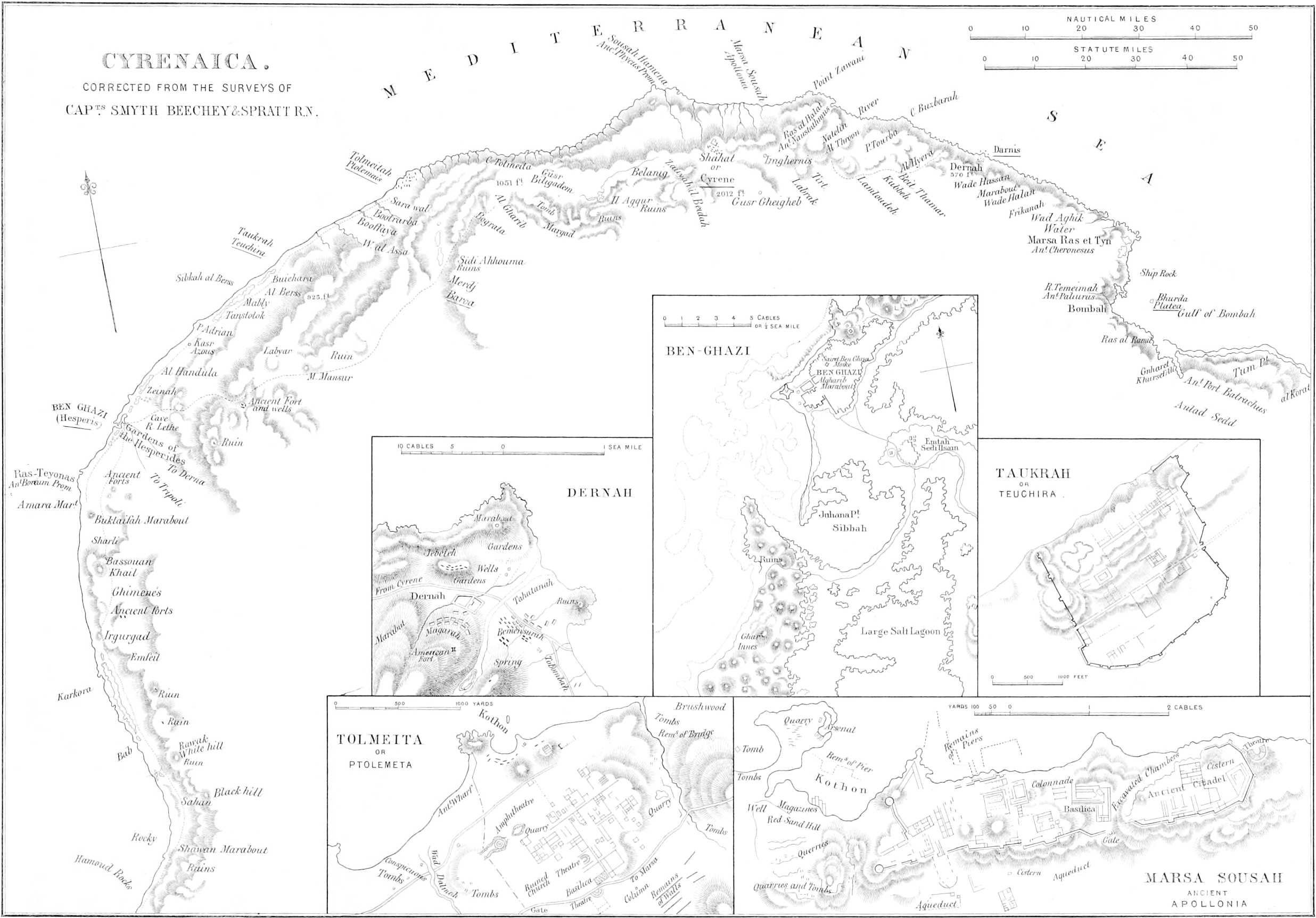
CYRENAICA.
CORRECTED FROM THE SURVEYS OF
CAPTS. SMYTH BEECHEY & SPRATT R.N.
Pl. 1.
Day & Son, Lithrs. to the Queen
[7]CHAPTER II.
FROM the short sketch of the ancient history of Cyrene given in the last chapter, the reader will be at no loss to discover the reasons which led us to undertake an expedition, for the purpose of examining the ruins of that distinguished city. The simple fact of its having been the capital of a flourishing Greek colony, afforded presumptive evidence of the existence of interesting and valuable remains; and the absence of any stationary population on its site, after the date of the Arab conquest, favoured the hope that such remains would be found in a comparatively perfect condition.
In many places, such as Athens, Rome, Halicarnassus, Rhodes, &c., the great obstacle to the recovery of the objects of ancient art, that lie buried among the ruins, is the occupation of the sites by modern towns. Where such occupation has been uninterrupted, the probability of the existence of extensive remains is, moreover, greatly diminished; inasmuch as the successive generations of inhabitants have not unfrequently made use of the materials of the ancient city in the construction of their own buildings, and wantonly destroyed the statues and other sculptures, as relics of Pagan idolatry.
In the case of Cyrene, however, it was almost certain that the site of the city had been unoccupied for upwards of 1,000 years; so that it was highly probable that whatever sculptures and other remains had escaped destruction at the hands of the early Christians and first Arab conquerors, must soon have been hid from view by a luxuriant vegetation, and, except in the most elevated situations, become gradually buried beneath the surface of the soil. From such considerations it was to be concluded, à priori, that many remains of the ancient Cyrene were still in existence,—a conclusion confirmed by the testimony of all the travellers who had visited the actual site.
Although there were thus sufficient grounds for regarding Cyrene as a good field for excavation, there were circumstances peculiar to its position and the present condition of the country, which made it very doubtful whether such excavations could be carried on successfully. One great obstacle lay in the fact of its inland position in a mountainous country, from which it was to be feared that heavy and fragile objects, such as marble statues, could not be conveyed to the coast for embarkation, except at excessive cost of time, labour, and money. Another no less important consideration was the character of the present inhabitants of the country, the Bedouins, a fanatical race of wandering Arabs, proverbial for their rapacity and violence. Moreover, Cyrene could only be reached by a long land journey from Benghazi, or Derna, the only places on the coast at which the caravan required for such a journey could be procured; and also the only places in the country where the authority of the Turkish Government was more than a name.
Before fitting out a regular expedition for the purpose of excavating, it was therefore advisable to gain sufficient information to form a proximate estimate of the cost and chances of success of such an undertaking; and this could only be obtained by an actual visit to Cyrene, and a careful examination of the country between the city and the coast. It struck me, when stationed at Malta, after the close of the expedition to Halicarnassus and Cnidus, in which I had been associated with Mr. C. T. Newton, that a reconnoitring excursion might be made to the Cyrenaica at little or no expense to the Government; the only absolute necessaries for its accomplishment being the use of a small vessel for, at most, two or three months, the sanction of the Foreign Office, and leave of[8] absence from military duty. At that time (the spring of 1860) there was a small sailing schooner lying in Malta harbour, called the Kertch, which, I thought, would answer the purpose admirably. A few men from H.M.S. Hibernia, to which she was a tender, would be a large enough crew; and being only a sailing vessel, she would cost nothing in fuel. I talked over the project with Commander Porcher, then Lieutenant of the Hibernia, who at once expressed his willingness to join me in the undertaking.
Our proposal was to visit the Cyrenaica at our own expense, for the purpose of examining the country with a view to a subsequent working expedition, provided the Foreign Office sanctioned the proceeding, and the Admiralty allowed the Kertch to be placed for a short time at our disposal. We thought it desirable to have some such vessel, not only to take us to the coast of Barbary, but to remain there while we made our journeys inland. She would thereby serve as a “base of operations,” and would be of special use in the event, which was not unlikely, of our being obliged, by the hostility of the Arabs, to beat a hasty retreat.
This proposal I submitted to Sir John Burgoyne, Inspector-General of Engineers, and to Mr. Newton, by both of whom it was cordially approved of. On their joint recommendation, Lord Russell kindly sanctioned the project, applied to the Admiralty for the means of carrying it into execution, and furnished us with letters of recommendation to her Majesty’s agents in Barbary, and a Firman which he had obtained in our favour from the Turkish Government. In reply to Lord Russell’s application, the Admiralty stated, that as the Kertch was urgently required for other services, she could not be given in the way we had suggested; but, if his Lordship wished it, that orders would be given to provide us with a passage as soon as possible to the coast of the Cyrenaica. This offer being accepted, orders were immediately sent to Admiral Sir William Martin, Commander-in-Chief of the Mediterranean fleet, to send us to Benghazi, or such other place as we preferred, as soon as there was a vessel available for that purpose. We were at the same time informed that H.R.H. the Duke of Cambridge, and the Duke of Somerset, First Lord of the Admiralty, had been pleased to grant us leave of absence for an indefinite period.
The want of a vessel like the Kertch, to remain with us during our excursion, caused, of course, a considerable modification of our plans. Instead of having our supplies and the means of retreat more or less at our own disposal, we should be obliged, by the new arrangement, simply to take our chance among the Arabs, and get on in the best way we could, the expense at the same time being greatly increased. We were thankful, however, for what we had got, and began at once to make the necessary preparations for the expedition.
On account of the want of harbours on the coast of the Cyrenaica, our original intention was to have started in July, and to have returned to Malta before the winter. Considerable delay, however, took place before a vessel could be had, and it was already winter when everything was ready for our departure.
It is always difficult to know what to take on a long journey in an uncivilized country. One is apt to forget a number of things that are really useful and even indispensable, and perhaps still more so, to take a great many that are afterwards only in the way. For the benefit of future travellers, therefore, we give the following list of our outfit, in which, fortunately, we found little that was either superfluous or deficient.
Materials, &c.—Two double circular tents complete with storm guys and pegs; two small portable wooden trestle bedsteads, made to roll up and be carried in waterproof bags; two field-hospital cork mattresses (rolling up), two pillows, four blankets, and two rugs, all carried in two waterproof bags; two iron folding chairs; cooking apparatus, consisting of a large saucepan, a kettle, a gridiron, and tea and coffee pots; a few knives, forks, and spoons, and some tin dishes, plates, and cups; a lantern (talc), and a large supply of candles and lucifer matches; a few simple medicines,[9] some lint, sticking plaster, an axe, two small hatchets, two saws, six spades and pickaxes, a crowbar, a coil of 1½-inch rope, a ball of whipcord, a hammer, and some nails.
Provisions.—Two bags of ship’s biscuit, a bag of rice, a large supply of tea, coffee, sugar, and salt, packed in tin boxes; two dozen tins of preserved meats to be used on emergencies only; two small cheeses; some spices, such as mustard, pepper, and curry-powder; two dozen of brandy.
Besides the above,—guns and revolvers, and a good stock of ammunition; English saddles, bridles, &c.; personal luggage, such as clothes, books, instruments, &c., as little as possible.
[10]CHAPTER III.
ALL our preparations being completed, we embarked, with our two Maltese servants, on board H.M.’s Gunboat Boxer, 2nd Master Gulliver commanding, and left Malta for Tripoli, Nov. 19, 1860. Our object in going there was to have our Firman presented to the Pacha or Governor-general of Barbary, who resides at Tripoli, and has subordinate Kaimakams, or Lieutenant-governors at Mourzouk and Benghazi. After a stormy passage, we reached Tripoli on the evening of the 21st, where we were most kindly welcomed by Colonel Herman, H.M.’s Consul-general, whose liberal hospitality we enjoyed during our stay. He had already presented the Firman, and seen that the most favourable orders regarding us had been forwarded to the Kaimakam of Benghazi. The evening before our departure, he entertained the Pacha at dinner, on which occasion we had the opportunity of becoming personally acquainted with His Excellency, who knew a little French, took his wine freely, played a fair game of billiards, and in every respect was quite unlike the ideal Osmanli.
Eastern towns bear such a resemblance to each other that it is difficult to give a distinctive description of one in particular. The houses, streets, and bazaars of Tripoli might be part of Constantinople or Smyrna. The inhabitants, however, are very different; instead of the slow gait and placid expression of the Turks, they have an unpleasantly wild and active appearance not at all reassuring to the traveller. Besides the Arabs, who form the great bulk of the population, there are a considerable number of Jews and Maltese.
The most prominent feature of Tripoli is the Meshiah or date-gardens, which occupy some six or eight square miles along the shore to the eastward of the town. Throughout their extent, they are so thickly planted, that the ground is almost completely shaded by the dense foliage of the date-palms. After traversing the Meshiah, one is much struck with its abrupt termination. From a luxuriant garden, the visitor, without warning, suddenly finds himself in the desert,—a bare undulating expanse of sand, stretching away to a range of distant hills.
The most conspicuous building in the city is the Pacha’s harem, close to the Eastern gate. By a strange freak of a former Pacha, part of it has been painted a bright red, which gives it an odd appearance in the midst of the surrounding mass of whitewashed walls. This building was the residence of the Karamanli Beys before Barbary was taken possession of by the Turks; and shortly before the fall of that dynasty, it was the scene of the murder of his brother by Yusuf Bey, in the presence of their mother—one of those domestic tragedies so common in the houses of Eastern rulers.
The government of Barbary and Fezzan is now similar to that of other Turkish provinces, being administered by a Pacha appointed by the Porte. As is the case with most Turkish governors, his tenure of office is usually very short, seldom, in fact, exceeding a year.
In the western part of the town, near the shore, stands the Castle, an irregular old building very much in need of repair. It contains the Medjlis or council chamber and the other public rooms of the Pacha, and is garrisoned by two or three battalions of regular infantry. A few years ago, the town was thrown into a state of consternation by the mutiny of the troops composing the garrison, who besieged the Castle, and threatened the town with destruction, if their arrears of pay were not settled and some other demands complied with. The firmness of the Pacha, and a few timely concessions, with difficulty restored subordination.
Pl. 2.
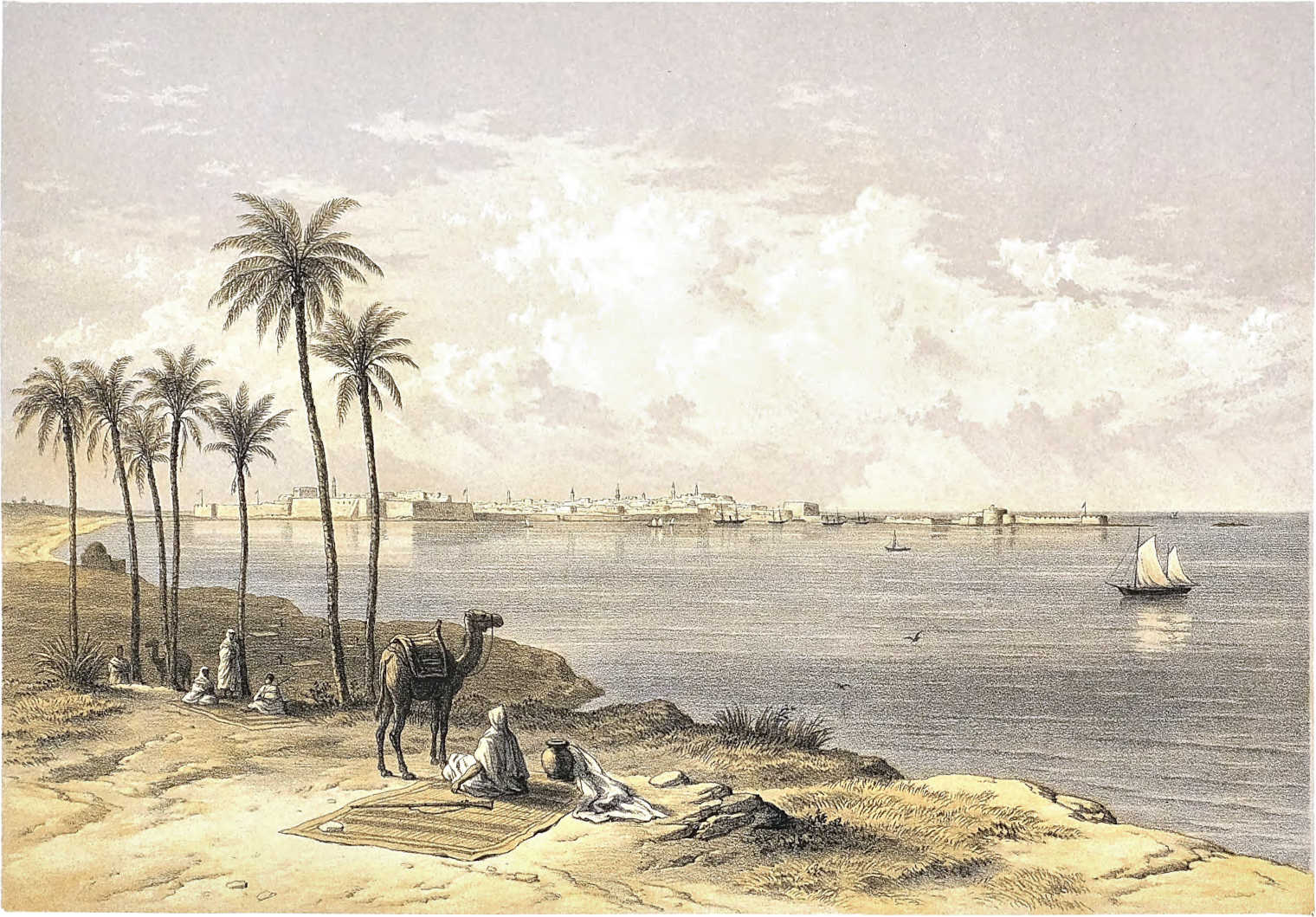
| E. A. Porcher, delt., T. Picken, lith. | London. Published July 1st. 1864 by Day & Son, Lithographers to the Queen &c., Gate Street Lincoln’s Inn Fields. | Day & Son, Lithrs. to the Queen |
TRIPOLI
[11]Besides the Infantry in the Castle, there is a considerable force of Artillery and Cavalry quartered in the Meshiah. When we told the General that we should like to see their barracks, he sent one of his aides-de-camp to show us over them. The two barracks (Artillery and Cavalry) are very pleasantly situated near each other, about a mile and a half from the town. We found them remarkably clean and well kept, and the stores of arms, clothing, &c., in perfect order.
In addition to the regular troops, many of the native Arabs are retained by the Government as irregular cavalry, called Koralié. They are similar to the Bashi Bozouks of other parts of Turkey, and are employed principally in the collection of the tribute.
During the late Russian war, an attempt was made to overthrow the Turkish government, and restore the rule of the Karamanlis. The head of the rebellion was a descendant of one of the last Beys, a chief named Ghomer, who had been kept a prisoner for some years at Constantinople, but had either escaped or been released. So many of the native tribes were in his favour, that for some time he was powerful enough to set the government at defiance. He seems, besides, to have been a man eminently well fitted for carrying on irregular warfare. Several expeditions sent against him ended in failure and disaster; but his army was at last completely defeated by a force under the immediate command of the Pacha, who on that occasion was accompanied by Colonel Herman, to whose judicious counsel he was much indebted for its fortunate result. After his defeat, Ghomer wandered as a fugitive, with a price set on his head, until, at last, he fell into the hands of some of the Pacha’s followers, by whom he was slain. One of his most active partisans was an Englishman, who, on the suppression of the rebellion, was taken prisoner and sent for trial to Constantinople; but on reaching the Dardanelles, he was quietly released by order of the Sultan.
The following quaint sketch of the history of Tripoli is given in a work published in 1670, entitled “Africa; being an Accurate Description of the Regions of Egypt, Barbary, Libya, and Billedulgerid, the Land of Negroes, Guinee, Æthiopia, and the Abyssines, &c. &c., by John Ogilby, Esquire, Master of His Majesty’s Revels in the Kingdom of Ireland.”
“This city and State (Tripoli) hath from the beginning had Lords of greatest eminency; as first the Romans, to whom it did Homage and Fealty, when they were Masters of Africa; but as their strength and glory declined, shrouded themselves under the protection of the Kings of Morocco, Fez, and Tunis, which have possessed it by right of Birth: but when the Inhabitants saw themselves oppressed by the Tyranny of Mukamur, Son of Hesen, King of Tunis, they threw the yoke off their Necks, first by a general Revolt, then expelling the King’s Lieutenant, and all other his officers, and at last electing from among themselves one whom they made their Ruler or Magistrate, putting all the Revenue and Support of the State into his hands. In the beginning this new Lord ruled with all gentleness; but afterwards degenerating into all sorts of Tyranny, his brother in law revenged the cause of the City by killing him. Freed from this Viper of their own breeding, they impowered a courtier of Prince Abubacer, who had been a Recluse or Hermit who held the command a few months, till Ferdinand, King of Arragon and Castile, sent Don Pedro de Navarre thither with an Army, who surprized the city, made all the Inhabitants Slaves, and brought them away; together with their Governour and his Son, whom he sent first to Messina, from thence to Palermo, where the Emperor Charles V. set him at liberty, dismissing him home to Tripoli, which the Christians, as we said, had dismantled and made untenable in all parts except the castle, which they furnished with a brave wall, whereon they planted divers great Cannon.
“The young Prince being come to Tripoli, repeopled it, in the name and on the behalf of the Emperor Charles; but in the year 1533, together with Tunis, Byserta, Susa, Monaster, and the Island of Zerby, was regained by Barberossa, who was scarcely warm in it before the Emperor Charles reassaulted and took it, forthwith making a Present of it to the Knights of Malta, who possessed it till the year 1551, when, under the reign of Solyman the Magnificent, Sinan Bashaw came and besieged Tripoli; to whom after a short time it was delivered upon honourable articles;[12] among which one was, That the garrison should march out with Bag and Baggage, and be provided of convenient shipping to Malta by Sinan; but, contrary to the conditions, most of them were plundered of their Goods: two hundred of the Moors, who had served the Maltese, were put to the Sword, and most of the Knights of Malta sent to the galleys, and the rest the Bashaw took and made slaves.
“After this victory Sinan appointed Morat Aga to be Viceroy, and ever since the Grand Seignior sends from Constantinople every three years a Beglerbeg or Bashaw thither to support his Conquests.
“About the year 1598, Sidi Haga, a Marabout, or Priest, designing to make himself a Master of the city and kingdom, with the assistance of the meaner sort, began a notable Rebellion; upon the first intelligence whereof, Assam Bassa, Admiral at Sea, sailed thither with sixty galleys and some soldiers, from Tunis and Algier, on a sudden fell into the Marabout’s Quarters, whose own men, finding their error, in some measure to mitigate the fury against themselves, set an end to their mutiny by presenting their Captain’s head to Sinan, who sent it to the Grand Seignior.
“In this condition Tripoli continued until about the year 1600, when the authority of the Bashaw was diminished by the soldiers and their commanders, in the same manner as Kara Osman did at Tunis, since which time Mahomet Bey, a Grecian Renegado, of the ancient house of the Justinians, hath so laid his business, that having got the Banner of Tripolis from the Grand Seignior, after he became Master of the Castle, would not endure the Bashaw any longer, but began to rule with full authority, yet still pretending a subjection to the Turk; and to preserve his favour, as an acknowledgement and homage, he frequently sends over many costly presents, and slaves: But at length this Bey became so powerful, that nothing was done but by his peculiar command. For he took soldiers at his pleasure, without the knowledge of the Divan, or Militia, and placed them in the Castle, for the security of his own person, that he might not be trepanned into his Ruin by the Policies of the Great Turk: and in this posture of Government it remained and doth still; only in 1667, the Moors made a dangerous Insurrection; but it proved only to the loss of their own heads.”
[13]CHAPTER IV.
AFTER spending four days very pleasantly at Tripoli, we reluctantly took leave of Colonel and Mrs. Herman, and started for Benghazi, in the Boxer, on the 25th. There being little coal to spare, we went under sail, and as the winds were light and variable, we did not reach Benghazi till noon of the 30th.
Shortly after we had anchored, the late Mr. Frederick Crowe, H.M.’s Vice-Consul, came on board, and most kindly invited us to take up our quarters at his house. Our original intention was to have gone on to Derna, and made it the starting-point of our journey to Cyrene, as the distance from that place was much less than from Benghazi. By Mr. Crowe’s advice, however, we gave up this idea, and resolved to adopt Benghazi as our “base of operations.” He told us that as there was not at that time a single European at Derna to assist us, we should have great difficulty in forming a caravan, and making the necessary arrangements for our journey. We were therefore easily induced to accept his kind offers of hospitality and assistance.
At the landing-place we were received by some officers sent by the Kaimakam, who informed us that rooms had been prepared for our accommodation at the Castle. Saddle-horses also were in waiting, out of compliment rather than for use, the distance to the Castle being only some fifty yards. After the exchange of the usual salutations and fine speeches, the ceremonial reception came to an end, and the officers retired. Immediately afterwards we were happy to find ourselves under the hospitable roof of Mr. Crowe. The following day the Boxer left to return to Malta.
Benghazi, built on the site of the ancient Hesperides or Berenice, occupies the point of a narrow strip of land between the sea and a shallow salt lake or lagoon. A belt of palm-trees behind the town, and the solitary minaret of a mosque, are the only objects that rise above the monotonous level of the surrounding country, and give any distinctive character to the scene. We must, however, except some half-dozen bent and melancholy-looking palms on Juliana Point, on the opposite side of the entrance to the harbour. For upwards of twenty miles inland from Benghazi, the country is an unvaried undulating plain, with hardly a single feature to mark one part of it from another. A few juniper and baturne shrubs grow here and there. The sketch we have given is taken from the northward of the town near the meat-market, and a few yards in front of the only windmill in the country.
The streets and houses in the town are wretched in the extreme. The houses, if such they may be called, are all built of small stones plastered and held together with mud. The consequence is, that the town is half laid in ruins every winter by the rain, and as but few of the fallen houses are ever rebuilt, the miserable appearance of the streets may easily be imagined. Whitewash, so liberally used by the Turks, and which gives such an air of comfort and cleanliness to many of their villages, is here unknown. The streets, encumbered with the ruins of fallen houses, are, moreover, filthy to a degree unknown in the worst of European cities.
No account of Benghazi would be complete without mentioning the plague of flies, to which it is at nearly all seasons subject. During meals, a partial escape from their persecution may be effected by darkening the room, and thereby inducing them to settle on the ceiling. Even then, however, they are perpetually crawling into the cups and plates, notwithstanding the efforts of a servant “told off” for the very purpose of driving them away. It is almost unnecessary to add that fleas abound, as in other Eastern places.
Pl. 3.
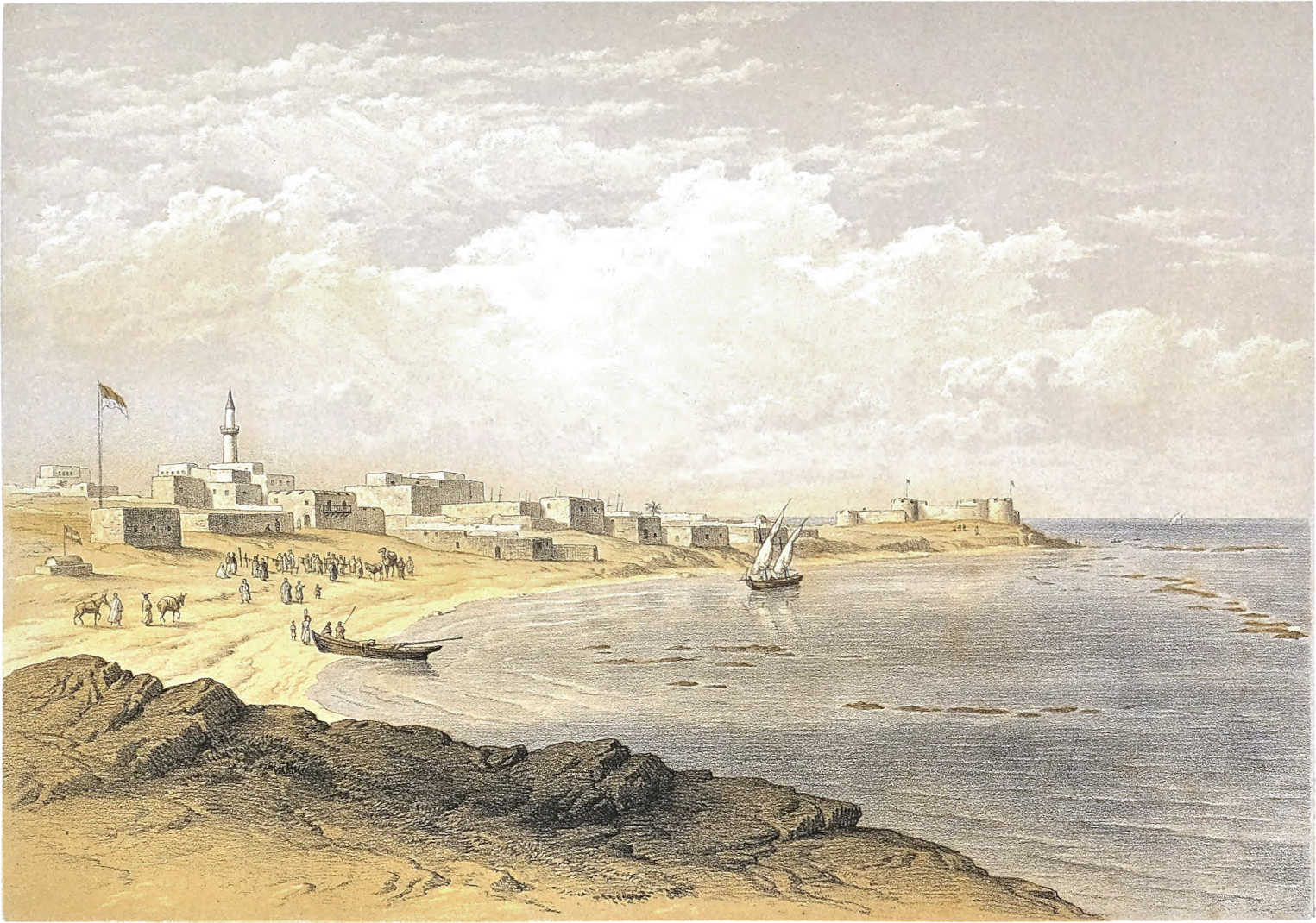
| E. A. Porcher, delt., T. Picken, lith. | London. Published July 1st. 1864 by Day & Son, Lithographers to the Queen &c., Gate Street Lincoln’s Inn Fields. | Day & Son, Lithrs. to the Queen |
BENGHAZI
[14]The following graphic and accurate description of the Benghazi flies is given by Beechey:—“On account of the filth and rubbish and the stagnant pools in the town, Benghazi is proverbial for flies, and every part of the town, both within and without the houses, may truly be said to swarm with them. Among the various annoyances with which the place abounds these are perhaps the most serious of any, or, at all events, they are those from which it is least possible to escape; there is, in fact, no chance of avoiding them. They follow you everywhere from place to place, settle on every part of the arms, legs, and body, which the heat of the weather obliges you to leave uncovered; creep obstinately into the corners of the eyes and up the nostrils, into the hollows of the ears and the corners of the mouth when it is closed; and often fly down the throat, nearly choking you, when it is open. At meals, every part of the dishes and their contents are covered as soon as they are produced, and every fluid becomes a trap for as many of these insects as can crowd over its surface. In short, there is literally no riding or walking, no reading or writing, no eating or resting one’s self in any part of Benghazi in comfort for them; and if at night they take up their accustomed position on the ceiling, and give place to the fleas and mosquitoes, the first dawn of morning finds them on the wing, and all alive to recommence their operations.”
The Castle, which stands on one side of the entrance to the harbour, consists of a number of houses enclosed by a quadrangular wall with round flanking towers at the corners. The masonry is very little superior to that of the rest of the town; in fact, the walls are so badly built that they would soon collapse under the concussion of the fire of their own guns. One range of houses is used as a barrack for the wing of an infantry regiment, another as the prison, and the remaining buildings as the residence and council-chamber of the Kaimakam.
The English Consulate, and a few two-storied houses lately built close by it, give a respectable appearance to the part of the town near the Castle. When we were at Benghazi, some missionaries from the Propaganda at Rome were building in this quarter a good substantial house and chapel, which promised to become by far the finest structure in the town. The object of this mission is not so much to attempt the conversion of the native Arabs, as to attend to the spiritual wants of the Christians of the place, who are almost all Maltese. The mission consists of one priest and two or three lay brethren, all of the Capuchin order of friars.
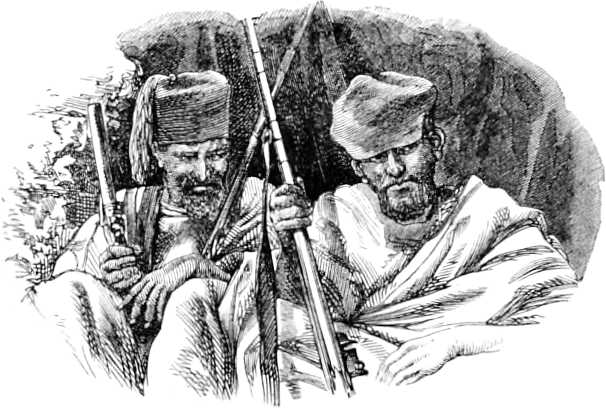
Plate 4.—Amor Bon Abdi Seyat and Sheikh Bochlega.
From a Photograph.
One of the first things we had to attend to at Benghazi was the question of escort. By order of the Pacha, the Kaimakam was required to furnish us with an adequate one; but Mr. Crowe advised us to go as independently of the Turkish authorities as possible; as he thought rightly, that all the soldiers the Kaimakam could send with us could afford little assistance if the Arabs actually turned against us, and would, probably, by their very presence, only provoke hostility. We therefore declined the Kaimakam’s offers of protection in this respect, and contented ourselves with a circular letter addressed to his subordinates, the Mudirs of Merdj, Ghegheb, and Derna. Meantime, Mr. Crowe sent for some of the principal sheikhs of the tribes on our proposed route, in order, if possible, to enlist them in our favour. Some of them fortunately happened to come to Benghazi a few days afterwards, when Mr. Crowe asked them to pay him a visit at the Consulate. When they came, he told them of our intended journey to Cyrene, and said that we should prefer their protection to that of the military escort offered by the Kaimakam. They replied that they were very happy to be able to do anything in return for the benefits he had conferred on them, and especially for the restraint which his presence[15] exercised upon the unlawful and oppressive conduct of the Pachas. They then gave us letters to the sheikhs of the principal tribes on our route, and ordered an Arab from the neighbourhood of Cyrene to accompany us on our journey, and remain with us afterwards. This man, Amor Bon Abdi Seyat, proved in the end of the greatest service. He is shown on the left of the annexed sketch, and the other was one of our friends at Cyrene, Sheikh Bochlega.
The question of escort settled, the next thing to be attended to was our equipment for the journey. In this, as in all our arrangements, we were greatly assisted by Mr. Crowe. We were also much indebted to Mr. Cesareo, a merchant of Benghazi, who afterwards accompanied us to Cyrene, at Mr. Crowe’s request. The Kaimakam undertook to procure as many camels for hire as we required. Our horses we bought at an auction, which is worthy of some notice, as it was conducted on rather a curious principle. The auctioneer walks about the bazaar, showing whatever is for sale, and calling out the last bid for it. When no one will bid more, the article is “knocked down” to the highest bidder, not at the sum offered by himself, but at the next highest. In bidding, therefore, against other people, the best plan is to allow them to run the price up till it has nearly reached the sum one is willing to pay, and then to offer a much larger price. This, of course, deters them from offering more; and the article is obtained at the smaller sum which they had bid for it. Our two horses bought in this way cost £14.
A great many necessaries for the journey had to be got, which, had we been left entirely to ourselves, we might have forgotten. Among the most important of these were skins for carrying water, called “girbehs,” and a leather bucket for drawing it. The girbeh is a whole goat-skin tanned inside, with the hair left on outside. To our stock of provisions we added another bag of biscuit and a large bag of onions. We also bought a dozen Barbary mats, which added greatly to our comfort, both on the journey, and afterwards during our stay at Cyrene. They make an excellent covering for the floor of a tent, for which purpose they are much to be preferred to rugs or carpets. Being made of thin strips of reed, they are not injured by the rain, and can be dried at once by simply rubbing them with a cloth. Their special excellence, however, is that they afford very little harbour for fleas.
We laid in a good stock of coarse-grained powder to be used as “bakshish,” or presents. As the importation and sale of gunpowder are prohibited, it is smuggled on shore by the traders of Benghazi, who charge the Arabs a price proportionate to the risk they run in procuring it, or the sum they expend in bribing the officers of the Custom-house. For this reason, powder is often more useful to the traveller than money itself. By Mr. Crowe’s advice, we also took for “bakshish” some printed cotton handkerchiefs, and some leaf tobacco for chewing. Somewhat to our surprise, we found smoking almost unknown, and the habit of chewing tobacco very prevalent among the Arabs. They use with it a kind of saltpetre, called “natron,” obtained, as we were told, from the salt lakes of Fezzan.
Of the ancient city very few remains are now visible. At the back of the Castle, where the ground rises a little, the sea has washed away the soil, and thereby formed a steep face or escarp, in which some foundations may be seen cropping out; but, unfortunately, the tomb of a Marābut or saint, and the surrounding public burial-ground, prevent any excavation being made.
During the twelve days that we remained at Benghazi, we made several excursions with Mr. Crowe in the neighbourhood. The most interesting locality is at the head of the shallow lagoon about two miles from the town. Here a succession of mounds and other irregularities in the surface of the ground mark the position of the ancient cemetery. About eleven years ago, some rather extensive excavations were made here by M. de Bourville, French Vice-Consul at Benghazi. His labours were rewarded by finding a number of valuable vases, and some sculptures of later date, all of which are now deposited in the Louvre. Judging from the appearance of a tomb which Mr. Crowe had recently opened, the necropolis seems to have consisted of tombs built[16] underground. His attention was attracted to the spot in which this tomb was afterwards discovered by noticing the hollow sound of his horse’s footsteps when riding over it. After digging two or three days, his workmen found the entrance in the end wall, only a few feet below the surface. The interior resembled, in plan, many of the rock sepulchres at Cyrene and elsewhere, consisting of an oblong centre chamber with lateral recesses for the sarcophagi. It was built throughout of isodomous masonry, without mortar. Besides a large plain marble sarcophagus, it contained two small ones, also of marble, and highly ornamented with figures in bas-relief. These were afterwards sent by Mr. Crowe to the British Museum, where they may be seen among the sculptures from Cyrene.
There is an old Arab at Benghazi, formerly employed by M. de Bourville both there and at Teuchira, who now spends his time in digging in the cemetery. His operations are, of course, on a very limited scale; but by digging small holes at random all over the place, he has found a great many vases, terra-cotta figures, &c., which he sells to the Maltese merchants in the town. We were inclined to engage him to go with us to Cyrene; but as he considered himself entitled to about as much pay as a dozen workmen, we had to dispense with his services.
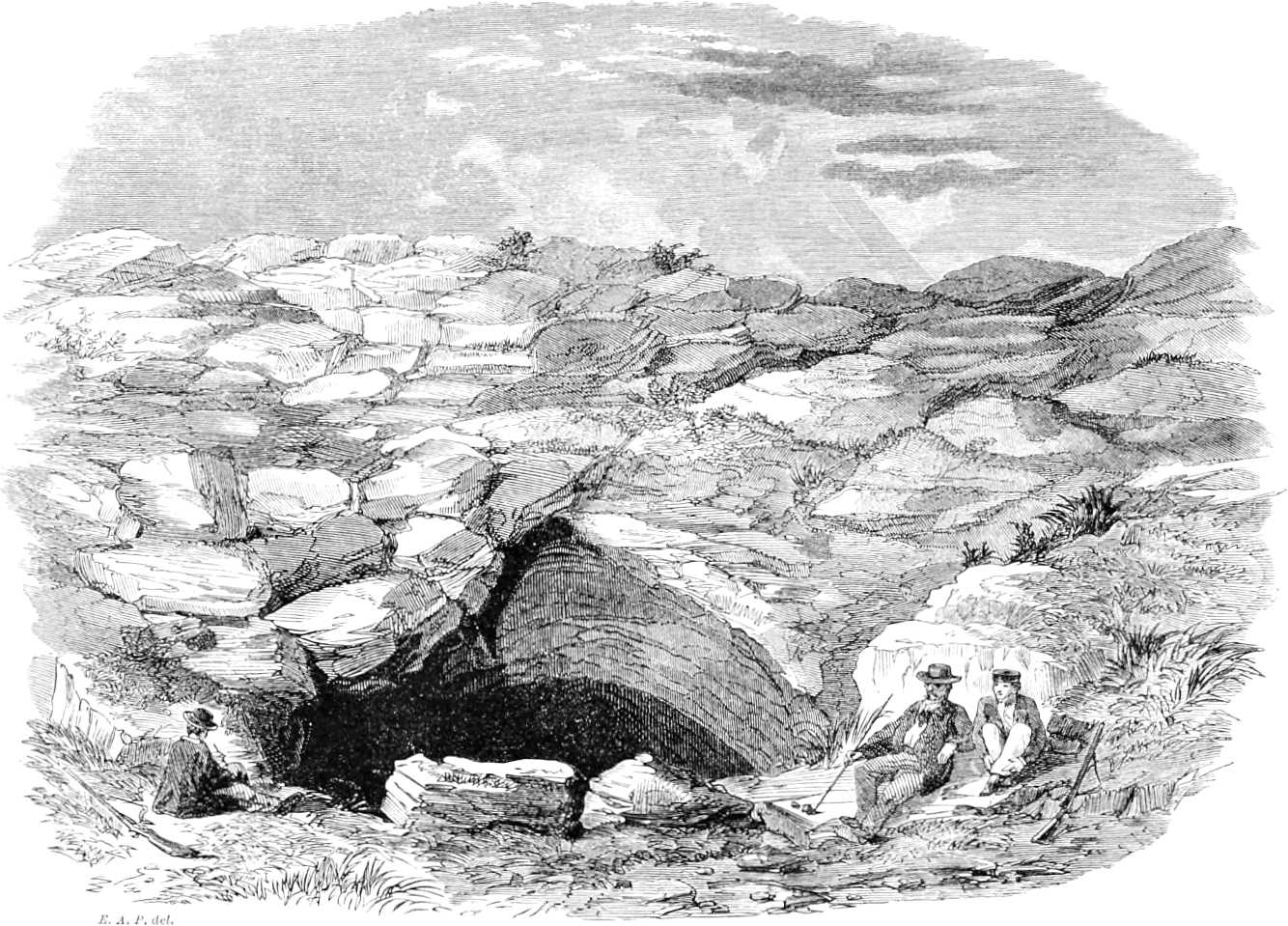
Plate 5.—Supposed Entrance to the River Lethe.
Beyond the cemetery, in the extensive plain of Benghazi, there are numerous natural hollows or chasms, with steep rocky sides, some of which still bear the marks of having been used as quarries. Moistened by the drainage of the surrounding ground, the soil at the bottom of many of them is covered with a luxuriant vegetation. One of them, about four miles from Benghazi, known as the “Garden of Osman,” is pretty fairly cultivated, and contains a well of excellent water. The verdure of these spots, resembling, as they do, oases in a desert, has given rise to the conjecture that they are the gardens of the Hesperides.
[17]We also visited a remarkable place, supposed, with a greater degree of probability, to be an entrance to the subterranean river Lathon, which has usually been identified with the Lethe. About a mile from the Garden of Osman we were conducted to the edge of an abrupt ravine, about 100 feet deep, with a dark-looking cavern at the bottom. Leaving our horses above, we descended the ravine, and entered the cave. At the entrance it was low and narrow; but after descending a few yards, it suddenly expanded to a height of fifteen and a width of about forty feet. Some thirty yards from the entrance we came to the margin of a sheet of water, which extended as far as the eye could reach. One of our Arab attendants waded in with a lighted torch, but was obliged to return on account of the depth of water, after going about fifty yards. Whether the water is really a river, or only a large subterranean pool, it is difficult to say. We wished to explore it further, but could not get a boat at Benghazi small enough to be portable. Some years ago, it was determined to sink a shaft to the cavern some distance from the mouth, for the purpose, probably, of making the large supply of water available; but through an error in the bearings taken by the superintending officer, the shaft was sunk in the wrong place, and consequently the water was never reached. The good work was then abandoned as unlucky, and has not since been resumed.
The harbour of Benghazi is very unsafe, and cannot be entered by vessels drawing more than six feet of water. The channel at the entrance is narrow, with a reef of rocks on each side. The outside anchorage is quite open and unsheltered, so that vessels lying there have to put to sea when it blows hard from seaward. Instead of doing anything towards improving the harbour, the authorities do not even prevent vessels from discharging their ballast into it, and thereby making it gradually worse. The day before we left, we saw a brig belonging to Benghazi wrecked on the rocks off the Castle. She had come from Leghorn with a general cargo, and anchored off the harbour during a stiff breeze from the S.W., the pilot thinking it unsafe to attempt to enter until the wind moderated. Her anchors, however, soon gave way, and she drove on the rocks, where she soon became a total wreck. Had the crew and the people on shore exerted themselves, they might have saved the greater part of the cargo; but, with true Mahomedan indifference, they looked on until it was too late to save more than one or two boat-loads.
The water in the wells at Benghazi is very brackish; so much so, that the inhabitants are obliged to bring water from sweet wells at some distance from the town. Some of these are about two miles off, near the end of the belt of palm-trees; but the best water comes from the wells on the opposite side of the lagoon. It is carried in skins, or small breakers, on the backs of camels and donkeys, whose drivers appear to be the only industrious class of the whole community.
[18]CHAPTER V.
ON the morning of the 12th December, our other preparations being completed, we commenced loading the camels. The distribution of the baggage was a very tedious operation, owing chiefly to the quarrelling of the drivers with each other, every man trying to get as light a load as possible for his own camel. The baggage required on the journey had to be kept separate from the rest, and each load had to be divided so as to balance on the camel’s back,—a complicated arrangement, which led to endless wrangling on the part of the drivers. It was only after summoning to our aid the Kaimakam, who threatened them with imprisonment and bastinado, that we at last got the caravan under weigh. It consisted of ten camels, on two of which our Maltese servants were mounted, four camel-drivers and four blacks on foot, and Mr. Cesareo, two guides, and ourselves on horseback. We left late in the afternoon, and were accompanied some distance by Mr. Crowe, and his interpreter Mr. Levi. It was with great regret that we bade him adieu, although little thinking that we should never see him again. We had spent twelve days with him most pleasantly, and his kind hospitality had made even Benghazi a second home to us.
We halted for the night at the “Garden of Osman” mentioned above. This is a favourite resting-place for caravans starting from Benghazi, as it has a well of excellent water, with which the Arabs fill their “girbehs” before proceeding on their journeys. Here we pitched our two tents, one for our servants and baggage, and the other for Mr. Cesareo and ourselves. The following morning, after filling our water-skins and loading the camels, we started at half-past eight, and rode straight across the plain in the direction of the hills. Before we had reached them, however, the rain, which had been threatening all the morning, began to pour in torrents. Further progress was impossible, as the camels could hardly keep their feet on the soft slippery ground; and we were consequently obliged to halt about the middle of the day at the foot of the range of hills known as the Augŭbah of Benghazi. We chose the best site for encamping we could find, but had great difficulty in pitching our tents, on account of the high wind and the softness of the ground, which by this time was saturated with water. We had to make use of our storm guys, as the ordinary ones were much too short to keep the tents up by themselves. It was nearly evening before we had everything snug for the night. Our efforts to light a fire, after innumerable failures, were finally successful, and soon after dark we had a splendid bonfire, which had a most cheering effect. The appearance of our little camp was very striking,—camels kneeling round the tents, horses picketed here and there, and groups of wild-looking Arabs crouching near the fire, while all around was perfect darkness. Our Barbary mats proved a great luxury, as the ground had become a perfect puddle with the trampling of men and animals. Before we got under the shelter of the tents, we had ample opportunity of testing the utility of the Arab burnouses we had bought in Benghazi. The burnous—the origin of the graceful one worn by ladies in Europe—is a long grey and white striped woollen cloak with a hood, made throughout in one piece, without seams, and woven thick and close enough to be waterproof. It is specially adapted for riding, as it forms a sort of tente d’abri for both horse and horseman. In fine weather it may be rolled up and strapped to the Ds of the saddle like a cavalry cloak.
The following day, the 14th, the weather was fine; but we were unable to start, as the ground was still too slippery for the soft flat feet of the camels. Meantime, two Arabs arrived, who were[19] sent by the Kaimakam to act as guides or escort; thus increasing our total number to seventeen. We would willingly have dispensed with their presence, as they only added to the number dependent on our rather slender stock of provisions; but as the Kaimakam insisted on their accompanying us, we thought it ungracious to send them back, and allowed them to remain. We spent the day pleasantly enough, walking about the neighbouring hills and ravines, and shooting partridges. We found neither golden plovers nor sand-grouse, although they had been very plentiful near Benghazi.
Next morning, as the weather continued fine, we struck our tents, packed up, and started about half-past nine. We ascended the Augŭbah by a rugged path winding through a ravine, until we emerged on an extensive plateau. For some miles the surface was undulating, with here and there patches of trees and brushwood. In many places the landscape was very pleasing, and somewhat resembled an English park on a large scale. During summer the aspect is very different, as the verdure entirely disappears under the scorching rays of the sun. As we proceeded, the scene became less and less diversified, until we found ourselves traversing what appeared a boundless plain, with neither tree nor shrub to be seen. Some two or three miles to our left, the ground rose slightly, forming a range of low hills parallel to our route. We saw very little game, and were only able to add one partridge to our stock. Shortly before sunset, we turned off our track to the low hills on the left, where we pitched our tents in a very pretty spot among shrubs and small trees, about a hundred yards from a Bedouin encampment. A good fire soon cooked our dinner, which, on this occasion, was improved by the addition of some mushrooms gathered during the day.
The following morning, the 16th, we started about nine, and continued our route across the plain nearly in a due easterly direction. There was a strong southerly wind all day, which was so bitterly cold, that we were glad to wrap ourselves in our comforters and burnouses for protection. We were rather astonished at the time to find the cold so piercing; but we afterwards observed that the south wind, proverbially a hot one in summer, is invariably the coldest in winter; a fact which may be accounted for by the effect of the great tract of elevated land which extends far to the southward, compared with the moderating influence of the Mediterranean on the north. After riding about eighteen miles, our path, for four or five miles, lay through a thick wood of juniper and cedar trees, which for a time sheltered us from the biting wind. When we had passed the wood, we saw the castle of Merdj about three miles distant, near the south-western end of the plain of the same name. Shortly after four o’clock we arrived at the Castle, where we were warmly welcomed by the Mudir, Hadji Achmet Bin ’l Agha, who had just arrived from Barca, a district under his rule, to the southward of Benghazi. Our camels did not arrive till after dark.
Hadji Achmet made us as comfortable as possible in his only room, and gave us the most sumptuous dinner that could be provided.
During the night the rain began again, and continued at intervals all next day, so that we were obliged to remain two days until the ground dried. The delay, however, was not unpleasant, as Hadji Achmet did everything in his power to make our stay agreeable. He was particularly jovial and good-humoured; so much so, that it was impossible to be out of spirits in his company. He enjoyed hearing amusing stories, and had a fund of them of his own, which he told with great glee. He was descended from an old and powerful family in Mesurata, near Tripoli, and as commander of the Koralié, had rendered good service to the Sultan’s Government during the rebellion of Ghomer. It was by him that Ghomer was at last taken and slain.
The castles of Merdj and Ghegheb were built about fifteen years ago by the Turks, and are always occupied by one or two companies of regular Turkish troops. They were intended as a means of overawing the Arabs, and assisting the Mudirs in collecting the tribute. They have utterly failed in attaining the former object; but, inasmuch as they afford a comparatively safe residence for the Mudir and his money-chest, they may be said, in some degree, to have accomplished[20] the latter. The Castle or Gŭsr (Arabicè) of Merdj is a quadrangular casemated building with round flanking towers at the angles, in each of which an old 9-pounder carronade is mounted on a superannuated carriage. The garrison at this time consisted of ninety cavalry, fifty infantry, and three officers. The room to the left of the entrance is the Mudir’s, that on the right the prison, and the remainder barracks and stables. The four marble pillars shown in the Plate were found near the spot, and placed here to ornament the Mudir’s room. Two of the capitals, of a mixed Corinthian order, stand near them at the end of the room; the other two are imitated in stucco. The Castle, although very dilapidated in appearance, is strong in reality, being built for the most part of squared blocks of stone found on the spot. It stands a little elevated above the surrounding plain, on a small plateau formerly the site of Barca, an offshoot of Cyrene, which attained to considerable size and importance, and was one of the five cities which constituted the Pentapolis. Remains of the ancient city may be seen in the materials of which the Castle is built, and in the walls of the few wretched houses which have sprung up near it; but none of them are worthy of any note. Near the gate of the Castle, however, there is a deep well lined with masonry, evidently of ancient date, which was discovered during the building of the Castle by some workmen, who were digging for blocks of stone. It yields an abundant supply of water, which, although very brackish, is a great boon to the surrounding country during summer.
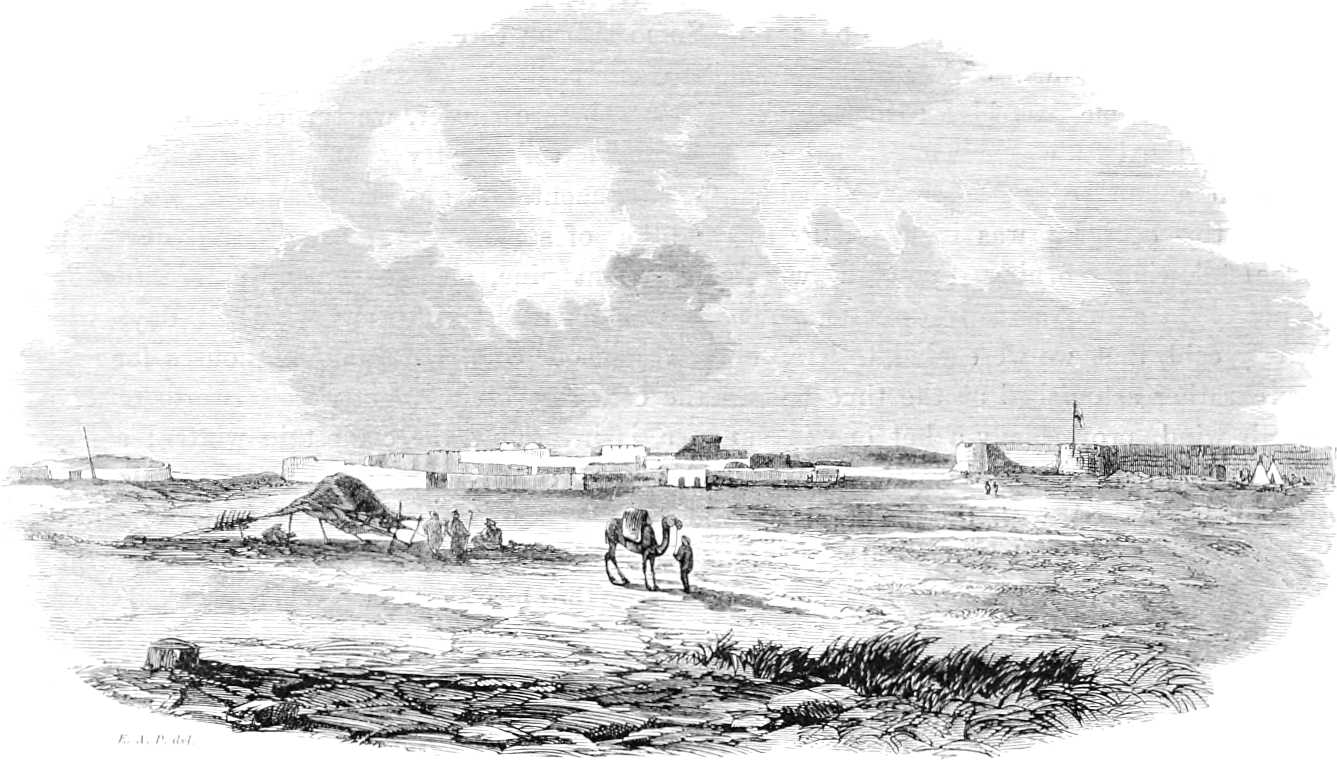
Plate 6.—Castle and Village of Merdj (Barca).
The plain of Merdj is of great extent, measuring upwards of twenty miles in length, and from six to eight in breadth. It is perfectly level, and is surrounded by ranges of hills, of which those on the east rise to a height of about 500 feet above the plain. As seen from the hills, it appears to have been at one time the bed of a lake. Its elevation above the sea is probably about 1,000 feet. The soil is a deep rich loam, about one third of which is under cultivation, and yields abundant crops of wheat and barley. The rest of the plain is good grazing land, and is much frequented by Arab encampments with their flocks during the early part of summer, before the pools which have formed in winter are dried up.
[21]The weather having cleared up, we again got the caravan together, and started on the morning of the 19th. The ground was still rather soft, so that the camels could only walk at a slow and cautious pace. Our kind host had loaded us with as many provisions as we could carry; among other things, a sheep, bread, butter, and dates, and barley for the horses. We shall always have a pleasant recollection of Gŭsr Merdj and its hospitable Governor, Hadji Achmet Bin ’l Agha (Pilgrim Achmet the Son of the Ruler).
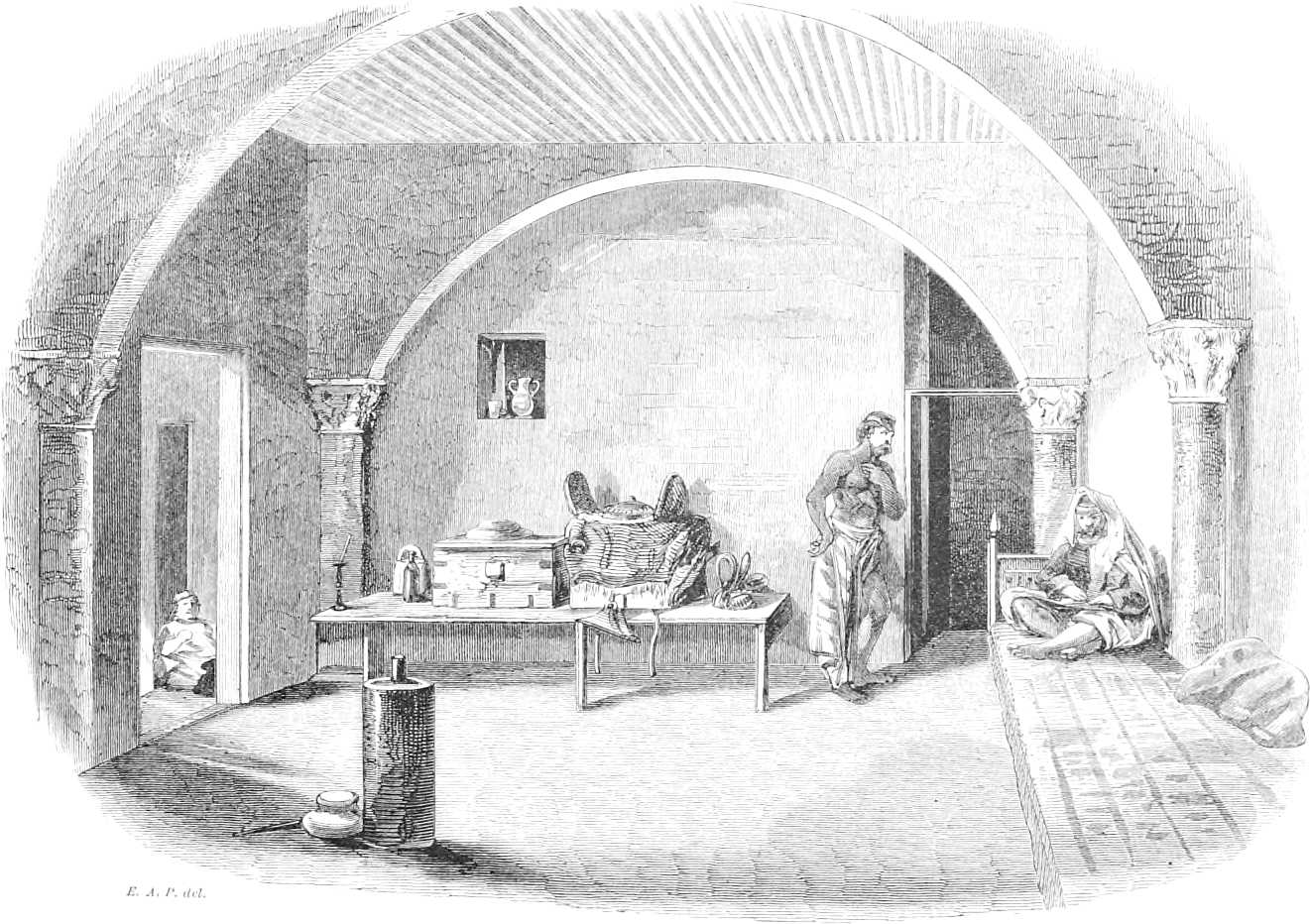
Plate 7.—Mudir’s Room in the Castle of Merdj.
After crossing the plain in a north-easterly direction, we reached the hills about mid-day. As we approached the verge of the plain, the country became well wooded, the hills at the base being covered with olives, and higher up with pines and junipers. A large quantity of oil might be made every year from the olives; but the Arabs are either ignorant of its value or too careless to take the trouble of collecting the berries, which are left to be eaten by the goats. The remainder of the day’s journey was chiefly through thick woods, in which we saw, for the first time, the arbutus, which was then in full bloom, being covered with both flower and fruit. The berries are of a bright red colour, somewhat resembling strawberries in appearance, and, although not luscious, are by no means disagreeable when quite ripe, notwithstanding Pliny’s remark that they are called unedo, because he who has eaten one will never wish to eat another. The bark is useful for tanning purposes, and good charcoal has been made from the wood.
After travelling eight hours, we encamped for the night by some wells in an open cultivated plain. The camels, as usual, were late in coming up, and it was quite dark before we got the tents pitched. While waiting for their arrival, we shot a good many golden plover.
The following day, we continued our journey through a very beautiful country, the track passing[22] over a succession of hills, from the summits of which we had many extensive views. The valleys, enclosed by the well-wooded sides of the hills, were frequently quite picturesque. To relieve the monotony of the march, we used to ride on some miles ahead of the caravan with one or two of the guides, until we reached a likely place for game, where, leaving our horses in charge of the guides, we walked about the covers shooting what we could find till the caravan came up. In this way, we kept up our supplies without being obliged to encroach on our small stock of preserved meat. This day we got a couple of hares, seven partridges, and twenty-five golden plovers. We encamped at night in the bottom of a ravine, where we found some water in the hollows of the rock.
Next day, the 21st, we passed over a similar tract of country, the features of which, however, became more strongly marked as we advanced, the hills becoming higher and steeper, and more frequently intersected by rugged ravines. Towards evening, we encamped by the side of an ancient hill-fortress, doubtless of Roman construction, called by the Arabs Gŭsr Biligadem, which occupies a most commanding position on the top of a hill. The scenery in the immediate neighbourhood is very beautiful, and the view from the Castle is one of the finest and most extensive in the Cyrenaica. The Castle is an oblong building, measuring 160 feet by 80, with a square flanking tower in the centre of each of the longer sides. It is still wonderfully perfect, the walls in some parts still standing to a height of 40 feet. Traces of a ditch and counterscarp may also be seen on two of its sides. It is built throughout of large squared blocks without mortar, and each wall is double, consisting, in fact, of two walls built close to each other, but without any connecting bond. Over the entrance, there is a double arch, the inner one of which is built on the radiating, and the outer on the more ancient horizontal principle. Near the Castle, there is a large well, now choked up, and a number of tombs cut in the sides of the rock.
Forts in similar positions occur in different parts of the Cyrenaica, none of which, however, are nearly so perfect as Biligadem. They were most probably built by the Romans soon after they acquired possession of the country, and were placed so as to protect the communications between the different cities.
The following day, the 22nd, we started as early as possible, in the hope of reaching Cyrene before sunset; but, owing to an error on the part of the guide, night overtook us about four hours’ distance from our destination. Immediately after leaving Biligadem, we descended into a deep narrow ravine with rocky sides, called the Wady Il Aggur, the bottom of which was covered with pines of immense size. Under the pines, there was a perfect thicket of smaller trees and shrubs, such as the carub or locust-tree, the juniper, oleander, &c. After winding along this Wady for five hours without seeing any possible means of exit, we turned up a smaller ravine to our left, and managed to climb to the top. Soon afterwards, we passed the Zauyah El Beidah, the only modern building we had seen after leaving Benghazi, except the Castle of Merdj. A Zauyah in Barbary is a sort of Mahomedan monastery and mosque combined. The resident devotees, called Achwan, who, except in the matter of celibacy, somewhat resemble monks, are under a chief, called the Sheikh El Zauyah, a man of immense influence, as we afterwards learned by most unpleasant experience. They belong to the sect of El Senoussy, so called from the name of the founder, who died not many years ago. Their chief object appears to be the revival of the fanaticism and intolerance of the good old times of the true faith.
As it began to get dark soon after we had passed the Zauyah El Beidah, we were obliged to halt and encamp for the night.
Pl. 8.
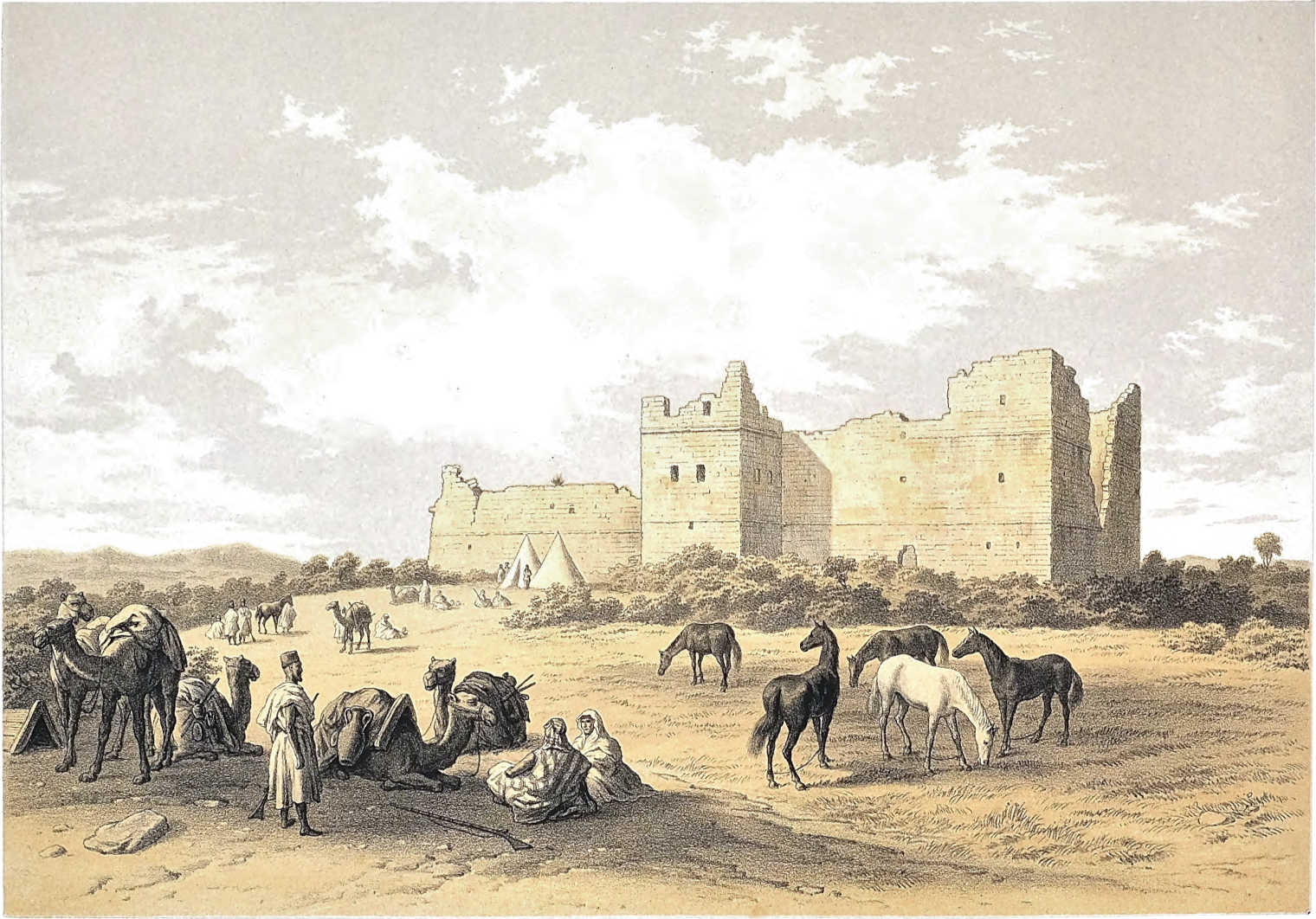
| E. A. Porcher, delt., T. Picken, lith. | London. Published July 1st. 1864 by Day & Son, Lithographers to the Queen &c., Gate Street Lincoln’s Inn Fields. | Day & Son, Lithrs. to the Queen |
ENCAMPMENT NEAR A ROMAN FORTRESS (GŬSR BILIGADEM)
Next morning, the 23rd, we started at nine, and after a three hours’ ride, arrived at Cyrene soon after midday. It was a cold gusty day, and before we had reached our destination, the rain was falling in torrents. The mist prevented our seeing to any distance; but the country immediately around us, being perfectly destitute of trees and even shrubs, looked desolate in the extreme. Meantime, we sought temporary shelter from the storm in some rock tombs near the Fountain of Apollo. When[23] the rain had somewhat abated, we selected the cleanest and most convenient of them for our future residence, and immediately set to work to clear out the earth and rubbish with which it was nearly filled. When the caravan arrived, some three hours afterwards, the drivers were so impatient to be off, that they would not even stay to assist us in getting the baggage under shelter. Our first night in our new quarters was certainly rather cheerless. Bags and boxes soaked with the rain lay in confusion on the muddy floor of the tomb, and no dinner could be had for want of a fire to cook it.
We spent the whole of the next day in making our quarters as comfortable as possible. The tomb we ourselves occupied was at the bottom of a steep hill about 250 yards from the Fountain, and almost overhead there was a long range of larger chambers also cut in the rock, which we used as servants’ quarters, kitchen, stable, &c. Our room had two doors or openings, one of which we built half-way up with stones and mud, leaving the upper part open to serve as a window. The mats which we had bought at Benghazi made an excellent carpet, and one of them suspended over the entrance was a good substitute for a door. In the course of time, we gradually improved our quarters by paving the entrance with tiles, making steps up to the kitchen, &c. We contrived to build quite a respectable door with rough planks cut from the trunks of trees.
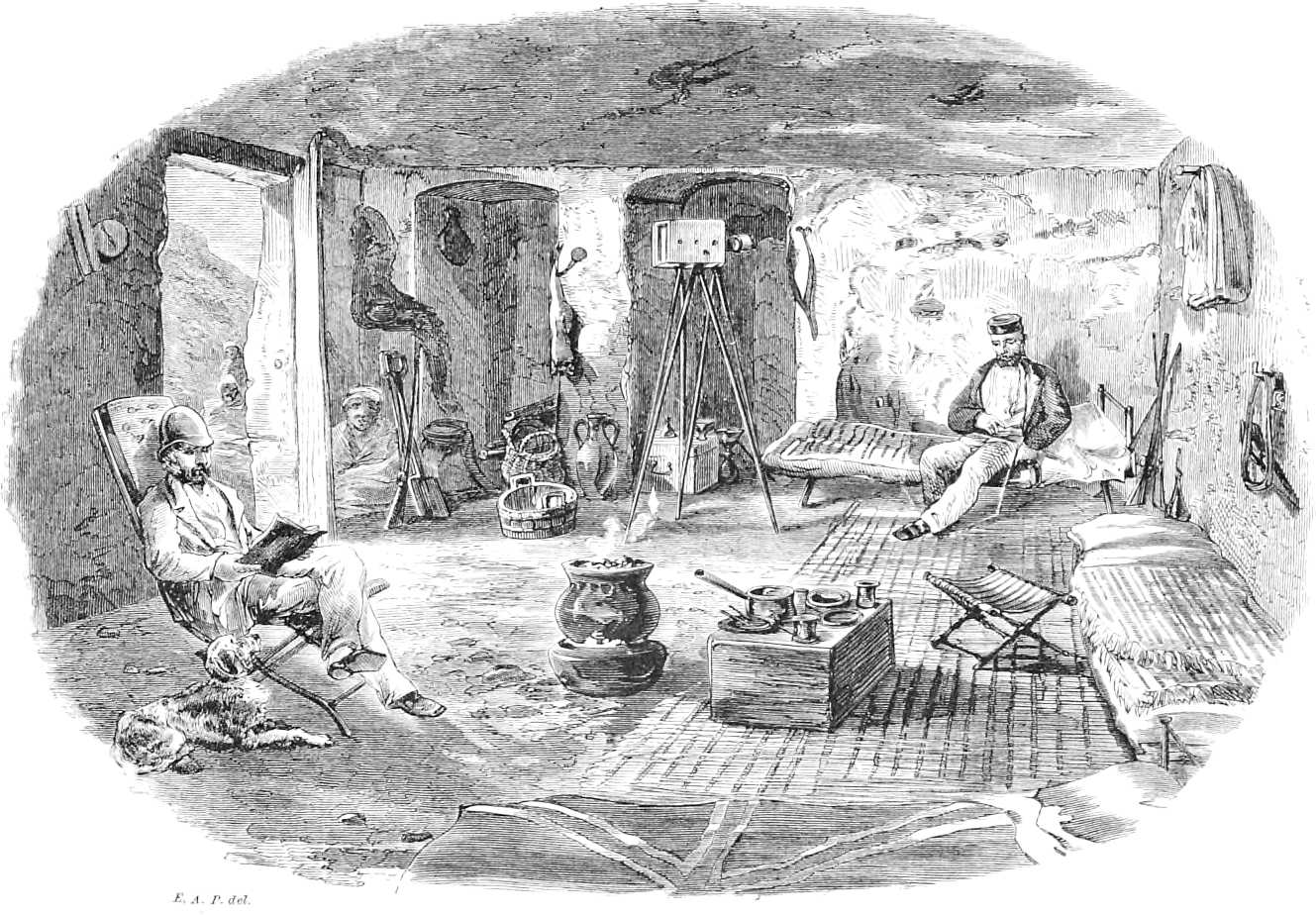
Plate 9.—Interior of our Tomb of Residence.
Having found on our arrival at Tripoli that our firman gave us authority to dig for sculptures, and remove such as we found, we were anxious before leaving Benghazi, to engage a few workmen to accompany us. Mr. Crowe accordingly got us four negroes, whose liberation from slavery he had recently obtained from the Kaimakam. Three of them having only just been brought from the interior, could hardly speak a word of Arabic. They seemed very glad to go with us, and all went[24] well till we reached Merdj, where we were told one morning, to our astonishment, that they had enlisted as soldiers. Our friend, the Mudir, immediately ordered them to be brought before him, but the only explanation he could get from them was, that they preferred becoming soldiers to being killed. They appeared to be highly indignant about something, and determined not to go on with us. Some soldiers were also interrogated, but no explanation could be elicited. It afterwards came out, however, that some of the black soldiers had assured them that we were taking them into the desert to cut their throats, and look for treasure with their blood. The Mudir, with great difficulty, induced them to remain with us, but it was some days before they were quite convinced of the innocence of our intentions.
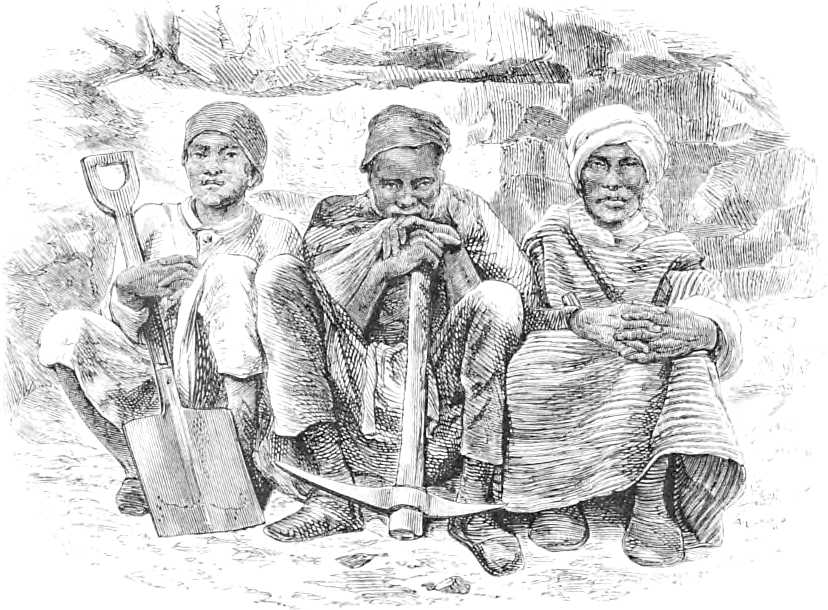
Plate 10.—Our Workmen—Saleh, Mohammed and Abdullah.
From a Photograph.
Pl. 11.
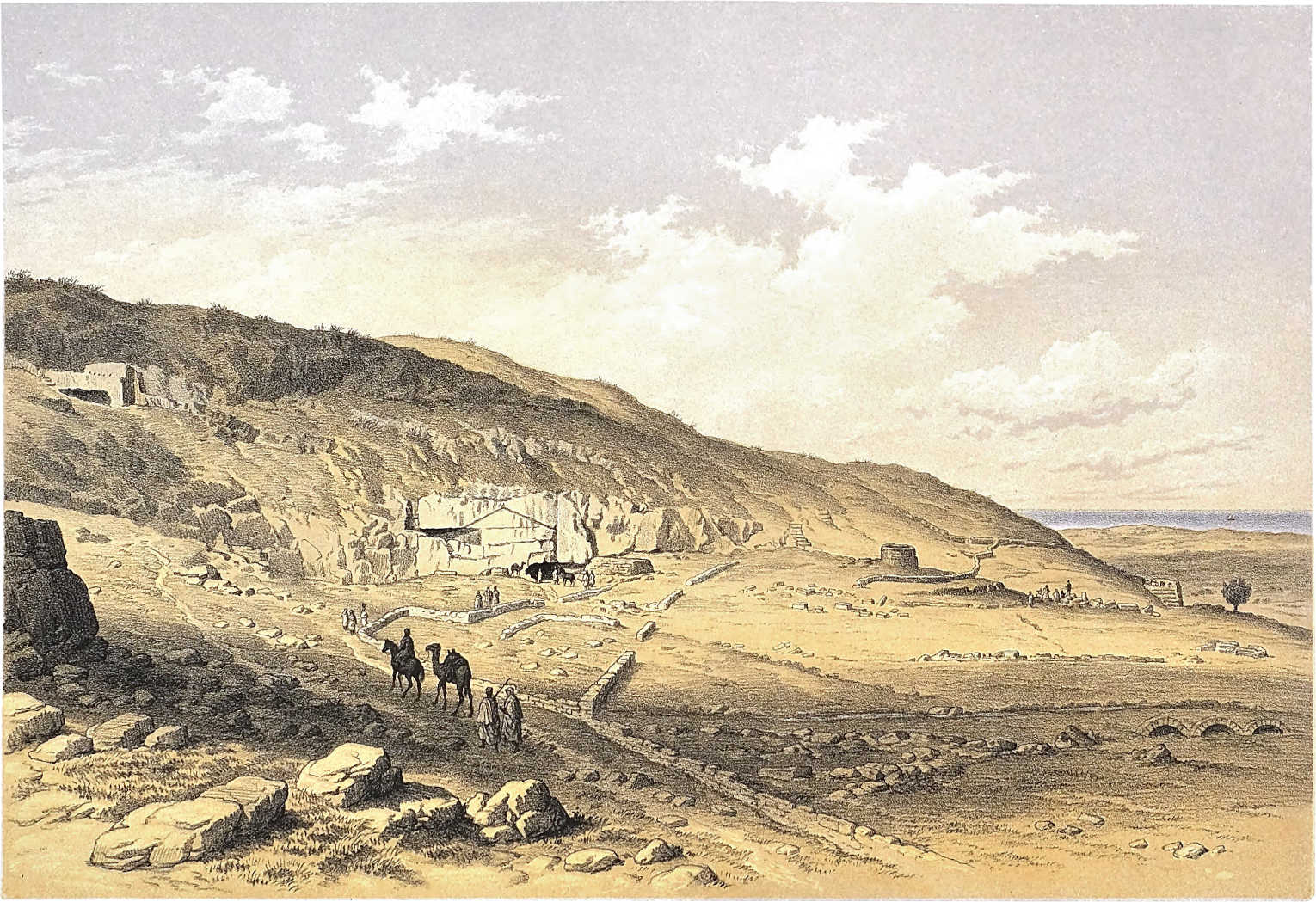
| E. A. Porcher, delt., T. Picken, lith. | London. Published July 1st. 1864 by Day & Son, Lithographers to the Queen &c., Gate Street Lincoln’s Inn Fields. | Day & Son, Lithrs. to the Queen |
WESTERN HILL OF CYRENE, WITH ENTRANCE TO THE FOUNTAIN OF APOLLO
[25]CHAPTER VI.
THE site of the ancient city of Cyrene is called by the Arabs, Shahat—a name which is rather indefinite, as it includes, besides the city, the adjoining district to the east, north, and west, that to the southward being called Grennah, a corruption evidently of the original Greek name. As the Fountain of Apollo is well known throughout the Cyrenaica, the traveller desirous of visiting Cyrene should ask for ’Ain Shahat, the Fountain of Shahat.
To understand the position of Cyrene, it is necessary to consider the general configuration of the country. From near Benghazi on the west to beyond Derna on the east, a range of hills about 1,000 feet high runs nearly parallel to the shore, at a distance from it varying from one to three miles. This range in the neighbourhood of Cyrene forms the northern or seaward boundary of a belt of table-land about eight miles in breadth, the southern or inland boundary of which is a second range of hills parallel to the first, and rising about 1,000 feet above the table-land. An upper plateau extends many miles inland from the summit of this interior range, at an elevation of nearly 2,000 feet above the level of the sea.
The lower range is exceedingly steep, and in many parts precipitous; so that, except at particular places, it is quite impassable. The upper range, on the other hand, although steep, is not precipitous, and is intersected by numerous ravines or wadys leading from the plateau above. Thus the face of this range presents to the eye a succession of rounded ridges, with intermediate furrows of various depths. Cyrene stands on the edge of the upper plateau, and occupies the summits of two of the ridges and the upper part of the intervening furrow.
One of the principal features of this site is this furrow or ravine between the two hills on which the city is built. It begins near the eastern wall of the city, and widens as it descends towards the face of the hills, where it is bridged across, so to speak, by a massive retaining wall, behind which it is partially filled up and levelled, so as to form an artificial platform. The Fountain of Apollo here issues from a passage in the rock on the western side, and the water, after traversing the platform, falls over the retaining wall into the ravine below.
This copious fountain of delicious water doubtless led the original Greek colonists to settle at Cyrene. The excavated channel from which it flows is in many respects so remarkable, that it deserves more than a cursory notice. The following description, which was verified by Captain Porcher, is given by Beechey:—
“The channel is formed entirely in the rock from which the stream issues, and runs in an irregular course for nearly a quarter of a mile into the bowels of the mountain. The sides and roof of the passage are flat, where time and the action of the current (which is very strong) have not worn them away; but the bottom is encumbered with stones, bedded fast in a quantity of clay which has accumulated about it and against the sides. The general height of this subterranean channel is scarcely five feet, an elevation which we found rather inconvenient, for it obliged us to stoop a good deal in advancing; and as it would not have been possible to examine the place properly, or, indeed, to have preserved the light, without keeping the head and body in an upright position, we usually found the water making higher encroaches than its chilling cold rendered agreeable.
[26]“In some places, however, where there appear to have been originally flaws or fissures in the rock, the roof was irregular, and there was room to stand upright, an occurrence of which we very gladly availed ourselves, to the great relief of our knees. We found the average width from three to four feet, although in the places just mentioned it was occasionally as much as six feet; and were it not for the clay which has been collected against the sides, we should often have suffered from their roughness. From the irregularity of the course of the passage we were obliged to take bearings very often, and at each time we stopped for this purpose we took down the distance, measured with our chain, between the point we stopped at and the last; so that, after much trouble, we succeeded in obtaining a tolerably correct plan of the whole. The length and course of the channel will be seen in the plan of Cyrene. Within forty feet of the end of the channel (that is to say, about 1,300 feet from its beginning at the foot of the cliff) it becomes so low that a man cannot advance further without creeping upon his hands and knees, and then finishes in a small aperture scarcely a foot in diameter, beyond which, of course, it is impossible to penetrate.
“We observed, after continuing our route for some time, that the clay which we have already mentioned had been washed down in considerable quantities by the current, was occasionally plastered against the sides of the passage, and smoothed very carefully with the palm of the hand; in this we thought we perceived that something like letters had been scratched, which we should scarcely have thought it worth while to examine, had we not been curious to know what Europeans had visited the place before us. Our first conclusion was that some of our own party had taken this method of writing their names on the wall; and it never for a moment occurred to us, that the characters, whatever they were, which might be traced on so perishable a surface, were of more than very recent formation. Our surprise may, in consequence, be readily imagined, when we found, on a closer examination, that the walls of the place were covered with Greek inscriptions; some of which, from their dates, must have remained on the wet clay for more than fifteen hundred years. They consist, of course, chiefly in a collection of names; many of which are Roman, and the earliest of the most conspicuous dates, which we remarked and copied, were those of the reign of Diocletian. They are, in general, very rudely scratched, with a point of any kind (a sword, or a knife, perhaps, or the stone of a ring) and often with the point of the fingers.
“Several hours had elapsed from the time of our entering the channel to that of our reappearance at its mouth; and we really believe that the Arabs of the place, who had collected themselves round the fountain to see us come out, were extremely disappointed to find that no accident had befallen any of our party, in spite of the demons so confidently believed to haunt its dark and mysterious recesses. For our own parts, we could not help laughing very heartily at the ridiculous appearance which each of us exhibited on first coming to the light, covered as we were from head to foot with the brown clay accumulated in the channel of the fountain, which had adhered too closely to be washed away by the stream, although its current, as we have mentioned, was extremely rapid.”
The mouth of the channel is in an open chamber cut in the face of the cliff, the bottom of which is about five feet lower than the bed of the stream, which falls over in a little cascade. Immediately above the fall the bottom of the channel is deepened and widened so as to form a cavity about six feet long and two feet deep. Filled, as it always was, with the clear, cool water of the fountain, a more delicious bath could hardly be imagined. It was, in fact, a perfect luxury during the long summer of our residence at Cyrene. The water was of the uniform temperature of 55° Fahrenheit, fresh and cool in summer, and not too cold in winter.
Pl. 12.
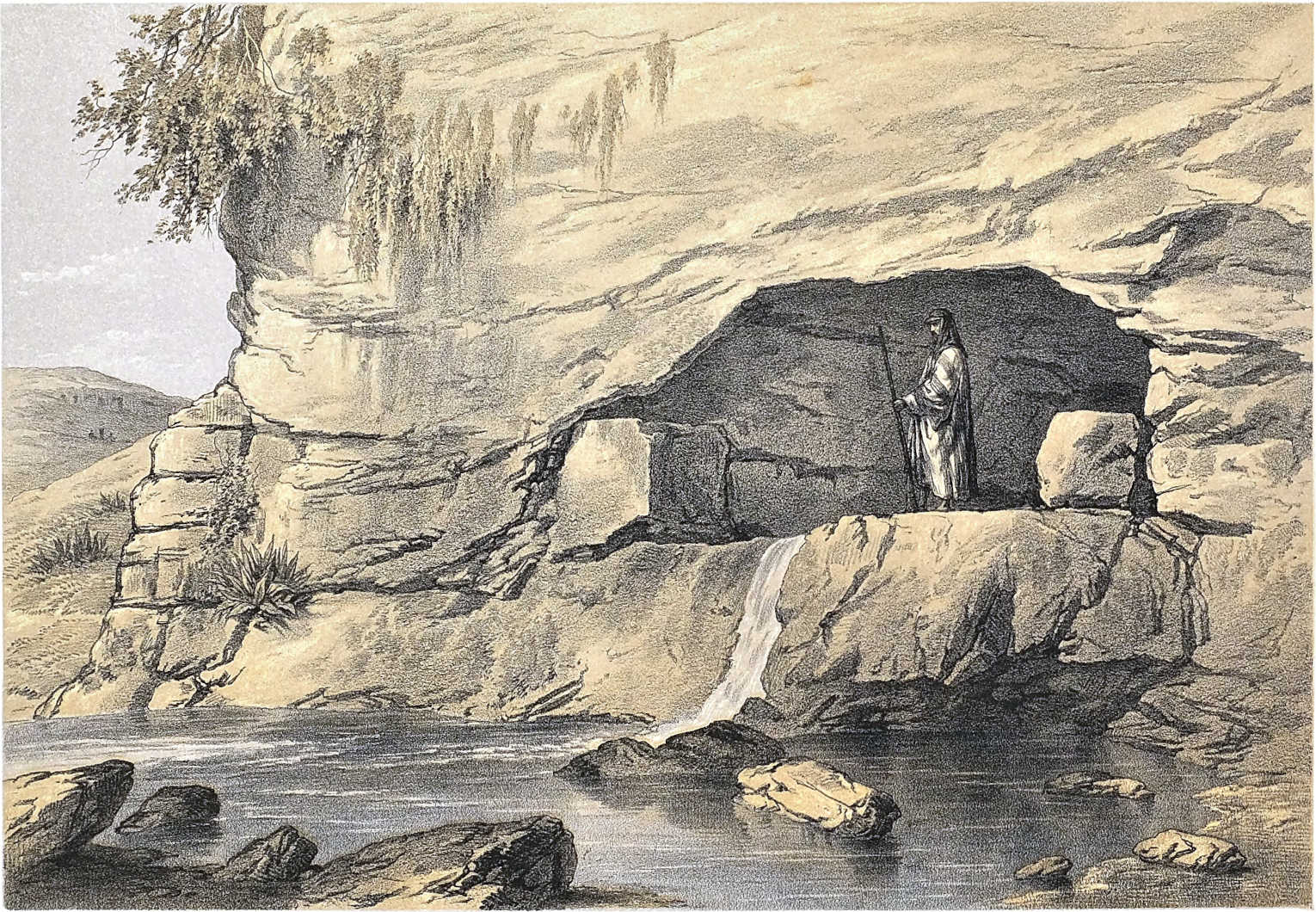
| E. A. Porcher, delt., T. Picken, lith. | London. Published July 1st. 1864 by Day & Son, Lithographers to the Queen &c., Gate Street Lincoln’s Inn Fields. | Day & Son, Lithrs. to the Queen |
FOUNTAIN OF APOLLO
The face of the cliff over the entrance to the chambers is marked by a channel cut in the rock, into which the pediment of a portico appears to have been inserted, as shown in the sketch[27] Plate 11. On a part of the cliff, at right angles to this face, and immediately over the entrance to the fountain is the following inscription:—
![[JPG]](images/insc1.jpg)
Λιγ Διονύσιος Σώτα ἱερειτεύων τὰν κράναν ἐπεσκεύασε. This inscription is published, Böckh, Corpus Inscriptionum, III. No. 5134.
Pl. 13.
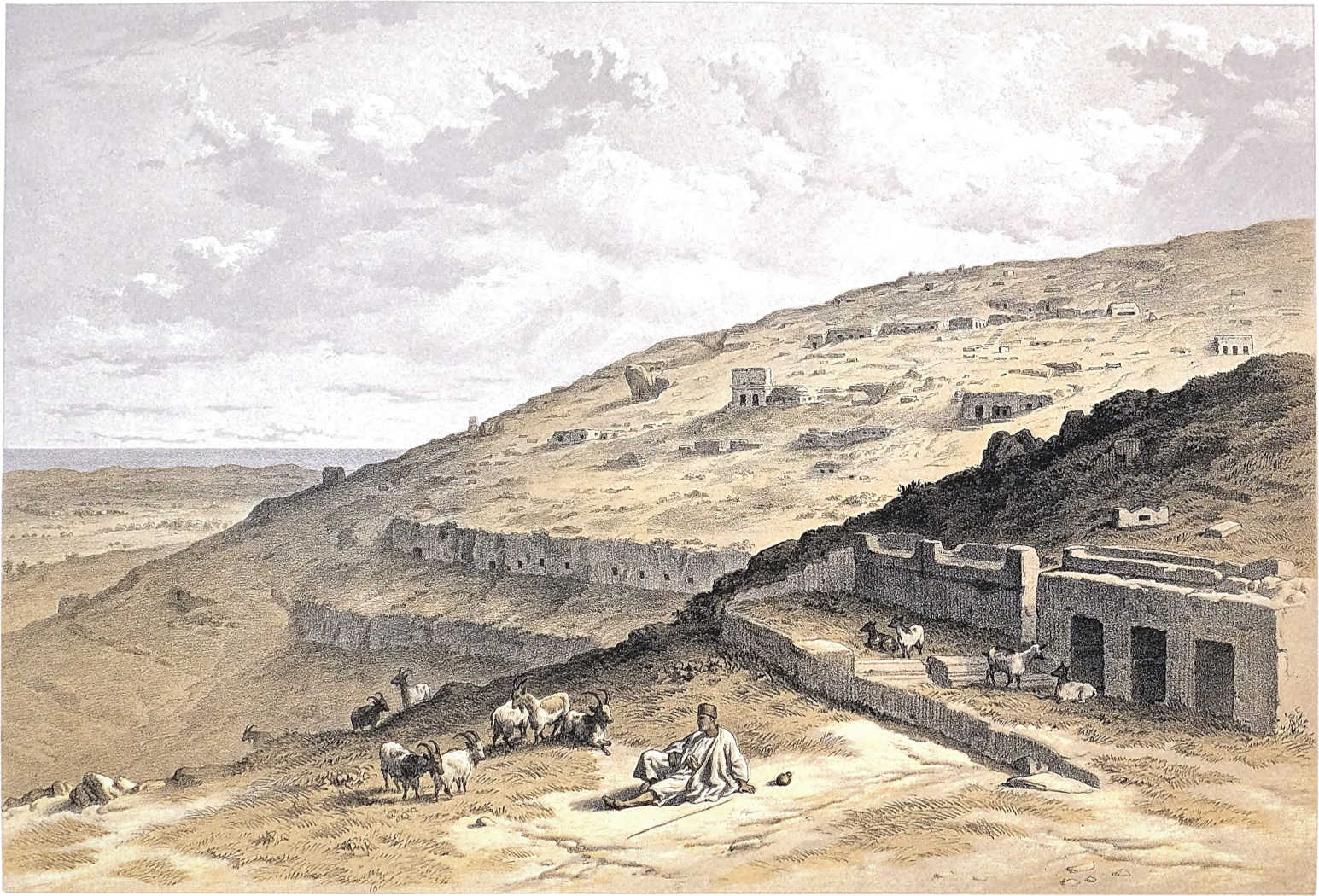
| E. A. Porcher, delt., T. Picken, lith. | London. Published July 1st. 1864 by Day & Son, Lithographers to the Queen &c., Gate Street Lincoln’s Inn Fields. | Day & Son, Lithrs. to the Queen |
GENERAL VIEW OF ONE OF THE HILLS IN THE NORTHERN NECROPOLIS OF CYRENE
Nearly parallel to the centre ravine, is another bounding the city on the south, called the Wady Bil Ghadir, or Valley of Verdure, which extends across the lower plateau to the sea. Several fountains pour their waters into it at Cyrene, so that even in the height of summer it quite justifies the name it bears. Its western side, which is very steep and rugged, is clad with fine old cypresses, and lower down, the myrtle and oleander grow in luxuriant abundance. The form of the city is nearly that of a right-angled isosceles triangle, the hypothenuse of which, facing the N.W., is formed by the general line of the face of the hills overlooking the lower plateau. Of the two sides containing the right angle, the southern is formed by the Wady Bil Ghadir, and the eastern, by an artificial line on the upper plateau, between the Wady Bil Ghadir and the face of the Cyrene range.
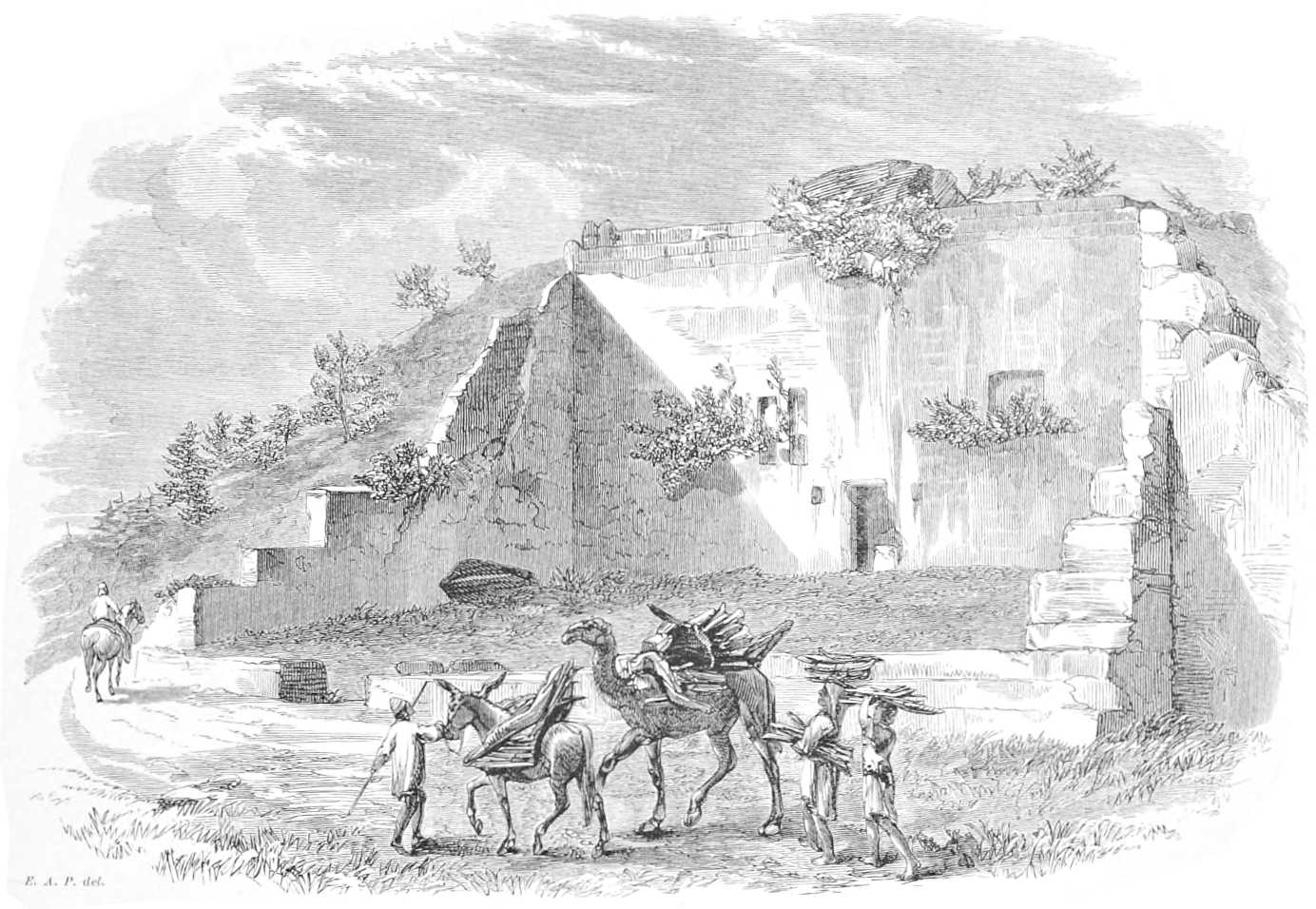
Plate 14.—Large Tomb at the Eastern End of the Northern Necropolis.
From this description, it will be seen that the city is naturally defended on two of its three sides, by a deep rugged ravine and the steep faces of a high range of hills. The remaining side, the east, is defended by a wall still distinctly traceable, the continuation of which is so carried along the edge of the Wady Bil Ghadir, and over the brows of the hills into the central ravine, where it[28] joins the massive retaining wall already mentioned. The enceinte being thus completed, the summit of the western hill was chosen with great judgment for the citadel. On its exterior sides are the Wady Bil Ghadir, several hundred feet deep, and the steep face of the hill itself cut into a succession of escarps and terraces of rock. Quite unassailable on two of its sides, and nearly so on a third, the citadel is cut off from the rest of the city by an inner wall of defence, well provided with flanking towers, which is carried along the edge of the centre ravine and across the hill to the Wady Bil Ghadir, where its junction with the main wall of the city is marked by the conspicuous ruins of a lofty tower.
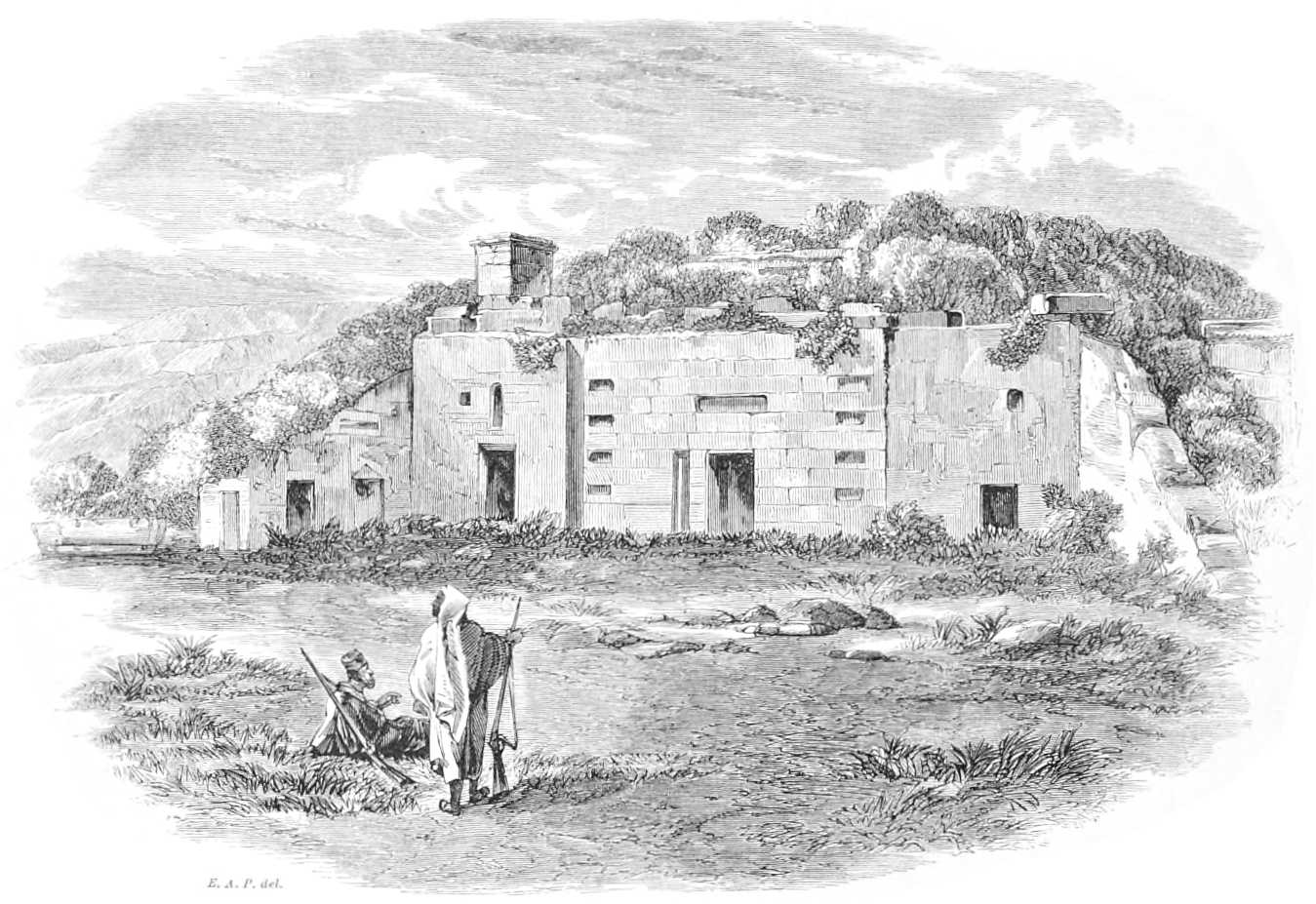
Plate 15.—Tomb in the Northern Necropolis.
By far the most striking remains of the former grandeur of the city are the cemeteries, which consist, for the most part, of tombs hewn out of the solid rock, many of which are still, in very perfect condition. They extend for miles in every direction outside the walls of the city, but the most remarkable are in the steep face of the range of hills overlooking the lower plateau, and in the sides of the ravines by which this range is intersected. The cemetery in the Wady Bil Ghadir, and on the face of the hill beyond it, is the most picturesque, and probably the most ancient, while that immediately below the city, to the N. and N.E., is the most extensive. The tombs on the upper plateau, to the southward of the city, are generally built above ground, except in the sides of small ravines, where sepulchres are excavated in the scarped face of the rock.
Pl. 16.
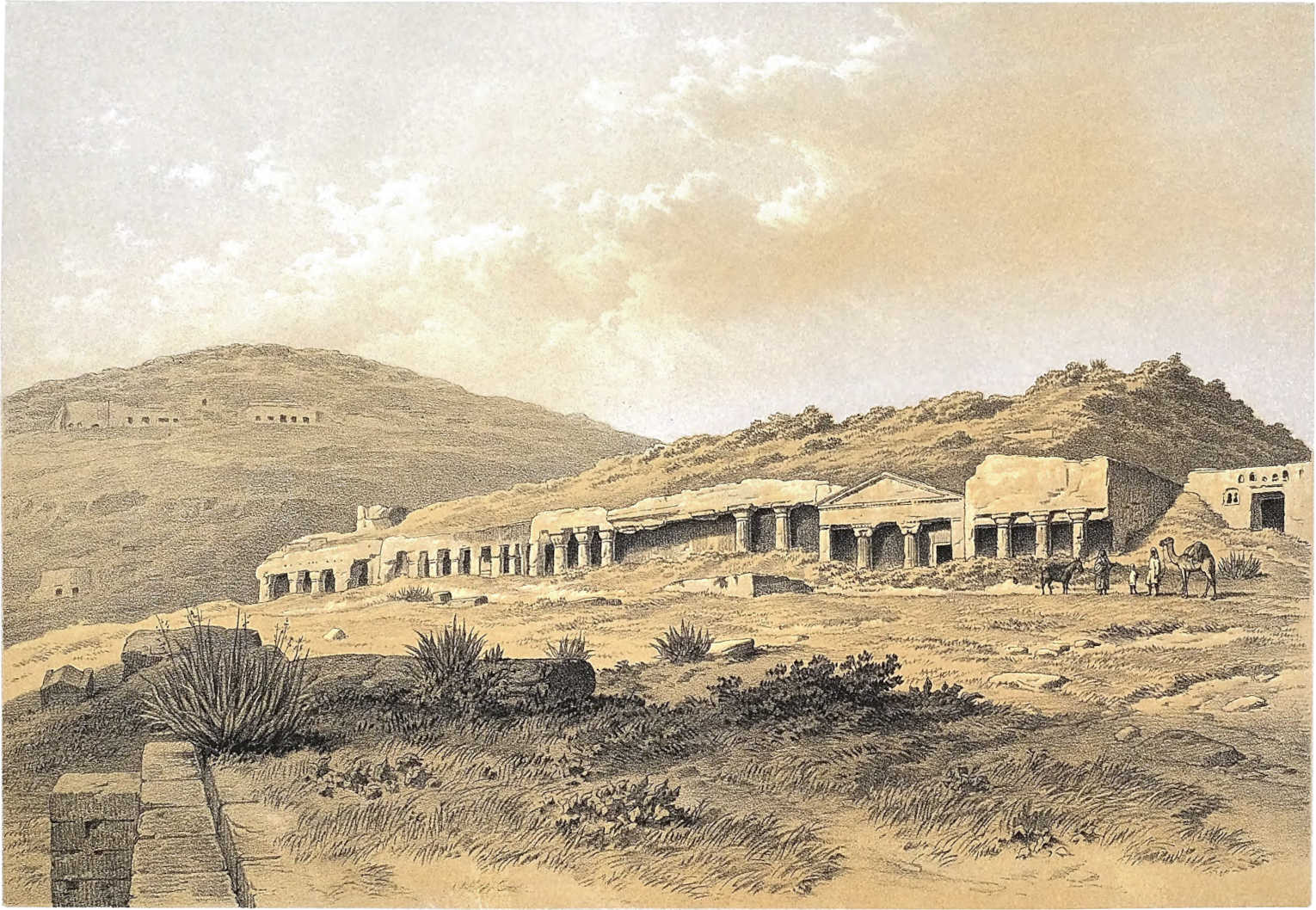
| E. A. Porcher, delt., T. Picken, lith. | London. Published July 1st. 1864 by Day & Son, Lithographers to the Queen &c., Gate Street Lincoln’s Inn Fields. | Day & Son, Lithrs. to the Queen |
RANGE OF TOMBS IN THE NORTHERN NECROPOLIS OF CYRENE
The tombs on the faces of the hills are generally arranged in long terraces, the rock being cut or stepped into a series of perpendicular escarps in which the tombs are excavated. The roads which follow the terraces in front of the escarps, are consequently flanked on one side by tombs for a considerable distance from the city. Besides these rows or streets of tombs, others occur irregularly, where the formation of the rock happens to be adapted for their excavation. There[29] are some, also, wholly or partially built, and on the slopes between the terraces the rock is frequently cut into groups of single sarcophagi. The excavated tombs are of almost endless variety. In some, the façade is cut out like the front of a small temple, with columns, architraves, pediments, &c., nearly all of which are of the Doric order. The columns, with the recess behind, form a portico over the entrance to the tomb, which generally consists of a rectangular chamber, with recesses round the sides for the reception of the sarcophagi.
Pl. 17.
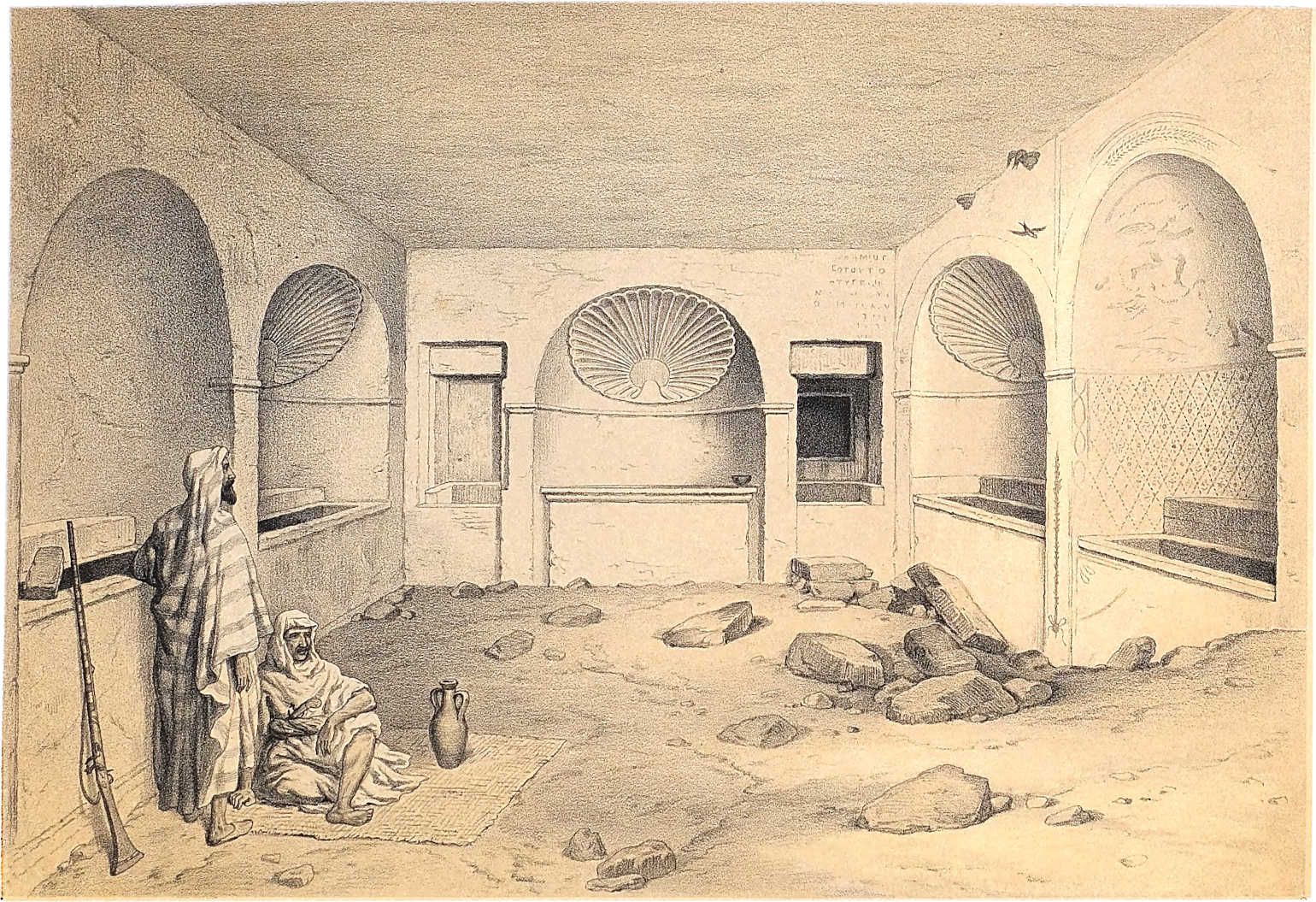
| E. A. Porcher, delt., T. Picken, lith. | London. Published July 1st. 1864 by Day & Son, Lithographers to the Queen &c., Gate Street Lincoln’s Inn Fields. | Day & Son, Lithrs. to the Queen |
INTERIOR OF A TOMB IN THE NORTHERN NECROPOLIS OF CYRENE
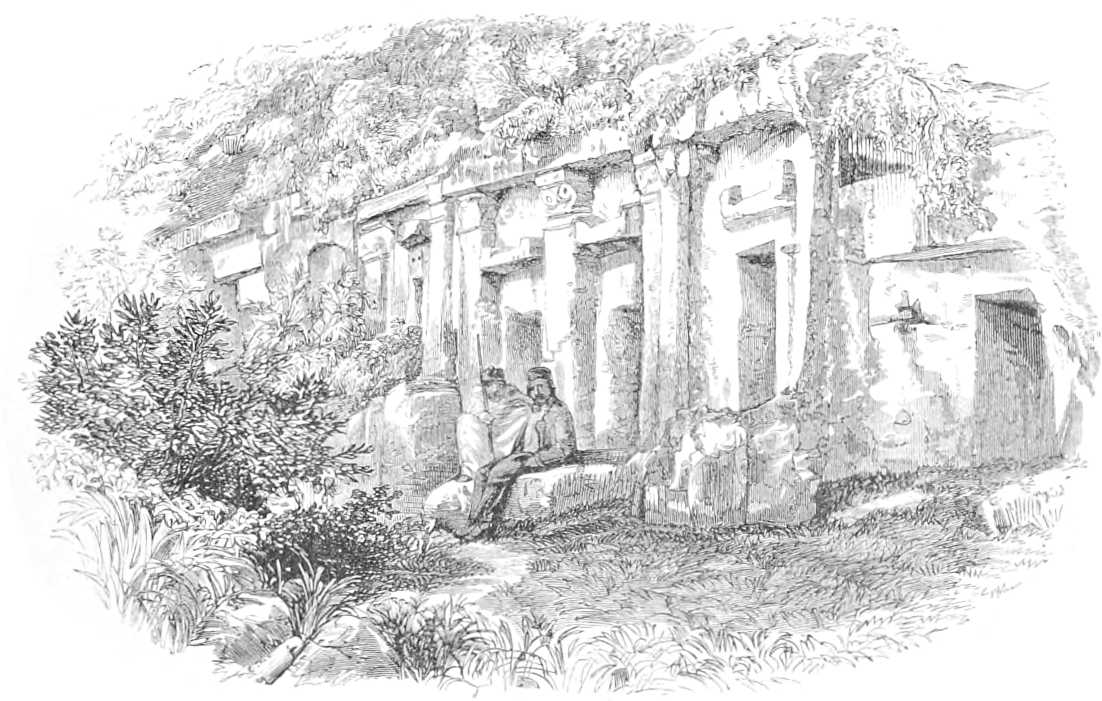
Plate 18.—Tombs to the Westward of Wady Bil Ghadir.
From a Photograph.
In tombs of this description, but without porticoes, the entrance is simply a doorway cut in the face of the rock, in some instances perfectly plain, in others embellished with lintels and pilasters, or with busts, as in Plate 19. The interior of this one is shown in Plate 33, and shows that the peculiar form of the chamber depended on the soundness of the rock. The chamber itself is usually without ornament of any kind, but in many tombs its walls are adorned with fresco-painting or carving. The sarcophagi are frequently arranged in tiers, in long narrow recesses, with three or four placed lengthways in each tier, as shown in Plates 20 and 32. In some cases, the sarcophagus is simply a trough, like a horse’s manger, cut longitudinally in a niche in the side of the chamber, as shown in the section (Plates 17 and 31); in others, where the tomb consists of a single chamber, or a succession of chambers, without recesses or niches, the sarcophagi are either placed on the floor or dug out of the rock beneath it, like shallow graves.
The above are the principal varieties of the construction of what may be called the chamber tombs.
Among the painted tombs, the only one that remains to exhibit the skill of the artist is situated on the side of a ravine, in the middle of the Northern Necropolis, and immediately under a range of tombs shown in Plate 16. The exterior is perfectly plain, and contains only a small chamber with a sepulchral vault in the centre. All the walls were originally covered with paintings; and by the appearance of the colours that are still left, and come out, when wetted, as bright as the day they were put on, show that the former inhabitants must have understood the art to perfection, as the damp of so many centuries has not yet obliterated them.
On one side is a procession, composed of thirty-six figures, performing a solemn march; some[30] having on rich dresses, whilst others are covered with very little drapery, giving the idea of the lower classes of the people of Cyrene taking their subordinate part in the festival. At the head of the painting is a piece of furniture, near which are some young people employed in cooking,—no doubt, showing what followed their popular festivals. Near the end are three mitred people standing near a pedestal, and a table covered with crowns and palm-leaves. A number of Greek names are scratched over the picture, denoting, probably, the people shown in the drawing.
The paintings on the opposite side to this have nearly disappeared, and the other two are occupied with hunting scenes, and a variety of games.
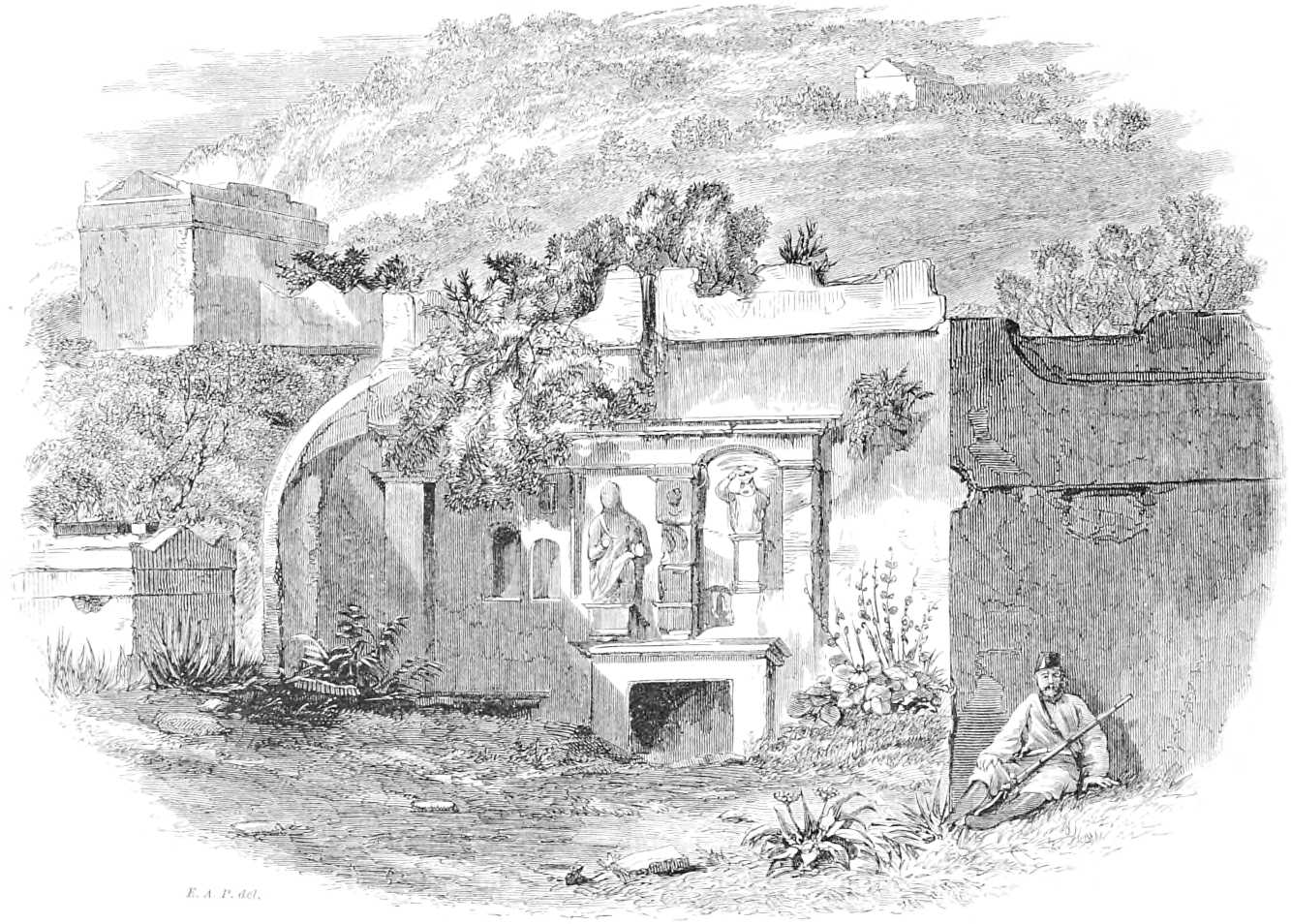
Plate 19.—A Tomb embellished with Figures in the Northern Necropolis.
In one part a deer and hares are seen escaping from dogs, and a hunter in the act of letting loose another. Near this there is a group of wilder animals, such as a bull attacked by a lion, a leopard and gazelle chased by dogs, and spears flying about in all directions. These seem to allude to the worship of Diana, one of the principal divinities of the Cyrenians.
On the remaining side are gladiators attacking each other with short swords, and defended by shields,—boxing, wrestling, and chariot-races.
These last may be particularly noticed, as the Cyrenians were extremely eminent for their equestrian talents, and especially for their skill in charioteering; and seem to have excelled all the neighbouring nations so much in this sport, that they sought to perpetuate their fame by having their coins struck with them.
Pl. 20.
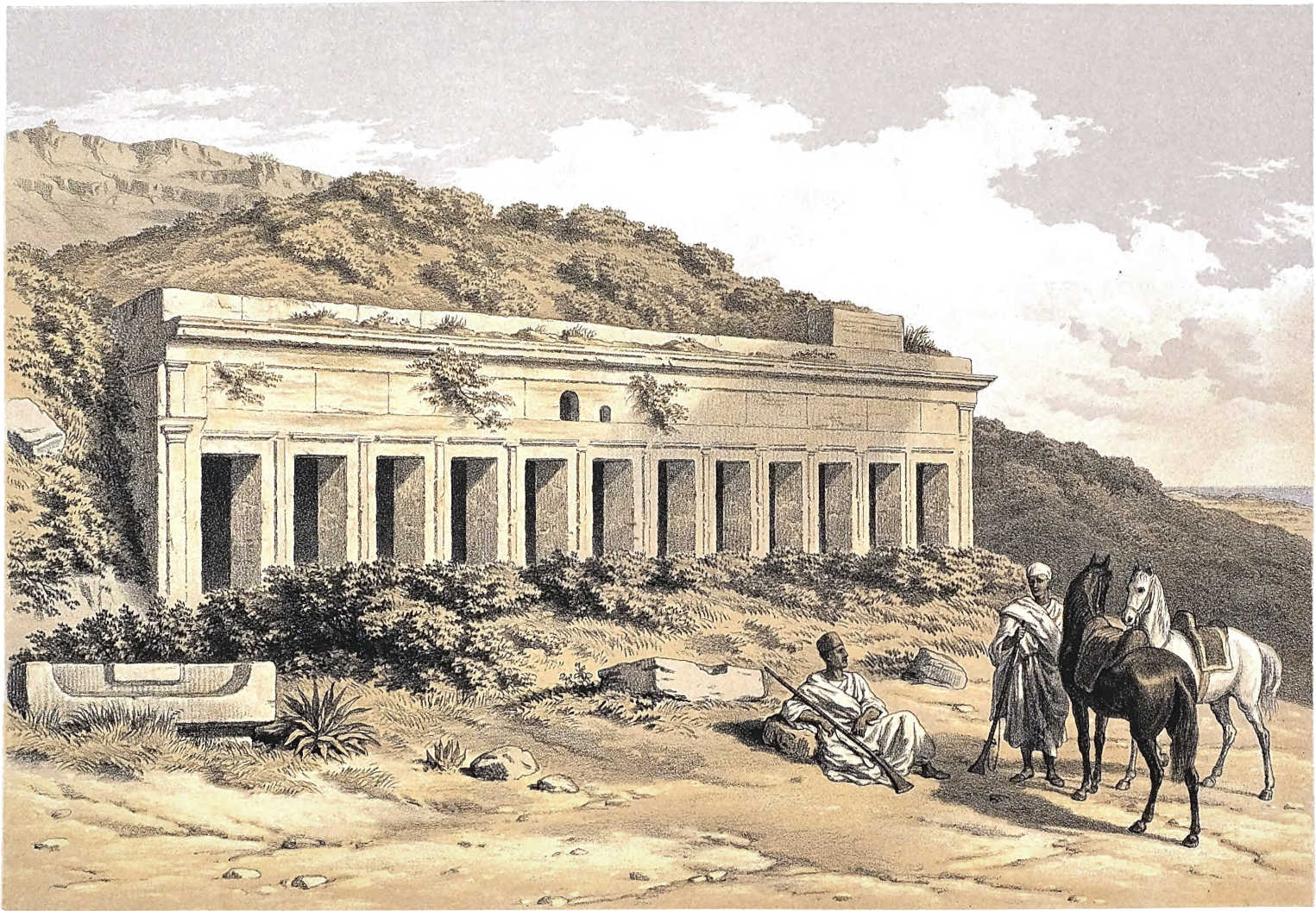
| E. A. Porcher, delt., T. Picken, lith. | London. Published July 1st. 1864 by Day & Son, Lithographers to the Queen &c., Gate Street Lincoln’s Inn Fields. | Day & Son, Lithrs. to the Queen |
TOMB FOR 105 SARCOPHAGI IN THE NORTHERN NECROPOLIS OF CYRENE
All these paintings were published by Pacho, as well as others that have now disappeared; and, to give the reader some idea of how these tombs were formerly ornamented, and the expense the inhabitants must have incurred to embellish this city of their dead, we will give a[31] short account of one that was seen both by Pacho and Beechey. A series of paintings were found on the metopes of the frieze in the interior, and the walls were coloured light green, making the chamber appear as though it was intended more for a habitation for the living than a receptacle for the dead. These appear to have been the different occupations of a black slave. First, a friendly conversation; then the education of a young girl; the pride of dress; the relaxation of the swing; the bath, so necessary in this warm climate; and, lastly, the death-bed on which the negress is laid, with her eyes closed, and the white Cyrenian standing by her side in the attitude of grief, lamenting her decease.
Pl. 21.
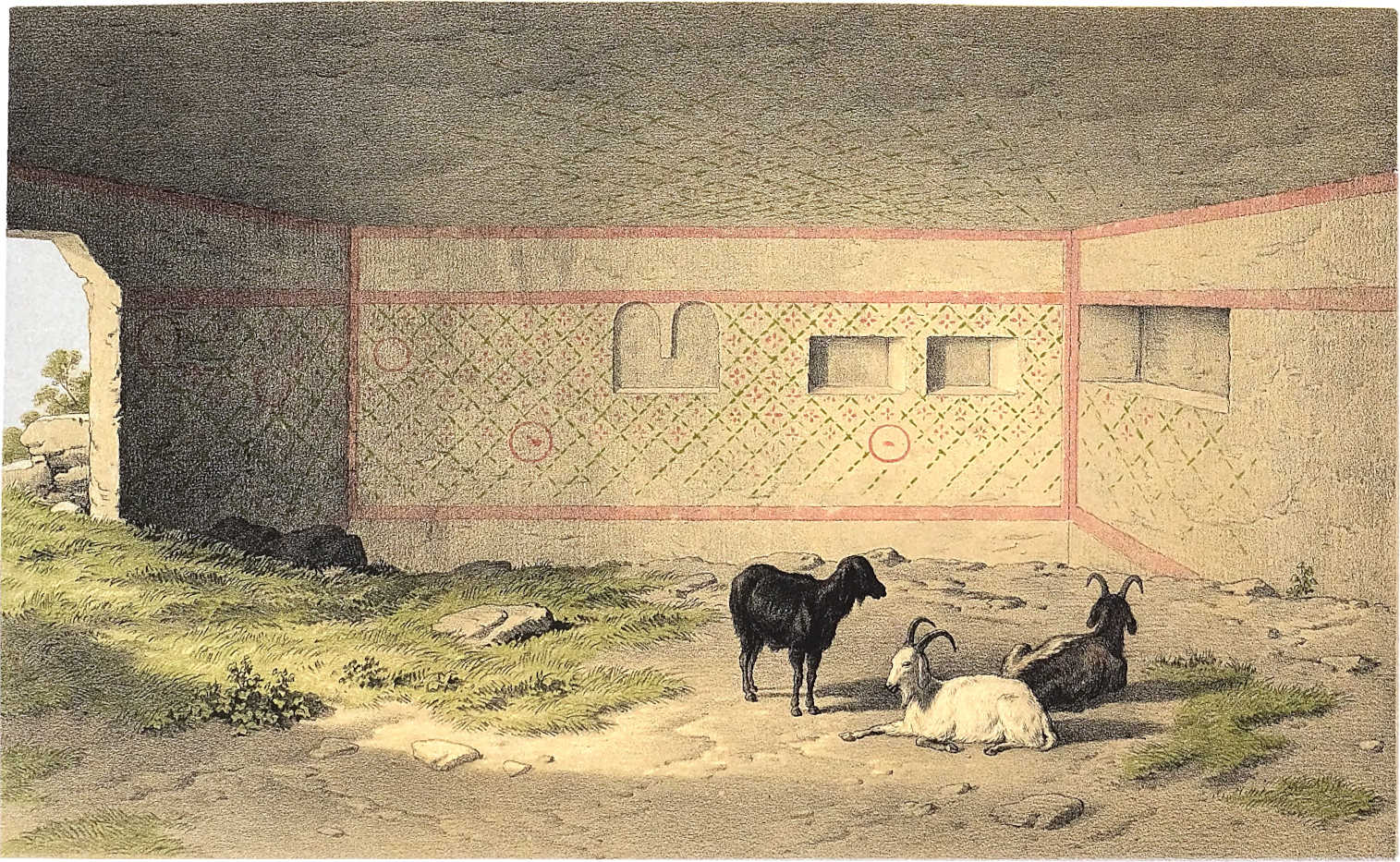
| E. A. Porcher, delt., T. Picken, lith. | London. Published July 1st. 1864 by Day & Son, Lithographers to the Queen &c., Gate Street Lincoln’s Inn Fields. | Day & Son, Lithrs. to the Queen |
INTERIOR OF A PAINTED TOMB IN THE NORTHERN NECROPOLIS OF CYRENE
By the description of these two tombs the reader can easily understand what a magnificent necropolis this must formerly have been; and when the exteriors, as well as the interiors, were ornamented with sculpture, combined with the beautiful scenery around, the traveller would have been well repaid by a visit to it.
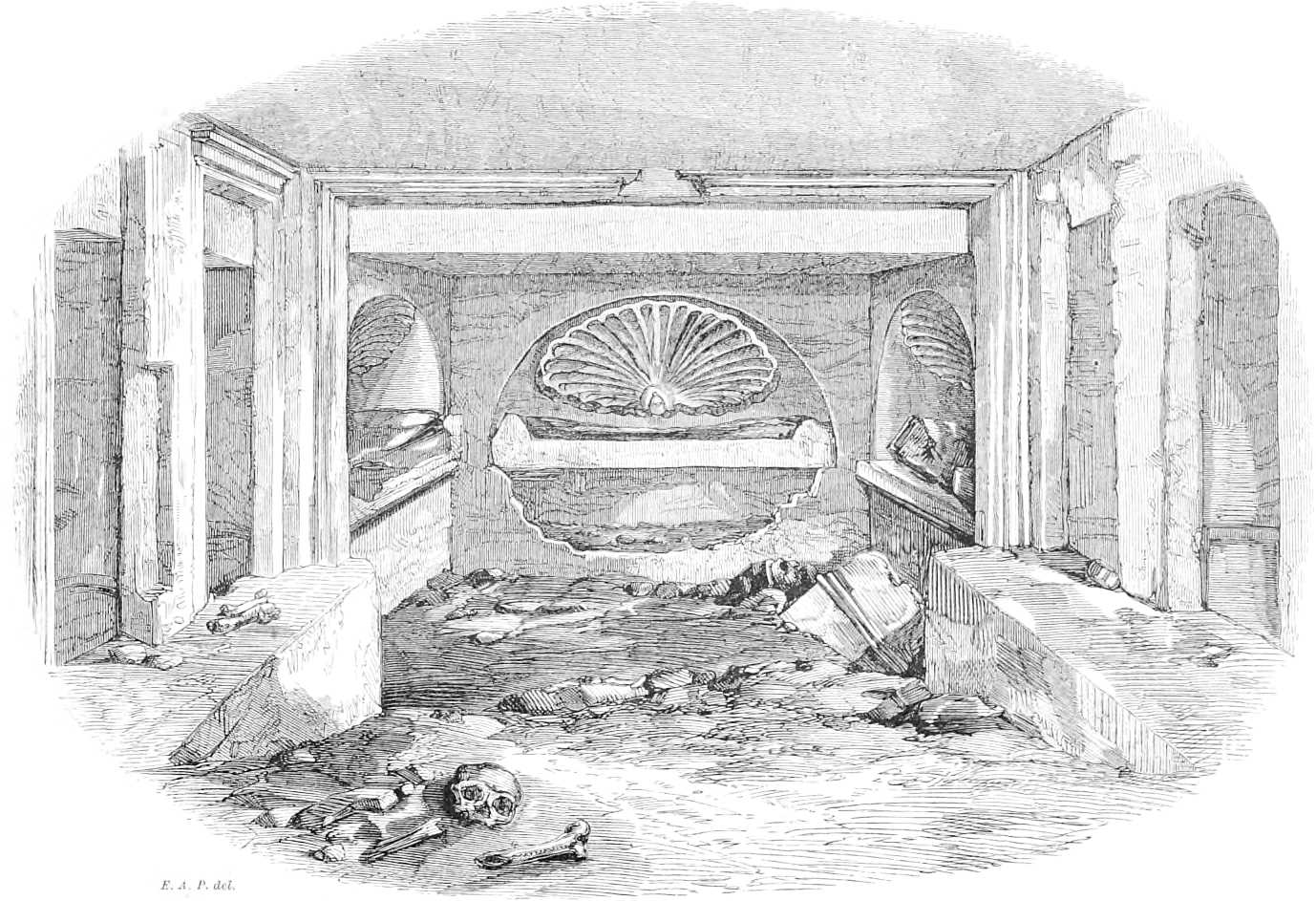
Plate 22.—Interior of a Tomb in the Northern Necropolis.
In Plate 21 is shown the interior of a tomb in the Northern Necropolis, where the painting is still very perfect and the colours bright.
In Plate 17 is a highly ornamented tomb adjoining the Kenissieh, with the height of eleven feet. The shells over three of the sarcophagi are cut out of the solid rock, and are in as good a state of preservation as when they were first sculptured. The niche on the right and the nearest to the entrance was ornamented round the arch with a band of bright vermilion, and the centre filled up with garlands, birds, and three figures, the centre and largest one with wings.
In Plate 22 is seen a smaller tomb, also with shells more gracefully shaped, and equally in as good a state of preservation.
[32]Quarries were met with in many places, and these, after the buildings in the vicinity had been erected, and when no longer required, were also converted into tombs, according to the general practice of the Greeks. Plate 23 shows the interior of one that has been used for this purpose, situated on the upper part of the hill in the Northern Necropolis. It had a large chamber measuring 27½ feet in length, and 13 feet in breadth.
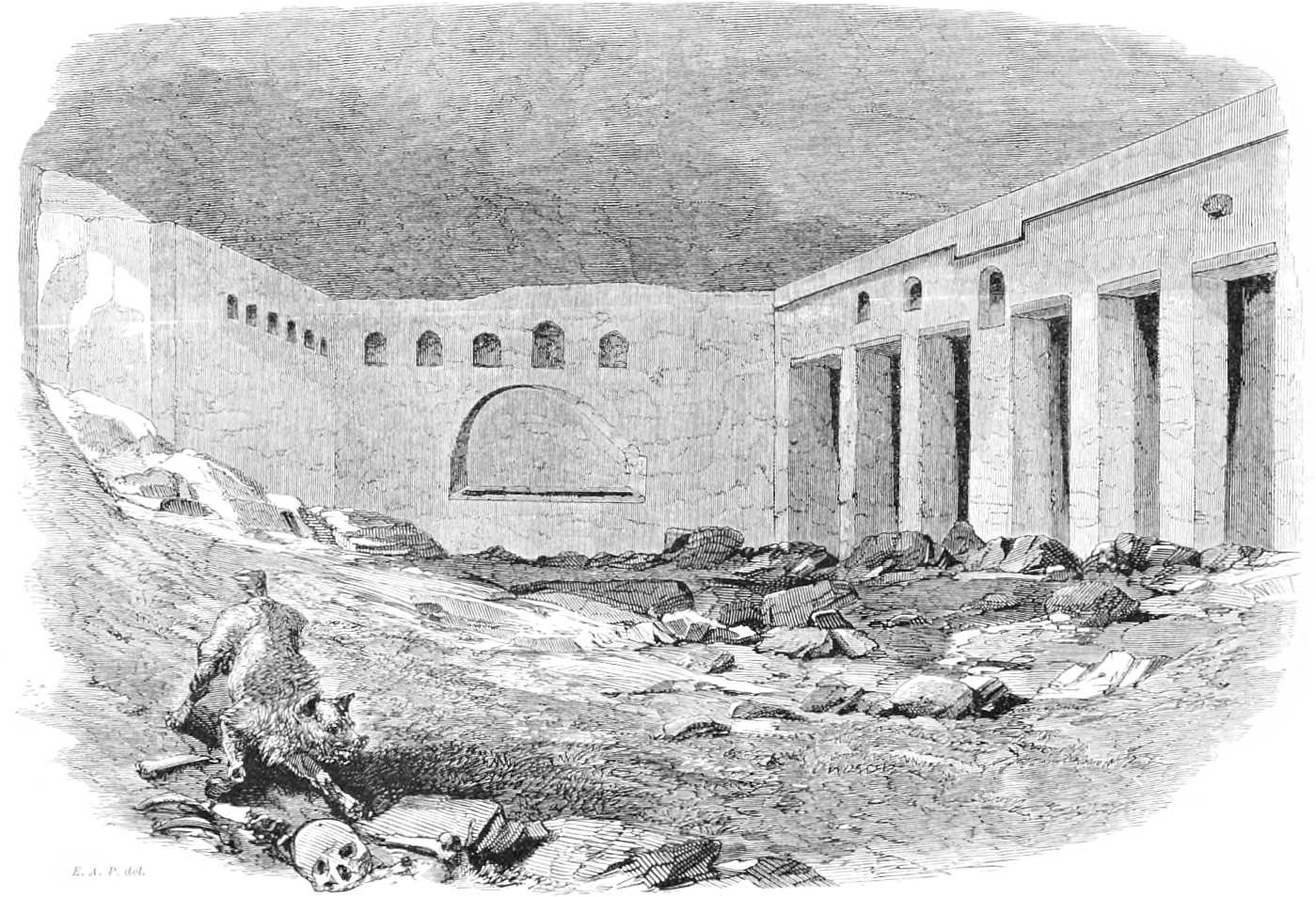
Plate 23.—Interior of a Tomb cut in the Side of a Quarry in the Northern Necropolis.
A class, perhaps not less numerous, consists of tombs without chambers, the sarcophagus recesses being cut directly into the face of the rock. These recesses, which contain several tiers of sarcophagi, like those already described (Plates 20 and 32), run into the rock perpendicular to the line of the escarp, or nearly so. Each tomb consists of from one to ten or twelve such recesses, separated from each other by thin partitions. Their fronts are quite as varied as those of the chamber ones, some being perfectly plain, while others have the ends of the partitions made to represent columns or pilasters, surmounted by architrave, frieze, and cornice. In some tombs of this description, where the rock fails, the Order is completed with masonry. In the western cemetery, many of these recess tombs, if we may so call them, are provided with porticoes like those already mentioned, and consequently have an outer façade with columns, and an inner one with pilasters, like the front of a Greek temple. The inner façades, not being exposed to the action of the weather, are still in an almost perfect state of preservation. Even in the minutest detail of the architecture they are finished with the greatest care and nicety, the fluting of the pilasters, the moulding of the cornice, &c., having that peculiarly delicate sharpness for which the buildings of the Greeks are so remarkable. Plate 37 represents one of these internal façades, showing the colours as they still exist.
Pl. 24.
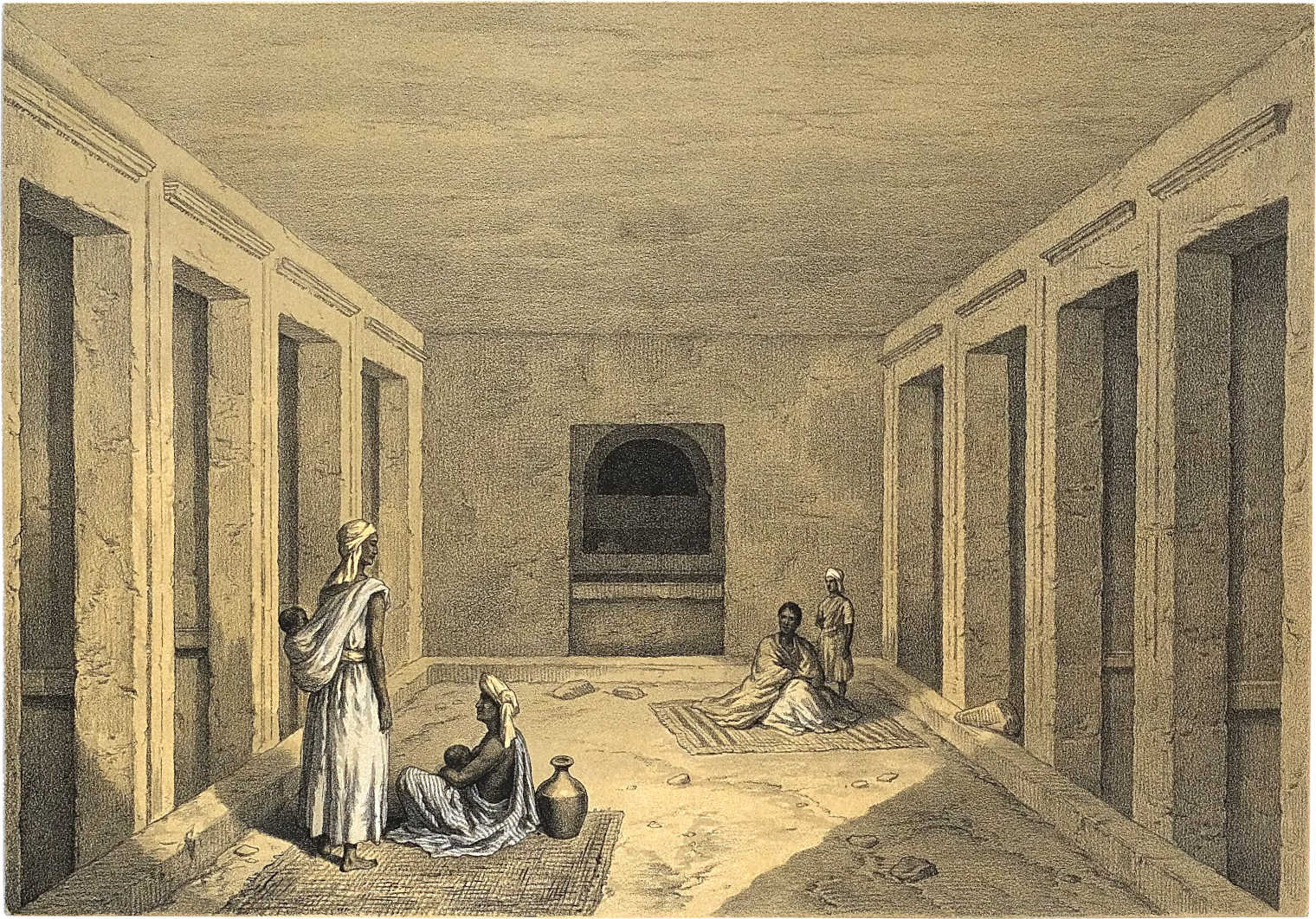
| E. A. Porcher, delt., T. Picken, lith. | London. Published July 1st. 1864 by Day & Son, Lithographers to the Queen &c., Gate Street Lincoln’s Inn Fields. | Day & Son, Lithrs. to the Queen |
INTERIOR OF A LARGE TOMB IN THE NORTHERN NECROPOLIS OF CYRENE
Pl. 25.
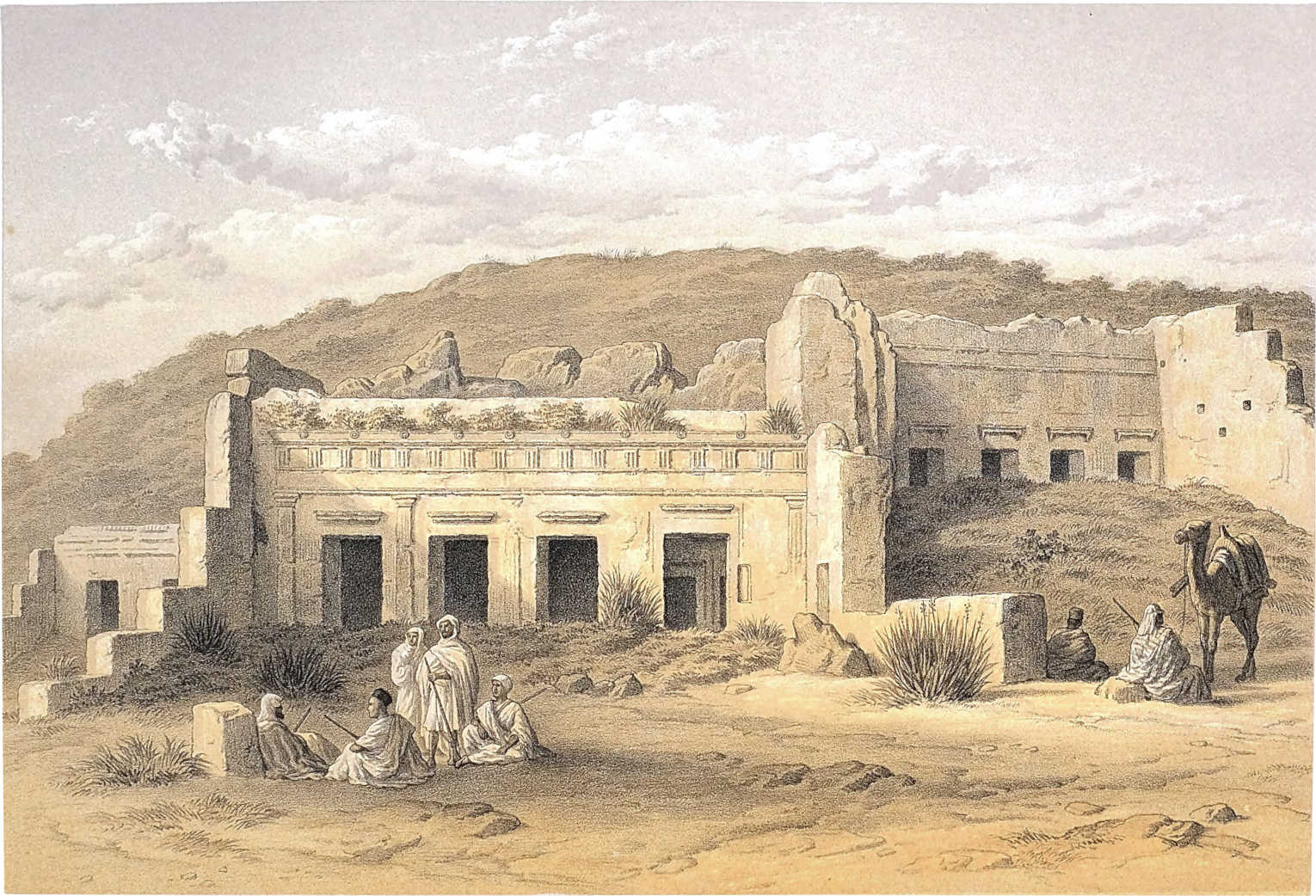
| E. A. Porcher, delt., T. Picken, lith. | London. Published July 1st. 1864 by Day & Son, Lithographers to the Queen &c., Gate Street Lincoln’s Inn Fields. | Day & Son, Lithrs. to the Queen |
TOMBS IN THE NORTHERN NECROPOLIS OF CYRENE
[33]In tombs of all kinds the entrances to the chambers, and the openings of the recesses, have been closed by single slabs of stone, either quite plain or panelled like a door.
The tombs are as various in size as in design. In some, the chamber is not more than six feet square, and hardly high enough to stand upright in, while others may be found with a total length of seventy, and a height of from ten to fifteen feet.
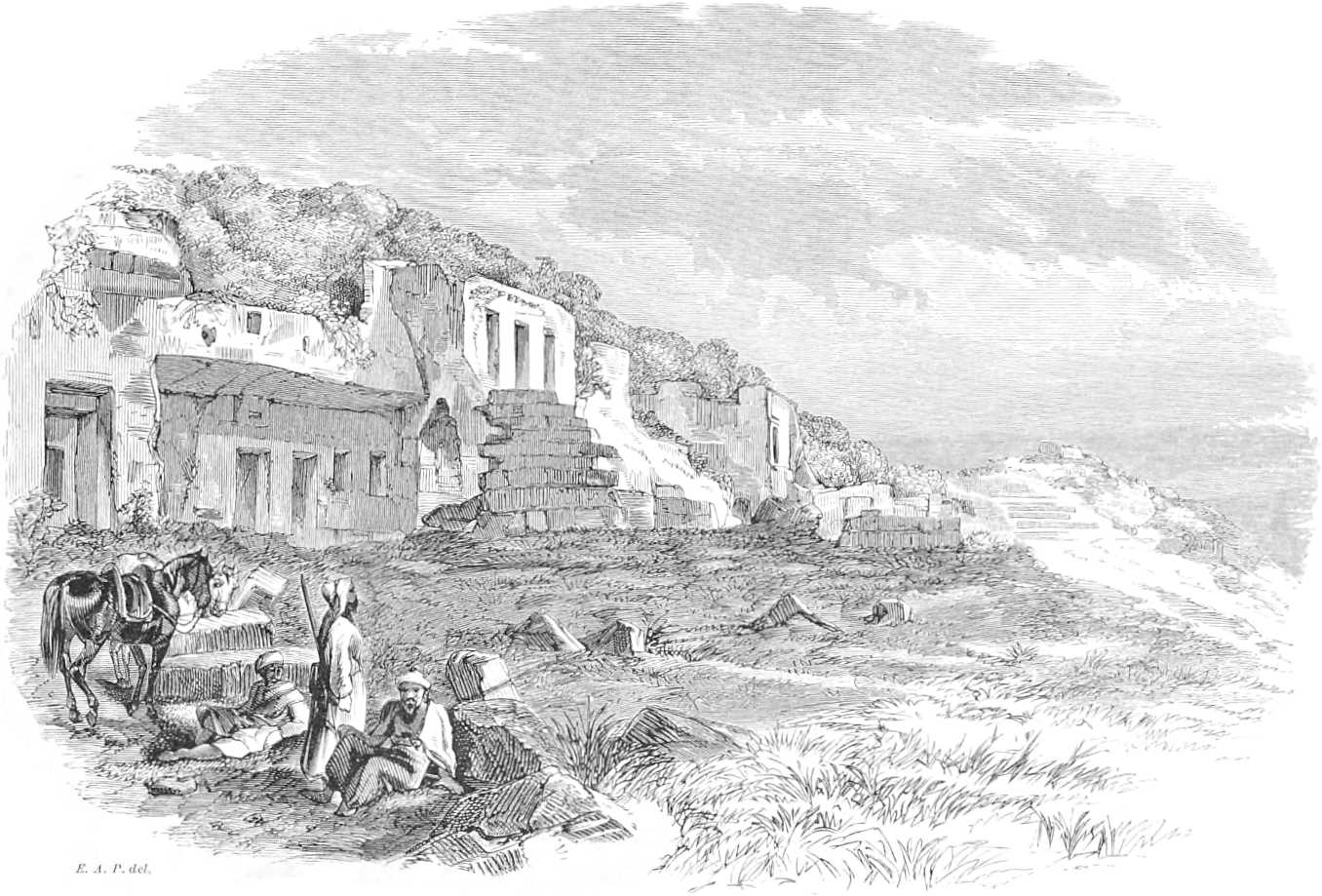
Plate 26.—Tombs in the Northern Necropolis (called by the Arabs “Kenissieh”).
One of this length is shown in Plates 24 and 35, which was the longest we saw for a single tomb. A short distance from this one, higher up the hill, and flanking the path that led to Marsa Sousah, was a much more extensive range of tombs, which were called by the Arabs the Kenissieh, and seems from the great number of sarcophagi to have been used as a public cemetery. A plan of the interior has been given by Pacho, and the exterior is shown in Plate 26, and extended to a much greater depth into the side of the hill, as it measured 128 feet by 68 feet in breadth. In the interior we found a large marble sarcophagus, and two marble pedestals with the following inscriptions:—
| ΑΡΓΕΙΟΣ | ΑΓΑΘΟΚΛΕ |
| ΕΝΙΟΣ | LΚ |
| ΑΡΓΕΙΟΣ | |
| ΔΕΙΝ | |
| [JPG] |
![[JPG]](images/insc2.jpg)
The built tombs are constructed on the same principles as the excavated ones. The greater number of them contain two compartments, similar to the recesses, with four sarcophagi in two tiers in each compartment (Plates 28 and 36); but many other kinds occur, some of which are of great size. Unlike the rock tombs, which from their nature are almost indestructible, most of these are now in ruins.
[34]Fewer inscriptions exist in the tombs than might have been expected. Those which we found were generally only a list of names.
The sites of the cemeteries seem to have been chosen with great care, as they occupy many of the finest positions around the city. Those on the faces of the hills command a magnificent view of the lower plateau, bounded in the distance by the sea. One of these is shown in Plate 27. It is situated to the westward of the Temple of Apollo, and immediately below the theatre in that quarter, and had the finest external façade. It was originally ornamented by a colonnade of six pillars, 75 feet in length, and by its size and finish was doubtless intended for some family of importance. The principal room measured 41 feet by 37 feet, with a height of 15 feet, and in it were found fragments of marble sarcophagi, with elaborate bas-reliefs. It is now used by the Arabs as a large granary for their corn, and has lost some of its beauty in consequence of the falling away of the middle part of the colonnade from the rock to which it was joined. The ravines, also, which have been selected are remarkable for their picturesque beauty. On the upper plateau, to the southward and eastward of the city, where most of the built tombs are to be found, every undulation of the surface is taken advantage of. In addition to the large cemeteries in the more immediate neighbourhood of the city, the roads in all directions are flanked by tombs for several miles, like the Via Appia, at Rome.
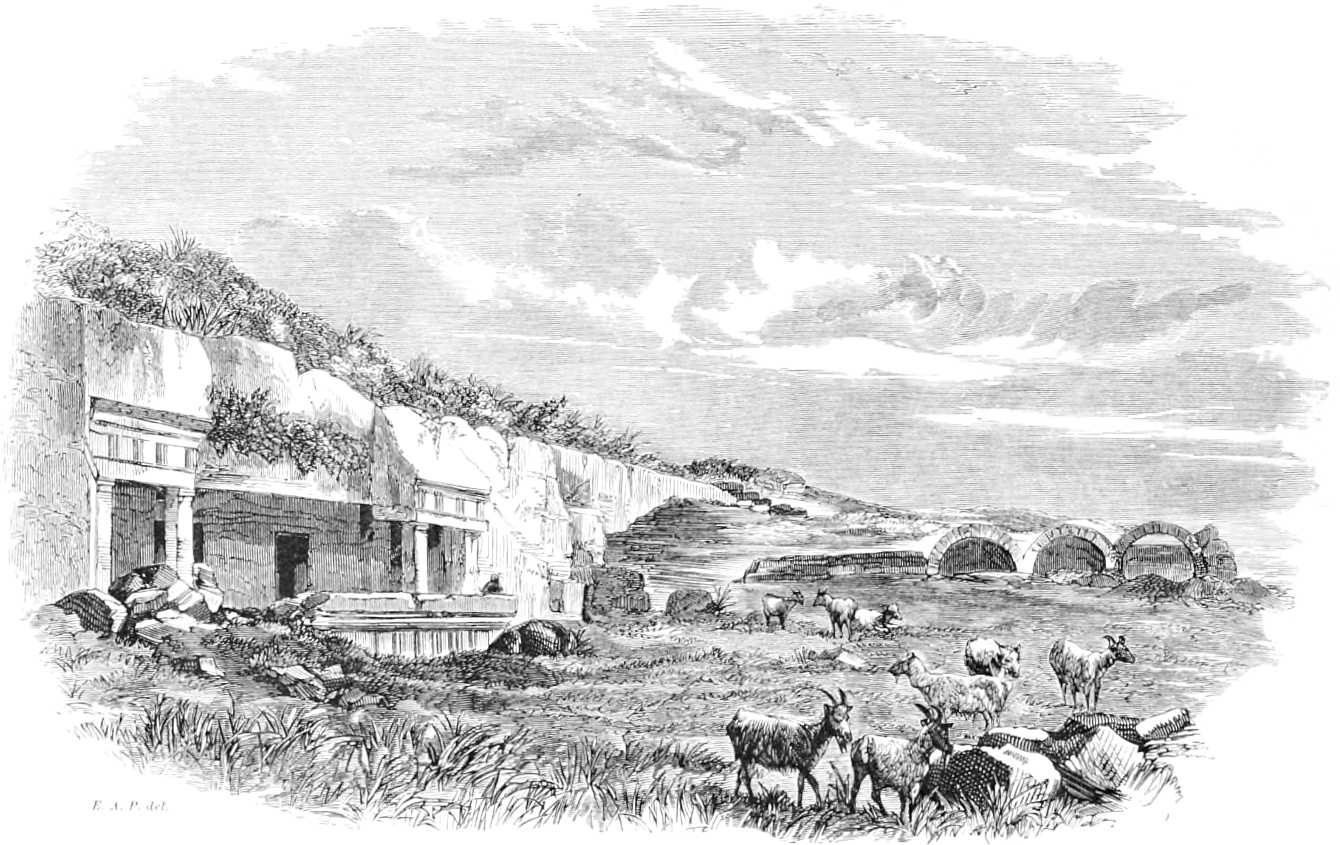
Plate 27.—Large Tomb on the Face of the Western Hill of Cyrene.
The various plans and sketches we have given will, it is hoped, enable the reader to form a pretty accurate idea of the appearance of these truly wonderful cemeteries. In regard to extent, variety, and wonderful preservation, the Necropolis of Cyrene, as a whole, is probably quite unrivalled.
Pl. 28.
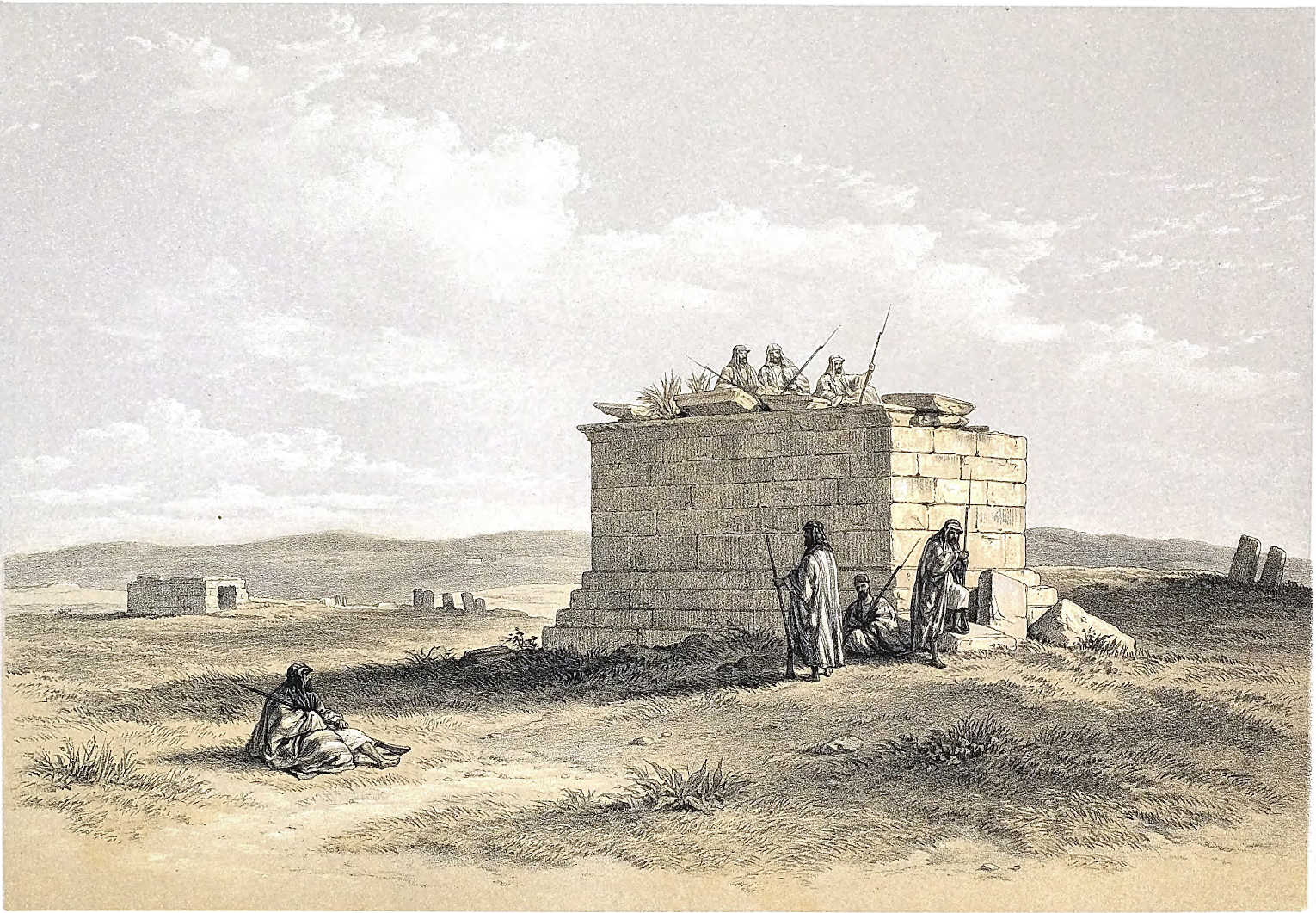
| E. A. Porcher, delt., T. Picken, lith. | London. Published July 1st. 1864 by Day & Son, Lithographers to the Queen &c., Gate Street Lincoln’s Inn Fields. | Day & Son, Lithrs. to the Queen |
BUILT TOMB ON THE SOUTH-WEST SIDE OF CYRENE
Of the city itself very little remains to be seen. A few walls cropping a foot or two above the surface of the ground, and some broken columns, mutilated statues, and blocks of stone strewn[35] about in different places, are almost the only objects that attract the attention of the traveller on first walking over the site of the city; but many traces of former buildings are discovered on a more minute examination of the ground. As already stated, a central valley traverses the city from south-east to north-west, dividing it into two portions, the Eastern and Western. Of the two, although nearly equal in extent, the Western contains by far the greater number of remains of ancient buildings; but the part of the city most thickly covered with ruins is the artificial platform at the mouth of the ravine, in front of the Fountain of Apollo. On the south-eastern side of the city, around the head of the valley, the ground is covered with ruins of a much later period. Their general style and appearance leave little doubt of their being the remains of the Christian city of Cyrene, in the time of the Byzantine empire.
Pl. 29.
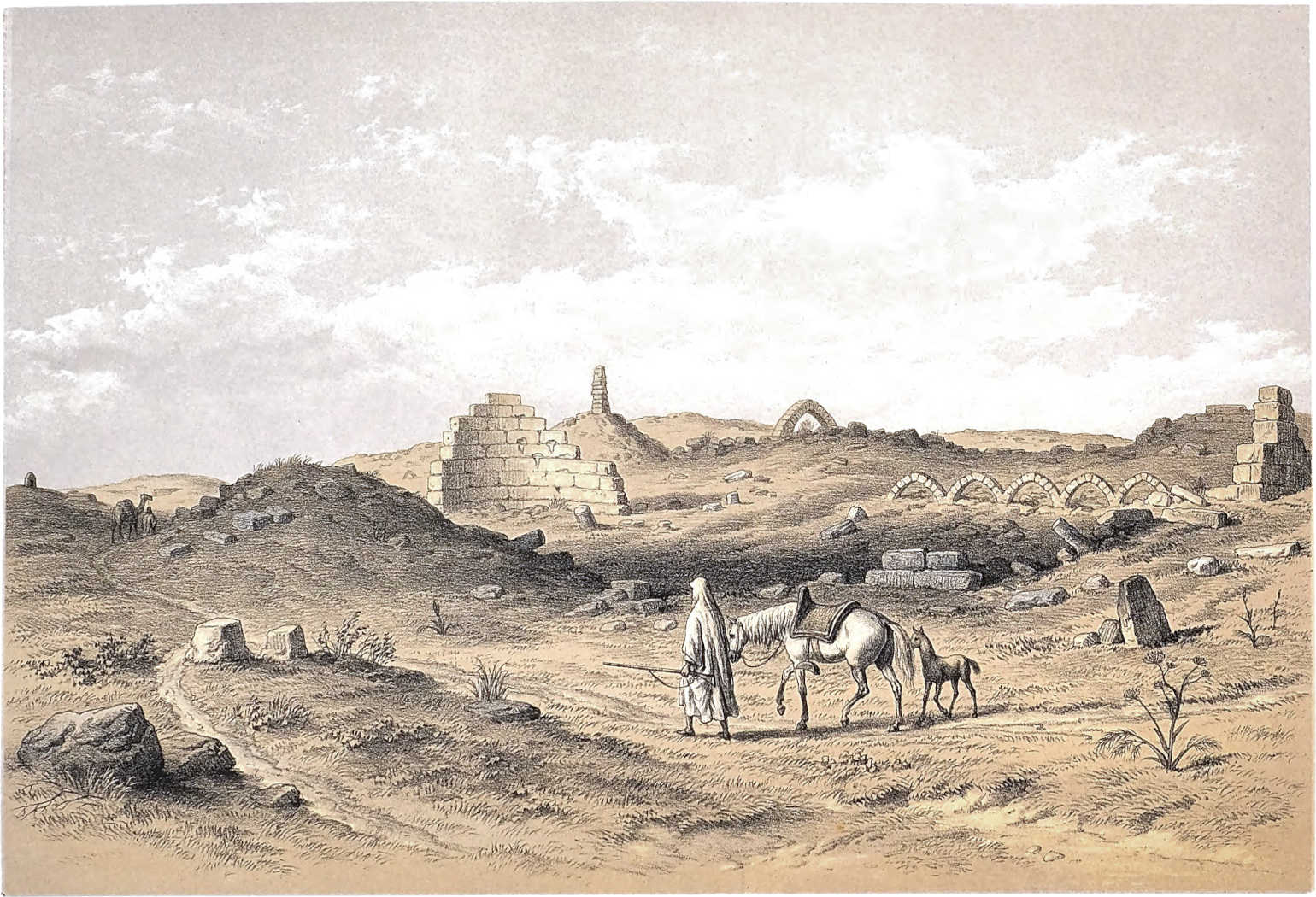
| E. A. Porcher, delt., T. Picken, lith. | London. Published July 1st. 1864 by Day & Son, Lithographers to the Queen &c., Gate Street Lincoln’s Inn Fields. | Day & Son, Lithrs. to the Queen |
RUINS OF THE CHRISTIAN CITY OF CYRENE
We shall presently have occasion to describe the remains of the principal buildings, in giving an account of our excavations.
Many of the ancient roads can be easily traced for several miles from the city. The one to Apollonia, the seaport of Cyrene, is quite distinct the whole way, a distance of about twelve miles. Passing the city wall on the side of the eastern hill, opposite the Fountain of Apollo, it descends to the lower plateau by a uniform incline about two miles in length, through the north-eastern cemetery, on the face of the range. For the greater part of the descent it is made by cutting into the side of the hill, the escarp thus formed being taken advantage of for the excavation of tombs, as already explained. Where a sufficient width is not obtained by simply cutting into the rock, the road is widened by embanking and revetting the lower side. In the descent of the lower range, the road is similarly constructed. Great skill is shown by the way in which it is laid out, so as to reduce the steepness of the gradient as much as possible. Another road, similar in every respect to this one, leaves the city at the large retaining wall at the mouth of the centre Wady, and descends to the lower plateau along the face of the western hill. Many roads also exist on the comparatively level ground of the upper plateau. Of these, the most important is the one by which we first approached the city, and which, without doubt, was the great highway of the west leading to Barca, Ptolemais, Teuchira, and Berenice. It enters the city by a gateway in the southern wall, near the head of the Wady Bil Ghadir. But perhaps the most remarkable road, if we consider the care and labour shown in its construction, is the one leading down the Wady Bil Ghadir, and along the face of the hills to the westward of the city. It leaves the city by the gate of the western road; whence, after making a sudden bend to the north, it follows the bottom of the Wady to near its mouth. In one place, where the bottom of the ravine is very narrow, the rock is cut away like a wall on each side to make room for the road. At this point, and at intervals lower down, may be seen the remains of an aqueduct cut in the rock to convey the water of the various fountains in the valley round the face of the citadel hill. It could not possibly have led to the city itself, and was therefore most probably made for the irrigation of gardens on a lower level. The greater part of it is an open conduit cut in the face of the rock; but at some points it is cut like a small tunnel.
On the south of the citadel, where the ravine approaches the face of the range, its bed falls abruptly to the level of the lower plateau, causing the stream from the fountains above to pour over the rocks in a succession of waterfalls. The road, which to this point had followed the bottom of the Wady, had consequently to be turned to the left along the face of the hill, which at this corner becomes a sheer precipice both above and below. The road is carried round it by means of a huge retaining wall built up to the proper level from the bottom of the cliff. It is still nearly perfect throughout its entire length, except at the end in the ravine, where a few of the stones have been displaced. About the middle of the wall, the cliff recedes some 30 or 40 feet, and as the wall is carried straight across, a platform of considerable size is thereby formed. Here a copious fountain of delicious water issues from a cavity in the face of the cliff,[36] from which a small aqueduct cut in the rock runs along the side of the road for several miles. Close to the fountain it was formerly hollowed out into a series of troughs, so arranged that, by the overflow of each passing to the next, they were always full,—a slight indication of the attention paid by the Cyrenians to the wants of the horses, for which their country was so celebrated. One can easily fancy the citizens of Cyrene halting in their evening drives at this beautiful spot to water their horses and enjoy the extensive view of the magnificent scenery around. On one hand is the high and rugged face of the cliff overhanging the ravine below; on the other the steep hill of Cyrene rising from the beautiful valley of verdure at its base; while far below lies the varied surface of the lower plateau, stretching away for miles to the dark blue line of sea beyond.
The following graphic description of this scene is given by Beechey:—
“The steep sides of the descent are thickly overgrown with the most beautiful flowering shrubs and creepers, and tall trees are growing in the wildest forms and positions above and below the roads. The Duke of Clarence (when the choice of his death was proposed to him) had a fancy to be drowned in a butt of Malmsey: and we think, if we found ourselves in a similar dilemma, that we should pitch upon some part of this charming ravine, as the spot from which we could hurl ourselves through myrtles and oleanders into the pure stream which dashes below, with more pleasure than one could leap with from life into death in most other places that we know of. We must, however, confess that, in passing along the dangerous parts of the galleries here alluded to, no such fancy ever entered our heads; and we took especial care, notwithstanding the beauty of the descent, to keep closer to the high rock on one side of the road than to the edge of the charming precipice on the other.”
From this point the road winds along the face of the hill towards the westward, gradually descending to the level of the plain. Near the platform it is flanked on the left by a most picturesque row of excavated tombs, the interior façade of one is given in Plate 37. Before reaching the plain, the road crosses a small ravine, which contains a larger number of highly finished tombs than any other part of the Necropolis. One of them, published by Beechey, had a suite of allegorical figures painted on the metopes of the inner façade; but on visiting it we were much disappointed to find the beautiful front completely destroyed, the whole of the entablature being roughly cut away, evidently for the purpose of obtaining the paintings.[2] It is to be hoped that they at least were safely removed, and that this beautiful tomb was not destroyed altogether in vain. It is, doubtless, right and proper that the remains of ancient art brought to light by excavation, or which, from their position, are liable at any moment to destruction, should be removed to a place of safety, where they may be studied and admired; but it is certainly carrying out this practice to an unwarrantable extent to destroy a beautiful structure that has survived the ravages of two thousand years, for the sake of what by itself is of comparatively little value.
Pl. 30.
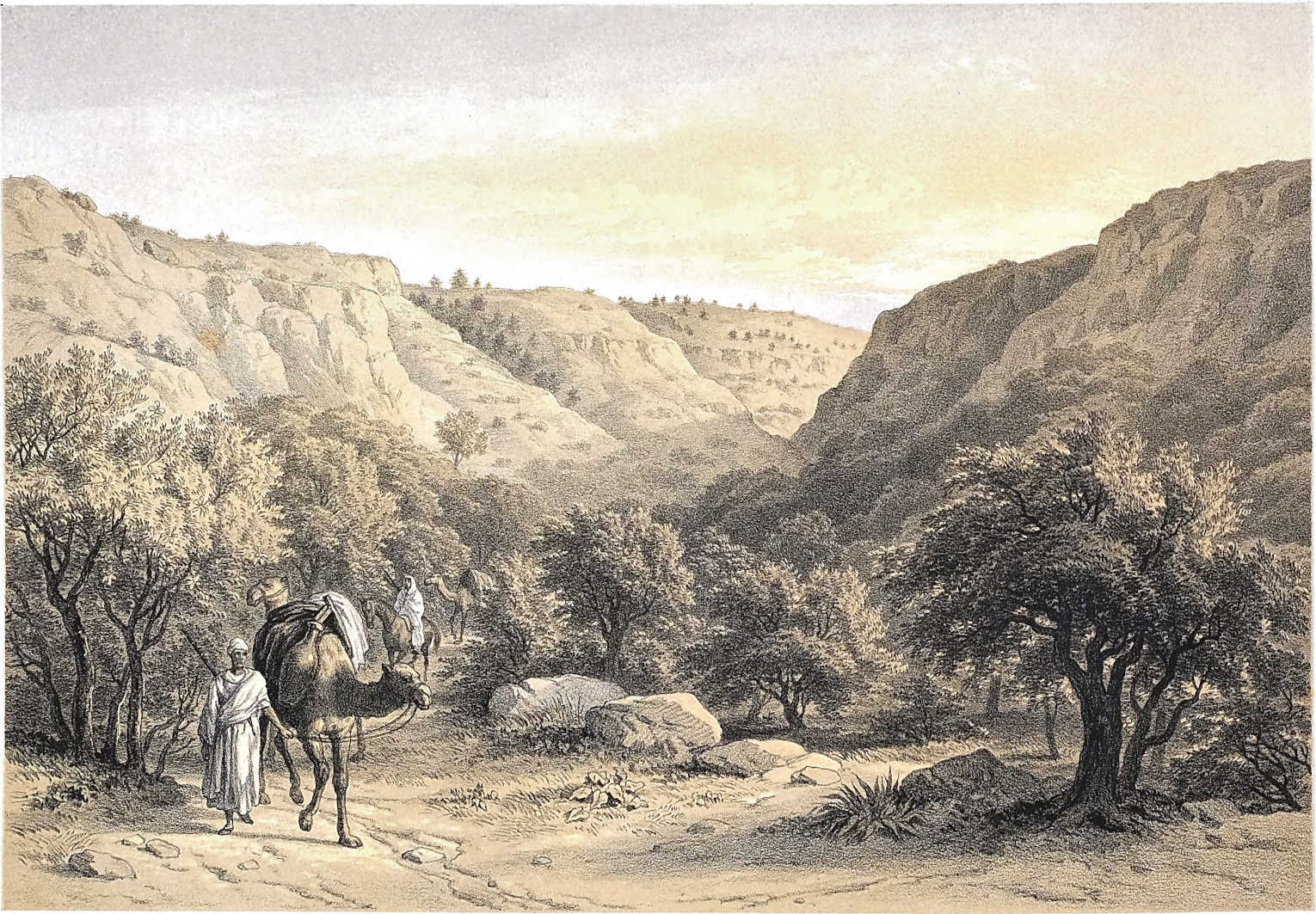
| E. A. Porcher, delt., T. Picken, lith. | London. Published July 1st. 1864 by Day & Son, Lithographers to the Queen &c., Gate Street Lincoln’s Inn Fields. | Day & Son, Lithrs. to the Queen |
WADY MŬCHGŬN, TWO MILES TO THE WESTWARD OF CYRENE
CYRENE.
PLAN OF AN ORNAMENTED AND PAINTED TOMB IN THE NORTHERN
NECROPOLIS.
BY COMMANDER E. A. PORCHER R.N.
Pl. 31.
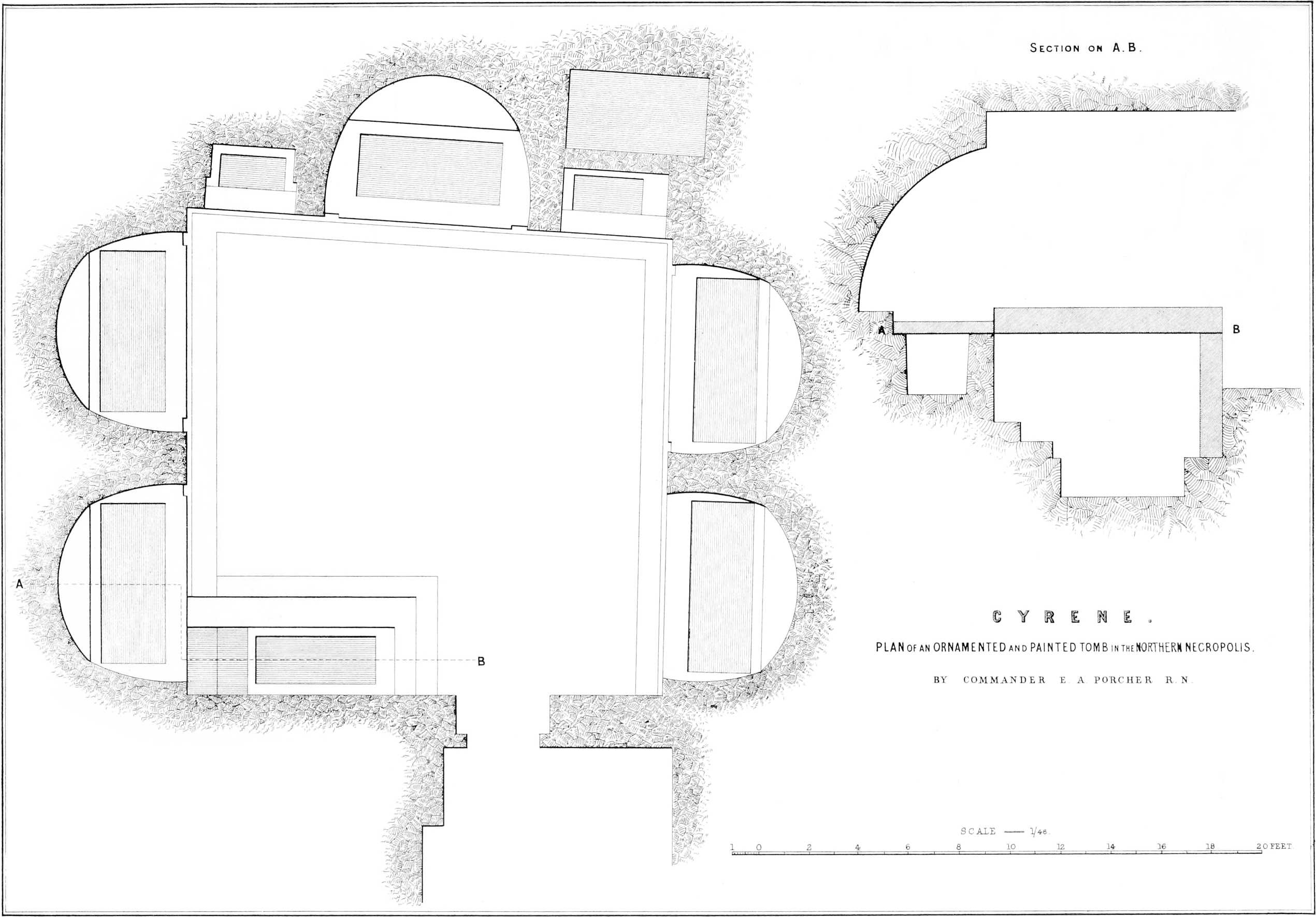
Day & Son, Lith. to the Queen
CYRENE.
PLAN OF A TOMB IN THE NORTHERN NECROPOLIS, CAPABLE OF HOLDING 105
SARCOPHAGI.
BY COMMANDER E. A. PORCHER R.N.
Pl. 32.
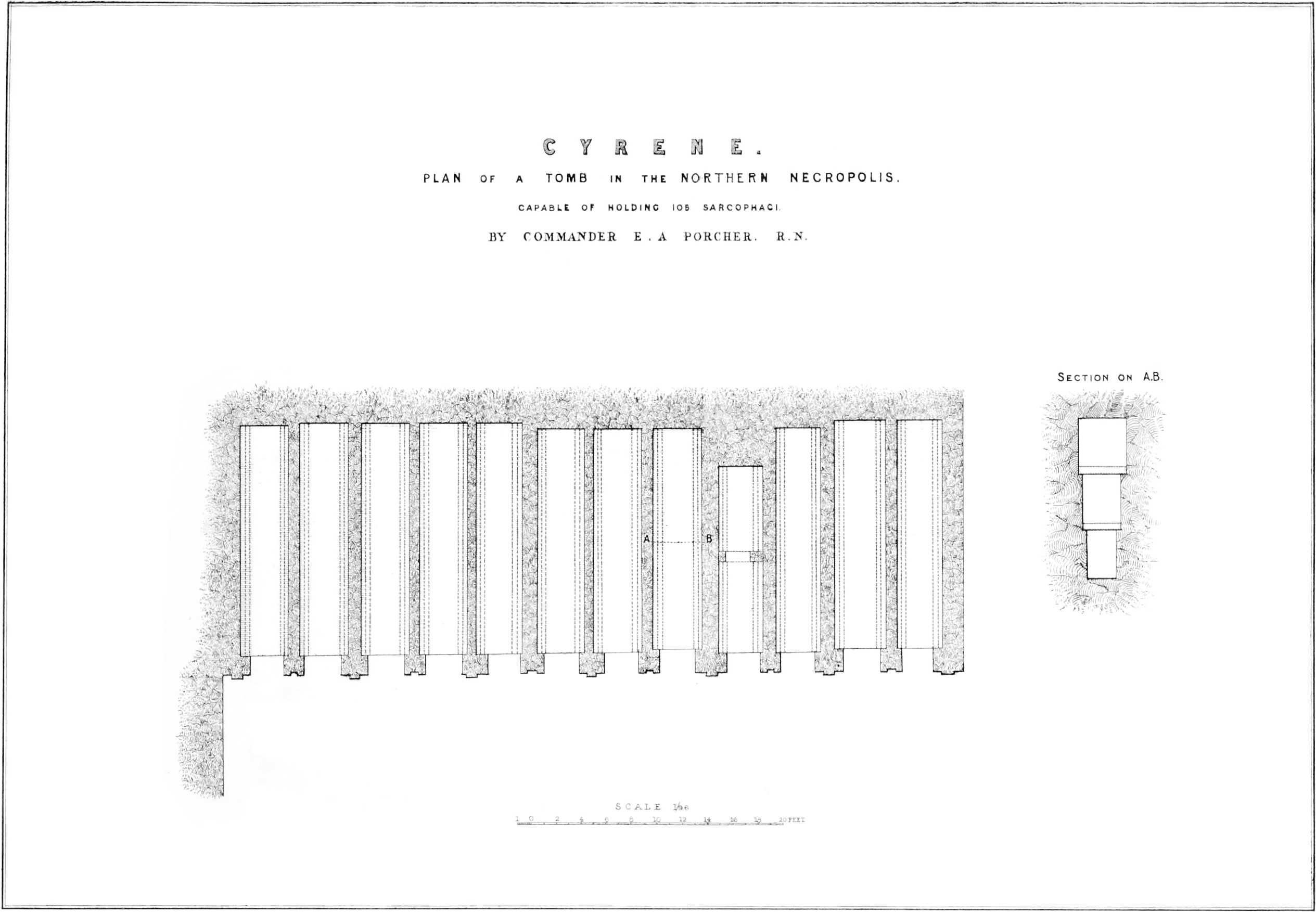
Day & Son, Lithrs. to the Queen
CYRENE.
PLAN OF A TOMB IN THE NORTHERN NECROPOLIS.
BY COMMANDER E. A. PORCHER R.N.
Pl. 33.
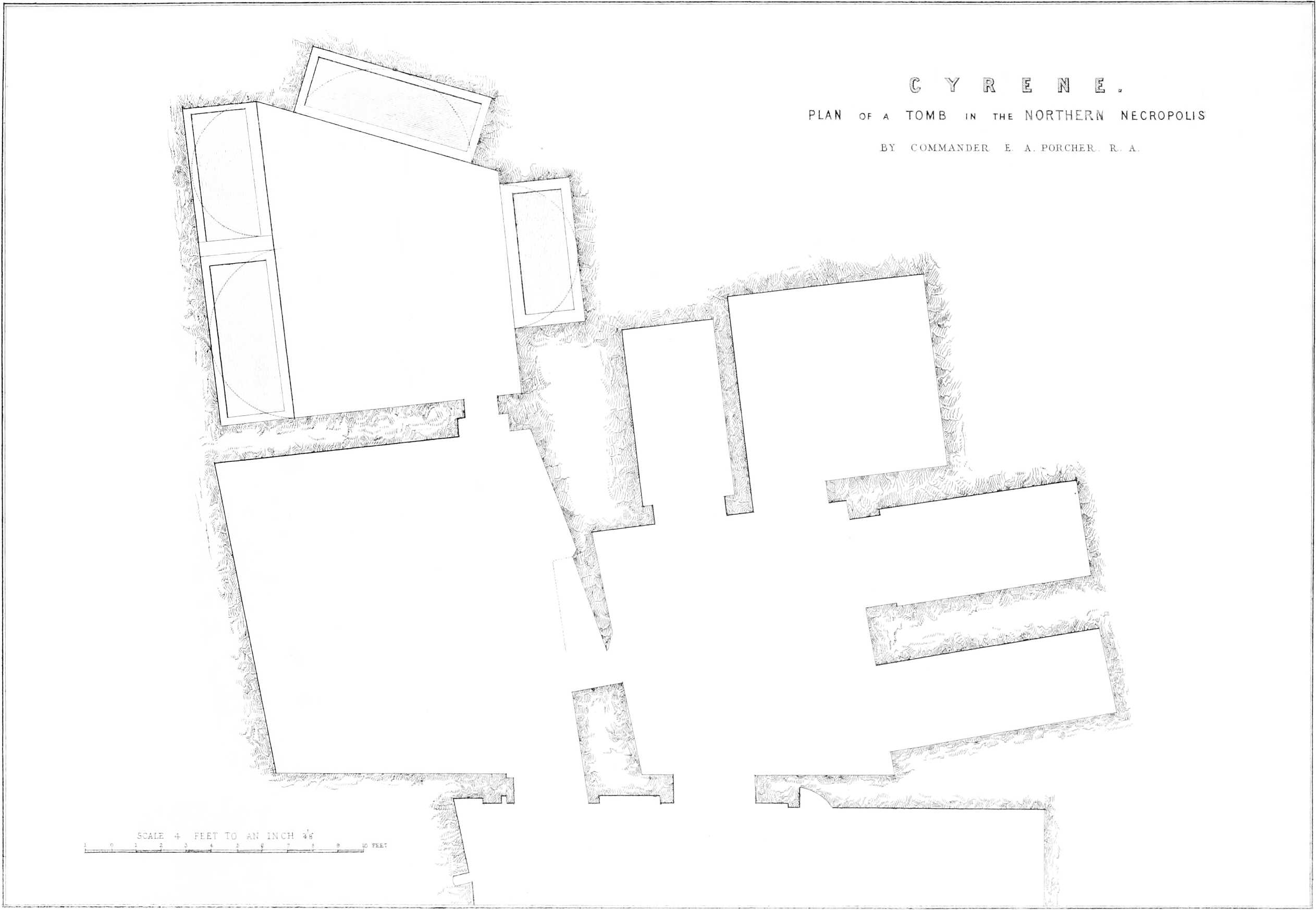
Day & Son, Lithrs. to the Queen
CYRENE.
PLAN OF A TOMB IN THE NORTHERN NECROPOLIS.
BY COMMANDER E. A. PORCHER R.N.
Pl. 34.
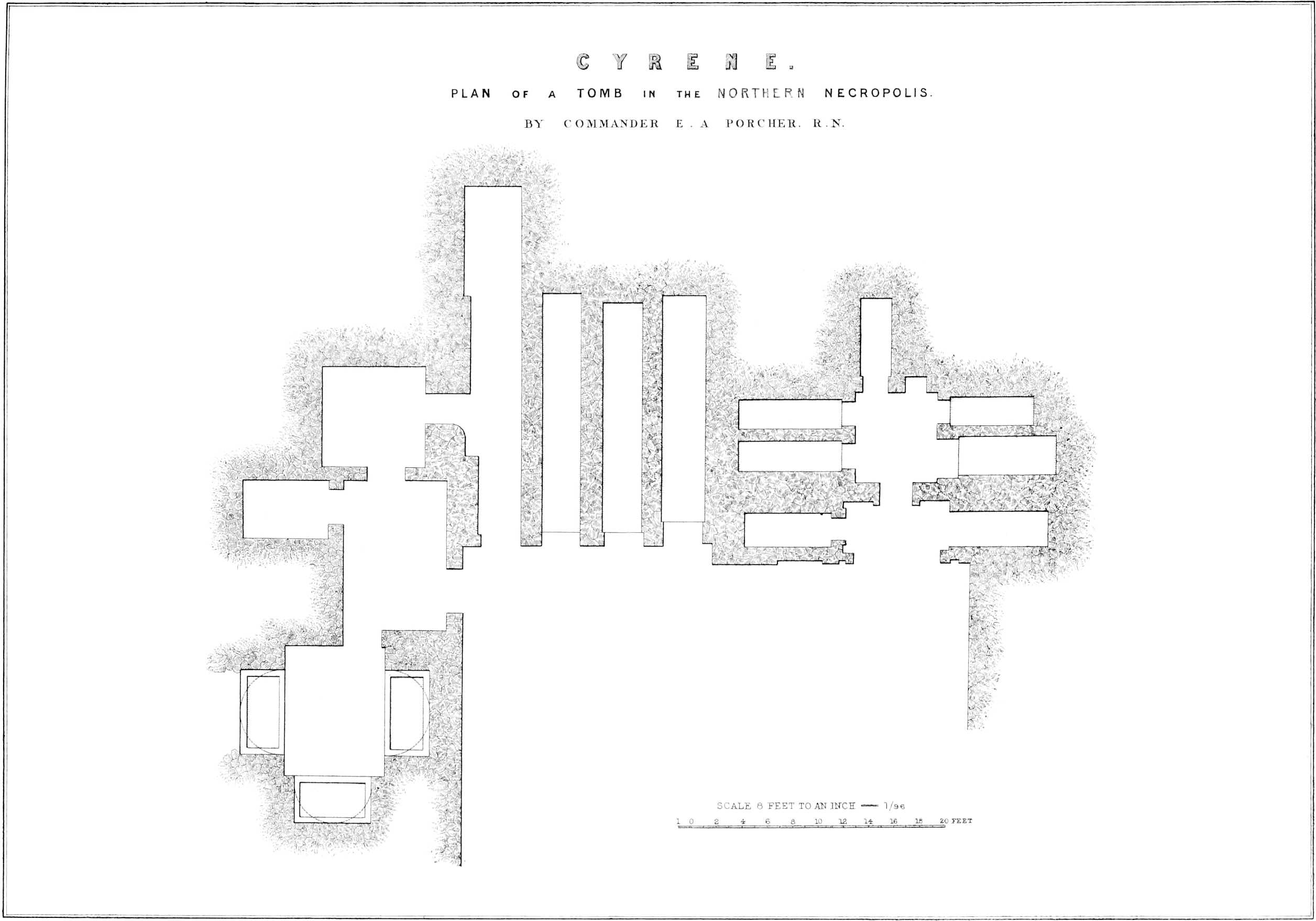
Day & Son, Lithrs. to the Queen
CYRENE.
PLAN OF A TOMB IN THE NORTHERN NECROPOLIS.
BY COMMANDER E. A. PORCHER R.N.
Pl. 35.
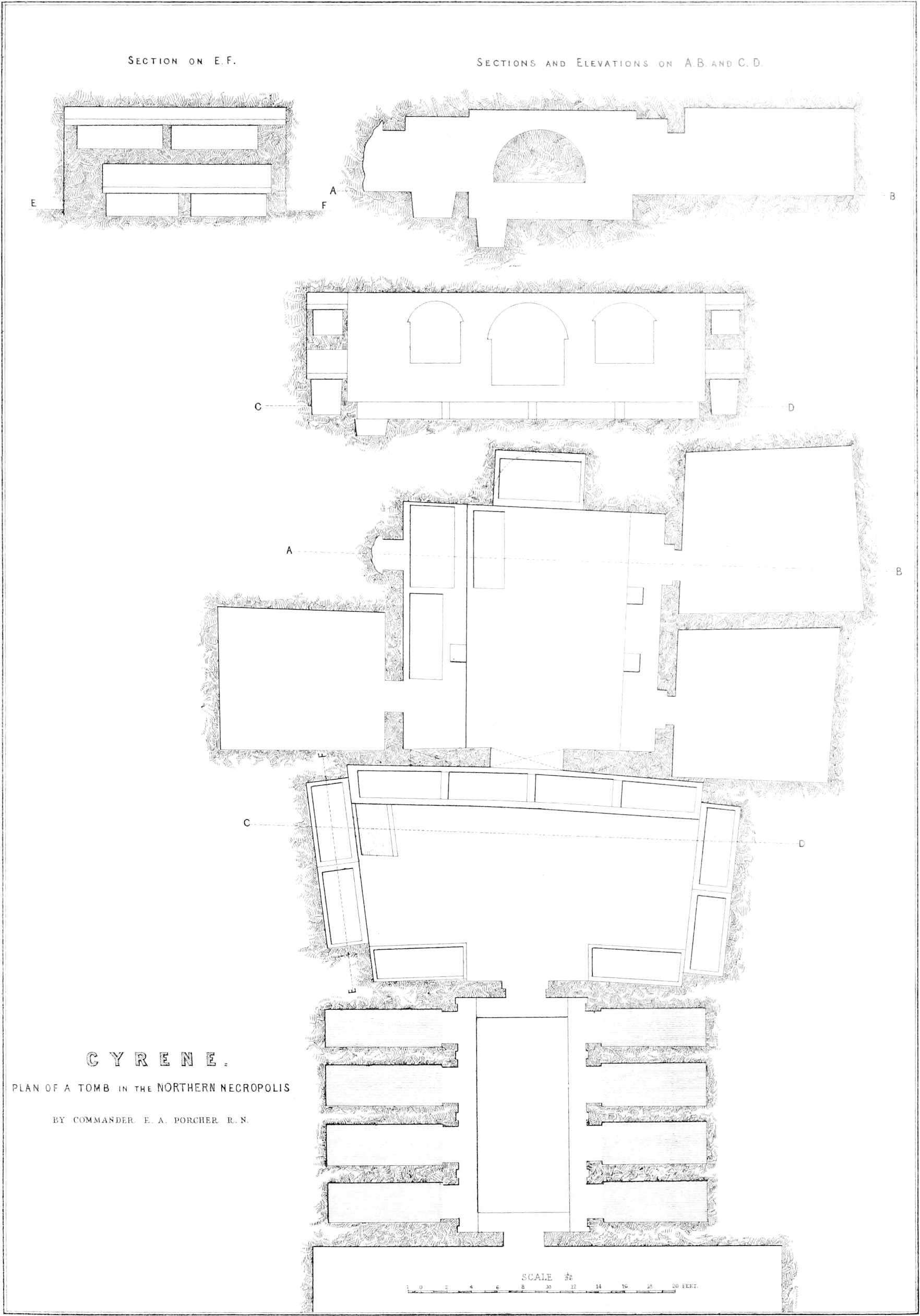
Day & Son, Lithrs. to the Queen
CYRENE.
PLAN OF A BUILT TOMB ON THE S.W. SIDE OF THE CITY.
BY COMMANDER E. A. PORCHER R.N.
Pl. 36.
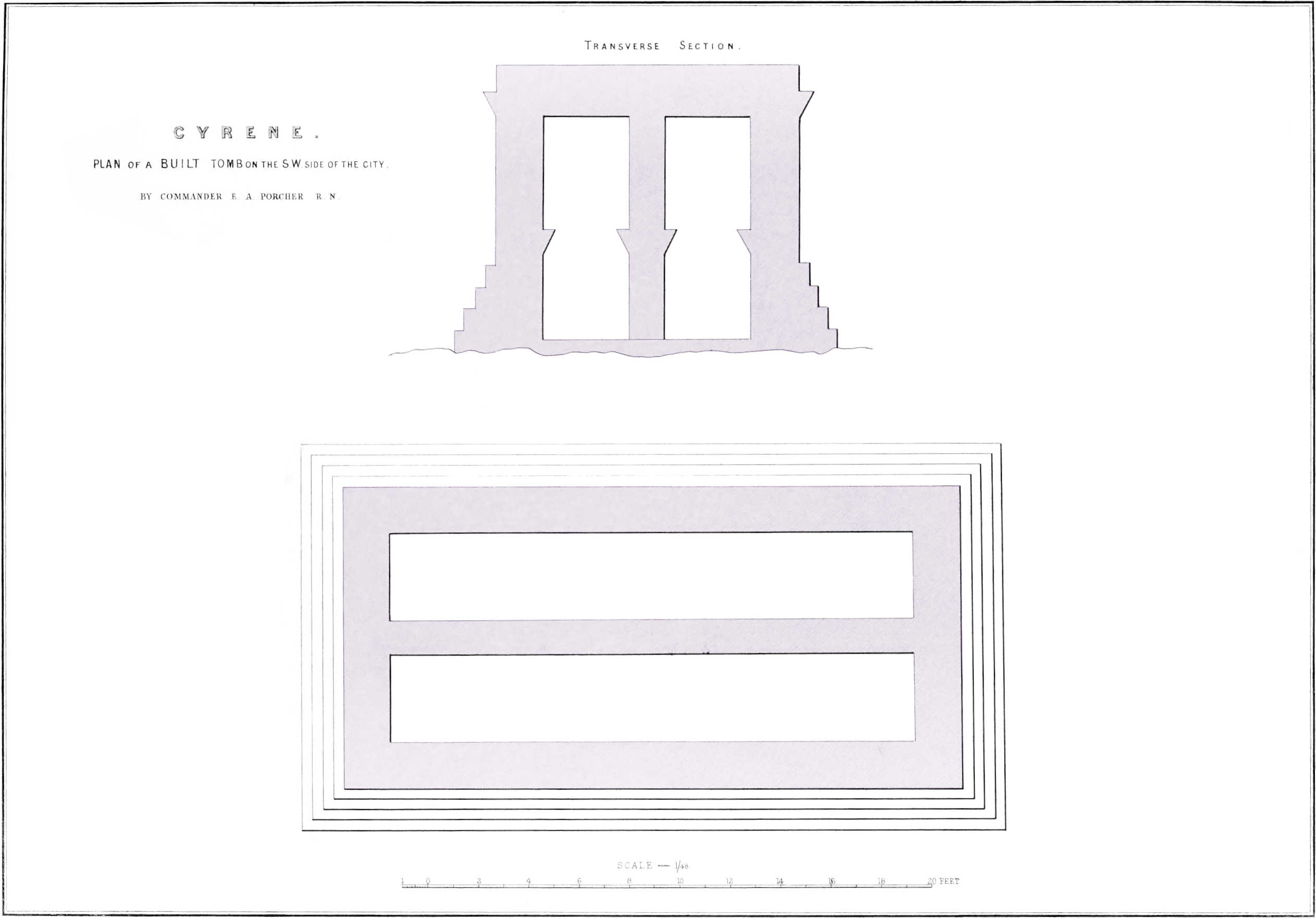
Day & Son, Lith. to the Queen
Pl. 37.
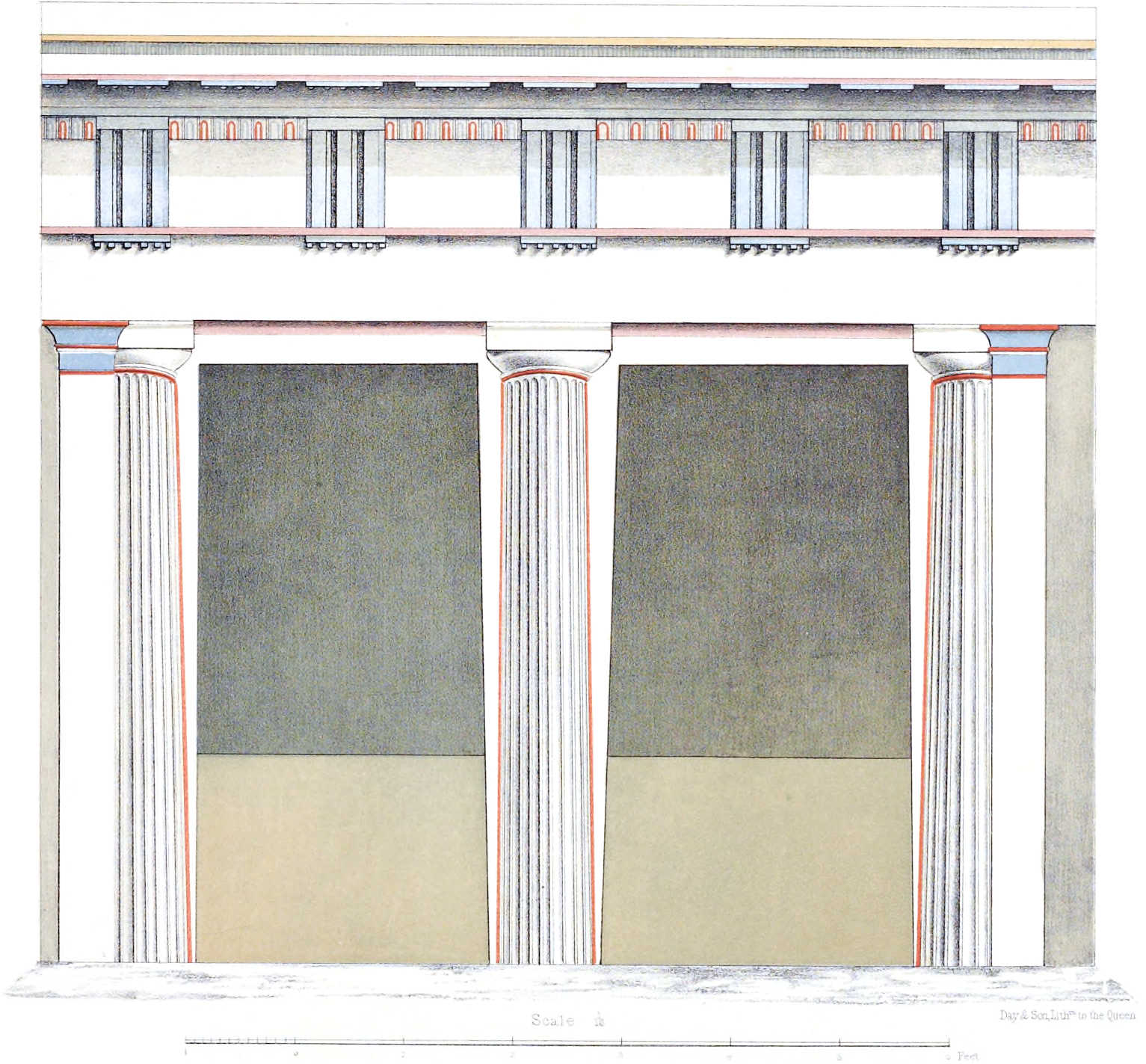
London. Published July 1st. 1864 by Day & Son, Lithographers to the Queen &c., Gate Street Lincoln’s Inn Fields.
ELEVATION OF THE INTERNAL FACADE OF A TOMB IN THE
WESTERN NECROPOLIS OF CYRENE.
Shewing the Colours as they now exist, by Commander E. A. Porcher
R.N.
About a mile from the face of the range, the Wady Bil Ghadir is joined in the lower plateau by the continuation of the central ravine of the city. The space thereby enclosed is an almost perfectly level plain, about a mile in length and three-quarters of a mile in breadth. The soil is exceedingly rich, and yields at the present day the finest crops of grain in the country. Spread like a map at the base of the hills, directly in front of the city, it seems specially suited for a large ornamental garden, and was most probably laid out as such by the inhabitants of Cyrene. It lies immediately below the Fountain of Apollo, and an aqueduct, as we have already mentioned, conveyed to it the stream from the fountains of the Wady Bil Ghadir; so that there was a sufficient supply of water available for its irrigation even during the droughts of summer. It is, moreover, protected by the high hills of Cyrene from the scorching blast of the Gibli—a wind from the desert[37] that not unfrequently destroys all the vegetation exposed to it. With its trees and flowers thus perpetually refreshed and protected, it must have formed one of the most pleasing features in the beautiful landscape seen from the city and terraces above.
Besides the Wady Bil Ghadir, two other ravines in the immediate neighbourhood of Cyrene are remarkable for the picturesque grandeur of their scenery, the Wady Mûchgûn to the west, and the Wady Leboaitha to the east of the city. The former, the widest and deepest Wady in the range, is filled with fine old olive-trees, many of which are covered in summer with clusters of honeysuckle.
The upper plateau around Cyrene is destitute of trees. Hardly a shrub is to be seen in this direction within three or four miles of the city. Grass, however, grows luxuriantly, so that the surface of the ground, except during the heat of summer, quite resembles the green sward of old pasture-land in England.
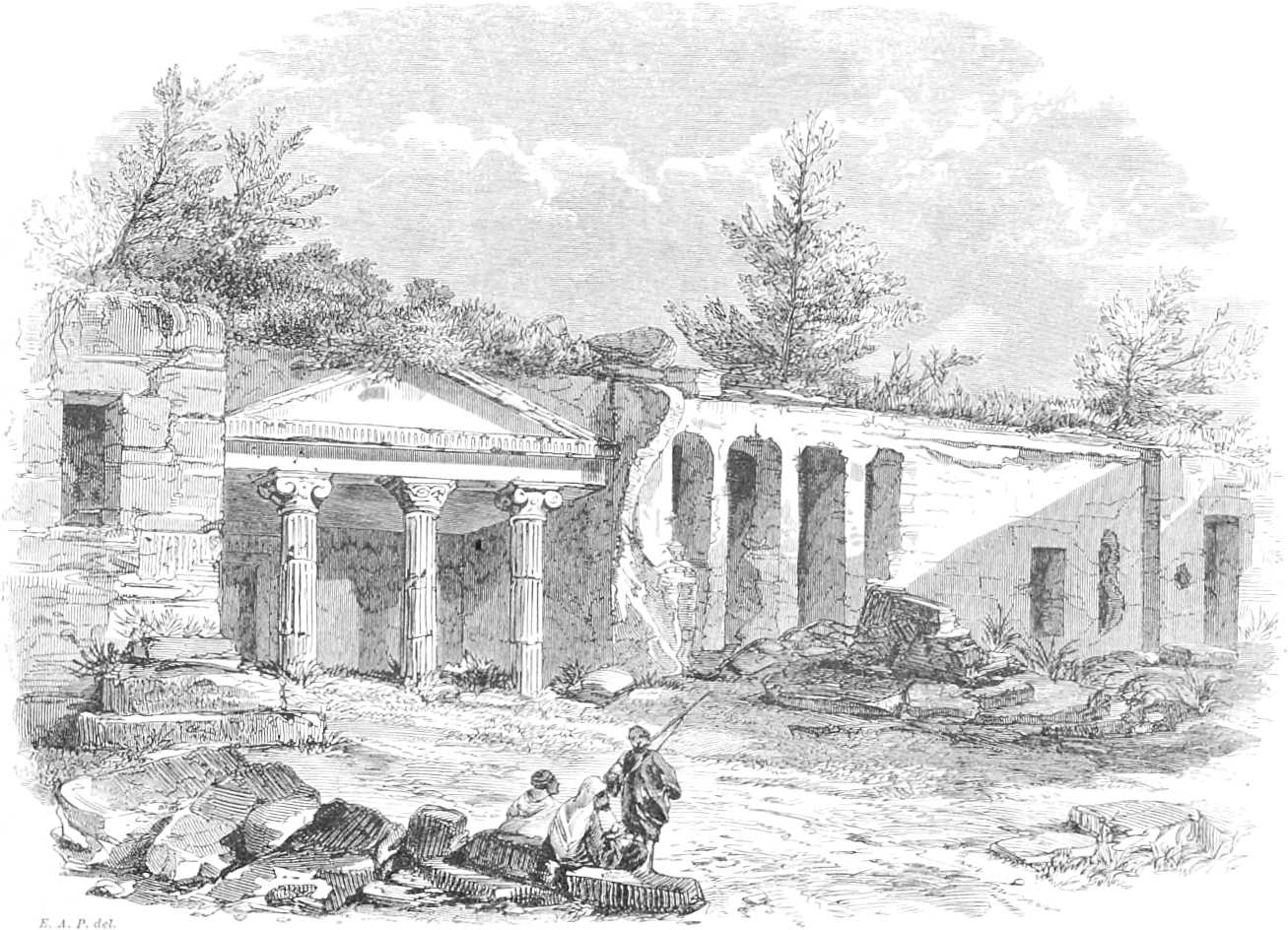
Plate 38.—Tombs on the Western Side of Wady Bil Ghadir.
The comparatively limited scope of the present work not admitting of further illustration, the reader is referred to the archives of the British Museum for other interesting details of this Necropolis.
[38]CHAPTER VII.
HAVING fairly established ourselves in our sepulchral residence, and made every arrangement for our future comfort that the means at our disposal rendered possible, we began to examine the remains of the city. Our attention was at first specially directed to the tombs, in which we hoped to discover small ornaments, vases, terra-cotta figures, and other portable objects. We were greatly assisted during our first rambles over the ruins by an Arab of considerable influence in the Cyrenaica, Mohammed El Adouly. He was a native of Benghazi, but having married the daughter of one of the Sheikhs of the Haasa tribe, who occupy the country in the neighbourhood of Cyrene, he kept his flocks, and spent the greater part of the year, in that district. One of the letters given us by the Sheikhs assembled at the Consulate was addressed to him, and Mr. Crowe, with whom he was well acquainted, had also sent him a special message regarding us. The day after our arrival at Cyrene he paid us a long visit, bringing with him the welcome present of a camel-load of milk and butter. He proved our constant friend during the whole time of our residence in the country, and on many occasions was of great service to us. Not being entangled in the perpetual feuds of the rival tribes around us, he was equally respected by all, so that we could hardly have had a safer friend. He was, besides, a man of much shrewdness and intelligence, and had profited greatly by his travels in early life. He had more than once been engaged in slave expeditions to Mourzook and Soudan, and had visited Constantinople, Alexandria, and Malta. He was withal a good Mussulman, although he confessed to having in his younger days been latitudinarian in his conduct, if not in his creed. In person he was a man of immense size, and had altogether a most imposing appearance.
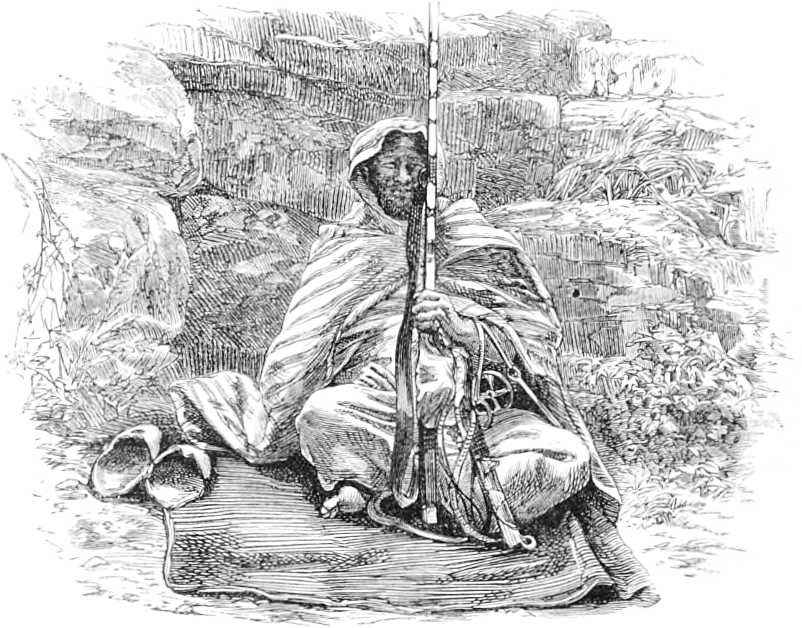
Plate 39.—Mohammed El Adouly.
From a Photograph.
The day immediately after his first visit he returned to show us the “lions” of the[39] place. After we had seen a few of the tombs in the north-eastern cemetery, he took us to the hill beyond the Wady Bil Ghadir, where he showed us an excavated tomb in which a number of objects had been discovered by M. Bourville. It was a large square chamber cut in the rock, with the ruins of some kind of building in front: two marble statues without heads were lying near it.
PLAN OF CYRENE
Pl. 40.
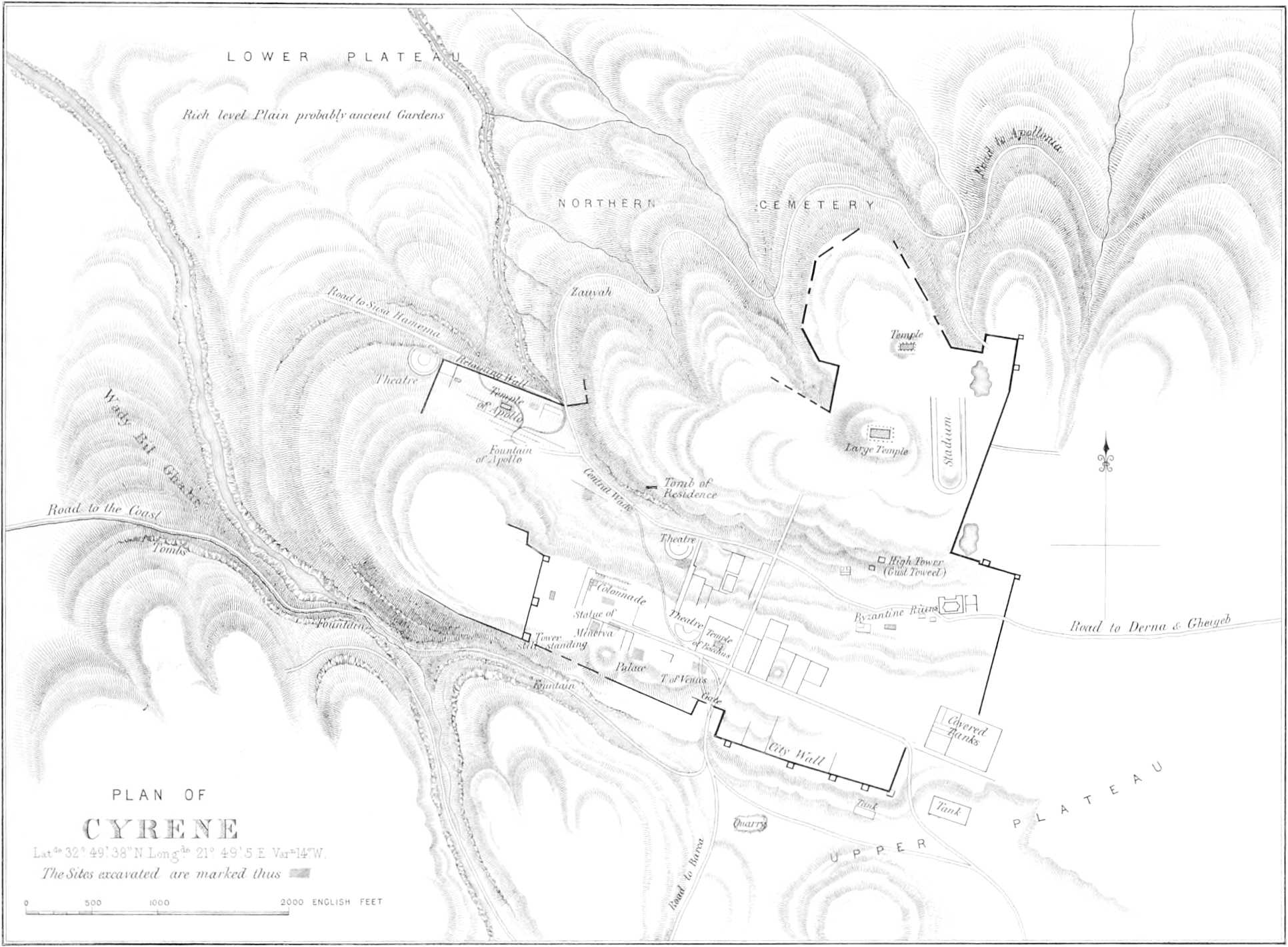
Day & Son, Lithrs. to the Queen
As every open tomb had doubtless been rifled long ago, we were anxious, if possible, to discover some under the surface of the soil, in the hope that they might still remain intact. In many of those cut in the scarped sides of the hills we found the fronts partially covered by the earth washed down from above, and therefore thought it probable that others existed which had been wholly covered. We accordingly looked for a place where such tombs were likely to be found, and at last chose, as the most promising spot, a heap of ruins lying against an artificial escarp near the tomb opened by M. Bourville.
The following day, the 27th of December, we commenced our excavations at this place. At first the work went on but slowly, owing to the inexperience of the blacks, who were quite ignorant of the use of the tools, which they now handled for the first time in their lives. For some time, therefore, we had to do the most of the digging ourselves. Although it may seem a very simple matter to teach an able-bodied man to use a pickaxe and a shovel, it is a much more tedious process than may be supposed. As every railway contractor knows, a “navvy” has to serve a good long apprenticeship before he is fit to take his place in a regular gang of excavators.
Our great difficulty, however, with the blacks was to make them understand the use of a crowbar. When a stone was too heavy to lift, or was so placed that it could not be rolled, their only resource was to try to break it. It was long before we could get them to see the power of the lever, and still longer before they could apply it themselves. After five days’ hard work, in clearing away the ruins of the building from the face of the escarp, we reached the rock at the bottom, about twelve feet below the original surface, but without finding an entrance as we had expected. As it was evident that nothing was to be discovered here, we left this place on the 1st of January, 1861, and removed to a rock-tomb in the Wady Bil Ghadir, where the absence of any remains of buildings made the work much easier. After a day and a half’s digging we came to a doorway, five or six feet below the surface, closed by a single slab of stone, of which one of the upper corners was broken away sufficiently to allow a man to enter. Inside we found a plain square chamber with recesses, partially filled with the earth that had been washed in through the doorway. It was impossible to enter the chamber without breaking the long, thin stalactites which covered the roof and almost touched the floor. Nothing, however, remained either in the chamber or the recesses—a result fatal to our hopes of discoveries in the tombs, as it proved that this one, at least, had been rifled, not recently, but before it became buried, a sufficient period having afterwards elapsed to allow the formation of the stalactites. This being the case, we concluded that other tombs, even if now covered with earth, had probably shared the same fate.
For this reason we abandoned the tombs, and turned our attention to the remains of buildings within the walls of the city. After a careful examination of several places, we chose a prominent site near the southern gate, marked in the plan “Temple of Bacchus.” In the centre of a large oblong platform, enclosed by a massive colonnade and a well-built peribolus wall, the position of the temple itself was marked by a low mound of earth, with a few blocks of stone and marble showing here and there above the surface. The exterior of the two side-walls of the temple had been partially laid bare by a former excavator, M. Bourville, as the Arabs informed us. Part of the gateway in the southern peribolus wall is still standing, and is one of the most conspicuous objects in Cyrene. The ruins of the colonnade, which is of the Doric order, are nearly all above ground.
[40]We began work at this temple on the afternoon of the 2nd, by digging along the outside of the western wall. The earth was filled with fragments of pottery and blocks of stone belonging to the building. Among the latter were portions of a frieze with triglyphs, a proof that the temple was of the Doric order. The stone was the same as in almost all the buildings in Cyrene,—a friable yellow sandstone, containing a great many fossil shells.
After finishing a trench along the western side, we began to dig inside the temple at the western end, going gradually eastward. We were soon rewarded for our labour by the discovery of a very perfect marble statue of life size. The head and both hands were gone, but otherwise the figure was uninjured, the surface being almost without a scratch. It was lying on the floor of the temple near the north-western corner, about four or five feet underground. Two days afterwards the figure was all but completed by the discovery of the head and left hand, near the same place. The head, that of a youth, wreathed with grapes and vine-leaves, and the hand holding a cluster of grapes, at once identified the statue, as one of Bacchus. The drapery falling from the left shoulder across the right knee left the greater part of the figure nude. This statue is given in Plate 61. The first thing to be thought of was its immediate removal to a place of safety, as the Arabs, in their hatred of images, would have considered its destruction a very meritorious act. But how to transport it without tackle or other mechanical appliances was rather puzzling. Meantime we pitched a tent close by, in which the blacks were stationed to act as a guard, while we made preparations for the work of removal. Carrying it was out of the question, owing to its great size and weight; and no vehicle, however rude, existed in the country. Having finally fixed on a sledge as the only means available, we went to a wood on the side of the hill beyond the north-eastern cemetery to look for a tree that would answer the purpose. We selected a good large cedar, which we felled, after a hard day’s work, with small hatchets, our only felling-axe having been lost or stolen during the journey from Benghazi. We then trimmed the trunk and lower branches into a very serviceable sort of sledge, the under side being cut as smooth as possible, and grooves made in it for the lashings. We also cut some spars to use as levers. With these and the coil of small rope we had brought from Malta we set to work the following day. By placing slings under the shoulders of the statue, and heaving on them with the spars, we got the figure into an upright position. The sledge, well covered with mats, was then lashed firmly to its back, care being taken to have the lashings well padded, to prevent their chafing the surface of the marble. The sledge, with the statue attached, was then gradually lowered by means of the spars, and a drag-rope made fast to it. By dint of hauling and shouting we got about halfway to our tomb before dark, when we again pitched the tent and set the guard for the night. Next day we tried the experiment of yoking in a camel, which proved quite successful. In the course of the forenoon the statue was safely deposited in our kitchen, where it was afterwards covered with a tent and walled up. We were not sorry when our labour was over, as, notwithstanding every contrivance for saving our hands, they had got sadly torn and blistered.
We completed the excavation of the temple in nineteen days. Besides the Bacchus, we found two small marble statuettes, and a leopard in stone, rather smaller than life, with a collar of vine-leaves, but saw no inscriptions. The temple, very small in size, had no pteron, and consisted only of a cella and pronaos, or portico. The front, which was towards the east, contained four columns, the two outer of which were engaged in the lateral walls. At the western end of the cella there was a built pedestal, about two feet in height, on which without doubt the statue stood. The whole of the interior bore traces of having been faced and paved with thin slabs of marble.
On the 21st of January we removed to the place marked on the plan of the city immediately above the theatre, on the side of the road leading up the centre ravine. There were several broken statues lying on the surface, and another was uncovered in the course of our[41] excavations, but as they were all of late date and inferior style, we did not think them worth the trouble of removal. We also came on the bases of some unfluted marble columns in situ, but were unable to follow up the line thus pointed out, owing to the surrounding ground being sown with barley. While digging at this place, we turned up a great many thick, square, flat tiles, with which we paved part of the floor of our tomb.
PLAN OF
CYRENE
To shew the positions from which the plans
and Sketches were made
Pl. 41.
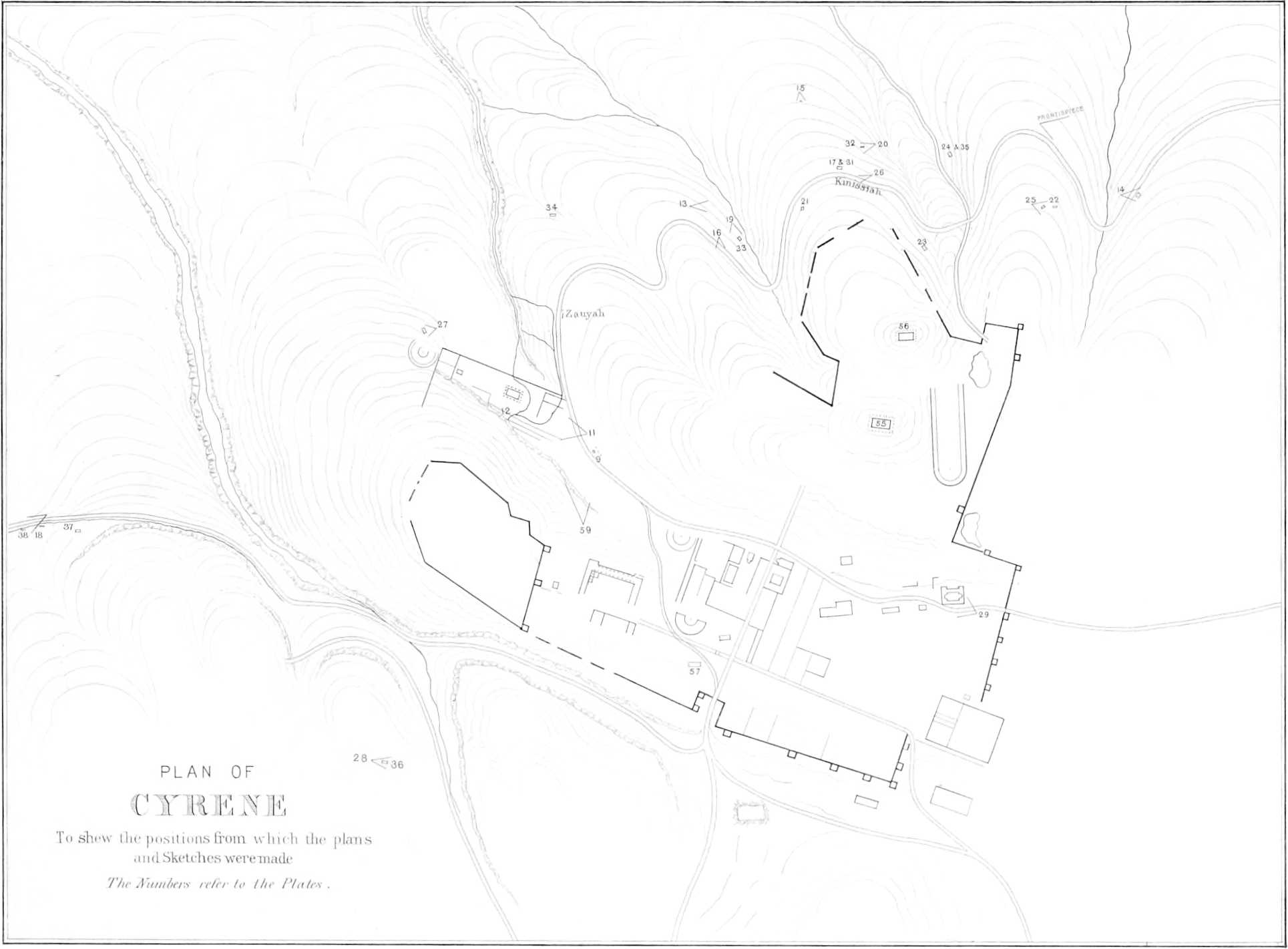
Day & Son, Lithrs. to the Queen
On the 31st of the month we commenced the excavation of the building in front of the fountain, marked on the plan “Temple of Apollo.” Although the form of the building could be easily traced, very little of it remained above ground. We began by clearing out, down to the level of the pavement, the space between the columns and the wall of the cella along the western and northern sides, on both of which we found parts of the columns in situ and fragments of the entablature, all of the Doric order. The stone was the same as that of the Temple of Bacchus. The building is particularly mentioned by Beechey, who supposed it to be the Temple of Diana. We were inclined, however, from the first to consider it the Temple of Apollo, on account of its commanding position immediately in front of the fountain; and our opinion was confirmed before we commenced its excavation, by finding two inscriptions among the ruins, both of which referred to that deity.
Our space for digging was very limited, all the surrounding ground, and even the eastern half of the temple itself, being covered with crops of grain. We would, willingly have bought them up, but found it impossible to do so, owing to the strong religious feeling of the Arabs, who regard the fruits of the soil as the immediate gift of God, and would resent their destruction as an act of sacrilege. The soil, once it has received the seed, becomes sacred, and can no more be desecrated by the excavator than a Greek church or a Turkish burial-ground.
After digging along the west and north sides as far as we could for the crops, we commenced inside the cella, at the north-west corner. Cramped as we were for want of space, we were obliged to throw the deblai, as we proceeded, into the trench we had already excavated outside. The first object we found was a small draped female statue, unbroken, about 3 feet 6 inches in height. A few days afterwards we discovered a colossal statue of Apollo himself, lying on the floor of the temple, about ten feet below the surface of the ground. The head was broken off, and the body in three pieces; but as the fractures were clean and sharp, and their edges unchipped, we hoped that the whole figure might afterwards be put together without difficulty. When this was actually done, after the arrival of the sculptures in England, the parts were all found to fit each other so accurately that the fractures were barely perceptible. The trunk of the tree, the lyre, the serpent, the bow and quiver, and some of the folds of the drapery, were found piecemeal, in a great many fragments, which we collected carefully. The statue, as it now stands, without the slightest restoration, in the British Museum, is built up of no less than 121 separate pieces. A Photograph of it is given in Plate 62. Near it was a large square pedestal on which it had once stood.
Its removal to our tomb proved a most tedious and difficult operation, on account not only of the great weight of each of the three parts, and the depth at which they were discovered, but also of the very tender way in which they had to be handled to prevent the thin sharp edges of the fractures from being chipped and bruised. Our troubles were increased by the conduct of the blacks, who thought this a favourable opportunity for advancing the most extravagant claims for remuneration. Some ridiculous notions had been put into their heads by the Arabs, during our absence for a few days at Derna. All our appeals and offers of a compromise were rejected; and as we would not yield to their absurd pretensions, they went off, and left us to get the Apollo to our tomb without them. As this was impossible, we were reduced to the necessity of reburying the statue to protect it from the Arabs. Our good fortune, however, had not deserted us. Two days afterwards, three negroes, sent by Mr. Crowe, arrived from Benghazi, and we were enabled[42] to resume work. With their assistance and that of some of our Arab friends, we deposited the Apollo in safety in our tomb, after several days’ very hard work. The sledge was used as before, and a camel yoked in to help us to drag it. On the former occasion, when the road was pretty smooth, and for the most part down-hill, the camel did very well; now, however, the road was rough and all up-hill, and as the camel, although an excellent beast of burden, was quite unaccustomed to pulling, he would do nothing when he found he could not walk away with the load easily. We had, consequently, to unyoke him, and drag the sledge, foot by foot, ourselves.
Our new labourers, with whom the work of instruction had, of course, to be recommenced, remained till the 20th of April, when they had to leave us for harvest-work at Benghazi. We then tried some Arabs, but were soon glad to get rid of them, as they gave us a great deal of trouble and did very little work. By this time, however, we had completed the excavation of the temple, nearly as far as our space allowed. We accordingly proposed to spend a few weeks in making excursions to different parts of the country, and to resume operations at Cyrene after the end of the harvest.
It was evident from the first that many of the ruins at the Temple of Apollo were of much later date than the building itself. The Cella was full of rubble walls and arches, roughly built of the materials of the more ancient building; and the eastern half was paved with coarse mosaic, about nine feet above the original floor of the temple, and, consequently, only two or three below the surface of the ground. Under this pavement there was a horizontal layer of broken columns resting on others which stood in rows on the floor of the temple.
Near the middle of the Cella, a draped male statue, about seven feet in height, but broken in two, was found lying on the tesselated pavement (Plate 63). The head, which was of a separate piece from the body, from which it could be removed at pleasure, fitted into a socket,—a somewhat barbarous expedient for making the statue of a deceased emperor do duty as his living successor’s, after the simple change of the head and the name. Close to the statue we found a broken marble pedestal, on which the following fragment of an inscription could be deciphered.
It may be presumed from this inscription that the statue represents the Emperor Hadrian. We also found on this spot a large marble slab, on which was the inscription, No. 26. We removed it to our tomb, like the others, by means of the sledge. Imbedded in the earth, between the feet of the statue, we found a head of Minerva, rather smaller than life, quite uninjured, with the single exception of the point of the helmet, which was a little broken. (See Plate 64.)
In the same part of the temple as the Apollo, that is, in the western half of the Cella, we found a head life-size, identified by an inscription as the portrait of Cnæus Cornelius Lentulus Marcellinus, the first Roman proprætor of Cyrene. (See Plate 65.) The inscription (No. 1) was cut on the face of a square block of marble, on which stood a square pedestal, 10 inches broad and 5 feet high, having at the top a deep socket, into which the head was fitted. The back of the head was cut flat, as if it had rested against a wall.
As our workmen had all left, we were unable at this time to complete the excavation of the interior of the Cella. The whole of the eastern half, between the mosaic pavement and the floor, we had to leave untouched, until the month of August. One of the most remarkable things which we then discovered was a bronze portrait head, in an excellent state of preservation (Plate 66), lying on the original floor of the temple, 11 feet beneath the mosaic pavement. Near it were some small bronze fragments of horses, &c., very much injured, as if by fire; several terra-cotta[43] lamps, and a quantity of fragments of gold-leaf mixed up with the earth. We also discovered several marble heads of different sizes, a number of inscriptions, eight small statues, varying from 2½ to 4 feet in height, and part of a leg of a colossal statue of very fine style. Of the small statues the most remarkable were a figure of Jupiter Ammon, a group representing the nymph Cyrene strangling a lion, and a huntress, probably Diana Venatrix, accompanied by a dog.
The temple was of the usual form and construction, although it might be remarked that its length was somewhat great in proportion to its breadth, and that the entrance was not in the west but in the east front. In these two respects, however, we found all the temples of Cyrene which we examined, alike. The entrance being in this position, the statue of the deity must have been placed at the west end facing the east, contrary to the following recommendation of Vitruvius: “The temples of the gods should be so placed that the statue, which has its station in the Cella, should, if there be nothing to interfere with such a disposition, face the west, in order that those who come to make oblations and offer sacrifices, may face the east when their view is directed toward the statue; and those who come to impose upon themselves the performance of vows, may have the temple and the east immediately before them. Thus the statue they regard will appear as if rising from the east and looking down on the suppliants.”[3]
[44]CHAPTER VIII.
WHEN our workmen left us, and the excavations were stopped in the end of April, we had a considerable collection of valuable sculptures in our tomb, but were still uncertain whether we should be furnished by the Government with the means of sending them home. To determine the best method of conveying them to the shore, should the means of doing so be granted, we had carefully examined the country between Cyrene and the coast. The greatest difficulty to be overcome was the descent of the Augubah, or lower range of precipitous hills near the sea, to which our attention was, therefore, specially directed. We soon found, however, that little or no choice was left us, the only practicable pass near Cyrene being on the track of the ancient road to Apollonia, now called Marsa Sousah. It was evident that the transport of the statues over such a road would be a work of great labour and considerable difficulty; but, at the same time, we thought it quite a feasible undertaking. We accordingly sent a report of our proceedings to Lord Russell as early as the month of February, soon after the discovery of the Bacchus, and enclosed a detail of the means we considered best adapted for the carriage of that statue and such others as might afterwards be found. His lordship readily granted the required means, and, at his request, a man-of-war, with all the stores and appliances we had suggested, was ordered to proceed to Marsa Sousah to embark the sculptures. Owing, however, to the want of communication with Europe, we did not receive the reply to our report until after the actual arrival of the vessel in the month of May. About the same time a letter reached us from Mr. Panizzi, principal Librarian of the British Museum, informing us that the Trustees had voted us a subsidy of £100 towards defraying the expenses of the expedition.
H.M.S. Assurance, Commander C. M. Aynsley, arrived off Marsa Sousah on the 10th of May, but finding a strong breeze blowing towards the shore from the north-west, she steamed on about fifteen miles to the eastward, and anchored in a more sheltered position behind Ras El Hilal. As the fact of our being at Cyrene was by this time well known throughout the country, the officers of the Assurance had no difficulty in finding an Arab to whom they could make themselves understood, and who was forthwith despatched with a letter to inform us of their arrival. After walking all night he reached our quarters early in the morning. As we had hitherto received no letters from England, we were most agreeably surprised by the good news he brought us, and gave him an unusually liberal backshish in consequence. Independently of the encouragement and assistance given us by the arrival of the vessel, we were, of course, delighted with the prospect of seeing some of our own friends and countrymen after our solitary residence of five months among negroes and Bedouins. We immediately saddled our horses and started for Ras El Hilal without delay, accompanied by the Arab who brought the letter, and by our friend Amor Bon Abdi Seyat and his brother. Great part of the road along the shore from Marsa Sousah was over sharp rocks and across deep rugged wadys, so that it was with difficulty that we reached Ras El Hilal after an eight hours’ ride. We there found some of the officers on shore shooting, with whom we went on board for the night, leaving our horses in charge of Amor and his brother.
Ras El Hilal, behind which the Assurance was anchored, is the site of the ancient Naustathmus, of which almost no remains are now to be seen.
The following morning, May 12th, the wind having moderated, the vessel steamed round to[45] Marsa Sousah, and anchored about half a mile from the shore. A party of thirty blue jackets and marines, who were all that could be spared from the ship, were immediately landed, under the command of Lieutenant Luard, R.N., and encamped on the beach. The waggons and stores of all sorts were then disembarked, and two ship’s carpenters sent to Cyrene to make packing-cases for the marbles. Amor and his friends meanwhile scoured the country in all directions to get camels to carry the plank and stores up to Cyrene, but had considerable difficulty in finding a sufficient number, as the Arabs were all at work getting in their harvest. After two days’ delay we at last got about a dozen collected at the camp on the beach. Besides those required for the carriage of the planks and stores to Cyrene, a number of camels were wanted to accompany the working party with the waggons to carry the sailors’ tents and baggage, and keep them supplied with water. An arrangement was accordingly made with the drivers, by which we agreed to pay a certain sum per trip for each camel carrying a load to Cyrene, and a certain sum per diem for each camel that remained with the waggon party. The tents and baggage were consequently placed in one heap, and the stores for Cyrene in another, the drivers being allowed to distribute the work among themselves as they pleased. The usual tiresome wrangling over the division of the loads ensued, as a matter of course, and on this occasion it lasted all day. Towards evening the different burdens were at last adjusted, and the camels loaded. We congratulated ourselves that we were now on the point of effecting a start, when the owners of the camels that were loaded with the sailors’ baggage changed their minds, and said they would either go up to Cyrene or not go at all. Argument and expostulation were in vain; they coolly unloaded the camels and took their departure. We were accordingly obliged to pitch our tents again for the night, and remain where we were as patiently as possible.
Next day we fortunately met our friend Mohammed El Adouly, who undertook to supply us with a sufficient number of camels, and to superintend the drivers himself. We were thus saved a great deal of trouble and delay, as he carried out his contract to our entire satisfaction.
We started from Marsa Sousah with the two waggons on the 14th, and reached the foot of the Augubah the same night. Next morning we dragged the waggons one at a time up the slope of the hill, until further progress became impossible. The only way of getting them to the top was by unscrewing all the connecting bolts, and carrying the separate pieces on the men’s shoulders. Owing to the steepness of the narrow rocky path, and the weight of the wheels and many of the other pieces, this was a work of great labour; but the sailors had made up their minds that it must be done, and they did it accordingly. It was only after three days’ incessant toil that they got everything to the top, when the waggons were again put together, and the journey resumed in the usual way. Our progress, however, was slow; as, throughout a great part of the way, a road had to be cleared and made before it was possible to get the waggons dragged along. Except at one or two places, the party was barely strong enough to drag one waggon at a time, although our numbers were by this time increased by the arrival of seven blacks from Benghazi.
Our usual method of proceeding was as follows:—We got up at daybreak, had breakfast, and started with the waggons before sunrise. We remained at work till eight or nine o’clock, when the party returned to the camp and rested till about three in the afternoon, when the tents were struck and packed with the baggage on the camels. From the distance traversed in the morning, it was easy to foresee what point would be reached before night. A convenient place for encampment was therefore chosen after the morning’s work, and two or three men were sent on with the baggage in the afternoon, to pitch the tents and cook the men’s supper, before their arrival with the waggons at sunset. The men worked most cheerfully, and seemed quite to enjoy the change from shipboard. After supper, their great amusement was to build large bonfires all round the camp,[46] for the purpose, as they said, of keeping off the wild beasts. Even after their hard day’s work, they used to sit round the fires telling stories and singing songs till far into the night, much to the wonder of the Arabs and negroes who were in the camp.
Meantime the carpenters had packed the statues, so that on our arrival at Cyrene on the 24th, the loads for the waggons were ready. On one waggon we placed the Bacchus and the largest of the small statues, and on the other the Apollo in three cases. The smaller objects, such as heads, statuettes, &c., were packed in small boxes to be carried by camels. We were obliged to leave three of the largest of the small figures, and also the statue of Hadrian, as there was no room for them in the waggons, and they were too heavy for the camels.
We started from Cyrene on the morning of the 29th, and, taking only one waggon at a time, reached the plain at the base of the hills the same night. The five following days were spent in crossing the lower plateau to the top of the Augubah, where we arrived on the 3rd of June. The wheels of the waggons were by this time considerably shaken by the heavy jolting over rocks and stones, but still remained unbroken.
We had now to face our chief difficulty, the descent of the Augubah. After considering every possible way in which it could be done, we decided on lowering the waggons straight down the face of the hill by means of tackle. The least rugged part of the hill being selected, our first care was to provide the means of making fast the lowering tackle, which was done by placing heavy boat’s anchors in holes cut for the purpose in the rock. The front axle of the waggon was then lashed to the body of the carriage to prevent the fore wheels from getting locked against the sides of the waggon, and thereby upsetting it. A tackle, consisting of a 3½-inch rope, rove through two double blocks, was then made fast to the anchors, and to the centre of the fore axle, and the waggon lowered slowly, hind wheels foremost. About one-third of the way down, there was a nearly level ledge or terrace, forming part of the ancient road to Apollonia, which served as a convenient halting-place from which to make a fresh start. To reach this point, however, the waggons, as they were being lowered, had to be guided in a slanting direction across the face of the hill, which was safely done with the first waggon by means of handspikes. Not content to “let well alone,” we unfortunately thought to improve upon this simple method in the lowering of the other one. In addition to the anchors already in position, another was placed some distance to the right, and directly above the part of the terrace to which the waggons had to be taken. After the waggon had been lowered to a convenient place, the standing part of the tackle was to be transferred from the first anchor to the second one, thereby causing the waggon, when the lowering was continued, to slant across to the right until it was directly under the second anchor, to which the whole tackle was then to be transferred, and the waggon lowered straight down to the halting-place on the terrace. It was, in fact, an application of the principle of the whip used for taking weights over a ship’s side. Unfortunately, the second anchor was not properly placed in the hole made for it. The petty officer sent to look after it, instead of letting it remain as we had left it, thought he had improved its hold by placing it horizontally in a cleft of the rock, so as to act not as an anchor, but as what is called a toggle. The result was, that whenever it felt the indirect strain of the slanting motion of the waggon, it at once tilted up and lost its hold. To our horror, away went the waggon at a tremendous pace, and the anchor after it almost flying. For a second or two the destruction of the waggon and the Apollo seemed inevitable, as it was heading straight for a precipice two or three hundred feet in height, when, to our relief, it gave a great bound, and landed itself in a large cavity in the rock. Strange to say, not even a spoke of a wheel was broken. With considerable difficulty we got it out of its lodgment, and along the terrace to the part selected as the starting-point for the further lowering to the bottom of the hill. Here the face of the hill presented a continuous slope, about[47] 400 yards in length, and so steep that it was impossible to climb it at some parts, except on hands and feet. All the ropes the ship could afford were spliced to make a tackle of sufficient length. The anchors were again placed in holes cut in the rock, and the fore axles of the waggons lashed as before. The great danger to be avoided was the serging of the waggon, caused by the elasticity of such a length of tackle. To prevent this, a few men with handspikes went with the waggon to keep it moving as uniformly as the nature of the ground would admit. Both waggons reached the bottom without accident, and were saluted on their arrival there by three hearty cheers from the whole party.
The following day the Assurance anchored abreast of the Augubah, and the waggons were dragged to the beach, where a triangle was set up in water deep enough for a loaded boat. The waggons were then run under it, and the cases, one by one, weighed and lowered into the ship’s boats. On the same day, Mohammed El Adouly’s camels brought down the last of the smaller cases; so that before night everything was on board.
For the success of all the operations connected with the transport and embarkation of the statues we were greatly indebted to Captain Aynsley, the officers, and crew of the Assurance, and particularly to Lieutenant Luard and the working party under his command. He was himself indefatigable in his exertions to get the work carried on, and his orders were most cheerfully obeyed by the men, whose “pluck” and determination overcame every obstacle.
Early the following morning, the 8th of June, the Assurance left for Malta, and we returned to our solitary residence at Cyrene.
[48]CHAPTER IX.
BEFORE resuming the narrative of our excavations, we may here give some account of our dealings with the Arabs, and of the excursions which we made to different parts of the Cyrenaica before the arrival of the Assurance.
Not long after our arrival at Cyrene we had a specimen of the kind of difficulties we were likely to meet with not unfrequently. Walking one day round the face of the hill opposite the fountain, we were met by an Arab who, in very expressive language, ordered us to turn and leave the place at once. For some time we could not exactly make out what had so stirred up his indignation, but afterwards found that it was our presence within the limits of the Zauyah. Thinking the Zauyah was probably one of the tombs converted into a mosque, we told him we had no wish to desecrate it, and asked him to show us where it was, that we might avoid it in future. To our astonishment, the boundary he pointed out included the whole side of a hill, which formed one of the most interesting parts of the north-eastern cemetery. To give up the right of visiting so large a portion of the necropolis was out of the question, especially as submission on our part would only encourage the Achwan, or devotees of the Zauyah, to further acts of aggression. We therefore determined to contest the point, which we did by walking within the proscribed boundary nearly every day. Several threatening messages reached us from the Sheikh of the Zauyah, who, professing himself our friend, said he could not control the rage of the Arabs if we continued to pollute the sacred enclosure by our presence. This Sheikh, Mustapha by name, was considered one of the greatest saints in the country, and was respected and feared accordingly. He was always called Sidi Mustapha, a title bestowed upon Marabouts, or holy men, and equivalent to Rabbi—my lord or master. Originally one of the greatest thieves in Mesurata, he had suddenly become intensely religious, and joined the fanatical sect of El Senoussy during the late revival of Mussulman bigotry. He, with others, had left Mesurata, and travelled about the country trying to stir up a crusade against the Christians. He was now settled down as the Sheikh of the Zauyah of Shahat.
Matters continued in this unsatisfactory state for nearly a month, till one day, when we were walking along the forbidden path, an Arab sallied forth from a tomb above us and began pelting us with stones. He was immediately joined by others from different directions, all in the highest state of excitement. Some of the more indignant were for shooting us at once, and one man had actually levelled his gun, but was prevented from firing by some of his cooler friends. Meantime such a number of Arabs had assembled that it would have been foolishness for us to attempt going farther. Sidi Mustapha, by whom the whole thing had evidently been planned, now appeared on the scene, and pretended to try and pacify the enraged crowd. After several unsuccessful efforts, turning to us, he said, “You see it is just as I told you; and if this goes on, I shall not be able to prevent their shooting you, if you remain at Cyrene at all.” We had, of course, to retire, but told his lordship that we had come to Cyrene for a special purpose, and had no intention of leaving until that was accomplished. Moreover, that we would see that the two men who had thrown stones and threatened to shoot us were duly punished for their offence.
Shortly before this time a tent and some other articles had been stolen from our tomb,[49] and although the Arabs must have known well enough who the thieves were, we could find no trace of our lost property. We therefore determined to test the value of our firman, by requesting the Mudir of Ghegheb to punish the two Achwani of the Zauyah, and to compel the tribe near Cyrene to deliver up the thief, our object in doing so being, if possible, to show the Arabs that we were not to be offended with impunity. Porcher and Cesareo accordingly went the day after the disturbance to the castle of Ghegheb, were they saw the Mudir, Lemin Ben Sitewi, an old Arab, who had been Mudir under the Karamanlis before the occupation of the country by the Turks. When he saw the firman, and was informed of the object of the visit, he promised that everything should be done at once to our satisfaction. The two Achwani should be apprehended and kept in prison at Ghegheb until he had communicated with the Pacha at Benghazi, and our lost property should either be immediately restored, or the tribe mulcted of its value, which was estimated at 3,000 piastres (£24). He said he had no doubt that the thief, and probably one of the principal intriguers against us, was a neighbour of our own, Mabrook Jerébi, who was, therefore, to be immediately apprehended.
So far as promises went, all this was satisfactory enough; but performance, as usual, was quite the reverse. In conducting business of any kind with officials in Turkey, there is never the slightest difficulty in making the preliminary arrangements and stipulations. During an interview everything is settled exactly as you wish, and you come away impressed with the idea that you have managed your business very cleverly, and that the authorities in Turkey are, after all, not half so bad as they are called. You soon discover, however, that here your real difficulties begin. If what is promised is ever actually performed, it is only after the most vexatious shuffling and delay, for which plausible excuses are never wanting. A Turkish official seems to reason with himself somewhat in this way:—“I do not wish to disturb my peace of mind by arguing with this man; I must, therefore, promise everything he wishes, reserving the question of performance for private consideration afterwards. Should he afterwards be so exacting as to insist on the fulfilment of my promises, I am quite unfit for my post if I cannot coin sufficient excuses to satisfy him. A judicious repetition of the promises, and the partial performance now and then of some of them, will keep matters all right for a time, and, meanwhile, ‘something may turn up.’ Should the worst come to the worst, I shall, after all, have to do no more than I promised at the first.”
Such is the almost invariable method of conducting business; so that, in proportion as a man becomes an adept in the art of delay, his reputation as a clever administrator increases. The Turks, and I believe Easterns in general, pride themselves on their superiority to Europeans in this kind of sharpness. Hence a common saying among them, “Frangestan marafat, lakin Arabestan akl,” “Europe for talent, but the East for cleverness,” the force of the word lakin showing the higher esteem in which the akl is held. We are, perhaps, too apt in this country to sacrifice the suaviter in modo to the fortiter in re, but in Turkey the tendency is quite the reverse.
The above was thoroughly exemplified in our dealings with Lemin Ben Sitewi. The day after Porcher’s interview, Lemin’s Kiayah, or Secretary, with a number of mounted Koralié, came to Cyrene for the ostensible purpose of carrying out the orders for the apprehension of the offenders. They took Mabrook Jerébi, whom we had never accused, but said they could not get the two Achwani as they did not know their names. When we gave them the names, they went again to the Zauyah, but returned immediately, saying the men were gone away and could not be found. On our saying that this was not the case, as we had seen them only a few hours before, they said that the fact was that both the men were the servants of Sidi Mustapha and could not be taken without his consent, which it was impossible to obtain that day, as he was from home. On his return, however, which was expected the following day, they would come again to Shahat and apprehend the men without fail. Seeing the way in which the matter was likely to end if left[50] in the hands of the Mudir, we told the Kiayah to inform his master that if the men were not taken within three days, we would communicate the whole of the affair through the Consul to the Pacha at Benghazi.
After waiting some days, and hearing no further tidings of the actions of the Mudir, we sent a courier to Benghazi with a letter to Mr. Crowe, in which we gave a full account of the matters as they stood, and requested him to take whatever steps he thought advisable. He at once called on the Kaimacam and insisted on his sending the most stringent orders to the Mudir to have the men apprehended and sent to Benghazi. A messenger was accordingly sent to Ghegheb with orders to the Mudir to go himself to Cyrene without delay and seize the men. After bringing them before us for identification, he was to send them to Benghazi to be dealt with by the Kaimacam himself. He was also to pay us the 3,000 piastres and levy the amount on the tribe guilty of the theft.
In consequence of these orders, Lemin made his appearance at our quarters one morning accompanied by a large retinue of Sheiks, Chavasses, and Koralié. After informing us of the object of his visit, he handed over to us 1,500 piastres, alleging the emptiness of the public chest as his reason for not bringing the whole sum. He also said that the two men had been sent for and would be brought before us in the course of an hour or two. Expecting further difficulties and excuses, we were certainly somewhat surprised by the actual arrival of the prisoners, who, however, seemed unaccountably cool and unconcerned. This the Mudir explained by whispering to us that they were not aware of the object for which he had called them, but had come with the idea that they were only to make an apology for their conduct and depart in peace. He even received them with a gracious “Salaam Aleikoum,” and bade them be seated. After a short pause he turned to us and asked if these were the men of whom we complained. When we said that they were, he called out “Bring the ropes.” The Chavasses immediately ran in and with a great pretence of activity and violence disarmed and pinioned the prisoners. They were then led off ignominiously by the mounted attendants, who, to make escape impossible, held them by long ropes attached to their pinions. They were followed by the Mudir and his retinue, the whole cavalcade moving off in the presence of a large concourse of Arabs who had meantime assembled round our tomb. The whole scene was quite dramatic.
We soon discovered that the drama had been rehearsed with a view to its effect, not on the assembled Arabs, but on ourselves. Within a week we heard that the prisoners were again at liberty, having, according to the Mudir, slipped their shackles in a miraculous manner, and escaped during the night when on their way to Benghazi. This feat, however, lost all its supernatural character in our eyes, when looked upon in connection with the purse of dollars previously subscribed by the Arabs and given to the Mudir. His superior cleverness on this occasion cost him dear, for on our again applying to Mr. Crowe, he was deprived of office and sent as a prisoner to Tripoli, whence he was not allowed to return to Benghazi until all his money had found its way into the coffers of the Pacha. Thus after two months’ delay, our dignity was finally and publicly vindicated.
About the same time the Kaimacam sent his Bash-Chavass, or head policeman, Osman Aga, to Cyrene, to remain with us as long as we thought his presence desirable, and to keep a good look-out on the doings of the Achwani of the Zauyah. Long before his arrival, however, Sidi Mustapha, seeing the turn affairs were taking, went off to Augila, and did not return until he heard of the coming of the Assurance, in which he thought we would take our departure. Although the Achwani committed no open act of hostility towards us, they caused us a great deal of trouble indirectly, by interfering with our servants. Our principal servant, Amor Bon Abdi Seyat, was bound to us by too secure a tenure to be much affected by their opinions, as he not only received liberal and frequent bakshish, but was, with his whole family, exempted[51] from the payment of the miri, or tribute, so long as he remained in our employment. Some of the other servants, however, the Achwani threatened with their vengeance if they remained longer in our service. They were particularly bitter against an old woman, Fatima, who ground the corn and made the bread of the establishment. Her services were absolutely indispensable, inasmuch as an Arab, or even a negro, would rather eat raw corn or starve than grind the wheat or barley himself. Of all employments, this of grinding corn is peculiarly a woman’s, and is never done even by boys. On the other hand, the sewing and washing of both men’s and women’s clothes are done by the men. Fatima’s office of Nufaga being, therefore one of the most important in our household, the Achwani made special efforts to deprive us of her services, telling her that they would cut her hands off after we were gone if she remained another day with us. They even went beyond threats, for one day when she was at the Zauyah for something or other, they got hold of her and gave her a beating. As this was a more tangible offence than mere threats, we put in force against them a law of retaliation recognized by the Arabs, by which they were compelled to pay old Fatima the sum of twenty-five dollars.
With these exceptions our intercourse with the Arabs was usually of a friendly nature. During the first two months of our stay at Cyrene, we were greatly indebted to Mr. Cesareo, whose knowledge of the language and acquaintance with the habits of the people were of the greatest service. He left us to return to Benghazi, in the beginning of March, after which time we had to transact our business with the Arabs in the best way we could without assistance. Our transactions consisted chiefly in making bargains for barley, wheat, butter, sheep, and bullocks. Concluding a bargain was always a very tedious affair, and seeing it properly carried out afterwards was much more so. One great cause of this was the absence of any definite standard of measurement; the only measure of capacity for both solids and liquids being the wugga, or oke, which, however, was little more than a name, the wugga of one Arab being sometimes half as much again as that of another. This, of course, caused endless disputes; and as we found the oke daily becoming “small by degrees and beautifully less,” we were obliged at last to adopt an arbitrary wugga of our own. When this, after long opposition, was fairly established, we were saved a great part of the previous trouble and annoyance.
The public disgrace of the Mudir had a very salutary effect on the Arabs, and was, no doubt, one of the principal causes of their general good behaviour toward us afterwards. Another was that they had gradually become accustomed to our presence, and were less hostile in proportion as we became better acquainted with each other. The tribes we met in other parts of the country, and those from the southward, who came to the neighbourhood of Cyrene late in the summer, took no pains to hide their great hatred of the Nazarenes. The following is an instance of this feeling. Some Arabs who were assembled in our tomb, were talking about a report that had reached us of a violent earthquake in Malta and Sicily, by which many thousand people had perished. One of the Arabs present, on being told, in answer to a question, that all these people were Christians, muttered in a low, expressive tone: “El Hamdu ’lillah!” (Praise be to God!)
We gained considerable influence by our reputed skill as doctors, although we disclaimed any pretensions to a knowledge of the healing art. People came with diseases of every kind, in the expectation that they were at once to be cured. Knowing nothing of the nature or causes of disease, they look upon it as a supernatural visitation, and therefore conclude that it is only to be abated or cured by supernatural means, of which medicine and written charms (kiteeba) are the most effectual. The latter, being altogether mysterious, are held in the highest esteem. Owing to the ignorance of the people, the few among them who can read and write are looked upon with a respect somewhat allied to fear; and if, in addition to the accomplishments of reading and writing, a man has the reputation of being a marabut, or saint, he is treated with the greatest reverence.[52] Such men are called fikkis, and not unusually turn their reputation to good account by selling written charms to their credulous clients. As we were often seen reading and writing, the Arabs became fully convinced that we must be great fikkis, although, as Christians, we could not have derived our power from the proper quarter. Applications for kiteebas were, therefore, very frequent, not only in cases of sickness, but also for the remedy of all sorts of domestic troubles and grievances. A woman, for instance, came for a kiteeba to enable her to retain the undivided affections of her husband, and thereby restrain him from taking another wife. A man whose hopes of marrying the object of his affections had been frustrated by the enmity of her relations, wanted one to overcome their opposition and secure the success of his suit. One young lady begged for a kiteeba that would get her a husband, and another asked for one to prevent her being married to a man she disliked. In vain we tried to persuade the people that charms were valueless, and that the idea of their efficacy was kept up by the fikkis solely for their own advantage. The belief in their power was too deeply rooted to be shaken by anything we could say, and our unwillingness to write them was attributed to mere churlishness. This being the case, we were often obliged to act as sorcerers to get rid of importunate applicants. In giving a kiteeba, we took care at the same time to recommend the use of such natural means as we thought most conducive to the desired result, and enforced our advice by saying, that the kiteeba was so written that it could have no effect if the means recommended were not adopted. If the desired result was obtained, the success was, of course, ascribed to the virtue of the charm; and if not, the failure was attributed to a final cause,—it was mektub, written as the will of God in the Book of Fate.
The wandering habits of the Bedouins are a necessary result of the form of their property and of the physical condition of the country in which they live. As the various tribes are in a perpetual state of feud or open war among themselves, agriculture is but little attended to, and property consists almost entirely of flocks and herds, which, being moveable, are better adapted than crops to a lawless state of society. For mutual protection, a number of families belonging to the same clan or subdivision of a tribe live together and form an encampment, which consists generally of from six to twelve tents, with one family in each. The flocks belonging to the camp graze on the surrounding pastures, and, during summer, drink the water that remains in the pools which form during the rains in winter. In a short time the grass and water within a convenient distance of the camp are consumed, and it becomes necessary to move to another place. The tents are then struck, and, with the smaller children and the few rude articles that belong to the household, are carried by camels and oxen; the men mount their horses, and the women follow on foot to drive the flocks.
In fixing on a spot for a camp, two points have to be attended to; good grazing-ground for the animals, and a sheltered and secluded position for the tents. On this account a thicket of brushwood is frequently selected, in the centre of which a space is cleared for the camp, and enclosed by a rough fence of shrubs and branches, which keeps in the cattle during the night, and serves to a great extent as a line of defence, as it is impossible to pass it without attracting the attention of the numerous watch-dogs on duty inside.
These dogs bark all night without intermission, and give warning of the approach of a stranger by a special howl of peculiar fierceness. One would naturally imagine that a dog given to perpetual barking, and in this respect like the boy in the fable who cried “wolf,” would be of comparatively little value as a watch. The Arabs, however, think otherwise. They say truly that if a dog barks all night he cannot possibly fall asleep, and that the change in his bark on the approach of an intruder is quite sufficient to arouse the soundest sleeper. His usual bark is a warning to the enemy that the sentries within the camp are awake, and to his master it is a perpetual report of “all’s well.” The hoarse voices of the dogs, the plaintive grumbling of the[53] camels, and the bleating of scores of lambs and kids, joining with the shrill cries of the surrounding jackals, form a midnight chorus the reverse of musical.
The flocks are generally tended by the young men and the children, while the women are chiefly employed in grinding the barley for the use of the family, churning butter, and weaving haircloth for tents and camel-bags. In good years, that is, when there has been plenty of rain in winter and spring, there is a considerable surplus of wheat and barley, which the Arabs take for sale to Benghazi and Derna. Such, however, is their improvidence, that little or no provision is made against a season of drought, so that they are not unfrequently reduced to poverty and starvation by the death of their cattle and the failure of the crops. In ordinary years, a large quantity of butter is made. The only churn in use is simply a goat-skin, which the women fill with milk and rock backwards and forwards on their knees until the butter forms. The buttermilk, called Leben, is one of the principal articles of food. The butter (Zibda) when made, is melted in a pot, and salt added in certain proportion. The curd part of the butter having sunk to the bottom, the oily part is poured off into goat-skins prepared for the purpose. This clarified butter, called Semen, is the only form in which it is eaten by the Arabs, the Zibda being considered unclean. It is exported in large quantities to different parts of Turkey.
The dish in most general use among the Arabs is a thick kind of barley porridge called Bazeen, seasoned with whatever they happen to have at the time. The favourite condiment, however, is red pepper of capsicums, which they consume in astonishing quantities when they have an opportunity. When they wish to be luxurious, or to do honour to a stranger, some melted Semen is poured into the middle of the dish, and in this each guest dips the bolus of bazeen which he has kneaded with his fingers into convenient size and shape for swallowing. When the dish, or rather trough, is cleared, copious draughts of leben finish the repast.
A kind of unleavened bread is sometimes eaten, but as its preparation is not so simple as the Bazeen, it is considered rather a luxury. It is made in the following manner:—A large fire is kindled, and into it are thrown a number of stones about the size of the fist; when they are thoroughly heated, some of them are laid on the embers so as to form a flat surface, on which the dough is placed and beaten out with the hand to an average thickness of about an inch and a half. This cake is then covered with the rest of the stones, and the red embers of the fire are raked over the whole. In a few minutes the bread is cooked, and is eaten at once before it cools. It is usually torn into small pieces, and served up in a bazeen-dish with melted semen, in which form it is called Hobsa Mitruda.
Wheaten bread is very rarely eaten; but the mode of baking it deserves notice. A large wide-mouthed earthen pot, called Taboona, is placed on the ground, and a fire kindled inside and around it. The dough is kneaded in the usual manner in a wooden dish, and formed into flat round loaves about three-quarters of an inch in thickness, and six or eight inches in diameter. The Nufaga taking one of these in her hand, sticks it against the inside of the taboona, to which it adheres until it is baked. Bread made in this way is called Hobsa Taboona, and if carefully baked and quite fresh is very palatable.
Meat is never eaten except on such great occasions as a marriage feast, or when it can be got for nothing. On such occasions it is devoured alone without either salt or bread. Tea, coffee, and sugar, are all but unknown.
The tents are of very simple construction, consisting simply of a broad piece of haircloth stretched over two upright poles. The two ends and the back are usually pegged down pretty close to the ground, and the front left open. The cloth is generally made up of alternate strips of black and white or black and brown. The cords, as well as the cloth, are made of hair. The tents contain nothing but the most indispensable articles; such as water-skins, butter-skins, camel-bags,[54] a hand mill, wooden bazeen-dishes, &c. The beds, if there are any, are simply bits of haircloth or matting spread on the floor, and the barracans, or Jered, worn by day are the only bedclothes during the night. When the weather is very cold, the Arabs have rather an ingenious way of keeping themselves warm. They dig a space under their beds about six inches in depth, and fill it up with stones that have been heated in the fire, over which they spread some twigs and leaves, and the mat on which they sleep. By this arrangement the beds are kept warm for several hours.
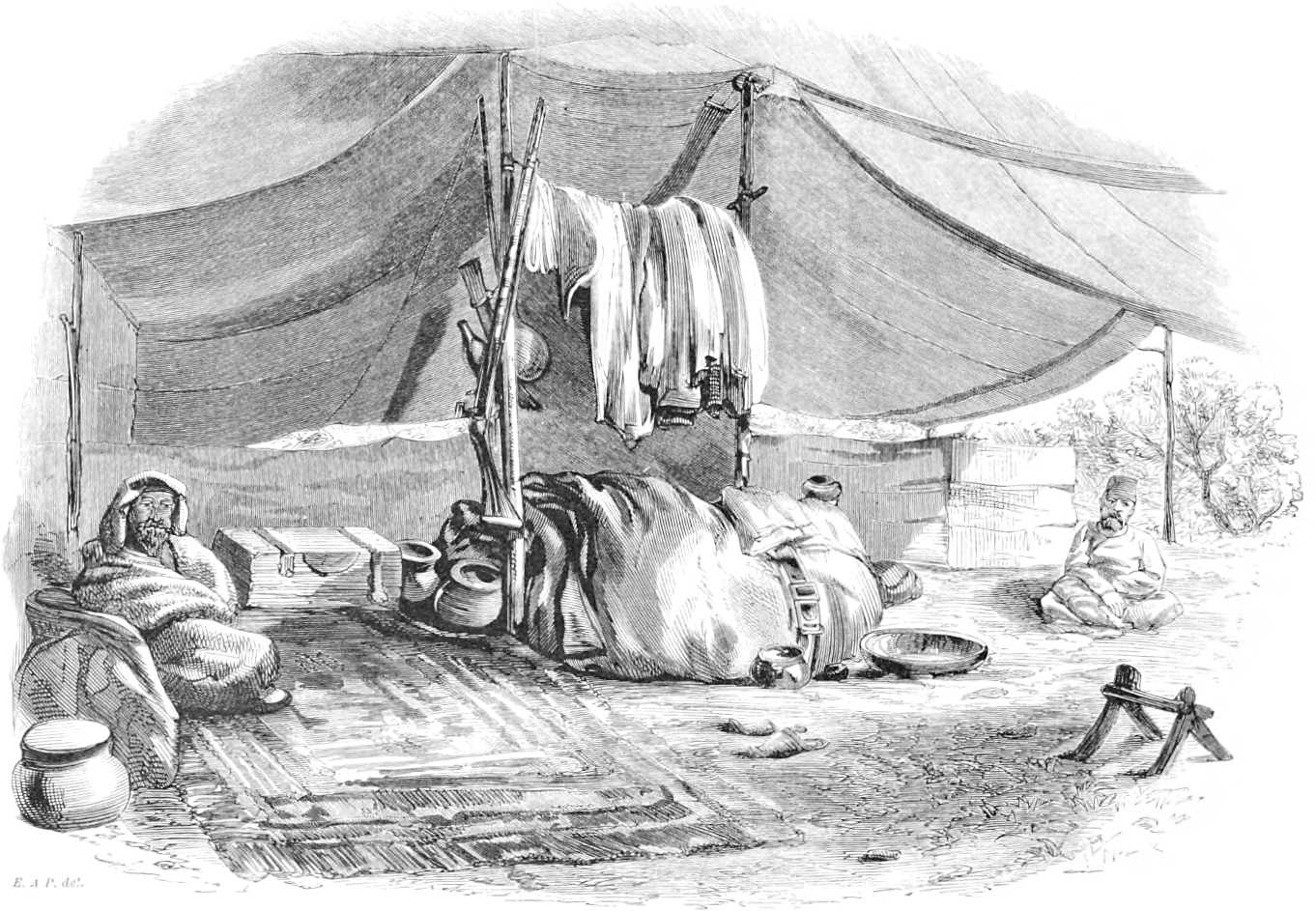
Plate 42.—Interior of Mohammed El Adouly’s Tent.
The affairs of state of a tribe are settled by a Medjlis or general assembly of all the men belonging to it. These assemblies are called on even the most trivial occasions, and sometimes last for several days. The speeches are generally confined to the sheikhs; but any one is at liberty to give his opinion. There is no particular method in the way in which they arrive at a conclusion. After a great deal of talking, the general mind of the meeting seems to become understood, and action is taken accordingly. With a few exceptions, the sheikhs do not seem to possess the power or influence usually attributed to them. The original signification of “sheikh” (pronounced shaich, ch guttural), is simply “old man.”
The form of salutation among the Arabs is very peculiar. When two people meet, they strike the palms of their hands against each other and kiss them. Then commences a perfect torrent of questions on both sides regarding each other’s welfare, but to which answers are never given: such as, “Peace!” “Peace be with thee!” “How are you?” “How are you?” “Peace!” “How are you?” “Peace be with thee!” “Are you very well?” “Thanks be to God!” “How are you?” “Are you very well?” “What is your colour?” “What is your colour?”[55] “Peace be with thee!” and so on for several minutes. After a pause, if they have nothing else to say, they begin again da capo, “How are you?” &c., &c. One subject they are never tired of asking about, viz., the price of grain, butter, and other commodities at Benghazi and Derna. A man returning from either of these places is therefore subjected by all the people he meets to a most tedious cross examination on this interesting topic. Although they may have asked the same questions immediately before, they receive the answers with some such exclamation of surprise as Wallah! Mashallah! &c. If you happen to be travelling from Benghazi, you get dreadfully “bored” by the perpetual series of questions: “How much is barley?” “Ha, Mashallah!” “How much is wheat?” “By God!” “How much is barley?” “God is great!” “How much are bullocks?” “By God, it is good!” and so on until you move off. Even then, however, so long as you are within earshot, the same questions are shouted after you, so that just before you are released by the distance from further interrogation, you may detect the faint reply, “God is great!” and some such forgotten inquiry, as, “How much are donkeys?”
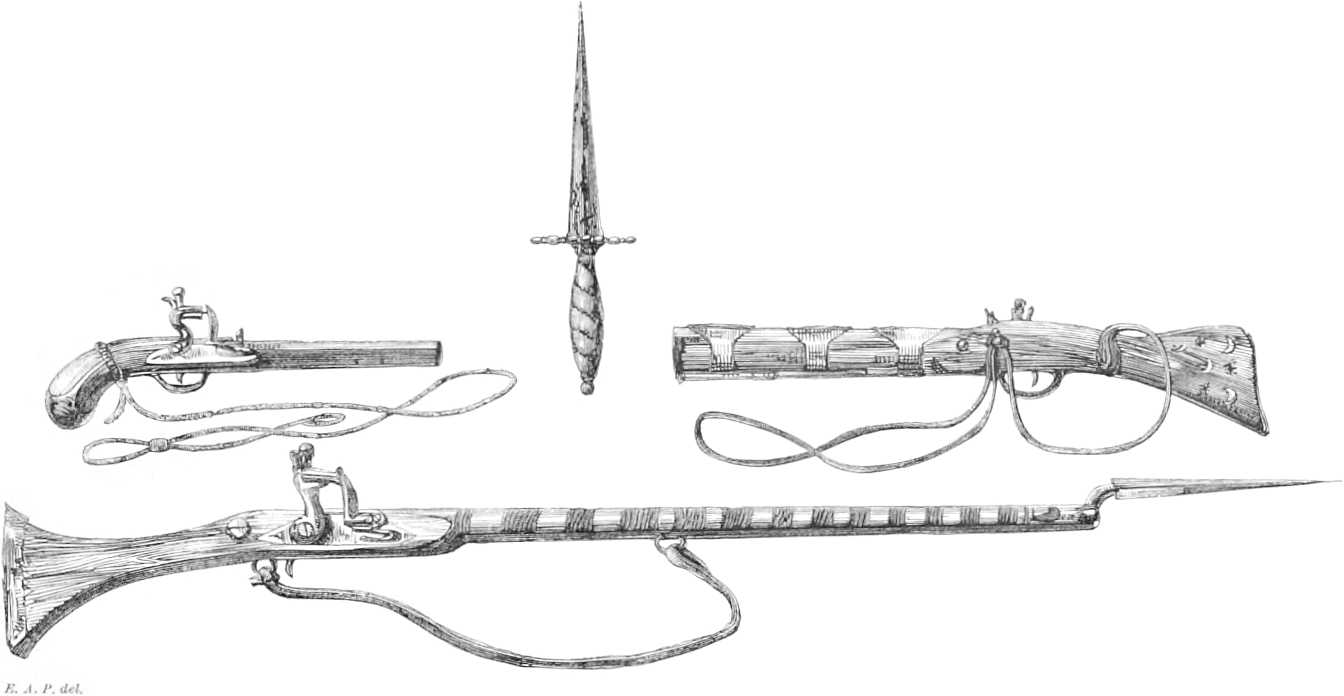
Plate 43.—Arab Arms of the Cyrenaica.
The habit of swearing is very prevalent, the most trivial statements being accompanied by the oath “Wallah!” or “Wallahi!” (By God!) If the truth of the statement is doubted, this oath is repeated thrice in succession with great emphasis: “Wallahi, Wallahi, Wallahi!” Its impressiveness being much weakened by continual use, other forms of asseveration are frequently added, such as: “Hakh El Senoussy!” (The truth of Senoussy!), and even “Hakh Sidi Mustapha!” (The truth of Sidi Mustapha!”), both of which expressions are considered much more solemn by the Cyrene Arabs than the usual “Wallahi!”
The universal use of firearms is caused in a great measure by the prevalence of the law of retaliation, or Vendetta. If a man of one tribe or camp is killed by a man of another, his friends endeavour to avenge his death by killing the manslayer, or, failing him, any one belonging to his camp. A man is, consequently, quite uncertain whether every thicket he passes may not conceal an enemy lying in wait to take his life, and he is therefore constantly armed for the purpose of acting in self-defence. The wearing of arms has thus become almost a necessity. The prohibition by the Government of the sale and use of firearms and gunpowder is of no effect, owing to the want[56] of power to enforce it. For the same reason the Government takes no cognizance of any crimes but such as directly interfere with the collection of the tribute; so that the Arabs are left at perfect liberty to indulge their propensities for murder, robbery, and theft as much as they please. Let the reader imagine a country some miles in length, inhabited by a proud, passionate race of barbarians, who are divided into innumerable tribes and families, mutually jealous of each other, with no fixed dwelling-places, and under no restraint from the force of public law,—and he will have a fair idea of the state of Barbary at the present day.
Pl. 44.
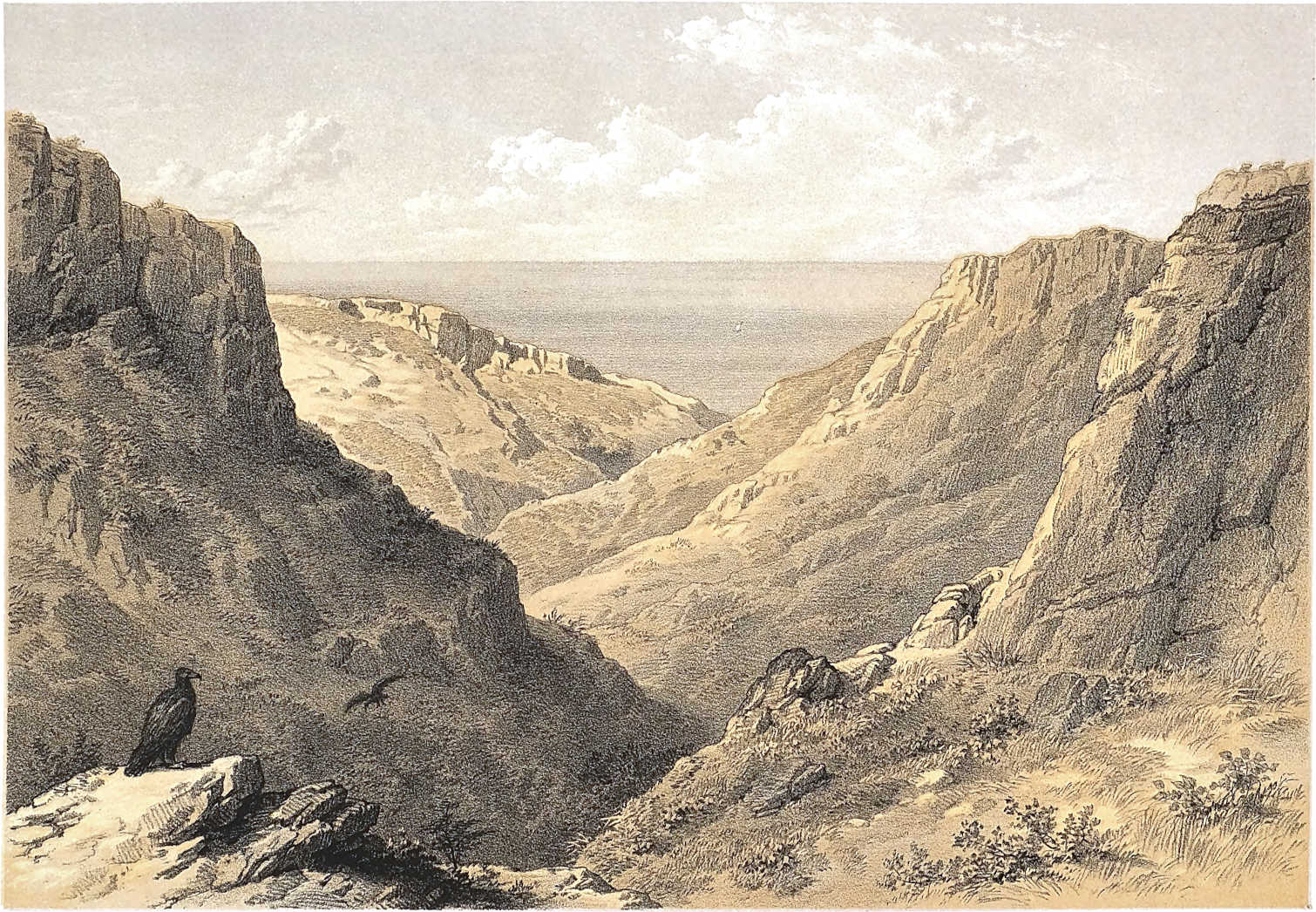
| E. A. Porcher, delt., T. Picken, lith. | London. Published July 1st. 1864 by Day & Son, Lithographers to the Queen &c., Gate Street Lincoln’s Inn Fields. | Day & Son, Lithrs. to the Queen |
WADY LEBAIATH, BETWEEN CYRENE AND APOLLONIA
[57]CHAPTER X.
PREVIOUSLY to the arrival of the Assurance, we made several excursions to different places in the Cyrenaica, the first of which was to Marsa Sousah, for the purpose of examining the road, with a view to the future transport of the Bacchus and other statues. Accompanied by Cesareo and Amor, we started from Cyrene on the 14th of January, and reached Marsa Sousah in four hours. The present Arab path follows the ancient road, which is distinctly marked by the deep tracks of the chariot-wheels. After crossing the lower plateau, the road approaches the head of the Augubah, through a dense wood of juniper, carub, and olive trees; on emerging from which it is carried across a sort of saddleback between two exceedingly picturesque wadys, about 1,000 feet in depth. A sketch of one of which is given in Plate 44.
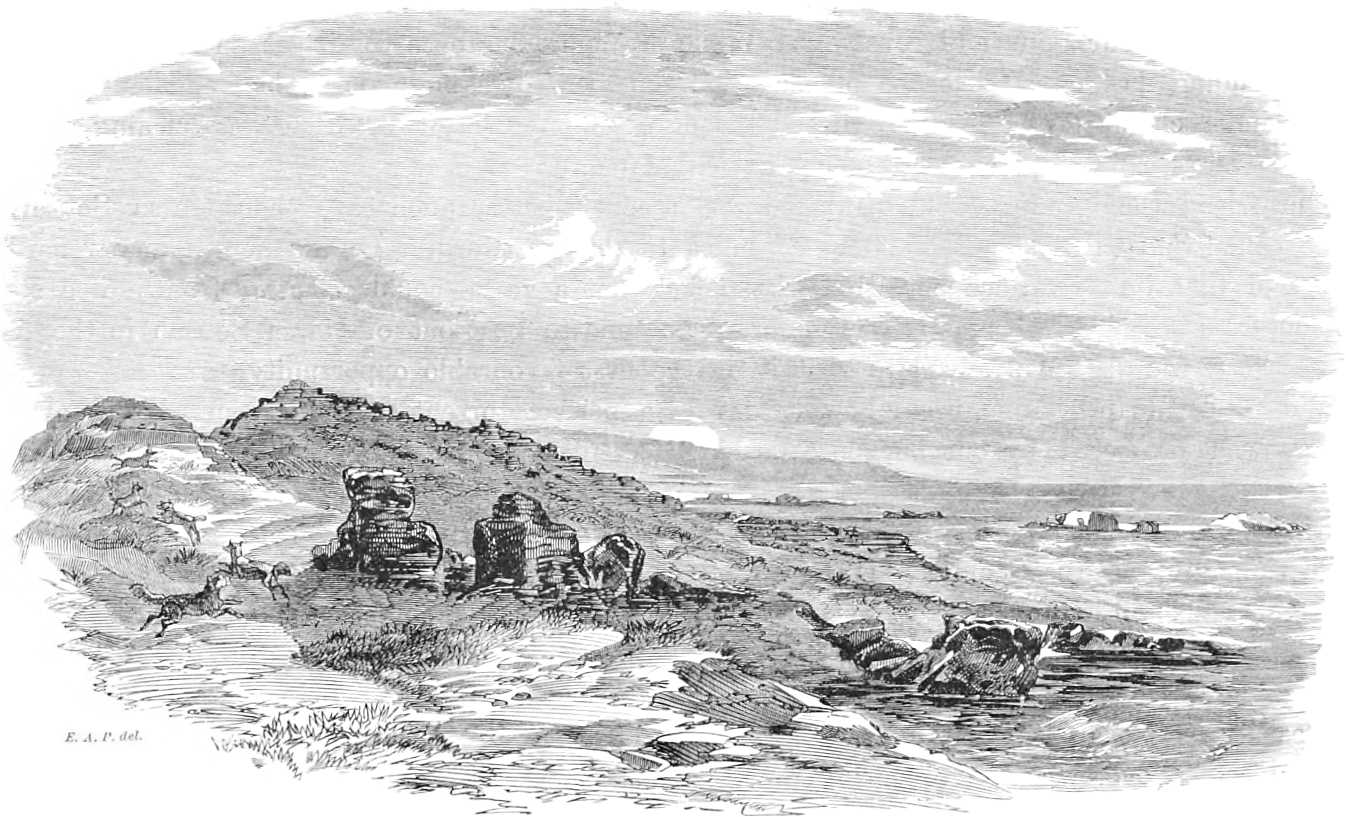
Plate 45.—Eastern City Wall and Ruins of Apollonia.
The remains of the ancient city of Apollonia are not of great interest, and seem generally to belong to a comparatively late period. The city wall can be easily traced throughout its circuit, some parts of it still standing to a considerable height. Just outside the wall, on the eastern side of the city, is a theatre in a very perfect state of preservation, and within the wall the ground is almost covered with the ruins of ancient buildings. Among these are the remains of two temples, distinguishable by the heaps of fallen columns, capitals, and architraves. Of the two, one is of white marble, and the other of a coarse Cipollino marble streaked with green, which has probably[58] given rise to the erroneous report that large columns of verde antico are to be found among the ruins of Apollonia. In the immediate vicinity of the city are a number of plain tombs cut in the rock, now used as grain-stores by the few Greek traders who occasionally visit this place for the purchase of the produce of the country. In a mass of ruins within the city we found two Latin crosses engraved on blocks of marble, almost the only decided relics of Christianity we met with in the Cyrenaica. On the northern side of the city there were some ancient tanks, and traces of an aqueduct could also be made out. The harbour, which is too small and shallow for even the coasting vessels of the present day, is protected from seaward by some rocky islets at its entrance.
As we had no tent with us, we took up our quarters for the night in the outer chamber of an ancient tomb, where we were visited in the evening by a neighbour troglodyte, a skipper from Candia. He spoke the inarticulate Turkish patois common to all Candiotes, and, although he looked more like a Greek than a Turk, called himself a Mussulman. He was buying up all the grain and butter he could get from the Arabs, while waiting for his vessel, which was gradually collecting a cargo at different places along the coast. Some of his sailors were with him to assist in keeping guard at night, as the Arabs were continually on the look-out for an opportunity of robbing him. He told us he had established himself in a tomb with a single narrow entrance, so that he could defend himself against considerable odds. We gave him some powder and bullets, for which he was very thankful, as his stock was by this time nearly expended.
During the night we were aroused by a creeping, rustling sound close to us, which made us instinctively seize our guns and revolvers. While straining our eyes to detect an Arab assassin in the surrounding darkness, the cause of alarm, in the form of a huge porcupine, suddenly emerged from an inner chamber of the tomb, rushed through the smouldering fire that was burning in front, and made his escape amid a cloud of sparks and flame.
Our friend the Candiote told us there was a much better anchorage than Marsa Sousah at a place called Sousa Hamema, about fifteen miles to the westward. On further inquiry regarding it, he said that its excellence consisted in the fact that a vessel could get away from it if a storm came on from seaward, whereas it was almost impossible to beat out of Marsa Sousah in the teeth of a northerly wind. We resolved to visit it on the first favourable opportunity.
We returned to Cyrene the following day in a perfect torrent of rain, from which, however, we were well protected by our burnouses, which had been equally serviceable as beds the night before.
Shortly after this, we visited a place called Imghernis, spoken of by the Arabs as full of ancient ruins. It is situated near the edge of the upper plateau, about eight miles from Cyrene. A number of walls and buildings are still standing, some of them to the height of about thirty feet. They seem, however, to be of a late period, and almost no traces of marble are to be seen. In the neighbourhood are a good many tombs, both built and excavated, some of which are of evidently much earlier date than the ruins of the town.[4] There were also several large reservoirs cut in the rock, and roofed over with long flags of stone.
On the occasion of a second visit which we paid to Imghernis some time afterwards, we were greatly annoyed by a tribe of Arabs, who surrounded us, and in the most dictatorial manner ordered us to leave the place. They threatened to shoot us, and for some time seemed on the point of actually trying to do so. Amor, however, meanwhile advised them for their own sakes not to attempt violence, telling them quietly that all who had in any way thwarted us at Cyrene, including the Mudir and Sidi Mustapha himself, had suffered in consequence; and that they might rest assured that the Consul at Benghazi would have ample vengeance for any injury we might receive. After[59] some time, they showed their faith in the soundness of his advice by moving off; and although we remained at Imghernis all night and part of next day, we saw no more of them.
Pl. 46.
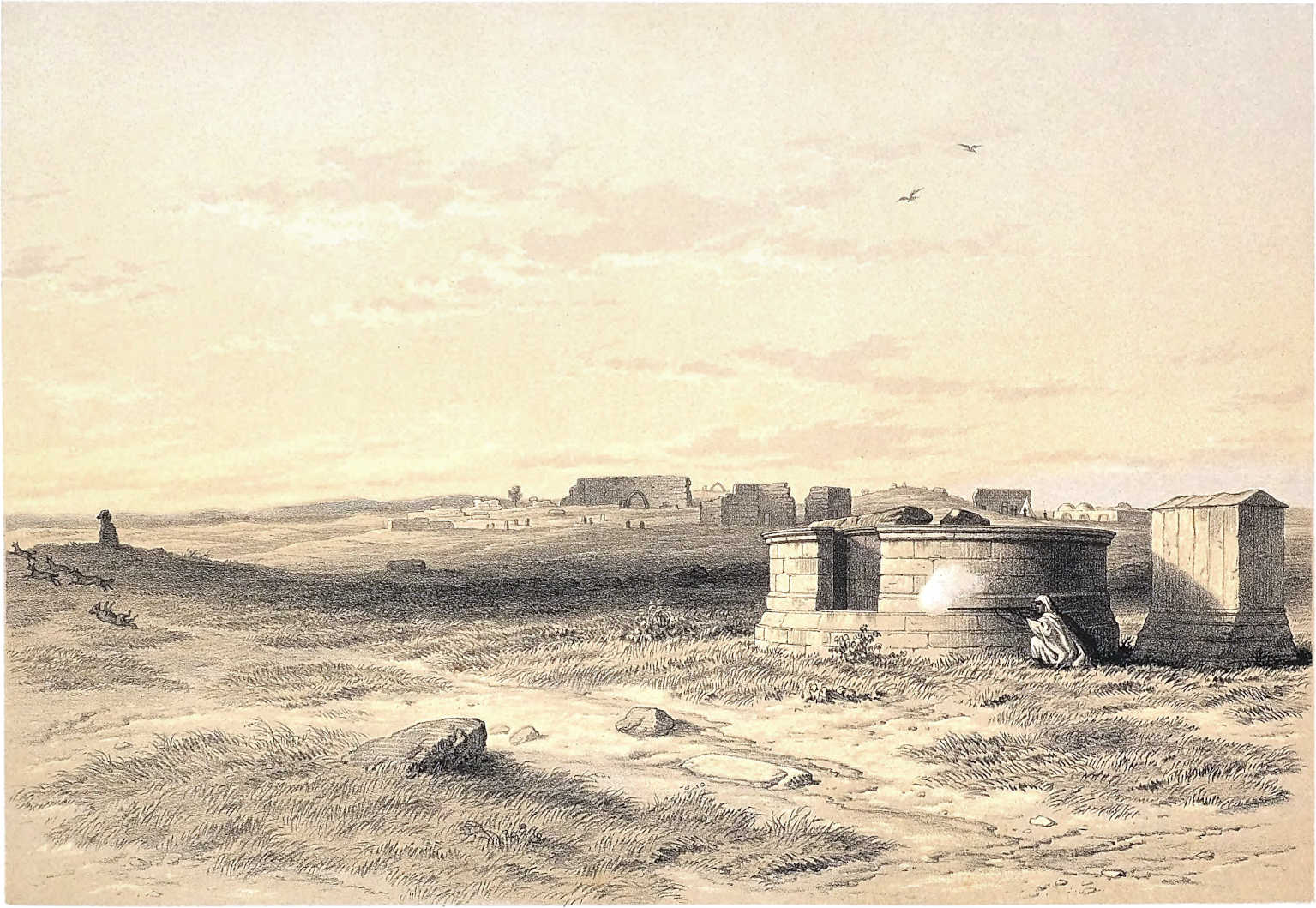
| E. A. Porcher, delt., T. Picken, lith. | London. Published July 1st. 1864 by Day & Son, Lithographers to the Queen &c., Gate Street Lincoln’s Inn Fields. | Day & Son, Lithrs. to the Queen |
RUINS OF IMGHERNIS
Our next excursion was to Derna; one object of our trip, among others, being to pay a visit to Mr. De Fremeaux, the British vice-consul, who had very kindly sent us from time to time such supplies as we required which Derna could afford. We started with Cesareo from Cyrene on the 26th of February, taking with us Amor’s brother, Abderrahim, and a camel to carry a tent and baggage. Two hours and a half after starting, we passed a few indefinite ruins at a place called Labrak, the scene, some thirty years ago, of the great battle between the tribes of Birasa and Haasa, the former under their redoubtable Sheikh Bou Bakr Ben Hadood. The Haasa were completely defeated, and 700 of them are said to have been buried on the battle-field.
An hour and a quarter further on, and a little to the left of the road, are a few ruins called by the Arabs Gabiout Younes, where there is an arched gateway of recent date still standing nearly perfect. About a mile beyond, are the ruins of what seems to have been a place of some importance, now called by the Arabs Tirt, where we found a small Zauyah, containing a rude building used as a mosque. The Arabs who were loitering about the place gave us a malicious scowl as we passed, but did not interfere with us. No traces of architectural buildings were to be seen.
From Tirt we rode about seven miles through a wood of arbutus and juniper, over a rough stony road, to Lamloudeh (Lebdis), where there are the remains of a town of considerable extent. Among the ruins are a number of very perfect arches and tombs, and also some large reservoirs at which we watered the horses and filled our water-skins. From Lamloudeh we continued our journey till sunset, when we halted for the night, encamping on the side of a hill called Kubbeh, where we found two fountains of good water, and some tombs excavated in the rock.
The following morning we started early, and rode about ten miles over a monotonous undulating country containing neither shrub nor tree. In this plain we passed some ruins on a slight eminence, close to the road called Beit Thamr, and a little further on, some tombs cut in the rock. We then entered a wood of arbutus, juniper, and olive, which, with a few breaks, extended to the head of the Augubah, where we first came within view of the seashore, and in the distance, away to the eastward, the town of Derna. The neighbouring hills are perfectly bare, so that the town, with its luxuriant date-gardens, forms quite an oasis in the stony desert around. The Augubah is similar to that of Marsa Sousah, being in fact part of the same range of mountains. The descent is very steep, and in some places where the surface of the rock has been worn smooth, it is very difficult for the horses to keep their feet. We got to the plain at the bottom in half an hour, after which we had a two hours’ ride over loose stones and shingle before we reached the town. The whole distance from Cyrene is sixteen hours, or about fifty miles.
On our arrival we were most hospitably received by Mr. De Fremeaux, who kindly furnished us with quarters at his house. He had himself arrived only a month before to succeed Mr. Aquilina, who had occupied the post of unpaid consular agent at Derna for upwards of a quarter of a century, during which time he was generally the only European in the place. In the course of the evening we were visited by the Kolaghassi (Major) commanding the troops, and the recently appointed Mudir, to whom we had given a passage in the Boxer from Tripoli to Benghazi. The Kolaghassi, who indulged in an amount of snuff perfectly astonishing, seemed, from the compound effect of tobacco and raki, to be in an incipient state of delirium tremens. The Mudir, an Albanian by birth, had spent the last twenty years in Barbary and Fezzan. Both were profuse in their offers of friendship, and the Mudir, on returning to the castle, sent us as a present a Roman silver coin and a small silver sphinx which had been found in the neighbourhood.
The town of Derna, with its gardens, covers a small triangular plain, formed by a projection of the seashore from the base of the range of hills already so frequently referred to. The shingly bed of a deep wady, which recedes several miles into the range, divides the small plain[60] and the town into two distinct portions. On the eastern side are the two villages of Upper and Lower Bou Mansour; and on the western, a village on a spur of the hills called Il Maghar, Derna proper lying immediately below, and a small detached village, called Gebéli, near the projecting headland. The whole assemblage of villages constitutes the town of Derna, which is supposed to occupy the site of the ancient Darnis. The remains of a few ancient walls may be traced in different parts of the town; and the name of the village on the spur, Il Maghar (the cave or rock-tomb), denotes the existence there of ancient sepulchres.
The beauty and fertility of the little plain of Derna are owing to the copious stream of fresh water which flows down the bed of the wady. Some two or three miles above the town the water is collected into an artificial aqueduct, by which it is led into the town, and thence distributed over the surrounding fields and gardens by means of small lateral branches. To insure the regular supply to every man’s property, a “Chief of the Water” is appointed, whose duty it is to see that a supply is sent to every district in succession, and to prevent any one from diverting for his own use the stream that for the time belongs to his neighbour. Water-stealing is very properly considered a serious crime, and is punished accordingly.
The houses are built with lime, and are altogether much superior to those of Benghazi. Most of them, too, are whitewashed, which gives the town a clean, wholesome appearance. Derna proper is surrounded on all sides by luxuriant gardens, and appeared to us a perfect Paradise after the wild and uncultivated country we had been accustomed to; but whether a stranger, coming direct from Malta or Candia, would be equally struck with its beauty it is difficult to say. Fruits and vegetables of all kinds grow in abundance, particularly dates, melons, figs, grapes, pomegranates, and bananas. The thick groves of tall palm-trees form a conspicuous and beautiful feature in the scene.
The town contains a large mosque, a bath, a market-place, a small bazaar, and a castle built at the same time as those of Merdj and Ghegheb. There is a considerable export trade in grain, butter, and wool, chiefly to Canea, in Crete. In the bazaar are shops or stalls of different kinds, most of which belong to Jews. The town Arabs being to some extent civilized, look down on their brethren, the Bedouins of the country, and think them fair game for any amount of deception and practical joking. An instance of this occurred in the case of our camel-driver. While lounging about the bazaar, an auctioneer showed him a pair of pistols he was selling at the time, and asked him what he thought of them. “Wallah! zain” (By God! good), was the reply. In a short time the auctioneer returned, bawling out a large price as the last bid, and handing the pistols to the camel-driver, again asked his opinion of their quality. “Wallah! zain!” repeated the camel-driver. “Well, no one has bid higher than you, so here they are, and give me the money.” “But I never bid for them at all! I have no money to buy such pistols as these!” “No money! Never bid! Did you not say ‘Wallah! zain!’ when I bid a price for you? Wallahi! if you do not pay you go to prison.” The other Arabs in the bazaar took up the chorus, “Wallahi! you shall go to prison. We’ll have none of your Bedouin tricks here!” and to the castle prison he was hauled off accordingly. He was, of course, released when his companion, Abderrahim, came and told us of his misfortune.
Pl. 47.
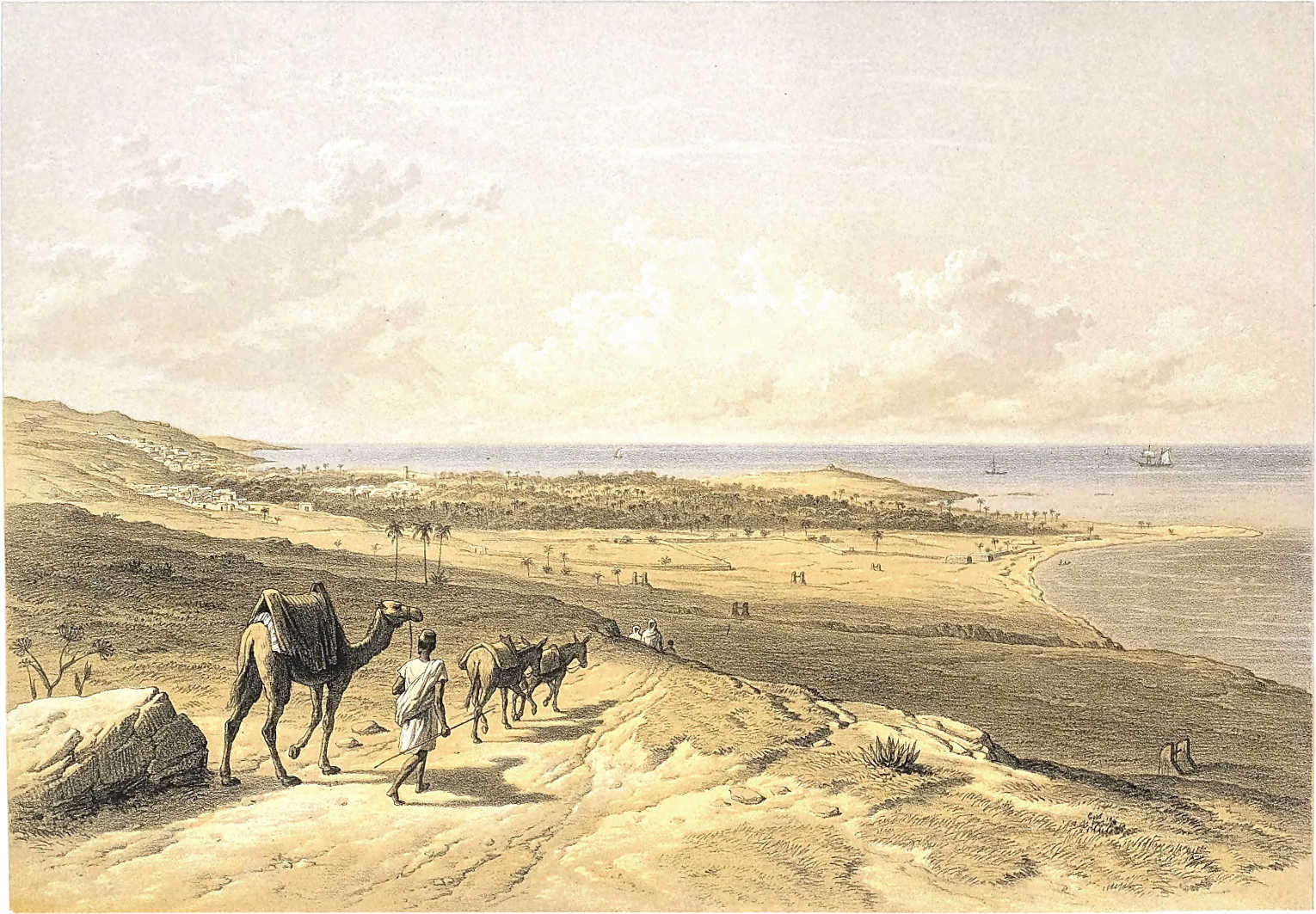
| E. A. Porcher, delt., T. Picken, lith. | London. Published July 1st. 1864 by Day & Son, Lithographers to the Queen &c., Gate Street Lincoln’s Inn Fields. | Day & Son, Lithrs. to the Queen |
DERNA
We returned the visit of the Mudir, and also called on the Kolaghassi, who told us that if we would come to the castle the next day he would have the troops turned out and put through their drill in our presence. He considered himself a great tactician, and showed us a Turkish book on military movements, illustrated with diagrams, by the study of which he said he had acquired his proficiency. When we went to the castle on the following morning, after the usual pipes and coffee, he showed us the barrack-rooms, &c., which were all in very good order. He pointed out with great pride some fantastic arabesques in red and black with which the white-washed walls were covered, informing us that they were all designed by himself. They[61] forcibly reminded us of the way in which a small boy delights to ornament a blank wall with a piece of chalk. The two companies of infantry were by this time drawn up for inspection. Their clothing was certainly not of the best quality, but their arms were good and in excellent condition. Some manœuvres were then executed in an open space in front of the castle. The men drilled very steadily, although impeded in their movements by the clumsy formation of three ranks, and the interference of the supernumeraries, whose chief occupation seemed to consist in kicking the shins of the men in the rear rank.
On the last day of our stay we rode about five miles up the wady, accompanied by Mr. de Fremeaux. The sides are very steep, and in many places quite perpendicular; and the stream which flows along the bed causes a luxuriant growth of reeds and oleanders, which give the ravine a most picturesque appearance.
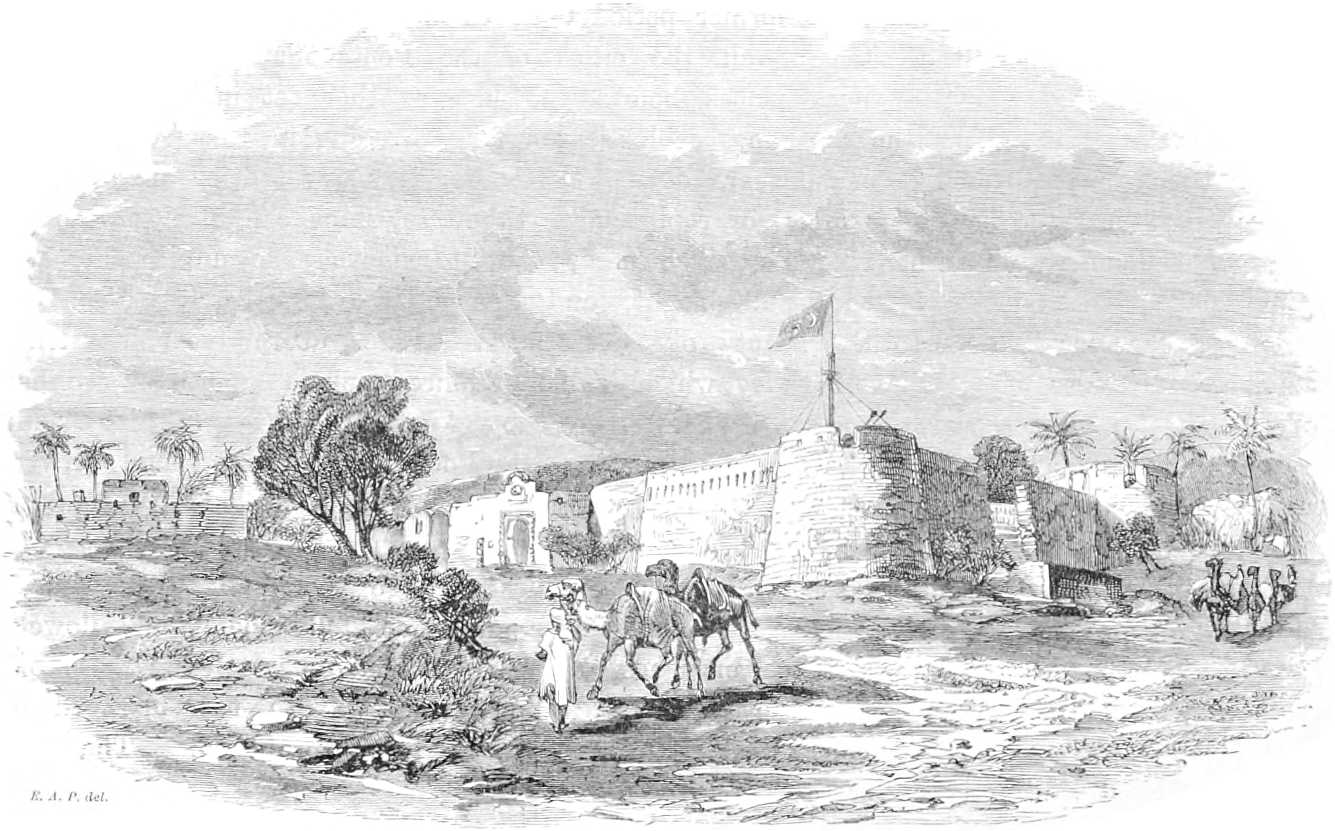
Plate 48.—Castle of Derna.
Before leaving Derna we examined the shops in the bazaar and bought everything useful we could find. On the fourth day after our arrival we left for Cyrene, which we reached without incident the following day. It was during our absence that our workmen made the first discoveries of sculpture at the Temple of Apollo.
On the 3rd of April we visited Sousah Hamema (Phycus), the anchorage spoken of by the Candiote skipper. It is confounded by Beechey with Apollonia, which he calls Marsa Sousah Hamema. The one place is Marsa Sousah and the other Sousah Hamema, so named from the number of rock-pigeons (hamem) which frequent its neighbourhood. The distance from Cyrene, seven hours or twenty-one miles, was greater than we had been led to believe. From the foot of the Cyrene range we crossed the lower plateau in a north-western direction, and descended the Augubah to the plain on the shore by a steep rocky tract exactly similar to those on the roads to Marsa Sousah and Derna. About two hours to the westward of this point, we reached Sousah Hamema, which occupies the point called Ras Sem, a name which seems to have become[62] obsolete, as none of the Arabs we spoke to were acquainted with it. The harbour is simply a small bay not half a mile wide, and perfectly open to the north. We found a small schooner from Canea at anchor outside. Remains of buildings were to be seen on both sides of the bay, and also a considerable number of rock tombs. The eastern side, however, which contained the greater number of these, was occupied by one of those pests of Barbary, a Zauyah, which prevented our making an examination of it. As there was nothing of interest to detain us, we left in the evening to return to Cyrene. Night overtook us in the plain at the foot of the Augubah; but after dark we saw at some distance the light of a fire, which guided us to an Arab camp, where we passed the night. The following day we returned to Cyrene by a path some five or six miles to the eastward of the one by which we had gone to Sousah Hamema the day before. In traversing the lower plateau, both going and coming, we very often passed the traces of ancient roads, and the remains of tombs and other buildings, which clearly showed that the whole plain had at a former period been thickly inhabited.
Having now examined the sites of all the cities of the Pentapolis except Teuchira and Ptolemais, we proposed to visit those places before the hot weather set in for the summer. The month of April is by far the most agreeable season for travelling in this part of Africa. The water which has collected here and there during the winter is not yet dried up by the heat of the sun, so that a sufficient quantity for replenishing the water-skins can always be obtained without much trouble. The heavy rains which make a winter journey so unpleasant, are by this time past, the weather is cool and bright, and the country is covered with a varied vegetation which adds greatly to the beauty of the scenery. Later in the year, the traveller would fail to recognize many a lovely valley which he had admired only a month or two before.
We left Cyrene on the 13th of April, accompanied by Amor and three of his friends in the capacity of guides and escort, with a camel to carry our tent, bedding, and provisions. Taking the road to Merdj and Benghazi, we passed close to the Zauyah El Beidah and along the beautiful Wady Il Aggur to Gusr Biligadem, where we encamped for the night. Many parts of the road, and particularly the eight or nine miles through the Wady Il Aggur, were rich and beautiful beyond description. Trees and shrubs were in full bloom, and flowers of endless variety hung in clusters from the branches of the trees, twined up the faces of the cliffs, and covered the fresh greensward at our feet, filling the air with the most delicious perfume. Roses, honeysuckle, myrtle, and oleander grew in great profusion. The country sometimes appeared a literal bed of roses.
While riding along the wady, we noticed that the partridges, when disturbed, had the peculiar habit of alighting on trees, in which position we shot three or four of them.
Our next day’s journey was also through a very fine country, the road passing over a succession of hills and valleys. The hills were generally overgrown with juniper, arbutus, and brushwood, with occasionally trees of larger growth, such as the oak, the carub or locust-tree, and the olive; and the valleys were either sown with grain or left fallow for pasture. After travelling eight hours and a half, we pitched our tent in a gully near an Arab camp, where we were soon joined by a large party of Arabs on their way to Benghazi. They were all very civil, and the women in the camp prepared a huge dish of bazeen for our supper, besides supplying us liberally with water and leben. We shared with the company the partridges we had shot, and gave them what they had never seen before,—a cup of tea. The partridges were cooked au naturel in a very primitive manner, being simply thrown into the fire as they were, feathers and all.
It may be mentioned here that the Arabs are much more scrupulous than the Turks regarding the sin of eating unclean animals, or such as have not been killed by a Mahommedan according to the requirements of the Koran. When an animal is to be killed, the operator,[63] before cutting its throat, turns its head in the direction of Mecca, and invokes a blessing. The short prayer, the look towards the Gibli, and the letting of blood afterwards, are the three essential forms which must in all cases be complied with. The attention paid to this law was of great convenience to us when shooting in the company of our Arab attendants, as it saved us the trouble of picking up the game we killed. Whenever a bird fell, one of the Arabs was sure to rush after it, knife in hand, to take its life in an orthodox manner before it had given its final kick. They could thus partake with a clear conscience of what we had shot during the day; otherwise they had to content themselves with a piece of dry bread or biscuit for dinner. The Arabs themselves hardly ever shoot, powder and lead being much too valuable to throw away on any game less noble than man.
About half an hour after starting on the following morning, the 15th, we came to a group of ancient wells, some four or five in number, called the “Libiar Il Gharib.” They were carefully lined with masonry, and contained a good supply of excellent water. Many such wells and cisterns still exist as the monuments of a former age; but, with a few rare exceptions, they are now choked up and dilapidated. We halted here for about an hour to draw water for the camel and the horses, and to let the Arabs have their breakfast. From Il Gharib the same hilly country continued for about three hours, after which the road emerged on the large plain of Bograta, which is surrounded by hills, and contains a few half-ruined wells. We halted a few minutes at a camp near the end of the plain, where we drank camel’s milk for the first time. It is considered wholesome, but is certainly not very palatable, as it tastes somewhat like cow’s milk mixed with salt. Leaving Bograta, the road led through a gorge in the mountains, from the mouth of which we looked down upon the great plain of Merdj, stretching away to the south and west as far as the eye could reach.
We had heard from Benghazi that our old friend Hadji Achmet Bin ’l Agha had resigned his governorship, and was at Benghazi on his way home; so that, on our arrival at the castle in the afternoon, we were most agreeably surprised to find him back again as hearty and hospitable as ever. He gave us a most cordial welcome, and seemed truly delighted to see us. He had none of the ceremonial politeness so common in the East, but was really a downright honest, good-hearted fellow, a perfect John Bull, both in appearance and disposition.
As it was past noon when we arrived, we stayed all night at the castle, where, besides Hadji Achmet himself, we found the newly-appointed Mudirs of Ghegheb and Derna and a military kaimacam, who had been sent from Tripoli as receiver-general of the miri, or tribute, from the country east of Benghazi. They were accompanied by Suliman Captan, one of the most remarkable men in the country. He was the grandson of a Scotch captain, who had turned Mahommedan, and settled in Tripoli, where he became a sort of admiral under the Beys of the Karamanli dynasty. Suliman Captan was Mudir of Ghegheb immediately before Lemin Ben Sitewi, and during his tenure of office acquired a great reputation for the courageous manner in which he kept the Arabs under his control. The tribes about Cyrene still retained a lively recollection of his own rule. On one occasion, however, his boldness nearly cost him his life. A tribe of Arabs having refused to pay their miri, he went to their camps, attended by only eight soldiers, to insist upon payment. Thinking this a favourable opportunity for paying off many an old score, the tribe surrounded him in overpowering numbers, determined to take his life. Nothing daunted, he cut his way through the whole mob, and succeeded in gaining the castle, although with no less than four bullets in his body. A broad scar right across his forehead marks the track of a ball from which he can have escaped with his life only by a hair’s breadth.
The new Mudir of Ghegheb, as we were informed by a letter from Mr. Crowe, had received the most stringent orders from the Kaimacam to attend to our requisitions, and afford us every assistance in his power. He seemed a weak, mild individual, not at all fitted for the difficult task of extracting[64] the due amount of tribute from the unruly tribes he had to deal with, and still less to be of much use to us, should we ever have occasion to require his intervention on our behalf. We were told by Hadji Achmet that the Pacha of Tripoli, aware of his weakness, had appointed as his official adviser the famous Bou Bakr Ben Hadood, the head of the large tribe of Birasa, who had been governor of the Ghegheb district for many years, both under the Karamanlis and the Turks. On our return to Cyrene, we found that this appointment had stirred up the wrath of our neighbours, the Haasa, who had never forgiven Bou Bakr for their signal defeat by him at Labrak. Their mutual hatred and fear gave rise, as we shall presently see, to serious disturbances.
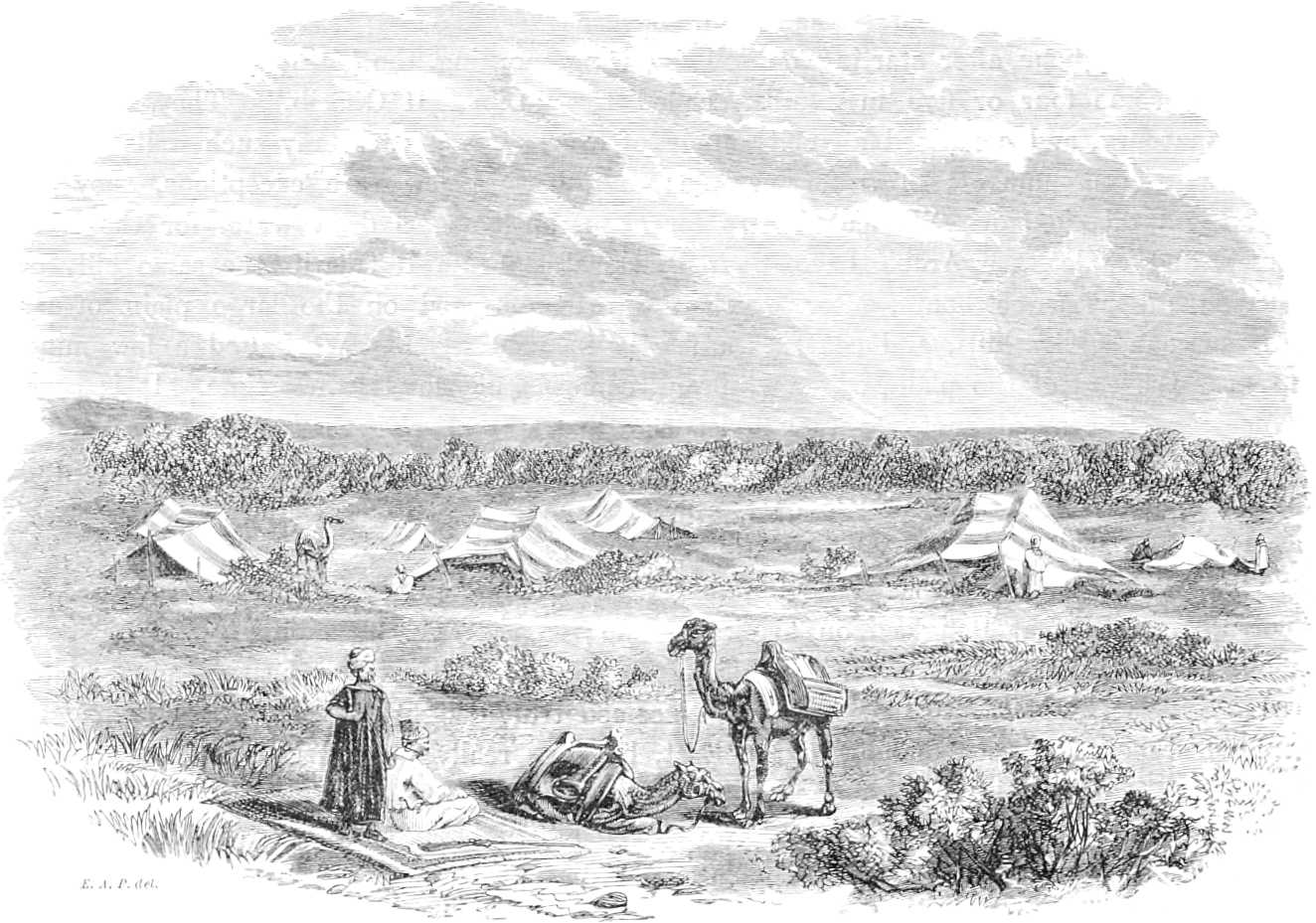
Plate 49.—Arab Camp near Teuchira.
We remained at Merdj till the middle of the following day, when we started for Teuchira. The road led, in a north-western direction, from the castle over a level grassy plain, which gradually sloped up to the brink of the Augubah, near which we pitched our tent for the night, close to an Arab encampment. The country was better cultivated and more thickly inhabited than any part of the Cyrenaica we had yet seen. Early next morning, the 17th, we descended the Augubah by a much better road than those at Marsa Sousah and Derna, and reached the ruins of Teuchira in about two hours, the distance from Merdj being altogether about eight. We encamped in one of the large quarries, to the eastward of the city.
Teuchira, named by the Ptolemies, Arsinoë, is now called Tocra, an Arabic corruption of its original name. It stands on the sea-shore, about two miles from the foot of the Augubah, and about 38 miles from Benghazi (Hesperis). The remains of the ancient city are of comparatively little interest, and consist for the most part of indefinite heaps of ruined buildings belonging to the period of the Roman occupation of the country. The city wall, rebuilt by the Emperor Justinian, is in good preservation, and in many places still stands to its original[65] height. In its circuit of nearly a mile and a half, there are altogether twenty-six quadrangular towers, which project from the general line of the wall, for the purpose of flank defence. Within the walls, we could distinguish the sites of several temples and churches, in one of which we observed a Greek cross deeply engraved on a stone; but not a vestige of marble was anywhere to be seen. Outside the city are a number of quarries, in the sides of which there are many excavated tombs. These are generally plain chambers, devoid of ornament of any kind; a few, however, are painted, and some of them contain inscriptions cut on small faces sunk in the face of the rock, which have a remarkable resemblance to mural tablets in churches at the present day.
Pl. 50.
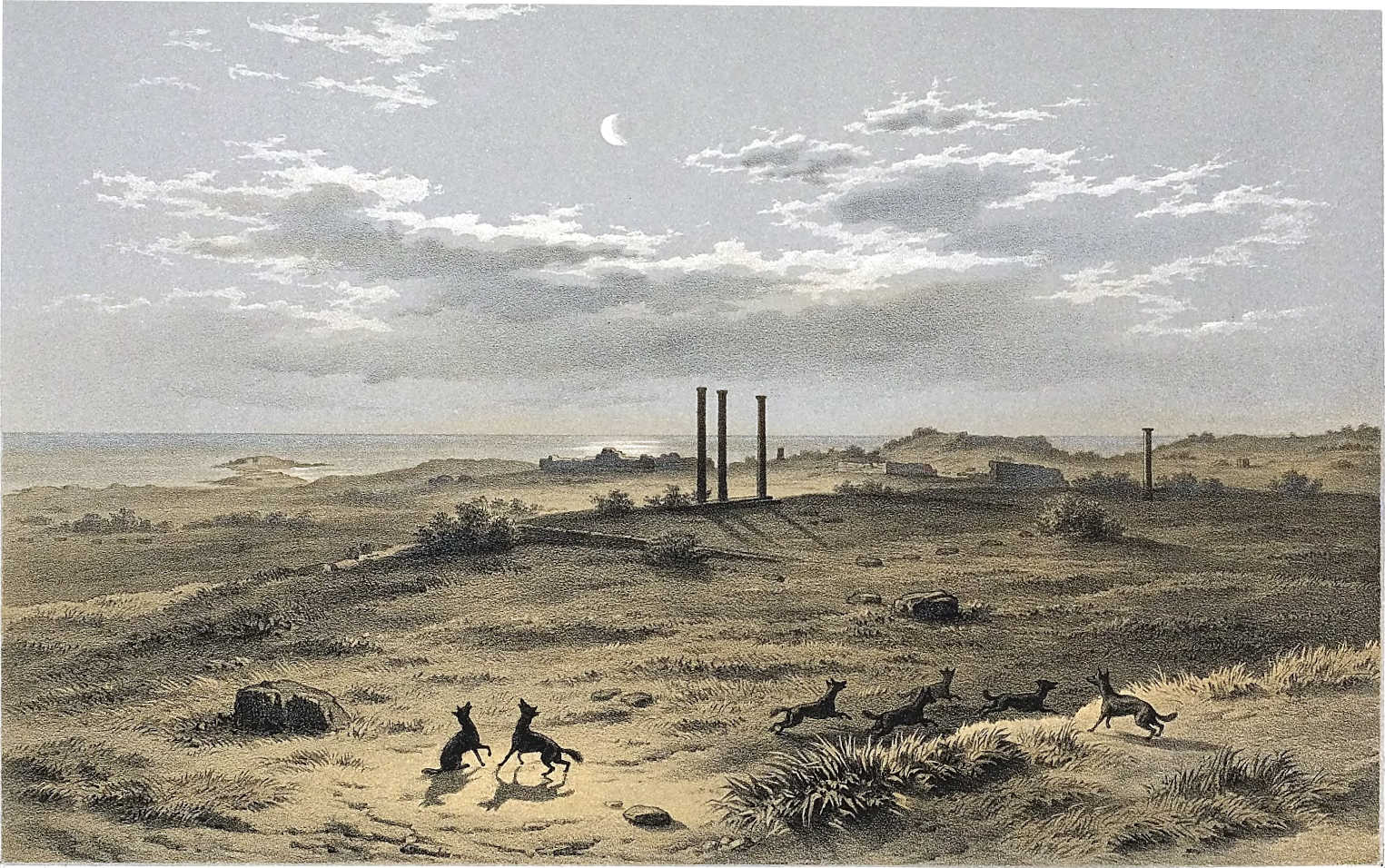
| E. A. Porcher, delt., T. Picken, lith. | London. Published July 1st. 1864 by Day & Son, Lithographers to the Queen &c., Gate Street Lincoln’s Inn Fields. | Day & Son, Lithrs. to the Queen |
RUINS OF PTOLEMAIS
![[ALT JPG]](images/i50_large_alt.jpg)
The country in the vicinity abounded with partridges, quail, snipe, pigeons, and doves. The weather on the day of our arrival was very disagreeable, squalls and heavy showers coming on at frequent intervals. Next day, the 18th, was little better; but as we had passed a most comfortless and sleepless night amid swarms of fleas, and as nothing of interest remained to be seen, we started about mid-day for Tolmeitah (Ptolemais).
There was a very fair road following the line of the shore the whole way. We saw no remarkable ruins, although we occasionally passed the remains of ancient buildings. Towards evening we came within view of a high building that marks from a great distance the situation of Tolmeitah. As we approached, we found that it was a large tomb of excellent construction, about half a mile to the westward of the city. It was now getting dark, and we pitched our tent in an ancient quarry between the large tomb and the western gate of the city, choosing this spot, as at Tocra, on account of the shelter it afforded from the wind. The distance from Tocra was altogether seven hours and a half, or about twenty-five miles. Some Arabs, who had halted for the night in the next quarry to ours, were very anxious to sell us part of a dead camel, and seemed quite astonished when we told them we would not have it if they offered it for nothing. The animal they said had broken down, and they had cut its throat “to save its life,” so that the flesh was perfectly good for food.
The two following days were spent in examining the ruins under the guidance of the Arabs of a small encampment we found near the foot of the hills. We were sorry to hear from them that we had just missed meeting an English man-of-war, which had anchored off Tolmeitah the day before our arrival. From their description we conjectured rightly that it was the Medina, Captain Spratt, then surveying the coast, preparatory to the laying of the Malta and Alexandria telegraph cable. Three of the officers, accompanied by an interpreter, had landed and remained on shore half the day.
The position of Ptolemais is very similar to that of Teuchira and Apollonia, the only difference being that at Ptolemais the ground rises more rapidly from the shore to the foot of the hills, which at this point come to within a mile and a quarter from the coast. The city, which is nearly square in form, occupies the whole breadth of the slope between the hills and the sea, and is inclosed by walls which can still be distinctly traced. The great gateway in the western wall is still standing, and is remarkable for the excellence of its masonry. It is built of massive ashlar-work without mortar, the stones of which are laid in alternate courses of “headers” and “stretchers,” like English bond brickwork. The faces of the stones are roughly dressed, and the joints deeply sunk like the “rustic” work of the present day. The otherwise unbroken surface of the walls is thereby relieved, and the general appearance of the building greatly improved.
The eastern wall of the city follows the side of a small ravine leading to the sea from one of the Wadys in the range of hills above. At a point nearly opposite the centre of the wall, this ravine is spanned by the arch of a bridge still standing, which appears to have been built for an aqueduct, which we could trace distinctly for some distance from the city. Within the walls the aqueduct led in the direction of a series of enormous reservoirs near the centre of the city, which were pointed out to us by one of the Arabs. Guided by him, we crept underground through a[66] small opening into a chamber, about one hundred feet long and twenty feet broad, completely arched over, from which we passed through a series of about half a dozen similar vaults, all of apparently the same size, and connected with each other by doorways in the walls below the springing of the semicircular arches of the roofs. They were beautifully built of ashlar-work, and lined with cement, but were so filled up with rubbish that we could not make out either their exact length or their number, as only parts of them were clear enough to allow a passage. In one or two of them there was a little water, to which some goats had found their way by a larger opening than that by which we entered. They were, doubtless, built by the Romans, and must have been of the greatest benefit to the city, as the country along the shore is much more liable to droughts than the high land beyond the Augubah. “We are informed,” says Beechey, “that the town of Ptolemeta suffered at one time so severely from want of water, that the inhabitants were obliged to relinquish their houses and disperse themselves about the country in different directions. The reparation of the aqueducts and cisterns of the town, which, it seems, had fallen into decay, restored Ptolemeta to its former flourishing state; and this act is recorded among many others of a similar nature performed at the command of Justinian in the eulogy of that emperor by Procopius. As Ptolemeta is unprovided with springs, the care of its reservoirs and aqueducts must have been at all times peculiarly essential; and we find that its buildings of this class are among the most perfect of its existing remains.”
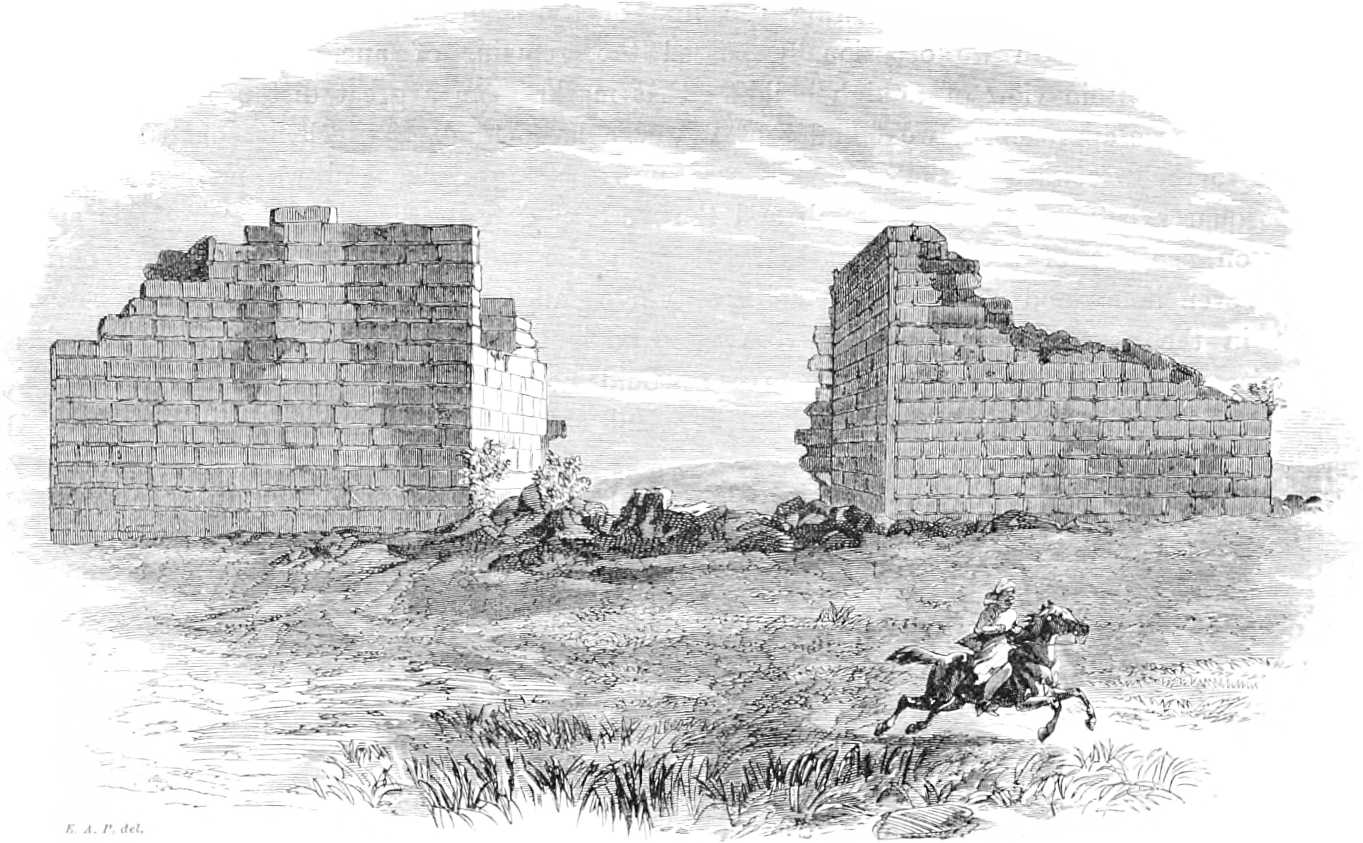
Plate 51.—Gateway in the Western Wall of Ptolemais.
Close by the entrance to the reservoirs stand three Ionic columns, the most conspicuous objects among the ruins of the city. They seem to have formed part of a colonnade which surrounded a space paved with mosaic immediately over the reservoirs. There are some Corinthian and Doric columns lying on the ground, which also appear to have formed part of the same colonnade. There is no trace of building within the inclosure.
Between the reservoirs and the sea are the remains of a very large building, the walls of[67] which are still standing to a considerable height, although there is nothing left to denote with certainty what the nature of the building was. It may, very probably, have been a Roman bath.
Pl. 52.
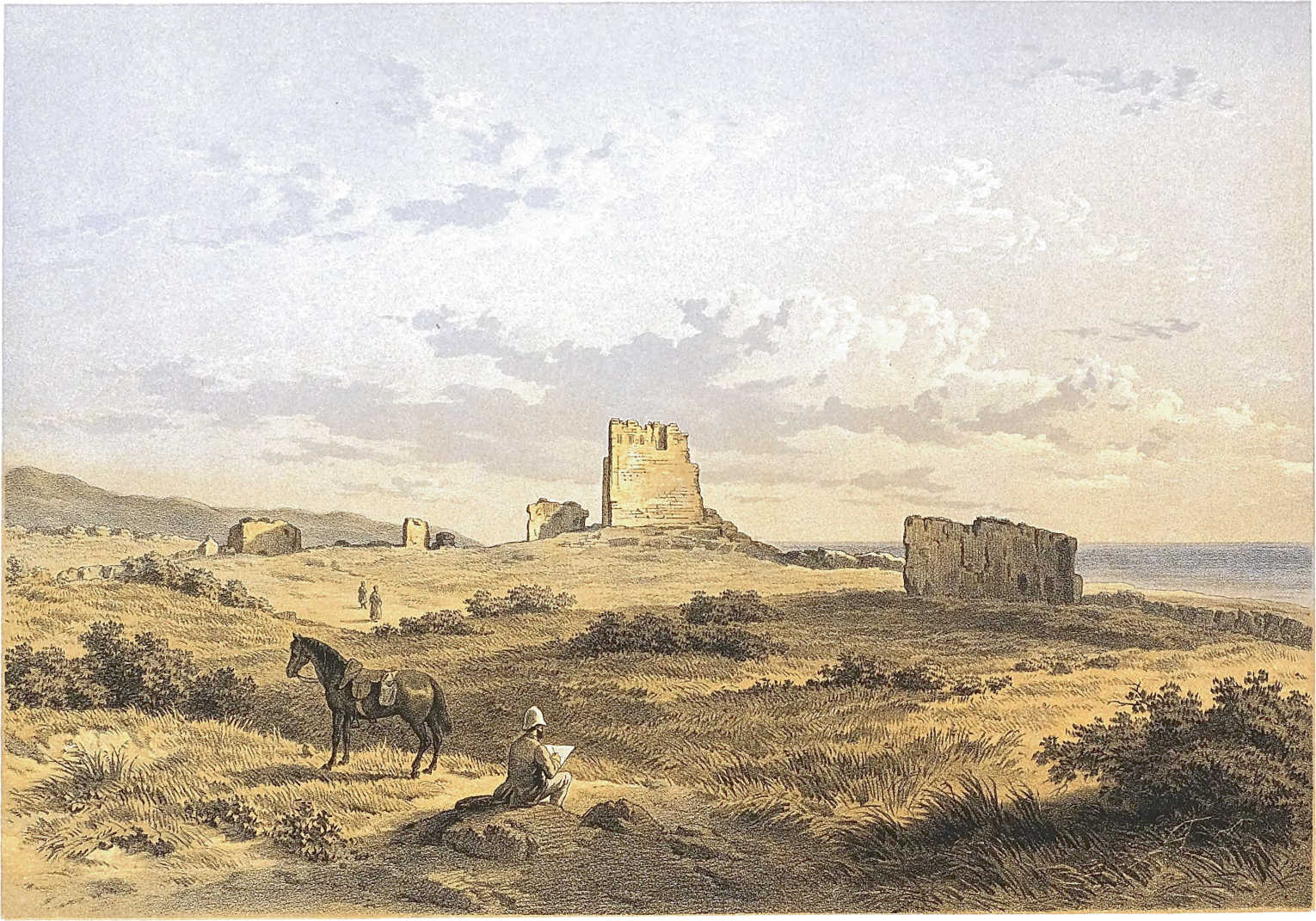
| E. A. Porcher, delt., T. Picken, lith. | London. Published July 1st. 1864 by Day & Son, Lithographers to the Queen &c., Gate Street Lincoln’s Inn Fields. | Day & Son, Lithrs. to the Queen |
TOMBS TO THE WESTWARD OF PTOLEMAIS
PTOLEMAIS.
PLAN OF A CONSPICUOUS TOMB ON THE WESTERN SIDE OF THE CITY.
BY COMMANDER E. A. PORCHER R.N.
Pl. 53.
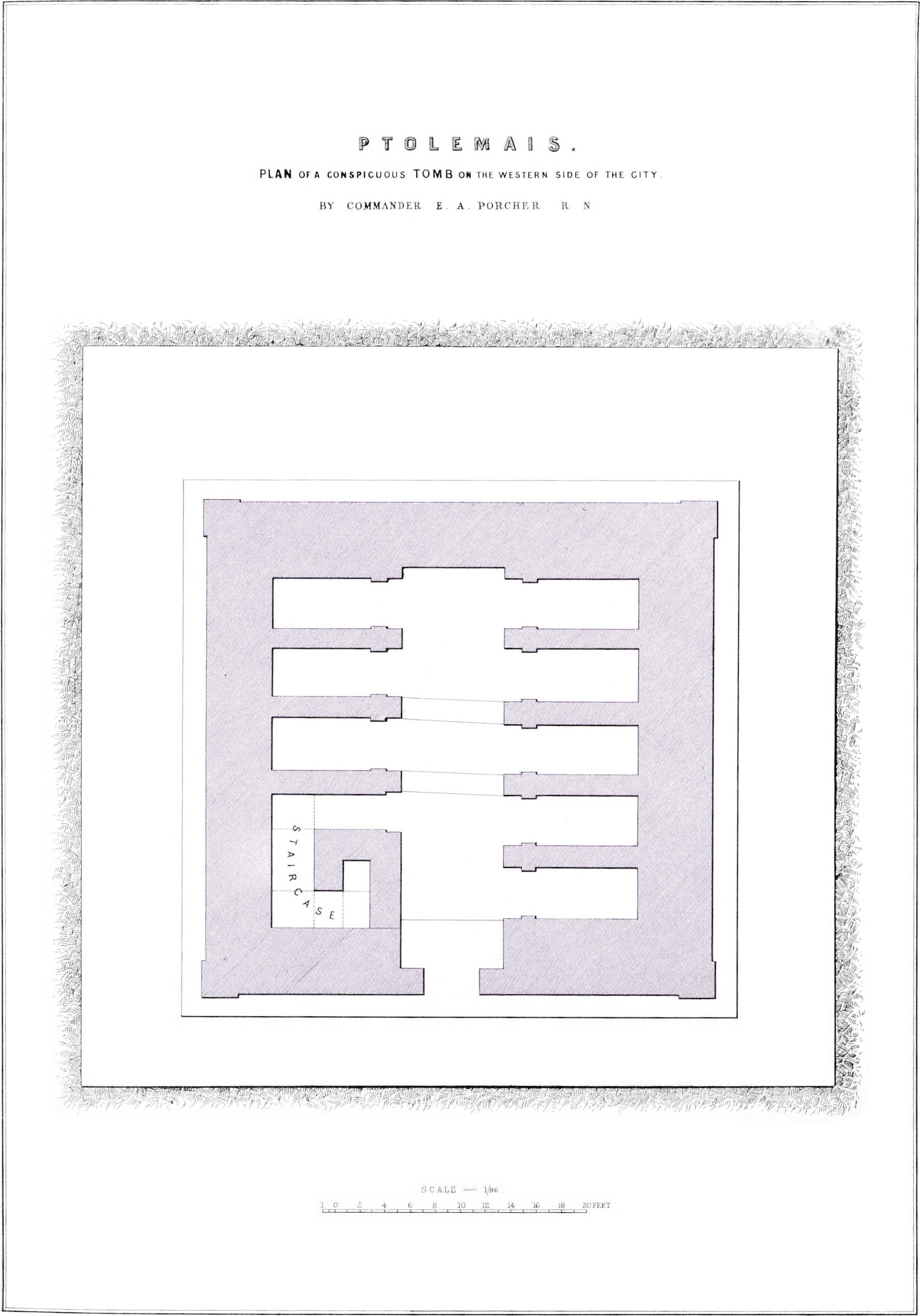
Day & Son, Lith. to the Queen
Close to where the western wall touches the shore, there is a small harbour protected by a projecting point of land, and a small rocky island, which were at one time connected by an artificial pier. The space thus inclosed is so shallow, and so limited in extent, that it can only have been available for a few light vessels.
Of all the remains of Ptolemais, the most prominent is the large tomb to the westward of the city, which we passed on the evening of our arrival (Plates 52 and 53). It is 55 feet in height, and is still in very perfect condition. It is built on a square platform of rock with scarped sides, about five or six feet above the surrounding ground, and contains a central chamber which occupies the whole length of the tomb, with lateral recesses for the reception of the sarcophagi. Close to the entrance is a staircase, which we found sufficiently perfect to enable us to climb to the top. In the neighbourhood are a number of quarries containing excavated tombs similar to those at Teuchira, many of which have the names of the occupants inscribed on the face of the rock.
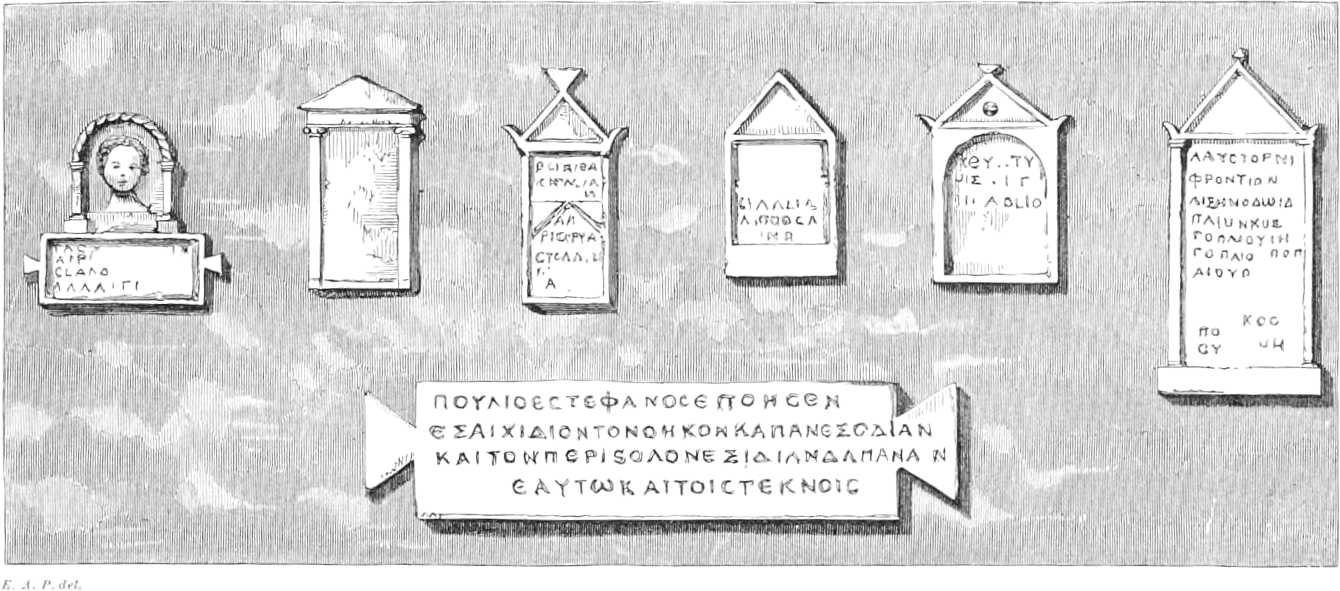
Plate 54.—Inscriptions over the Entrances to the Tombs at Ptolemais.
Our last night at Ptolemais was a very uncomfortable one, on account of a very strong gibli, or southerly wind, which nearly choked us with clouds of dust and sand, and necessitated our turning out every half-hour to hammer in the pegs of the tent. We packed up at daybreak, and after paying a last visit to the ruins, started for Merdj about the middle of the day on the 21st. After riding about two miles to the westward of the city, we turned up one of the wadys to our left, and commenced the ascent of the Augubah. The strong gibli was still blowing, so that although we were greatly sheltered by the range of hills, it made our journey very fatiguing and unpleasant. When about half-way up, we found that our guides had mistaken the path, and brought us to a regular cul de sac, from which there was no exit but by returning as we came, or climbing what appeared the insurmountable hill in front. We chose the latter alternative, and after nearly an hour’s exertions, reached the top with our horses, where we lay down under some bushes to wait for the camel. We soon found, however, that it was impossible to get him up, so we left the drivers to seek the proper pass, while we rode on in the direction of Merdj. It was difficult to find a way across country among the almost impassable wadys by which we were surrounded; but after a two hours’ ride we had the satisfaction of seeing before us the great[68] plain of Merdj, dotted over with Arab camps. Thoroughly parched by the exertion of climbing, and the burning heat of the gibli, we hurried to the nearest tents for something to quench our thirst. The cool fresh leben, which was readily offered us by the women, was peculiarly refreshing.
A little after sunset we reached the castle, where we were greeted by the cheery welcome of our kind friend Hadji Achmet. A really sumptuous dinner of bread, rice, mutton, and eggs, was soon prepared and most heartily partaken of. Fatigued as we were with a hard day’s work after a sleepless night, we thoroughly enjoyed the luxury of sleeping on the soft bed-quilts so mindfully provided by our host.
The camel with our baggage arrived the following day at 11 o’clock; and about the same time Amor, whom we had sent with letters from Teuchira to Benghazi, made his appearance. As there was now nothing to detain us, we started at three in the afternoon for Cyrene, after taking leave of Hadji Achmet, who, as usual, loaded us with presents of corn and provisions. The hot gibli was now blowing more fiercely than ever, and felt as if it came from the mouth of a furnace. The air was so thick with impalpably fine sand that even the sun was invisible. Several square miles of the plain around us were covered with magnificent crops of nearly full-grown wheat, which I found, on a subsequent visit, were utterly destroyed by this day’s gibli. Between nine and ten o’clock we reached the Libiar Il Gharib, near which we passed the night in a hollow of the rock, which was preferable to the tent during the hot wind. Wrapped up in our burnouses, we slept soundly, notwithstanding the rain which came on in the night, and from which the overhanging rock only partially sheltered us. The following day we continued our journey, and encamped at night at our old halting-place, Gusr Biligadem. The gibli had by this time given way to a fresh cool breeze from the north, which completely transformed the aspect of the country. Next day (the 24th) we reached our quarters at Cyrene, glad to find ourselves again at home. During our absence of twelve days, we had travelled over about 250 miles, the distance in hours being as follows:—
| From Cyrene to Zauyah El Beidah | 3½ | hours. |
| „ „ Gusr Biligadem | 9 | „ |
| „ „ Gusr Merdj | 25 | „ |
| „ Merdj to Teuchira | 7¾ | „ |
| „ Teuchira to Ptolemais | 7½ | „ |
| „ Ptolemais to Merdj | 5½ | „ |
| „ Merdj to Libiar Il Gharib | 7 | „ |
| „ „ Gusr Biligadem | 16 | „ |
During the fortnight that elapsed between our return to Cyrene and the arrival of the Assurance, a serious disturbance arose in the country, caused, as already mentioned, by the appointment of Bou Bakr Ben Hadood as the official adviser and associate of the new Mudir of Ghegheb. According to custom, the sheikhs of the different tribes, and among others the ten sheikhs of the Haasa, among whom we lived, went to the castle to pay their respects to the newly-appointed governor. Before this time, however, Bou Bakr had told the Mudir that the Haasa sheikhs were a rebellious, turbulent set, whom he should seize and imprison on the first favourable opportunity. Their coming to the castle on a peaceful errand was accordingly taken advantage of for carrying this sage advice into execution. The men of the tribe, on learning that their sheikhs had fallen into the power of their old enemy, appealed to us for assistance, and requested us to write to the consul at Benghazi, to obtain the liberation of their chiefs. We told them that, as the matter in no way concerned ourselves or any one in our service, it was impossible for us to interfere. They thereupon called a medjlis, or assembly of the whole tribe, in[69] which it was determined to release the sheikhs by force before further evil should befall them. They accordingly assembled, to the number of about 1,000, in the neighbourhood of the castle, and attacked it at midnight. The gate soon yielded to their blows, and the garrison was at their mercy. Some firing had meantime taken place, in which six Arabs and two soldiers were killed or wounded. The prisoners were immediately released; but the castle was searched in vain for Bou Bakr, who had wisely retired the day before to the camps of his own tribe of Birasa.
The sheikhs, however, were no sooner at liberty than they began to reflect on the unpleasant position they were placed in by the rash zeal of their followers. The Sultan’s castle had been attacked, and the Sultan’s soldiers killed; and although they themselves had been prisoners at the time, they knew that it would be vain to disavow their complicity in the act of their tribe. Such an open and violent insult to the Government must, they feared, be in some way avenged by the Pacha, who might possibly send hosts of soldiers to exterminate the tribe. At all events, they would suffer severely by being excluded from their only markets, Benghazi and Derna, by the fear of their falling into the hands of the Pacha. A Medjlis was called to deliberate on their difficulties, at which it was determined to make a second application to us for assistance. The sheikhs accordingly came to our quarters, and in the name of the whole tribe begged us to intercede in their behalf. They urged that they had been imprisoned simply to gratify Bou Bakr, and for no offence of their own; nevertheless, that, to preserve the peace, they had represented to the Mudir that they could not answer for the consequences if at least one of their number were not allowed out of prison to control the passions of the Arabs, while the remaining nine were retained as hostages. As this was refused, and they were all kept in close confinement, they knew nothing of what was going on until they heard the firing and battering at the gate of the Castle during the assault. It would, therefore, be unjust to punish them for a crime of which they were perfectly innocent, and it would even be hard to hold the tribe responsible for its actions when suddenly and treacherously deprived of the advice and guidance of their only chiefs. It was certainly wrong to attack the Castle; but what was to be expected in the circumstances; and had they not warned the Mudir of the consequences of his own act? Besides, by appealing to us in the first instance, the tribe had taken the only peaceable means they had of obtaining the release of their sheikhs.
We asked them why they did not tell or write all this to the Pacha, who was the proper judge of their conduct. Their answer was, “You know yourselves well enough what the result would be; our remonstrances would never be listened to, and we or our messengers would only be seized and imprisoned with irons: our only hope in a case like this is in the Consul.” We said that if the Consul interfered, the Pacha had a perfect right to say, “Are the Haasa Arabs Englishmen? This is none of your business.” “There is no chance,” replied they, “of his saying anything of the kind; when the Consul speaks, the Pacha must obey.”
As we knew very well that the Pacha had not the power to punish the tribe, we thought it probable that he would be glad of any excuse for saving his dignity by pardoning the offence. We therefore believed that our intercession would be as welcome on the one side as on the other; and, if successful, that it would be most useful to ourselves, by establishing our influence over the tribe in whose country we resided.
Mr. Crowe having left for England, we wrote to the above effect to Mr. Aquilina, then acting as vice-consul at Benghazi, and requested him to use his own discretion in bringing the matter before the Kaimacam. He immediately called at the Castle, and read a translation of our letter to the Kaimacam, who, as we had conjectured, readily promised to pardon the tribe. We soon after received a letter from the Kaimacam himself, informing us that, in consequence of our intercession, he had been pleased to forgive the Haasa the very serious crime of which they had been guilty, on condition of their good behaviour and prompt payment of the Miri in future.
[70]This letter reached us soon after the arrival of the Assurance, when Mr. De Fremeaux was with us on a visit from Derna. Immediately after its receipt, we summoned the sheikhs to a meeting, at which Mr. De Fremeaux read and explained the letter of the Kaimacam. Highly delighted with the happy termination of their difficulties, they were profuse in their expressions of thanks, and said that they and their tribe were now our servants for ever.
Immediately after our return from Ptolemais, and before the above disturbances took place, we went to pay a visit to the Mudir at Ghegheb, where we also found Bou Bakr and some of his sons. Although nearly seventy years of age, he seemed as strong and active as a man of thirty. It is said that although Cyrene was the site selected for the existing castle, Bou Bakr, who was Mudir at the time of its erection, had it built, for obvious reasons, in the territory of his own tribe at Ghegheb. It is exactly similar in construction to the Castle of Merdj, and stands on a slight eminence in a sheltered position surrounded by hills. The country in the neighbourhood is bare and desolate; the only recommendation of the site being an abundant spring of excellent water, which issues from the rock under the southern wall of the Castle. About seven miles and a half from Cyrene, we passed a most remarkable place, called by the Arabs Safsaf, where there are a number of reservoirs similar to those at Ptolemais, but on a much larger scale. One of them, which is cut in the rock and lined with cement, is about sixty yards in length, and is still in very perfect condition. It is covered with a continuous semicircular arch, which springs from near the ground-line. Although in a great measure filled up, it contained a large quantity of water when we saw it. These cisterns appear to have been built by the Romans for the supply of Cyrene, as an aqueduct may be traced a great part of the way to the large reservoirs, also Roman, at the south-east corner of the city. Safsaf was evidently chosen as the site of the waterworks of Cyrene on account of its position, which is rather above the level of the city, and is surrounded by higher ground, which could be easily drained into the reservoirs. The distance is considerable; but there is no other point nearer Cyrene so well adapted for the purpose.
CYRENE.
PLAN OF THE LARGE TEMPLE AT THE N.E. END OF THE CITY NEAR THE
STADIUM.
BY COMMANDER E. A. PORCHER R.N.
Pl. 55.
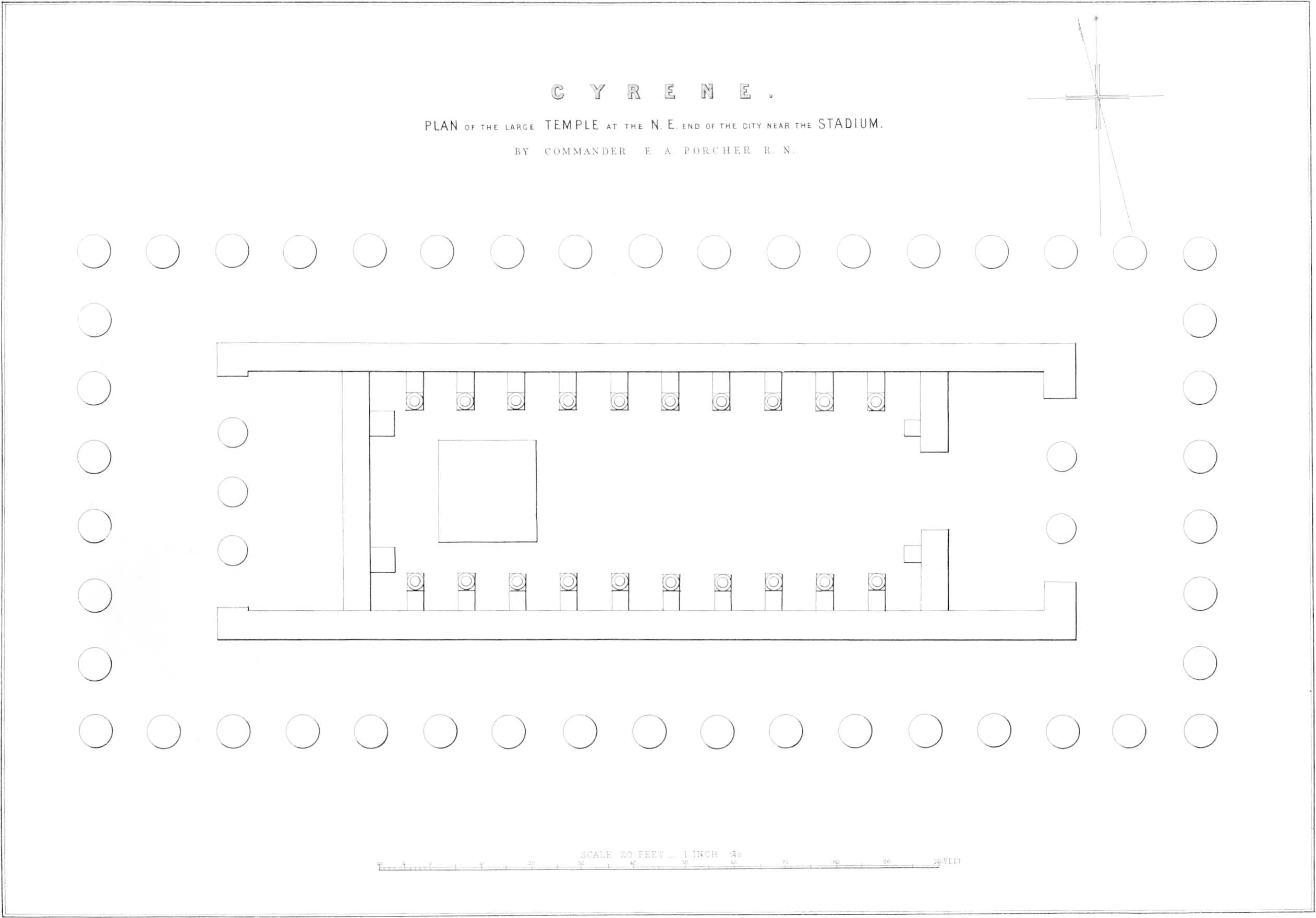
Day & Son, Lithrs. to the Queen
[71]CHAPTER XI.
IT will be remembered that while the Assurance was with us, seven blacks, sent by Mr. Aquilina, arrived from Benghazi, and assisted in the transport of the statues. With these men we recommenced work on the 9th of June, by beginning the excavation of the large temple in the eastern part of the city, near the Stadium. The site seemed very promising, both on account of the extent and the apparently undisturbed state of the remains of the building. In fact, we had been prevented solely by want of workmen from digging here long before, as the temple was by far the largest, if not the most important, in Cyrene. We began as usual at the western end of the building, where we soon came to a large pedestal, 20 feet square, and 10 feet in height above the pavement. The total length of the temple, which consisted of Pronaos, Cella, and Posticum, was 169½ feet, by 58 feet in breadth. The interior of the Cella, 108 feet in length, was ornamented on each side with a marble colonnade of the Corinthian order. The bases of most of the columns were found in situ on square pedestals, projecting from the lateral walls. They were two feet in diameter, with an intercolumniation of seven feet. The wall of the Cella was built of stones of immense size, the surface of some of them measuring upwards of 40 square feet. Enough of the wall was left to show the manner in which it was built. The courses were alternately of long blocks of stone, about a foot deep, and equal in breadth to the thickness of the wall, and of large slabs laid on edge, back to back; care being taken to have the work well bonded. The marble peribolus wall of the Mausoleum at Halicarnassus was built in an exactly similar manner, strength being, in both cases, sacrificed to appearance.
The exterior colonnade consisted altogether of forty-six columns; viz. seventeen on the sides and eight on the ends or fronts of the building. As in all the temples of Cyrene, the entrance was in the eastern front. The order was Doric, and the stone was the same as that of the temples of Bacchus and Apollo. As nearly as we could make out, the columns, which were fluted, were six feet in diameter at the base; but as they were much worn away, it was impossible to measure them very exactly. They had all fallen outwards, and many of the capitals, measuring nine feet in diameter, were to be seen cropping out above the surface of the ground. The architraves and beams must have been of great size, as the columns were 14 feet apart centre from centre, and 18 feet from the face of the wall of the Cella. The building stood within two degrees of due east and west.
In the course of our excavations we came upon innumerable fragments of sculpture, evidently of excellent style; but nothing was found in the least degree perfect. Amongst them we found, in the middle of the Cella, between the pillars, a male head in white marble, much mutilated, being nearly cracked in two and the nose broken off. It had been well executed, and the lips still retained a bright light-red colour. This head is rather larger than life. Even the marble columns of the interior of the Cella were broken in small pieces, which could not have been the result of natural causes. Although the appearance of the remains clearly showed that the temple had been wantonly destroyed by the hand of man, the discovery of fragments of good style induced us to continue the excavation of the building.
In the Pronaos, and close to the entrance, we found a block of marble measuring 4′ 6″ × 2′ 1″ × 1′, with the inscription given in Plates 78, 79, No. 6, and on the opposite side of the Pronaos, a smaller slab, measuring 1′ 4″ × 1′ 3″ × 3″, with the inscription in two columns given in Plate 79, No 7. Both these contain lists of names, probably of persons contributing to some public subscription.
[72]We also found fragments of an inscribed architrave of sandstone, and some pieces of copper and iron; among which may be mentioned a circular piece of iron, half an inch in thickness, with two handles like a small tub without a bottom. It was 8½ inches in diameter, and 6½ inches in height.
As there was no hope of finding anything undestroyed, we abandoned the building, after spending seven weeks in its excavation, the only part left unfinished being the centre of the Cella, which was covered with enormous blocks from the side walls. Outside the Cella, we only dug sufficiently far to discover the exact positions of the columns of the peristyle.
On the 17th of June, only nine days after the departure of the Assurance, we were most agreeably surprised by the unexpected appearance at our tomb of a large party of naval officers, consisting of Captain Jones and some of the officers of H.M.S. Scourge. They were the bearers of a telegram and a letter from Mr. Panizzi, by which we were informed that the trustees of the British Museum had voted us a further sum of £500, and had sent out a carpenter, Mr. Wm. Dennison, to assist in packing the statues, &c. He arrived in the Scourge, and remained with us till our departure from the country. Although there was little carpenter’s work to be done till near the close of the expedition, he was of great service in superintending the workmen.
The Scourge had anchored off Marsa Sousah early in the morning, when Captain Jones and the rest of the party immediately started for Cyrene, guided by the directions given them by the officers of the Assurance. They lost their way, however, in climbing the Augubah, and did not reach Cyrene till nearly sunset, much fatigued by their long day’s wandering under a burning sun.
The following day, the 18th of June, being the anniversary of the birth of the Prophet, there was a great gathering of the Arabs on the upper plateau near Cyrene to celebrate the festival of the Melood, which we attended as spectators by the invitation of the sheikhs. When the men were all assembled, they dismounted and ranged themselves in a line of two ranks, with their horses picketed in the rear. A long prayer was then repeated aloud by the whole line, who made the usual prostrations together, like a regiment at drill. Prayers over, they remounted their horses, and the tournament began. An open level space being chosen, those about to engage in the games placed themselves in two irregular lines, facing each other, about 150 yards apart, the mere spectators like ourselves remaining at the sides. The object of the game, or rather exercise, is to show the skill of the rider in handling his weapons and directing his horse when at full gallop. A man, for instance, breaks out from one of the lines, and canters carelessly toward the other. Presently another horseman dashes after him in pursuit, and they tear along, ventre à terre, till they come close up to the opposite line, when they unsling their guns, aim, and fire at each other, at the same moment wheeling sharply to the right-about to avoid running into the line in front. At other times a number of men gallop straight up to the opposite line, deliver their fire, and wheel when at full speed, within a yard or two of the stationary line. Sometimes two horsemen engage in a sort of running duel, each man riding at full speed, and using pistols, blunderbuss, gun, and bayonet. Collisions at the wheeling-point were not unfrequent; and as the horses were always going at a great pace, it was wonderful that no one was killed. Some of the men were bruised and their horses lamed, and one man had several ribs broken. In consequence of the general introduction of firearms, this kind of amusement has taken the place of the older lance exercise and the throwing of the jereed.
The Scourge being about to proceed to Alexandria to assist in laying the Malta telegraph cable, Captain Jones kindly offered to give us a passage to Derna if we wished to revisit that place. As we were in want of a number of things, we were glad to avail ourselves of the opportunity of going. We accordingly left Cyrene with Captain Jones and the other officers[73] on the afternoon of the 18th, and got on board the same night. We started the following morning at daybreak, and anchored off Derna late in the afternoon, when we went ashore, and occupied our old quarters at Mr. De Fremeaux’s house, the Scourge leaving soon after for Alexandria. Captain Jones had previously most kindly allowed us to take from the ship everything likely to prove useful to us. We remained at Derna two days, buying articles in the bazaar, and waiting for our horses and camels, which we had sent by land from Cyrene. When these had been somewhat rested after their arrival, we started on our return journey, and by travelling all night, with only an hour or two’s halt, reached Cyrene within twenty hours. Among other things which we brought from Derna were some thin deals, with which we furnished our tomb with a table, shelves, &c.
By this time our money was beginning to run short, and we hardly knew how we were to get a fresh supply. The trustees of the British Museum having given us authority to draw bills on them to the amount of £500, we were anxious, if possible, to get more workmen, and carry on our excavations on a larger scale during the remaining months of summer. As writing was apt to cause delay, I determined to go to Benghazi myself for the purpose of getting both money and men. I started on the afternoon of the 6th of July, accompanied by a single mounted Arab; and as time was now an object of great importance, I took no camels, and consequently had neither water nor baggage of any kind. By halting only a few hours each night, I reached Merdj at mid-day on the 8th, and left the same evening for Benghazi. Travelling all night and all next day, we arrived at Benghazi shortly after sunset on the 9th; thus accomplishing the whole journey of 160 miles in three days, and without water after leaving Merdj on the evening of the 8th. It was, of course, most fatiguing work both for man and horse, especially during the day, when the heat of the sun and the want of water were together almost intolerable.
As it would have been unsafe to carry a sum of money with me, Mr. Aquilina gave me two orders, one on Mr. De Fremeaux, at Derna, and the other on our friend Mohammed El Adouly, from both of whom we were to draw the amount in instalments as we required it. This proved, as was to be expected, a most convenient arrangement, although a Bedouin camp seemed an odd place for negotiating bills and keeping a banker’s account.
I had no difficulty in getting as many workmen as I wanted. The morning after my arrival Mr. Aquilina sent for the Sheikh Il Abid, or chief of the negroes, and told him that I wanted twenty good strong blacks to go to Cyrene, on the terms of five Turkish piastres (10d.) a day and food for each man. These wages were very high for the country; but we had found it impossible to keep men at Cyrene, at such a distance from their wives and families, except by paying them so highly that they did not like to give up the work; and it was always difficult to get workmen to supply the places of those who left, as the blacks were afraid to come to Cyrene by themselves, on account of the danger of being seized and re-enslaved by the Arabs on the way. It was therefore advisable to pay such wages as would not only induce the workmen to remain with us after they came, but, by making dismissal from our service a severe punishment, would give us the means of enforcing obedience.
At an appointed hour, the Sheikh appeared at the Consulate with fifty or sixty men, all eager to be engaged; but as it would have been difficult to feed such a number, and as we had only a very limited supply of tools, I at first selected only twenty. Before leaving Benghazi, however, I was induced to take eight more, which, with the seven we already had at Cyrene, made up our number to thirty-five.
Soon after my arrival at Benghazi, I was visited by the Kaimacam in state, attended by the “heads of departments;” viz. the Colonel commanding the troops, the Cadi or Judge, the Collector of customs, and the Sheikh El Beléd, or chief of the town. Suliman Captan and some of the principal Arab inhabitants also called; so that I was obliged to devote an entire day to returning[74] the visits. I found that the arrival and stay of the Assurance had become magnified by report into a much more formidable affair than it was. The Kaimacam told me that he had been officially informed that an English fleet had come to Marsa Sousah and disembarked several thousand soldiers, who were to be employed in occupying the country; and that the laying of the telegraph was only a part of a general scheme of conquest. I had some difficulty in disabusing his mind of the impression that we had some ulterior object in view in the works we were carrying on at Cyrene. Our statues and waggons, according to the general belief, were artillery; our road to the coast, a military one for the use of the army of occupation; and our excavations, forts and batteries.
There was, of course, considerable delay in getting fairly started on the journey from Benghazi with such a number of blacks. By Mr. Aquilina’s advice I gave every man a small advance of pay, to enable him to get his own provisions for the journey; thereby saving me the trouble of providing for such a number. As there were no water-skins for sale in the bazaar, I had to send all over the town to get a sufficient number, and the endless debates with camel-drivers had to be undergone as usual.
At last, everything being ready and the men collected, we started on the afternoon of the 12th, and after filling the water-skins at the Garden of Osman, halted for the night near the foot of the Augubah, about six hours’ distance from Benghazi. Although the blacks knew there was no more water to be got till we reached Merdj, it required the greatest vigilance to keep them from drinking the whole of the contents of the girbehs before the morning. About mid-day on the 14th we arrived at Merdj, where I was very sorry to find our good friend Hadji Achmet Bin ’l Agha suffering from a violent attack of fever. Long before our arrival, the blacks, with their usual improvidence, had eaten all the food they had provided for the whole journey, and I was obliged to look out for a fresh supply. There was no bread to be had; but I fortunately got a sufficient quantity of dates to serve for the remainder of the distance.
After halting a day at Merdj, we resumed our journey at daybreak on the 16th. Shortly after passing the Libiar Il Gharib in the afternoon, I happened to be riding by myself through a wood about a mile ahead of the caravan, when my attention was attracted by about a dozen Arabs seated under a tree near the path, with their horses standing beside them. They looked rather suspicious, and commenced talking rapidly to each other as I came up; but as this was nothing unusual, I rode on, thinking that they were probably a travelling party halted for a rest. In a few minutes, however, I heard a loud shouting and screaming in the rear, and on hastening back to see what was the matter, I saw the negroes running in all directions, and in such a state of terror that it was some time before I could make out what had happened. I finally learned that the Arabs whom I had passed in the wood, had charged into the straggling caravan, and seized one of the negroes. While some of them were binding him on the back of a horse, the others formed a circle round him with their bayonets at the “charge,” and threatened to shoot any one that interfered. When their prisoner was secured, they rode off with him into the wood, and before I came up they had all disappeared. In the course of the evening I found out with some difficulty who the perpetrators of the outrage were; but although I at once wrote to Benghazi, nothing was ever done in the matter, the Kaimacam being unwilling, or more probably unable, to apprehend the offenders.
Next day we passed Gusr Biligadem, and leaving the caravan, halted near the Zauyah El Beidah: I rode on the same night to Cyrene. The blacks arrived the following day, and told me that the Achwani of the Zauyah had refused to give them even a drop of water, because they were in the service of “Christian dogs.”
By the time I reached Cyrene, the excavation of the large temple near the Stadium was almost finished, and the smaller temple near it had just been commenced. Before we had dug[75] far, we found unmistakeable proofs that the latter building, like the former, had been purposely destroyed. It was built on a small rocky eminence which commands one of the finest views to be had within the walls of the city. The Ædes, consisting of Cella and Pronaos, occupied the summit, the surrounding rock being cut in terraces, so that the peristyle was on a lower level than the Ædes. Like other temples, it stood nearly east and west. In the western end of the Cella were two courses of a pedestal measuring 26 feet by 15, a little to the east of which the floor of the Cella sank two feet. The eastern front had so entirely disappeared, that a satisfactory plan of the entrance could not be made, and the positions of the columns marked on the Plan are partly conjectural. The columns themselves, many fragments of which were lying around the temple, were deeply fluted, and of the Doric order, and measured 4 feet 5 inches in diameter. In the eastern or lower part of the Cella we discovered a few fragments of sculpture of very fine style, but so small and so few in number, as to make us only sorry that there were no more. The most perfect of these fragments were two small marble statuettes, probably of Venus and the nymph Cyrene, which have been photographed together (Plate 67); and perhaps the most remarkable were three or four parts of a colossal male head now put together in the British Museum. As it measures 1 foot 8 inches in height, the statue to which it belonged must have been 11 or 12 feet high; but not another fragment of it was to be seen.
CYRENE.
PLAN OF THE SMALLER TEMPLE NEAR THE STADIUM.
BY COMMANDER E. A. PORCHER R.N.
Pl. 56.
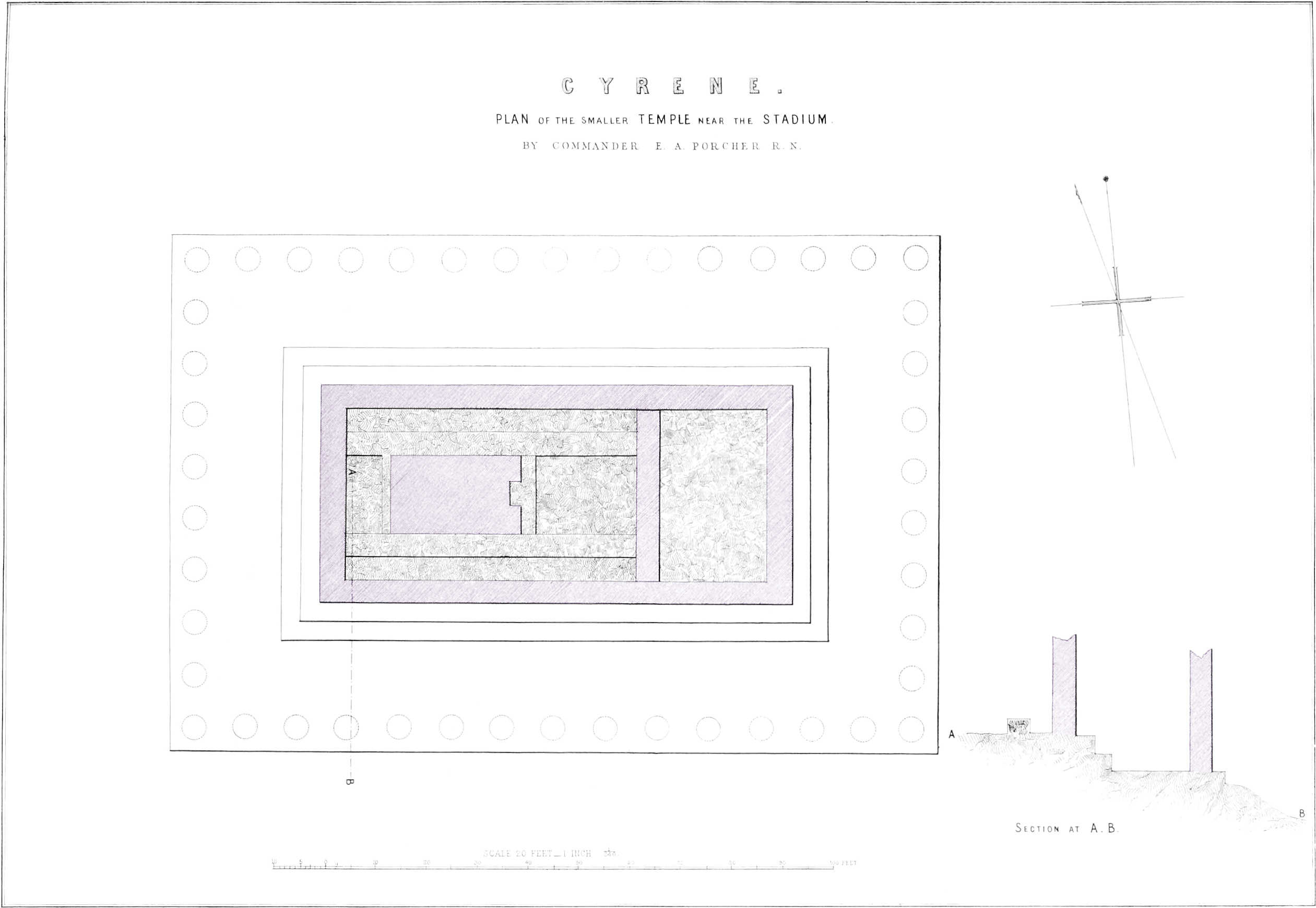
Day & Son, Lithrs. to the Queen
Shortly before this time, we had discovered a statue of Minerva, and another female dressed statue, rather larger than life, at the place marked on the Plan “Statue of Minerva.” Both statues were but little injured, so that we hoped, by digging some distance round the place, to find the heads. We therefore employed more than half our force in excavating at this place and at the other points near it marked on the Plan; but we discovered nothing. The removal of the two statues to our tomb was the first occasion on which we made use of the stone-trucks brought by the Assurance. In the course of the excavations, we found several frusta of fluted marble columns, which no doubt formed part of the building to which the statues belonged. The small building between the statue of Minerva and the wall of the citadel was probably a monument.
On the 31st of July we returned with our whole force to the Temple of Apollo and its immediate neighbourhood. As already mentioned, it was only now that we were able to complete the excavation of that building. Besides the sculptures found in the Temple itself, we discovered on its northern and eastern sides altogether four statues, four statuettes, fourteen heads of different sizes, and seven inscriptions. A seated figure, rather larger than life, which was lying on the surface, was noticed by Beechey, who thought it was Diana; but which we made out to be Archippe, of the family of the Ptolemaic dynasty, from the following inscription on the base:—
![[JPG]](images/insc3.jpg)
It was in a very imperfect state of preservation, owing to its long exposure on the surface of the ground.
Near it we found what appeared to be a copy of itself on a small scale, so much alike in every respect were the two figures. The girdle encircling the waist was distinctly striped on both edges with bright vermilion. The most remarkable of the large statues found at this place was a colossal female figure, seven feet in height, in very good condition; most probably a portrait of one of the queens of Egypt (Photograph Plate 68). The head was separate, and the body broken in two, the lower half of which was found in an upright position, and the upper half lying across it, with the head on the top. Another statue, life-size, discovered here, was a draped figure, the portrait of an old man; and among the smaller statues may be mentioned a nude figure of Bacchus, 3 feet 7 inches in height.
At the western end of the platform, near the large theatre, we excavated the small building[76] marked on the Plan, in which we found a statuette and some small marble heads. We also examined the ruins toward the eastern end of the platform, but found no traces of sculpture in any of them.
We finished the above excavations near the Temple of Apollo on the 14th of August, after which we tried nine separate buildings in different parts of the city without success. On the 23rd we commenced the excavation of the building to the westward of the Temple of Bacchus, marked “Palace” on the Map. Our attention was attracted to this place by the torso of a Roman emperor in armour, which had been seen forty years before by Beechey, who was of opinion that it was the statue of one of the Ptolemies. Considering the number of years it must have lain exposed on the surface of the ground, the marble was in a wonderfully good state of preservation. After removing it to our tomb, we commenced digging in the immediate neighbourhood of the spot in which it was found. In the course of our excavations we found traces of a large building consisting of several rooms, some of which had their walls and floors veneered with thin slabs of marble. The division of the building into separate rooms, its central and prominent position in the city, and the nature of the sculpture we discovered in it, led us to believe that it had most probably been the palace of the Roman governor. Lying on the floor about four feet below the surface, we found a large female draped statue in very good condition, measuring 5 feet 11 inches in height, but without the head, which we failed to discover. We also found busts, life-size, of Antoninus Pius and another Roman emperor, quite uninjured (Photograph Plates 69 and 70); a female bust well preserved, three heads, and three inscriptions. These sculptures, as they were found, were all thickly coated with an incrustation of sand and lime, which has been most successfully removed in the British Museum by frequently steeping them in warm water.
From the 3rd of September little excavation was done for a fortnight, most of our workmen being employed in improving and repairing the road to Marsa Sousah, preparatory to the removal of the statues when a vessel should arrive. The point that particularly required our attention was the Augubah, near the shore, which had caused so much trouble and delay when the Assurance was with us. On that occasion, we had discovered the track of the ancient road winding round the faces of the hills at a comparatively easy slope; and we now resolved to make it, if possible, practicable for the waggons. In many parts it was almost quite hidden with brushwood, and in others it had totally disappeared, owing to the slip of its embankment or retaining-wall, caused by the rush of water down the steep face of the hill during the heavy rains in winter. By clearing away the brushwood, restoring cuttings and embankments, and in some places making an entirely new section, we succeeded in forming a road by which it was possible to take the waggons up and down the mountain without resorting to the laborious and tedious expedients which we had formerly been obliged to adopt. We also cleared and improved our old road the whole way from Cyrene.
Meantime, a few men had been employed digging at the site marked “Temple of Venus,” a little to the south-west of the Temple of Bacchus. When the road to Marsa Sousah was finished, we employed all the workmen at this building, the excavation of which we had barely finished when H.M.S. Melpomene arrived on the 26th of September. Of the temple itself nothing but the foundations remained, although it yielded a large amount of sculpture.
The Ædes, which consisted of Cella and Pronaos, was 84 feet in length by 35 feet in breadth. No trace of a peristyle could be found. The floor of the western half of the Cella was on a higher level than that of the rest of the building, access being had to it by flights of steps in front and at the sides, as shown in the Plan and Section. At the corners of the steps were two circular pedestals, on the northern of which faint traces of an inscription could be seen, although it was too much worn away to be deciphered. In the eastern part of the Cella were six large pedestals of sandstone in situ, on which, in all probability, stood the statues which we found[77] near them. As the floor of the Temple was covered with only three or four feet of soil, we completed the excavation of the whole building in little more than a week. We found statues and other pieces of sculpture in every part of it, but did not discover either the principal statue or any inscription by which the Temple could certainly be identified. Our reason for calling it the “Temple of Venus,” was that we found in it altogether statues or statuettes of that goddess. One of these, a small nude figure of Venus Euploia, is remarkably graceful (Photograph Plate 71). In some of the other figures she is represented half-draped, with Cupid by her side, seated on a dolphin (Photograph Plate 72). Three of the statues discovered in this temple were life-size, or rather larger. One of them is the figure of a female, perhaps a queen, with a very peculiar head-dress (Photograph Plate 73), and the two others, which may be called a pair of statues, represent hunters equipped for the chase. The smaller statues, besides those of Venus, were, one of Pan, 3 feet 11 inches in height, and a draped one, 4 feet 8 inches in height, of Apollo or Aristæus resting on a rod encircled by the coils of a serpent. Both of these figures were all but perfect, and that of Pan still retained much of its original colouring. We also discovered three female busts in very perfect condition, two of which, of life-size, had curious high head-dresses, somewhat Elizabethan in appearance (Photograph Plate 74). The other, which is considerably smaller, is of a peculiarly transparent marble resembling alabaster. Some heads were also found besides those belonging to the statues and statuettes; among which may be mentioned a perfect one of Minerva, smaller than the similar head found in the Temple of Apollo, and a small marble head of Perseus (Photograph Plate 75). A slab of marble was also found, containing in relief a representation of Libya crowning with laurel the nymph Cyrene, who is in the act of strangling a lion (Photograph Plate 76). Beneath the group, and on the same slab, are four lines of inscription which explain the allegorical myth which forms the subject of the sculpture.
CYRENE.
PLAN OF A TEMPLE TO THE S.W. OF THE TEMPLE OF BACCHUS.
BY COMMANDER E. A. PORCHER R.N.
Pl. 57.
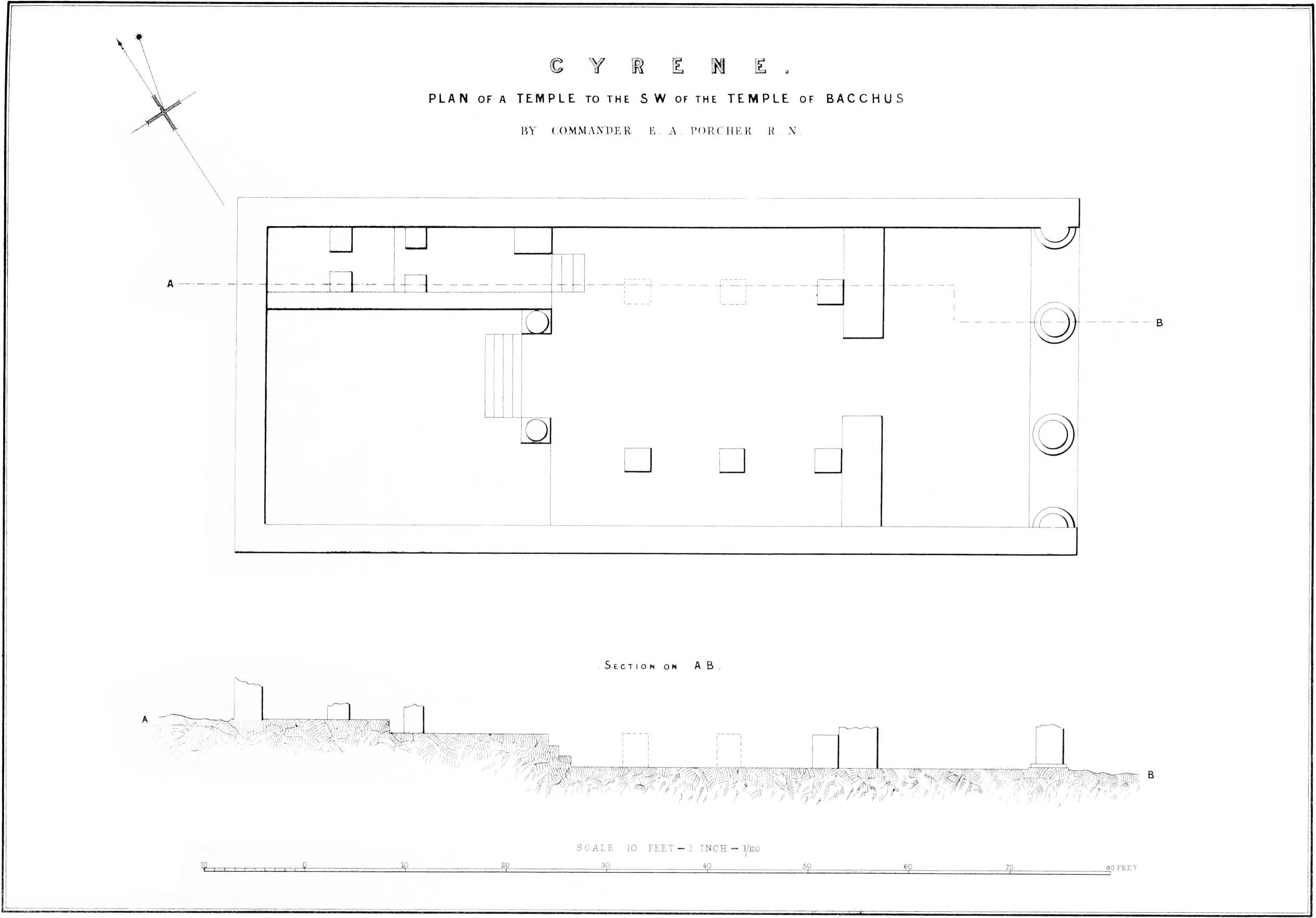
Day & Son, Lith. to the Queen
In the Temple of Venus we discovered altogether six statues of various sizes, twenty-nine small statuettes, three busts, twenty-six separate heads, including those which belonged to the statues and statuettes, one bas-relief, and three inscriptions. About ten yards to the eastward of the Temple we saw the two pedestals containing the inscriptions copied by Beechey.
[78]CHAPTER XII.
OWING to the want of means of communication with England, we had not yet (September) received answers to our letters sent home by the Assurance in June, so that we were quite uncertain about the arrival of a ship. In writing to Lord Russell and Mr. Panizzi, we had recommended that a much larger vessel than the Assurance should be sent, as it was of importance to save time by having a working party on shore large enough to take three waggons at a time. In the case of the Assurance we had found that thirty men, which was the largest number that could be spared, were about the proper force for a single waggon. Three waggons would therefore require ninety men, a number as large as we could safely undertake to supply with the necessary water, camels, &c.
We had also recommended that the vessel sent should arrive at Marsa Sousah before the middle of September, to insure our having time enough for the transport and embarkation of whatever statues we might find, before the fine summer weather should break up. As the very lightest wind from the north caused a heavy surf all along the beach, it was impossible to carry on boat operations except in perfectly calm weather. Day after day, however, passed without any word of the arrival of the vessel, and we began to contemplate our continued stay in the country for another winter, and to consider how we might best occupy the time. As we had already dug every promising spot at Cyrene not occupied by the crops of the Arabs, we purposed going to Benghazi to dig in the ancient cemetery there, previously burying all the marbles we could not carry with us, to protect them from being destroyed by the Bedouins. If the vessel came in the following year, they could be exhumed with little difficulty.
Since the end of August I had been confined to the tomb, and most of the time to bed, by a severe attack of fever, caused, most probably, by fatigue and exposure at night during the journey to Benghazi in July. With one of our party thus laid up on the “sick list,” and with a prospect every day more certain of a further residence of eight months in the country, we looked with some anxiety for the expected ship. As usual on such occasions, the number of false alarms was so great that we at last paid little attention to them. Our Maltese servants, quite beside themselves with excitement at the chance of soon returning to Malta—their “Fiore del mondo,”—stood gazing at the sea from morning to night, and raised a shout of joy whenever they detected the slightest speck on the distant horizon.
Their hopes were at last realized on the 26th of September, by the appearance of a large frigate standing in towards Marsa Sousah, which proved to be H.M.S. Melpomene, Captain Ewart, from whom we soon after received a note announcing his arrival. As I was still unable to leave the tomb, Porcher went down to the ship by himself early next morning, to make the necessary arrangements with Captain Ewart, and to accompany the working party, while I remained to look after the packing and other affairs at Cyrene. Our friend Mohammed El Adouly had, unfortunately for us, gone to Benghazi; so that we had not the benefit of his assistance, as on the former occasion. The chances of difficulties and misunderstandings were, moreover, much increased by the presence of a large number of Arabs from the southward, who had lately come to water their flocks till winter at the springs in the neighbourhood of Cyrene. Having no occupation at this season of the year, they wandered about perfectly idle, and therefore in readiness for any[79] mischief. Even before the arrival of the Melpomene, they had subjected us to considerable annoyance, and were becoming daily more and more unfriendly in their general demeanour; and there was little doubt that the large addition to our numbers brought by the Melpomene would proportionately add to their hatred of the “dogs of Nazarenes,” as we were not too courteously called. There were, consequently, more than the usual difficulties with the numerous camel-drivers we required, who adopted a peculiarly insolent tone in dealing with us. In the course of the subsequent operations, they frequently refused to take any loads but such as they themselves selected, and sometimes struck work altogether, thereby causing us a vast amount of unnecessary trouble.
Owing to the excellent arrangements made by Captain Ewart while on the passage from Malta, everything was ready for beginning the work immediately after the arrival of the ship. The working party had already been told off and thoroughly equipped and organized. The shafts of the waggons had been taken off and long capstan bars substituted, by which the guiding or steering was greatly facilitated—a point of some importance, as it was only by means of such powerful levers that the heavy waggons could be guided with ease and safety over the rough and stony roads. The drag-ropes, too, were fitted with canvas straps to pass over the men’s shoulders, by means of which the dragging was done much more easily than by hand.
All the plank and other stores required for packing the statues were landed immediately after the arrival of the ship, and sent up to Cyrene as rapidly as we could get camels to carry them. Ten carpenters and a guard of ten marines under the command of Lieutenant Saunders, R.M., came up to Cyrene the same day, and the work of making cases and packing was begun at once under the superintendence of Mr. Dennison. A working party of ninety men, fully equipped with tents, water-breakers, provisions, &c., was then disembarked under the command of Lieutenant Carter, R.N., ten camels with their drivers being told off to attend to their wants. The waggons, three in number, were the artillery platform waggons of the service, the same as those used by us on the former occasion. Each waggon had its own “crew” of thirty men, under the immediate command of one of the three midshipmen attached to the party,—Messrs. Jackson, Cane, and Wade.
The ship was anchored about two miles to the westward of Marsa Sousah, directly opposite our new road over the Augubah, in nearly the same position as the Assurance had taken up for the embarkation of the statues in June. As communication with the shore was very liable to be interrupted by the heavy surf on the beach, Captain Ewart caused a depôt of provisions and fresh water to be established on land under the protection of a guard. From this depôt, which was replenished from time to time as the state of the weather permitted, the working party could at all times draw its supplies, and the cases of sculpture brought down from Cyrene could be safely left in charge of the guard, until a favourable opportunity occurred for taking them on board. This arrangement was the more necessary as we knew that the transport of the objects too heavy to be carried by camels would require three if not four trips of the waggons. Moreover, at so late a season of the year, a continuance of fine weather could not be reckoned upon, and the ship herself might not improbably be obliged by an equinoctial gale to put out to sea.
Every precaution being thus taken to insure the success of the operations, the working party started from the depôt with the waggons on the morning of the 28th. Our new road proved quite practicable, and the party reached the summit of the Augubah and encamped there the same night. They arrived at Cyrene the following day, by which time the carpenters had a sufficient number of statues packed to load all the waggons. The 30th was occupied in securing the cases on the waggons, and on the 1st of October the party started for the shore. The descent of the Augubah was accomplished without accident, and the cases were safely deposited at the depôt on the evening of the 2nd. Two other trips were afterwards made with equal success, although not without serious apprehension on our part of a violent interruption by a tribe of hostile Bedouins.
[80]Ever since the arrival of the marines and carpenters at Cyrene, scores of “ugly-looking” Arabs kept prowling about our tomb with the evident design of picking a quarrel with us. Occasion for doing so was likely to occur at any moment, and especially when we absolutely refused to comply with some extravagant demands on the part of the camel-drivers. An open quarrel, however, was fortunately avoided until the first arrival of the large waggon party.
The sailors, who were then encamped on the hill opposite our tomb, were in the habit of washing and bathing at the Fountain of Apollo, a practice at which the Arabs became greatly enraged. One evening, a little before sunset, as we were sitting down to dinner, we suddenly heard a few shots fired, and immediately afterwards, the loud screeching by which the Arabs were wont to call each other to an armed gathering. Numbers soon answered to the cry, and came pouring into the Wady from all directions. On inquiring into the cause of the disturbance, we learned that some sailors and marines had been bathing as usual at the fountain, when a number of Arabs, annoyed at what they thought their indecency, began pelting them with stones. A marine had thereupon loaded his rifle with blank cartridge, and fired in the direction of the Arabs, thinking thereby to frighten them away. His foolish act had, as might have been expected, a totally different result. In less than an hour, the Wady in front of our tomb was swarming with armed men. As we had in this instance been the aggressors, we at once sent Amor for the sheikhs of the collected force, and explained to them that we quite disclaimed the act of the marine, whose rashness, however, was somewhat excused by the previous conduct of the Arabs. The sheikhs, who seemed peaceably disposed, replied that the whole disturbance had been caused by our men occupying the fountain all day, and preventing the Arab women from coming to fill their waterskins. As there was some truth in this, we promised that in future the men should be allowed to use the fountain only at particular times; and we requested the sheikhs to come to us, if at any time they had cause of complaint, and not to speak to our men, who knew nothing of their language. The Arabs, only partly pacified by our assurances, remained where they were all night, and spent great part of the following morning in firing at marks close to our tomb, for the purpose of making an imposing show of their power to treat us as they pleased.
This disturbance was hardly settled when a certain Sheikh Said ’M Rubbut made his appearance at the head of his tribe, and demanded a large sum of money, under the pretence of harbour dues, or something of the sort. On our refusing to pay it, he went off in great wrath, vowing vengeance on our whole party. The following day, he returned with a similar demand, but this time for the much smaller sum of 200 piastres (18s.). On our again refusing to acknowledge his right to any sum, however small, he lowered his tone considerably, and said that, having no wish to quarrel with us, he would forego his claim, but begged two or three bullock-skins which were of little or no value to us. To a request in this form we willingly acceded, as we were anxious at all hazards to keep the peace until the marbles were safely taken to the beach. By this time the waggons were on their way to the depôt on the shore, after their second trip to Cyrene.
The day after the departure of the waggon party, Sheikh Said again paid a visit to our tomb, and told me that he was not satisfied with the skins, and that he would not allow the waggons to pass, unless I paid him a large bakshish besides. Seeing that his object was simply to levy “black mail,” and that yielding in any way to his demands would only encourage him to make further exactions, I refused to give him anything, and ordered him to leave the tomb. With the threat that none of us should leave the country alive, he went away, and encamped in the lower plateau, near a steep ravine which the waggons had to cross. He there barricaded the road with trunks and branches of trees, and for two days prevented any communication between Cyrene and the working party or the ship.[5] Some of our camels on their way from the depôt, laden with planks, were seized and[81] detained. Our retreat from Cyrene was effectually cut off, and we were altogether in rather a helpless state.
In this dilemma, I thought of the sheikhs of the Haasa, whom we had befriended after the attack of the Castle of Ghegheb, and who had then expressed their desire to repay us in any way in their power. I accordingly sent for Husseim and Hadji Hassan, the two head sheikhs of the tribe, and after reminding them of our interference with the Pacha on their behalf, told them that they could never have a better opportunity of proving the sincerity of their gratitude than now, by ridding us of the presence of Sheikh Said and his followers. I also assured them, that as we were living in the territory of the Haasa, of which Sheikh Said’s tribe was a subdivision, they themselves would be held responsible by the Consul for our safety. They at once promised to request Sheikh Said to depart peaceably, and if he refused to do so, to drive him away by force. With some of their subordinate sheikhs, they immediately went to carry their promise into effect, and returned after two or three hours with the intelligence that Sheikh Said had gone when they ordered him, and that the road was therefore quite clear.
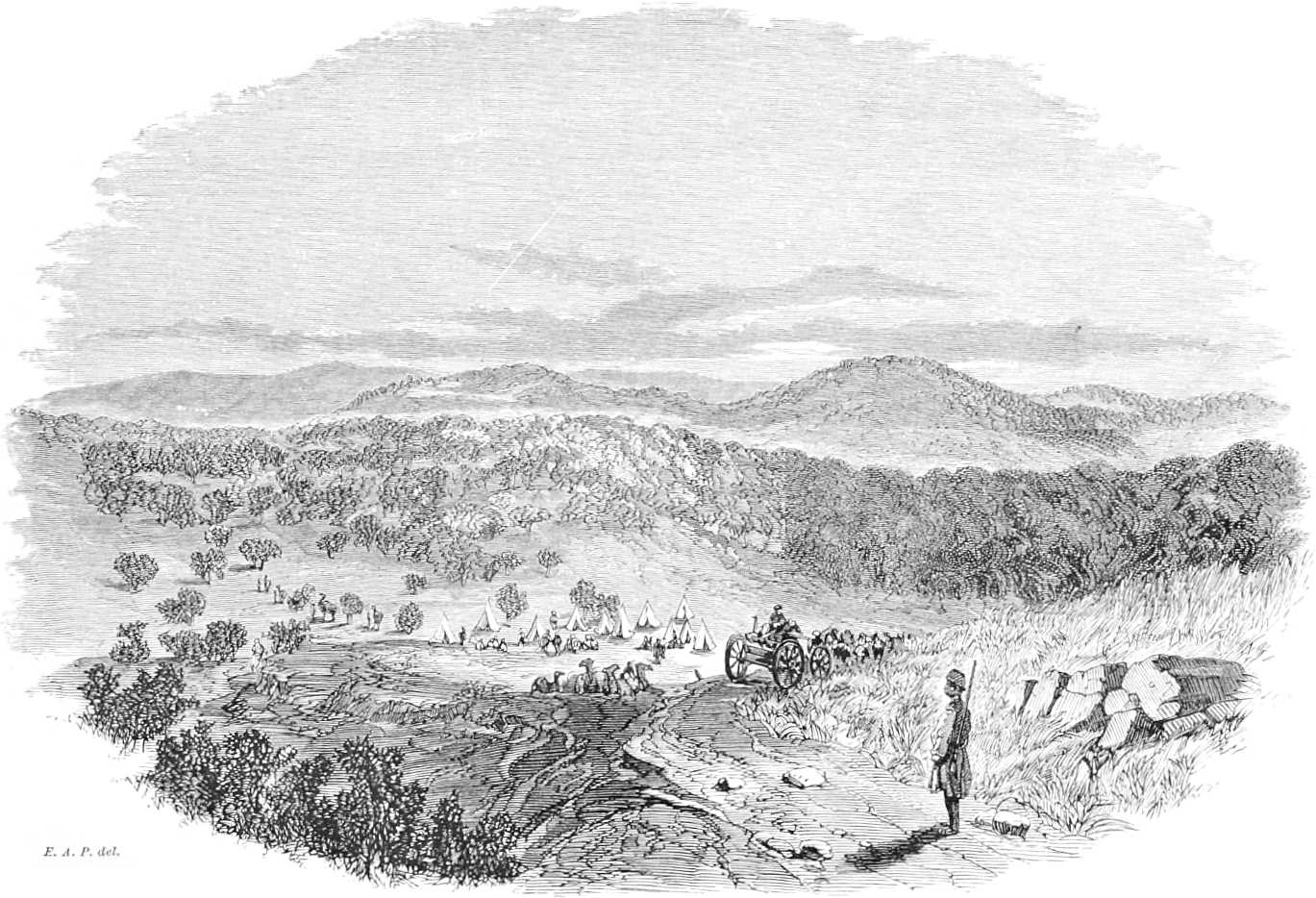
Plate 58.—Encampment of the Party from H.M.S. “Melpomene” near the head of the Augubah.
Although he had thus apparently obeyed the order of the sheikhs, he had by no means given up the game. Foiled at Cyrene, he merely shifted his ground, and lay in wait for the waggon party in a wood at the top of the Augubah, hoping, no doubt, to extract something from them by his threats. The waggons soon afterwards came up from the shore, and halted for the night. The tents were no sooner pitched than Sheikh Said and some of his followers entered the camp, and threatened Porcher and the whole party with utter destruction if he did not agree to give him a bakshish. Porcher had not yet heard of our two days’ siege at Cyrene, but gave him the same answer I had done; viz., a point blank refusal. The sheikh thereupon left the camp, and collecting all the[82] men of his tribe, placed them in a large open space at the foot of the Cyrene range, while he himself came up to our tomb to offer me, as he said, a last chance. I told him I had already given him an answer, and that if he wanted to attack us we were quite ready to receive him. On his departure, I again called upon the head sheikhs for assistance, and they again obliged him to move off; so that the waggon party reached Cyrene for the third time without an actual encounter.
The friendly interference of the principal sheikhs of the Haasa had thus been of great service to us hitherto, by preventing a collision which must have led to very serious consequences. Had it come to blows or bloodshed, even the Arabs who were most friendly to us would have been compelled to take side with their brethren against the Christians. With thirteen miles of bad road and close cover between Cyrene and the coast, we must have suffered great loss in fighting our way to the shore against overwhelming numbers. Such a result had fortunately been avoided; but we now began to have doubts of the good faith of the friendly sheikhs, and to suspect that, after all, they might be in secret league with our enemies. We were led to fear that this was the case by the pertinacity and confidence shown by Sheikh Said, and by the fact that Hussein and Hadji Hassan acted in concert with our old foe Sidi Mustapha, who was loud in his denunciation of Sheikh Said’s acts. We naturally thought that if the heads of the Haasa and the chief of the Zauyah were sincere in their professions of friendship, Sheikh Said would not presume to threaten and annoy us.
Affairs being in this state, we thought it advisable to apply to the Mudir of Ghegheb for protection, although we had little hope of his rendering us any really efficient assistance. Our object was rather to put ourselves in the right, by being able to say that we had appealed to the only representative of the Government in the country. I was still too weak to ride as far as Ghegheb, or I should have gone to see the Mudir before now; but Porcher went immediately after his arrival at Cyrene with the waggons. The Mudir himself, he found, was absent, and the Kolaghassi or Major who was acting in his place said that all he could do was to send two Koralié with letters to Sidi Mustapha and the sheikhs Hussein and Hadji Hassan.
Finding that no assistance was to be expected from the Mudir, and that we must rely solely on our own resources for protection, we were anxious to get everything on board as soon as possible, especially as every day’s delay seemed only to add to the difficulties of our position. We therefore determined to make the third trip of the waggons the final one, although, by doing so, we were obliged to leave behind us the large statue of Archippe and some of the inscriptions. Future visitors to the ruins of Cyrene will probably find the statue where we left it, at the western end of our upper range of tombs, and the inscriptions in a subterranean chamber almost immediately beneath the same spot.[6]
The 10th and 11th were spent in loading the waggons, packing up our personal effects, and collecting the necessary number of camels. We made our preparations as quietly and secretly as possible, in the hope of giving the slip to Sheikh Said and his friends, by reaching the shore before he should hear of our departure from Cyrene. Meantime, the road to the coast was clear, and everything promised a peaceful termination to our long sojourn among the Bedouins. On the night of the 11th, however, one of our Arab servants brought us word that Sheikh Said, having heard of our intended movement, was again in position on the road with a larger force than ever, determined to fight us if we did not satisfy his demands.
Early next morning, the marines were paraded under arms, and told off in two parties to act as advanced and rear guards to the main body with the waggons and camels. It was some time, however, before everything was ready for a start. Crowds of Arabs collected round our tomb, clamouring and struggling with each other for the empty bottles and other articles which we were[83] to leave behind. At last the camels were loaded, and we were on the point of beginning our march, when, somewhat to our astonishment, we saw a number of Arabs coming up the Wady, among whom we recognized Sheikh Said and our former friends Sheikhs Hussein and Hadji Hassan. It seemed as if our suspicions of these Haasa sheikhs were, after all, but too well founded, and that they were now openly associated with our enemy, in order to share with him the expected booty.
Pl. 59.
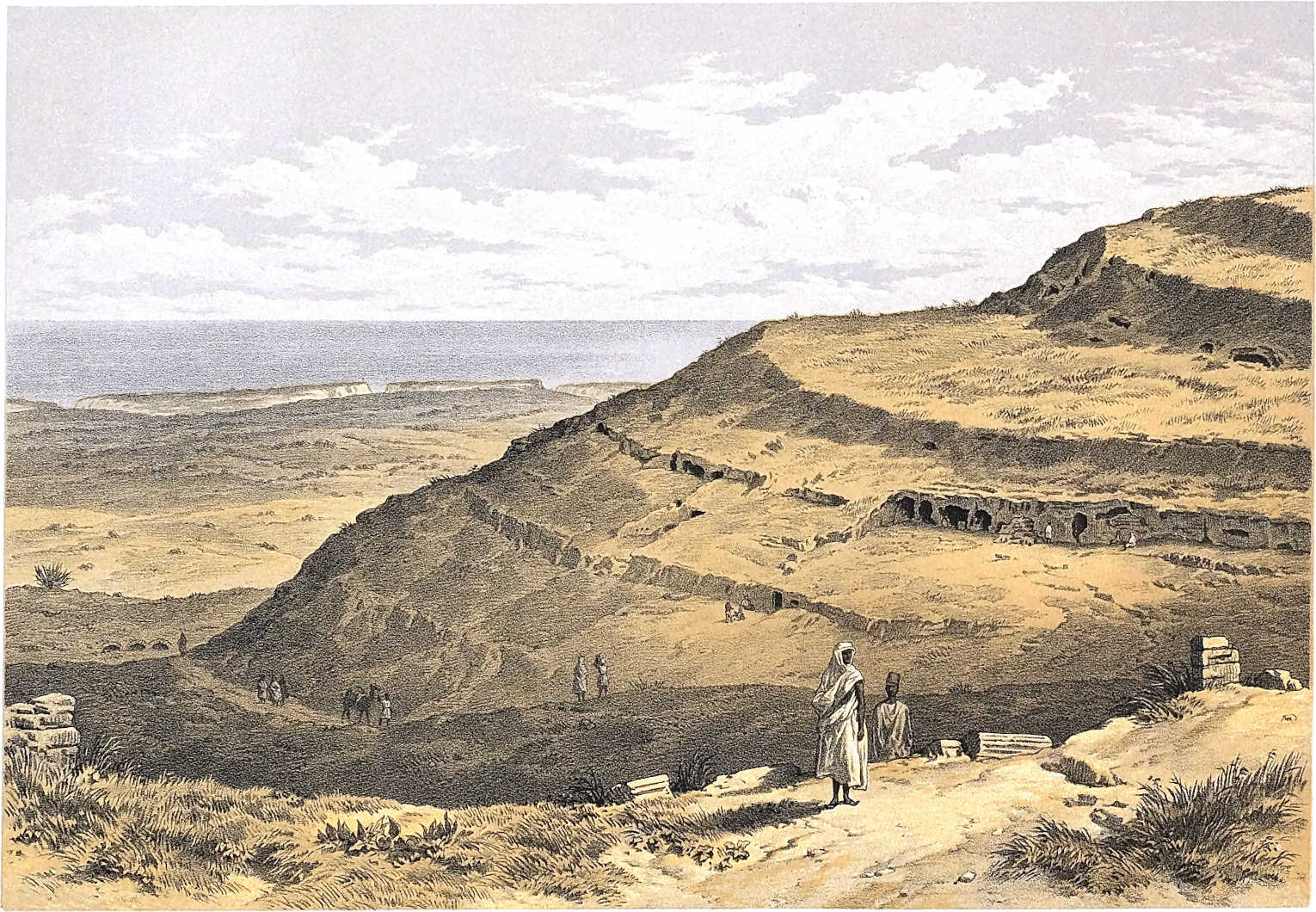
| E. A. Porcher, delt., T. Picken, lith. | London. Published July 1st. 1864 by Day & Son, Lithographers to the Queen &c., Gate Street Lincoln’s Inn Fields. | Day & Son, Lithrs. to the Queen |
CENTRAL WADY AND SLOPE OF THE EASTERN HILL OF CYRENE
Such, however, was not the case. Leaving the other Arabs who were with them, the two sheikhs came up to our tomb and told us that, having accidentally heard that Sheikh Said was again in arms against us, they had hurried off during the night to the position taken up by him in the lower plateau, and, by threatening himself and all his followers with instant death, had compelled him to come to make his submission to us. As no blood had actually been shed, they had given him their word that we should not injure him. On being assured that we would respect the safe-conduct they had given, they brought up their prisoner, who forthwith, in the most abject terms, expressed sorrow for his past offences, and begged to be forgiven. Thus, fortunately, ended an affair which, but for the gratitude of the powerful tribe we had formerly befriended, would, in all probability, have resulted in a great loss of life.
To insure us from further molestation, Sheikhs Hussein and Hadji Hassan accompanied us to the beach, where we induced them with some difficulty to intrust themselves to leave terra firma, and pay a visit to the ship. When they came on board, Captain Ewart made them a liberal and most welcome present of powder, and at their own earnest request I gave each of them a certificate of good conduct addressed to the English vice-consuls at Benghazi and Derna.
The waggon party reached the head of the Augubah the same night, and on the following morning descended to the plain, where they were met by the ship’s band, who escorted them to the beach. Before evening everything was safely embarked.
The narrative of the excavations would be incomplete without mentioning a small dressed statue of a girl found near the central theatre of Cyrene, by some of the sailors, who spent the two days before our departure in digging for “images” on their own account. For want of a more appropriate name, her discoverers gave her that of the ship: “Melpomene.”
While getting the last of the cases on board, on the afternoon of the 13th, we observed a steamer coming along the shore from the westward, which was soon made out to be H.M.S. Medina, commanded by Captain Spratt, C.B., who was then engaged in testing and correcting the charts of the coast between Tripoli and Alexandria. He had previously written to inform us of his intended visit to Cyrene; but his letter did not reach us until after the arrival of the Medina herself. Unfortunately it was now too late to think of going, as Sheikh Said and his followers were doubtless eager to have revenge for their late humiliation. Immediately before coming to Marsa Sousah, the Medina had anchored for a few hours at Sousah Hamema, for the purpose of taking some observations on shore with the artificial horizon. The party that landed for this purpose, having crossed by chance the limits of the Zauyah, were indignantly ordered off by the saintly Achwani, who would not have hesitated to enforce obedience by firing on the intruders.
The last duty we had to perform before our departure was the distribution of bakshish among our friends and attendants. Of these, Amor Bon Abdi Seyat, who had stood by us well during the whole of our residence in the country, had the greatest claim on our gratitude. Honesty, in our sense of the word, was a quality of which, in common with his countrymen, he could form no conception, and to which he, consequently, had no pretension. But he refrained from actual theft, and had discernment enough to see that in honesty, that is, in limited peculation, lay his best policy; inasmuch as the periodical bakshish which he received varied inversely as the amount he gained by illicit means. In every respect he was probably the best man we could have got in the country. Naturally quick-witted, active, and courageous, he had acquired considerable[84] influence over the men of his tribe, which, on more than one occasion, he exerted with success in our behalf. As a farewell gift, we gave him our two horses and a large supply of powder.
It was not without regret that we finally left our temporary home at Cyrene. The beauty of the scenery and the interesting nature of our occupations had combined to render our residence in the country a most agreeable one. We had occasionally suffered considerable annoyance and anxiety; but, on the whole, our relations with the Arabs had been much more satisfactory than might have been anticipated. Several considerations, however, now induced us to return to Malta in the Melpomene. As a ship could not approach the coast with safety during winter, we should have had to remain at Cyrene at least six or seven months, before another vessel could be sent to visit us; and this period we were afraid we should not be able to employ to much advantage in the way of excavation. Immediately after the first rains, the Arabs begin to sow their crops, which, at Cyrene, cover nearly the whole site of the ancient city. During the previous winter, we had examined nearly every promising spot that was left unoccupied. Very little digging, therefore, could be done until the ground was again clear after the harvest in May, as the Arabs would on no account allow their crops to be interfered with. We should, consequently, have been obliged to remain in the country a whole year, for the chance of finding more sculptures during the five or six months of the following summer. There was no doubt that many statues were still to be found; but as we had already excavated all the prominent sites in the city, in many of which we discovered nothing, further operations must have been carried on almost at random. For these and other reasons, we made up our minds to leave Cyrene, and return to Malta in the Melpomene.
At daylight on the morning of the 14th we weighed anchor, and sailed for Malta. It was well that we had got all the cases of sculpture on board the day before; for we had hardly left the coast when a breeze sprang up and rapidly freshened to a gale, which would have made it quite impossible to communicate with the shore, and would have obliged the ship herself to put to sea for safety. After a stormy passage of three days, we reached Malta on the 17th, just in time to correct a report sent from Benghazi by the new submarine telegraph, to the effect that, in an attack made upon us by the Arabs of Cyrene, one of us had been killed and the other wounded.
At Malta the sculptures were transferred to H.M.S. Supply, Master Commander Balliston, in which vessel they were soon afterwards safely conveyed to England.
[85]CONCLUSION.
BEFORE taking leave of the subject of the Cyrenaica, it will not be out of place to offer a few remarks upon the future prospects of this beautiful country.
It may, I think, be safely premised that, so long as it remains in the hands of its present rulers and occupants, no great change in its condition is likely to take place, either for the better or the worse. From what has been already stated in a former chapter, it will be seen that the present state of the country, and the character and peculiar habits of its inhabitants are, to a great extent, mutually dependent on each other. That is to say, the physical condition of the country, owing to the absence of rivers or any large artificial reservoirs for water, is not adapted to the requirements of a settled sedentary population, and therefore tends to confirm the Bedouins in their wandering, and consequently wild and lawless, habits; while, on the other hand, it is hardly to be expected that a race of people like the Arabs would exert themselves in achieving public works for the purpose of making the country suited for a manner of life which they have been taught from infancy to hate and despise. As an illustration of this, I may mention that the road which we made from Cyrene to Marsa Sousah, instead of being regarded as a benefit to that part of the country, was looked upon with considerable suspicion as a means of facilitating the movements of troops sent by the Government.
Nor is this indisposition on the part of the inhabitants likely to be compensated for by the energy of a government which exists in little more than the name. Justice is not administered, crime is not punished, and life and property are wholly unprotected. The collection of tribute is, in fact, the only function of government performed by the representatives of the Sultan.
The expediency of forming a colony of Maltese in the Cyrenaica has, we believe, been sometimes contemplated; but it is evident that, in such a state of affairs, successful colonization by Europeans would be impossible. In the first place, a general system of irrigation by means of reservoirs and cisterns for the collection of the rains in winter, would have to be created; roads and harbours would also be required to make the resources of the country available for the purposes of commerce; works which could only be carried out under the protection of a powerful government. There is little hope of Turkey ever acquiring the enlightened energy necessary for such a task, and the example of Algeria as a French colony is probably not such as to induce any other European nation to attempt it. It is a remarkable fact that a region once so prosperous, and even now blessed with a salubrious climate, a fertile soil, and an excellent geographical position, should have remained for centuries on the very borders of Europe, not only undeveloped, but almost unknown. And from the combination of causes which we have indicated, it seems not improbable that it may remain in the same condition for many years to come.
[87]APPENDICES.
I.—ON THE SILPHIUM.
IN the foregoing chapters reference has occasionally been made to the Silphium of Cyrene, the identification of which has given rise to considerable discussion among modern travellers and botanists.
Della Cella, Beechey, and Pacho agree in the opinion that the Silphium of the Greeks is identical with a plant growing in abundance at the present day in the neighbourhood of Cyrene, partly from the description of it given by Pliny, and the general resemblance of the drawing on the coins of Cyrene.
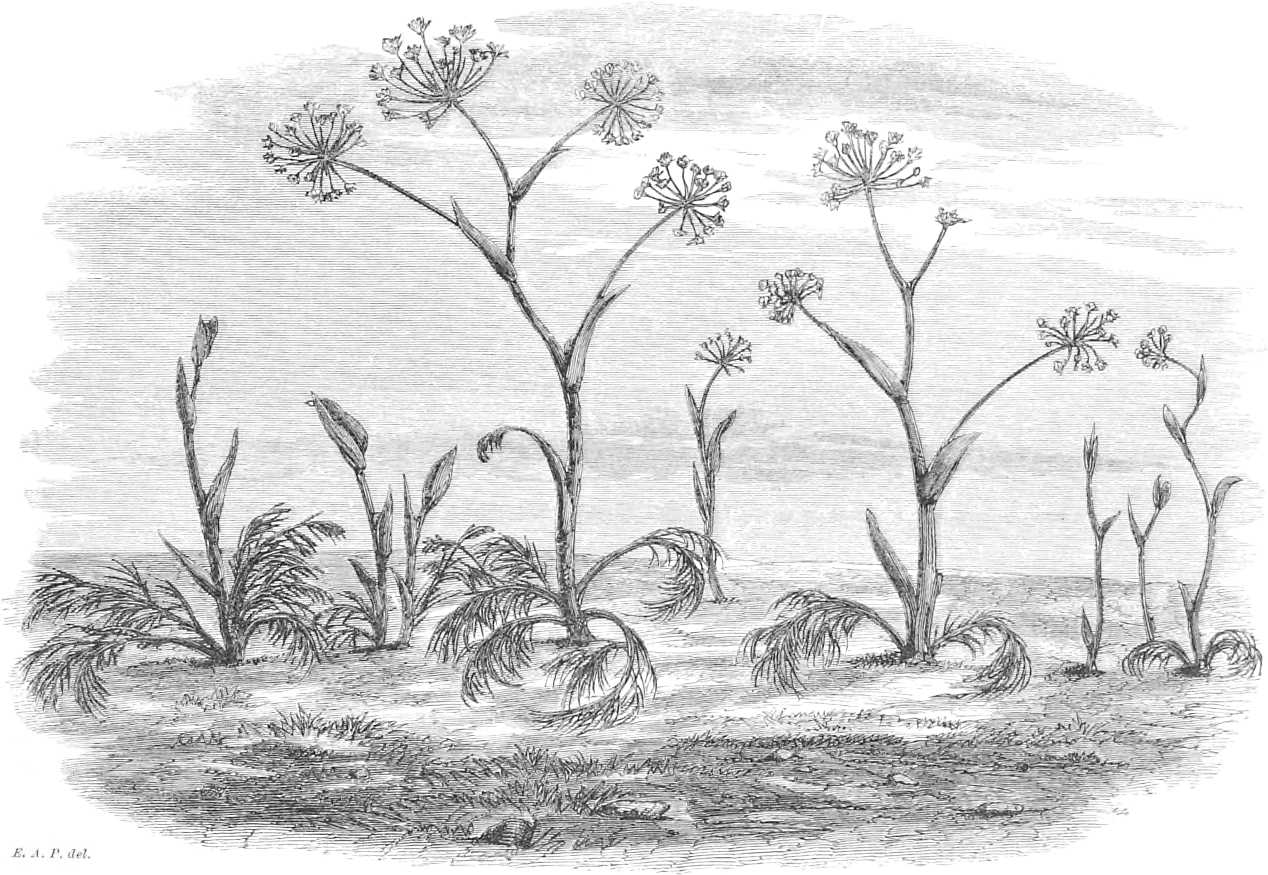
Plate 60.—Thapsia Garganica.
Dr. Schroff has lately published an article on the subject, which seems to be the most important hitherto written, and having gone minutely into the accounts given by Hippocrates and Dioscorides of the properties of the ancient Silphium, and the experiments made from the plant now growing there, it is quite evident that they are not the same.
From the following account it will be seen that the present plant, of which a drawing is[88] shown in Plate 60, is proved to be the Thapsia Garganica, and agrees with the plant well known to the ancients under the name of Thapsia, but has none of the properties of the true Silphium.
It is called Drias by the Arabs, and abounds at Cyrene and the immediate vicinity, disappearing altogether about thirty miles to the westward of it; and we observed it occasionally as far as Derna in the opposite direction. This plant appears above the ground in the month of October, when the autumnal rains commence, and is in flower in May, when it attains the height of 4 feet on the average, occasionally measuring 4¾ feet, and dying down to the ground again in July and August.
The following description of the plant has been kindly translated by Professor Oliver from the German article of Dr. Schroff.
The question as to the identity or otherwise of Thapsia Garganica, now so abundant about the site of the ancient Cyrene, as well as elsewhere on Mediterranean shores, with the Silphium of the Greeks, has been recently very carefully investigated by Dr. C. Schroff.
The results of his inquiry appeared in the “Zeitschrift der K. K. Gesellschaft der Aerzte” of Vienna, Part I., 1862.[7] They are briefly these: he finds that the properties, &c., of Thapsia Garganica do not accord with those attributed by classical writers to their Silphium; on the other hand, they do accord with the properties ascribed by Theophrastus, Dioscorides, and others to a plant called by them Thapsia. Dr. Schroff therefore rejects the prevalent notion that the ancient Silphium of Cyrene is represented by Thapsia Garganica, now growing wild on its site, and confidently identifies the latter with the Thapsia of the Greeks and Romans.[8] He does not attempt to indicate the present representative of the true Silphium.
With regard to the properties of Thapsia Garganica, it is stated by Von Heinzmann (by whom specimens of the drug—the rind of the root—now in use at Tripoli, obtained from T. Garganica, were sent to Europe) that the fruit is very poisonous to camels, a single fruit (so-called seed) sufficing to kill a large and powerful camel. The Arabs in travelling through districts where the Thapsia abounds, at the time when the fruit is ripe, are accustomed to muzzle their camels to prevent their feeding upon the plant. The green herbage of the Thapsia, however, is eaten by them without ill effect.
A very high value is ascribed to the rind of the root as an application to foul wounds or ulcers, whether of man or beast. A portion of the rind is laid upon or into the sore and it heals forthwith. M. Heinzmann experimented with the tincture upon bad wounds of different kinds with “die wunderbarsten Resultate.” When the tincture is applied to the sound skin, it occasions almost unendurable itching, and gives rise at length to blisters or pustules, without causing much[89] inflammation. Neither itching nor burning is felt when the drug is applied to a wound. Six to eight grains of the powdered rind of the root taken internally are stated to occasion the following symptoms: giddiness, buzzing in the ears, confusion of ideas, great feeling of weakness, with tendency to vomit, and actual vomiting and purging. The most striking symptom, however, is a long-continued, heavy perspiration. Experiments repeated in Europe lead to the Thapsia Garganica being classed as a drastic cathartic, and, to a certain extent, confirm its usefulness as an external application.
The properties of the plant Thapsia, described by Theophrastus, Dioscorides, and Pliny, agree with those just cited as characteristic of Thapsia Garganica. Dr. Schroff says a comparison of the description given by the above writers of their Thapsia with the character, both as to structure and properties, of T. Garganica, leaves no doubt as to their identity.
With regard to the ancient Silphium. Our most precise information respecting it is derived from the Cyrenian coins and the writings of Theophrastus and Dioscorides. It is referred to by Pliny (with admixture of error), as well as by many of the more ancient classical writers. The fresh root, prepared with vinegar, was eaten, and the stem was highly prized as a delicacy.—(See Knights of Aristophanes.) It was also used as a spice and condiment. Its application in medicine (the inspissated juice) is fully detailed by Dioscorides. It was in great repute as an antidote to poisons and the bite of venomous reptiles, scorpions, mad dogs, &c.
The older Cyrenian coins bear a representation (according to Dr. Schroff) of the fruit of the Silphium. It is represented as obcordate, with a narrow wing. This does not agree at all with the form of the fruit of T. Garganica, nor can the account given of the use of the Silphium as a table delicacy and condiment be reconciled with the active properties of that species.
In conclusion Dr. Schroff says: “If, then, our researches establish beyond all doubt that the plant now known as Thapsia Garganica, L., and Thapsia Silphium, Viv., is not, as so many travellers and botanists have asserted, the original Cyrenaic Silphium, on the other hand, the result of this inquiry is not purely negative in reference to the Flora of the ancients, for we have proved that the plant in question may be certainly identified with another plant used in ancient medicine, the Thapsia of the Greeks and Romans.”
This extract clearly establishes the fact that the Drias of the Arabs is the Thapsia Garganica. At the time the Romans took possession of the country, the Silphium seems to have been grown in large quantities, and was considered an excellent medicine, and sold for its weight in silver. The medicinal properties of the gum are described as having the smell of myrrh, but more mild and agreeable.
It was said by Pliny to have grown not far from the Gardens of the Hesperides and the Great Syrtis; but, in his time, it had so entirely disappeared that a single plant was sent as a rare and valuable gift to the Emperor Nero. This scarcity had been caused by the barbaric races that overran the country, as well as by the Cyrenians themselves, who aided in its extirpation in order to free themselves of the enormous tax which the Romans had laid upon it.
[91]No. II.
DESCRIPTION OF THE SCULPTURES FOUND AT CYRENE.
Plate 61.—BACCHUS.
Height 5 feet 9 inches; found in a temple of Bacchus. (See ante, p. 40.)
The god is represented under his youthful type, holding a bunch of grapes in his left hand, and with his head encircled with a vine-wreath and diadem. The right arm, now wanting, appears to have hung down by his side, as a little below the hip is a projection for the attachment of the hand. A mantle passes round the lower half of his body and over his left arm and shoulder. This statue is remarkable for the admirable preservation of the face. The form has a certain effeminate beauty, though the style is somewhat mannered and meretricious. The drapery is carelessly executed, especially at the back. When it was first found, red colour was very visible in the eyes and wreath round the head.
Plate 62.—APOLLO CITHARŒDUS.
Height, inclusive of the plinth, 7 feet 6 inches.
This statue was found, as has been already stated (ante, p. 41), in the Temple of Apollo, and originally stood on a lofty base within the cella. The god is represented in a musing attitude, as if pausing between the strains of his music. His left hand, now broken off, must have played over the strings of his lyre; his right arm has been raised; the right hand, resting on the crown of his head, has held the plectrum, with which he is about to strike the lyre. On the hair may be seen a projection where this hand has been attached. The lyre rests on the trunk of a tree, round which a serpent is twined. A bow and quiver hang from the tree. The head of the serpent is upturned, as if he were listening to the music of the god. Red colour may be seen on the tree and quiver.
This statue is probably a copy from some celebrated original, as two other nearly similar figures exist, one in the Capitoline Museum at Rome, the other in the Museo Borbonico at Naples. (See Clarac, Musée de Sculpture, iii. pl. 479, fig. 921B; and ibid., pl. 489, fig. 954.)
The countenance has a suave and beautiful expression, and the general attitude is very harmoniously composed. The body is finely modelled, but the drapery very inferior to the nude part; the lower limbs seem rather short and clumsy, but perhaps, if this statue were placed on a higher base, this want of proportion would be less apparent. This statue when found was broken into 123 pieces, all of which have been rejoined since its arrival at the British Museum.
Plate 63.—THE EMPEROR HADRIAN (?).
Height 6 feet 7 inches.
This Plate represents a male personage clad in a mantle thrown over his left shoulder, under which the folds of a chiton are seen on the breast; on his feet are sandals; the right arm is crossed[92] over the breast under the mantle, the left hand holds a sprig of laurel; the head is bound with a pine wreath, and has been inserted into a socket at the base of the neck. This head is evidently a portrait, and appears to be intended for the Emperor Hadrian, though the likeness is not a very strong one. As, however, the statue was found in the Temple of Apollo, close to a base inscribed with a dedication to Hadrian (see ante, p. 42), it may be presumed that it represents that emperor. It is possible that the head may have been substituted for that which originally belonged to this statue, as the general character of the drapery would be rather suitable to a poet or a philosopher than to a Roman emperor. Both hands have been joined on at the wrist, and were found detached. The left hand seems not to be made of the same marble as the rest of the statue, and it is very doubtful whether it belongs to the figure.
The pine-wreath on the head would indicate a victory either in the Great Isthmia, or in some smaller festival bearing the same name. There does not, however, seem to be evidence to show the connection of the Emperor Hadrian with such contests.
Plate 64.—HEAD OF PALLAS ATHENE.
Height 1 foot 2 inches.
This head was found near the middle of the Cella in the Temple of Apollo, near the preceding statue, supposed to represent the Emperor Hadrian.—(See ante, p. 42.) It is in unusually fine preservation, and from the purity and whiteness of the marble is an attractive object to the uncritical eye. It is, however, rather coarse and heavy in execution, and belongs, therefore, probably, to the Roman period.
The helmet, which is of the kind called Corinthian, has had the point of the nasal broken off. In other respects this head is uninjured.
UNKNOWN MALE HEAD WITH INLAID EYES.
Life Size.
On Plate 64 is also represented a male head, which is especially interesting, as an example of polychrome or inlaid sculpture. The crown of the head is cut away, so as to form a joint, and it is evident that a helmet or other head-dress has been fitted on to it, doubtless, of a different coloured marble. The eyes are inserted in hollow sockets. The whites of the eyes, formed of marble, still remain in these sockets. The pupils, which have, probably, been made of coloured vitreous pastes, have fallen out. All round the marble eyes the edge of a thin bronze plate intervenes between the eye and the upper and lower eyelids; this edge has probably been serrated so as to indicate by its projection the upper and lower eyelashes, as is the case with the bronze head, Plate 66.
This head is greatly disfigured by the mutilation of the nose, and by the want of the eyes and the part above the forehead. What remains is, however, finely modelled, and is, probably, the work of a Greek artist of a good period.
[93]Plate 65.—HEAD OF CNÆUS
CORNELIUS LENTULUS MARCELLINUS,
PROPRÆTOR OF CYRENE.
Life Size.
This head was found in the Temple of Apollo, in the western half of the Cella. With it was found a marble base, on which was graven the inscription No. 1, recording the dedication of a statue, by the people of Cyrene, to Cnæus Lentulus Marcellinus, styled here Proprætor, Patron, and Saviour of Cyrene. (See ante, p. 42.)
With this base was found a square pedestal, 10 inches broad and 5 feet high, which fitted into a square socket in the base, and which had at the top a deep socket into which the head fitted. This pedestal, which establishes the connection between the base and the head, was unfortunately left behind, on the final embarkation of the marbles, on account of the insufficient means of transport at the command of the expedition. It has been already noticed that the back of this head is cut flat, as if to enable it to be placed like a pilaster.
As a specimen of provincial sculpture in the Roman period, this head is very well worthy of study. It seems singular that a work of art possessing so much merit should have been united to its pedestal in so rude and unsightly a manner. It is, however, possible that the head originally belonged to a statue, and that, after this statue was broken by an earthquake or other accident, the head was remounted in this clumsy fashion.
The Cnæus Cornelius Lentulus Marcellinus whose portrait we have here was the son of P. Cornelius Lentulus Marcellinus, of the illustrious family of Marcelli, and a man of some note in the latter years of the Republic. While yet a young man he supported the cause of the Sicilians against Verres, B.C. 70. He held the office of Prætor, B.C. 59, and presided over the trial of C. Antonius, the colleague of Cicero. The following year he went to Syria, and administered that province for two years. He was Consul B.C. 56, and took a prominent part in resisting the factious violence of Clodius; and Cicero, whose cause he greatly favoured, declared him to be one of the best Consuls he had ever known. We hear very little of him after the expiration of his Consulship, and the period of his death is wholly unknown.
Ancient writers are not agreed as to the precise date when Cyrene was first made a Roman province. The conflicting authorities are examined by Thrige (Res Cyren. pp. 274-277), who adopts for this event the date B.C. 75. Borghesi, who reconsiders the question very fully in his Œuvres Complètes, Paris, 1864, II. pp. 396-407, prefers the later date, B.C. 65, in which he is followed by Falbe and Lindberg (Numismatique de l’Ancienne Afrique, I. p. 7). According to these two latter authorities, Lollius, whose name appears on the coins of Cyrene, was its first Proprætor; but it is not unlikely that he was preceded by Cn. Lentulus Marcellinus, whether we take the earlier or the later of the above-mentioned dates for the establishment of the Roman province there. He may be the same as a Cnæus Lentulus whose name appears on a Roman family coin (Cohen, Description Générale, p. 104, No. 25) as Quæstor, and who was probably Quæstor in Spain with Metellus, about B.C. 79-75.
[94]Plate 66.—BRONZE ICONIC HEAD.
Life Size.
This head is in very fine condition, and a most interesting example of ancient portraiture in bronze.
The person whom it represents has not yet been identified; the type of the features seems rather African than Greek or Roman, and it is possible, therefore, that this head may represent some king of Numidia or Mauritania. The eyes have been inlaid in vitreous pastes, portions of which still remain in the sockets. The eyelashes are indicated by notched lines. The under lip is formed of a separate piece of bronze, the junction of which may be traced along the edge of the lip.
It is probable that the lips were covered with a thin plate of silver or some artificial substance which served to represent their difference of colour. The hair and beard are finished with great care and refinement of treatment. Throughout there is a scrupulous adherence to nature, and this head may be considered as an interesting example of that realistic school of portraiture which seems to have originated in the time of Lysippus.
It was found in the Temple of Apollo, on the original floor of the eastern part of the cella, 11 feet beneath a mosaic pavement superadded in Roman times. Near it were some small fragments of bronze horses, very much injured, as if by fire, some bits of gold leaf, and several terra-cotta lamps. (See ante, pp. 42, 43.)
Plate 67.—APHRODITE.
Height 2 feet 4 inches.
This statuette is broken off below the knees. The figure is draped in a tunic, reaching probably to the feet, and girt at the waist; a peplos passes round the right hip. The arms are wanting. The head is bound with a diadem.
This figure has been so mutilated that it is difficult to judge of it as a composition. The marble is of an exquisite quality, and is wrought with a refined skill, which shows that this statuette belongs to the best period of Greek art. The countenance is one of great beauty. The long eyes and general type of the features are characteristic of Aphrodite.
Though Praxiteles is said to have first made nude statues of this goddess, draped representations of her are comparatively rare, except those executed in the archaic period.
CYRENE.
Height 1 foot 3 inches.
On this Plate is also represented a female torso, attired in a tunic reaching only to the knees. The head, arms, and legs of this figure are wanting. Above the girdle the fashion of the tunic is peculiar. The sides are left open, so as to expose the breasts, between which the folds are gathered together in a broad band. On this band and on the folds near it traces of red colour may yet be seen.
The composition of the drapery in this statuette is remarkable for severe and simple beauty.[95] It is probably executed by a Greek sculptor of the best period. The type and costume are those of a young girl trained to the chase or athletic exercises. These characteristics make it probable that in this statuette we have the nymph Cyrene herself, of whom there are two other representations in this collection of sculptures. (See Pl. 76, and No. 6, post.) Both these statuettes were found in a large temple near the Stadium, with some other fragments of sculpture of a very fine character. (See ante, p. 75.)
Plate 68.—ICONIC FEMALE FIGURE.
Height 6 feet 6½ inches.
This figure is clad in a tunic reaching to the feet, over which is an ample mantle or peplos wound round the body. Her head is bound with a diadem, and covered at the back with a veil. From the character of the features, it may be inferred that this statue is a portrait rather than the representation of any ideal personage. If such is the case, it is probably the portrait of some queen, perhaps of the family of the Egyptian Ptolemies, as several of the queens of this dynasty are represented on their coins wearing the diadem and veil. Though this figure has rather an imposing effect at a distance, near inspection shows that it is very coarsely executed. The proportions are very clumsy. It was found in some ruins on the north side of the Temple of Apollo.
Plate 69.—BUST OF THE EMPEROR ANTONINUS PIUS.
Height 2 feet 4½ inches.
This bust is well sculptured and in very fine condition. The features are intact. The Emperor is represented clad in the paludamentum, or military cloak, which is fastened by a circular fibula on the right shoulder over a tunic and cuirass. This bust was found on the site of a building marked “Palace” on the Plan, but which, from the number of Imperial busts discovered in it, was probably an Augusteum. (See ante, p. 76.)
Plate 70.—BUST OF THE EMPEROR MARCUS AURELIUS.
Height 2 feet 4¼ inches, inclusive of plinth.
This bust is in very fine condition, having sustained no injury except the fracture of the neck. The Emperor wears on his shoulders the paludamentum, fastened on the right shoulder by a fibula. The hair is skilfully disposed in clustering masses, and the general treatment of the head is simple and dignified, though as a work of art this bust is inferior to the Antoninus already described. It was found in the building marked “Palace” on the Plan, which, as has been already remarked, was, probably, an Augusteum.
Plate 71.—APHRODITE EUPLOIA.
Height 1 foot 9 inches.
A small statuette representing Venus in the act of adjusting the sandal of her left foot. She leans forward standing on her right leg, and resting her left thigh against a pillar. The[96] toes of her raised foot, now broken away, have been supported by a dolphin. Her left arm, which is also wanting, is drawn back, and probably rested on the pillar; as the head is broken away at the base of the neck, it is uncertain in which direction it turned. Drapery hangs from the column, against which a rudder is leaning. Many varieties and repetitions of this figure are extant, in marble and bronze, among which the following may be cited:—
1. A small bronze figure in the British Museum. (Millingen, in the Transactions of the Royal Society of Literature, 2nd series, i. p. 62.)
2. A small bronze figure found at Herculaneum. (Antichità di Ercol., vi. 14; Müller, Denkmäler d.a. Kunst, ii. Taf. xxxvi., fig. 283.)
3. A small bronze torso in the British Museum. (Clarac, Musée de Sculpture, i. pl. 628, fig. 1354.)
4. A small bronze figure. (Galeotti, Mus. Odeschalc., ii. pl. 35.)
5. A small marble torso in the British Museum. (Museum Marbles, x. pl. 20, p. 43.)
6. A similar figure occurs on the bronze coins of Aphrodisias during the Roman period. (Mionnet, Recueil, iii. p. 323, No. 109.)
Several small torsos in marble, which represent the same subject, have been found in Crete, Rhodes, Cos, and Calymnos. It is evident, front the number of repetitions of this figure, that they are all derived from some celebrated original. The name of Aphrodite Euploia has been given to this figure because, in two instances, the statuette now under consideration and the bronze figure in the British Museum, published by Millingen (No. 1, supra), the goddess leans on a rudder. The veil held over her head in the latter bronze seems to represent the sail filled by a favourable wind. These nautical emblems would accord well with the epithet Euploia, “the giver of a favourable voyage,” which was given to Aphrodite. In this character she was an object of special worship at Cnidus. The number of small statuettes with this type which have been found in cities of the Archipelago suggests the notion that they may have been dedicated by seafaring men after a voyage.
This statuette was found with several other statues of Venus in a small temple, marked on the Plan “Temple of Venus.” (See ante, p. 77.) The composition is very graceful, but the forms rather coarse and clumsy. It is, probably, of the Roman period.
Plate 72.—GROUP OF APHRODITE AND EROS.
Height 3 feet 2½ inches.
The hands and head of the Venus being wanting, the motive of the figure is uncertain, but it is probable that the goddess was represented engaged in her toilette: her drapery is gathered round her lower limbs; on her feet are sandals. The Cupid bestrides a dolphin, in which attitude he is frequently represented at the side of statues of Venus. In Clarac’s Musée de Sculpture are two groups of Aphrodite and Eros, in which the drapery is similarly disposed,—Pl. 607, fig. 1339, and Pl. 615, fig. 1366. This group, though rather coarse in execution, is copied from a good original. It was found in the Temple of Venus.
[97]Plate 73.—UNKNOWN FEMALE FIGURE OF THE ROMAN PERIOD.
Height 5 feet 9½ inches.
This figure is clad in a tunic reaching to the feet, and a mantle, the end of which she is casting over her left shoulder, and in the folds of which her left hand is partially muffled. Her hair is plaited and wound round her head, after a fashion prevalent in the time of the Empress Sabina, the period to which this figure may therefore be assigned with probability. It is evidently a portrait, but has not as yet been identified. The countenance is very expressive, and the whole figure, though not finely executed, is interesting from the simplicity of the conception and the impression it conveys of a faithful rendering from nature. The right forearm, which was a separate piece of marble, has been broken away. It was found in the Temple of Venus. (See ante, p. 77.)
Plate 74.—ICONIC FEMALE BUST.
Height 1 foot 10½ inches.
This bust is remarkable for the singular headdress, composed of plaits coiled round in a conical mass.
This headdress seems a caricature of that which prevailed in the time of the Empress Faustina the Elder; and as the bust is evidently a portrait, it may represent some lady of the period of that Empress. The sculpture is very inferior to that of the busts of Antoninus and Aurelius already described. This bust, with another nearly identical, was found on the site of the supposed “Temple of Venus.” (See ante, p. 77.)
Plate 75.—HEAD OF PERSEUS.
Height 4 inches.
This head has wings, which are characteristic either of Mercury or of Perseus. The countenance, however, has an intense expression, which seems more suitable to the hero than the god. This head is probably broken off from a statuette representing Perseus holding in his hand the head of the slain Medusa. A very similar head occurs among the reliefs which ornament the cuirass of a Roman emperor on the torso described post, No. 107, p. 104.
The features are very forcibly modelled. This head is probably a work of the Macedonian period. It was found in the Temple of Venus. (See ante, p. 77.)
[98]Plate 76.—CYRENE CROWNED BY LIBYA.
Group in Relief, 3 feet 4 inches by 2 feet 3 inches.
This relief represents the nymph Cyrene in the act of strangling a lion, while, to commemorate this triumph, a crown is held over her head by Libya. Below is the inscription engraved Pl. 82, No. 19, which may be thus translated:—
“Here over the architrave, Carpos, making this dedication in token of great hospitality, has placed the lion-slaying Cyrene, whom Libya, having the glory of three continents, herself crowns.”
In this group the nymph Cyrene is represented in attire very like that of Diana Venatrix. She wears a succinct chiton reaching to the knees, over which is a mantle, and buskins; her hair is drawn back from her face.
Libya wears a talaric chiton girt at the waist, and a mantle fastened at the breast and falling down behind; her hair, bound with a diadem, is arranged over her forehead in long regular curls, and falls down her neck; at her side is an animal couchant, of which the head is broken off, and which is probably a gazelle.
According to one legend, Cyrene was the daughter of Hypseus, king of the Lapithæ, in Thessaly, whose flocks she guarded against wild beasts. Apollo seeing her slay a lion in the valley of Pelion, became enamoured of her, and carried her off to the parts of Libya which afterwards bore her name. According to another legend, Eurypylus, king of Libya, having promised a portion of his kingdom to the person who would slay a lion then dreaded for his ravages, Cyrene performed this exploit, and received in reward the promised district. It is probably in connection with this latter legend that Libya is introduced crowning Cyrene in this relief. Aristæus, the mythic founder of Cyrene according to some, was the son of Apollo and Cyrene. The composition of this relief suggests the idea that it may have been a metope. Hence the words ὑπὲρ μελάθροιο in the inscription have been translated “above the architrave.” It was found in the Temple of Venus.
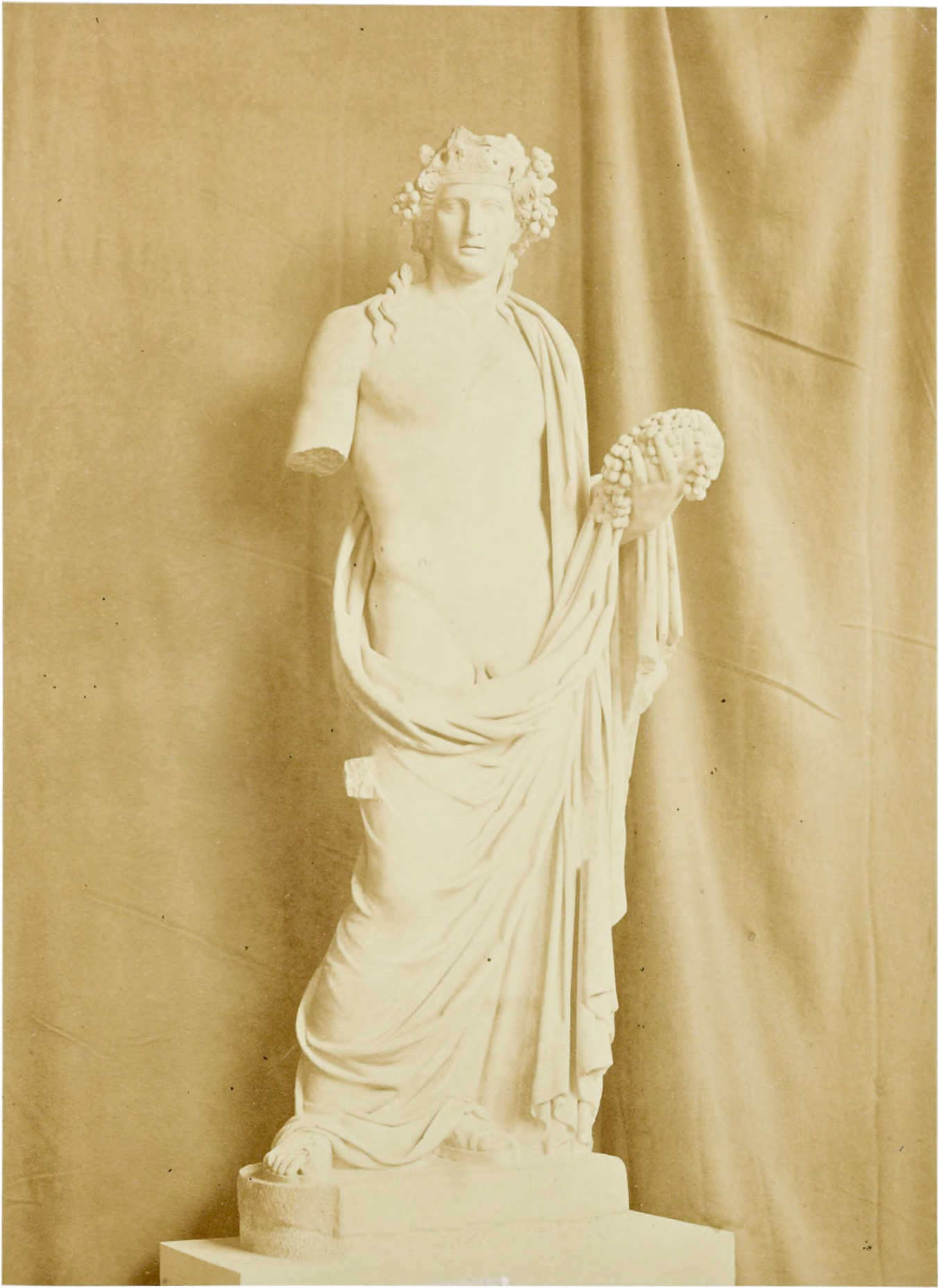
BACCHUS,
No. 61.
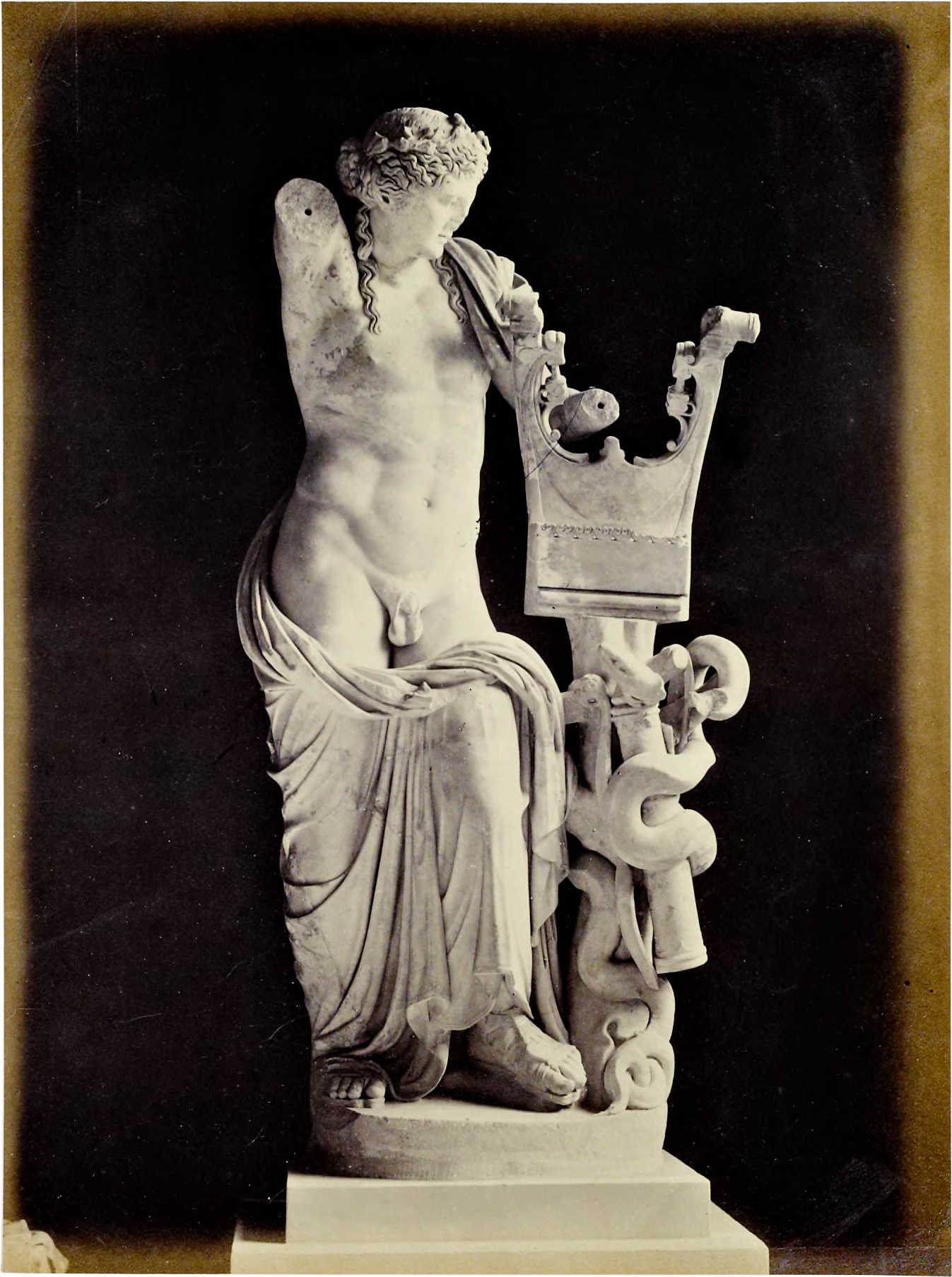
APOLLO CITHARŒDES,
No. 62.
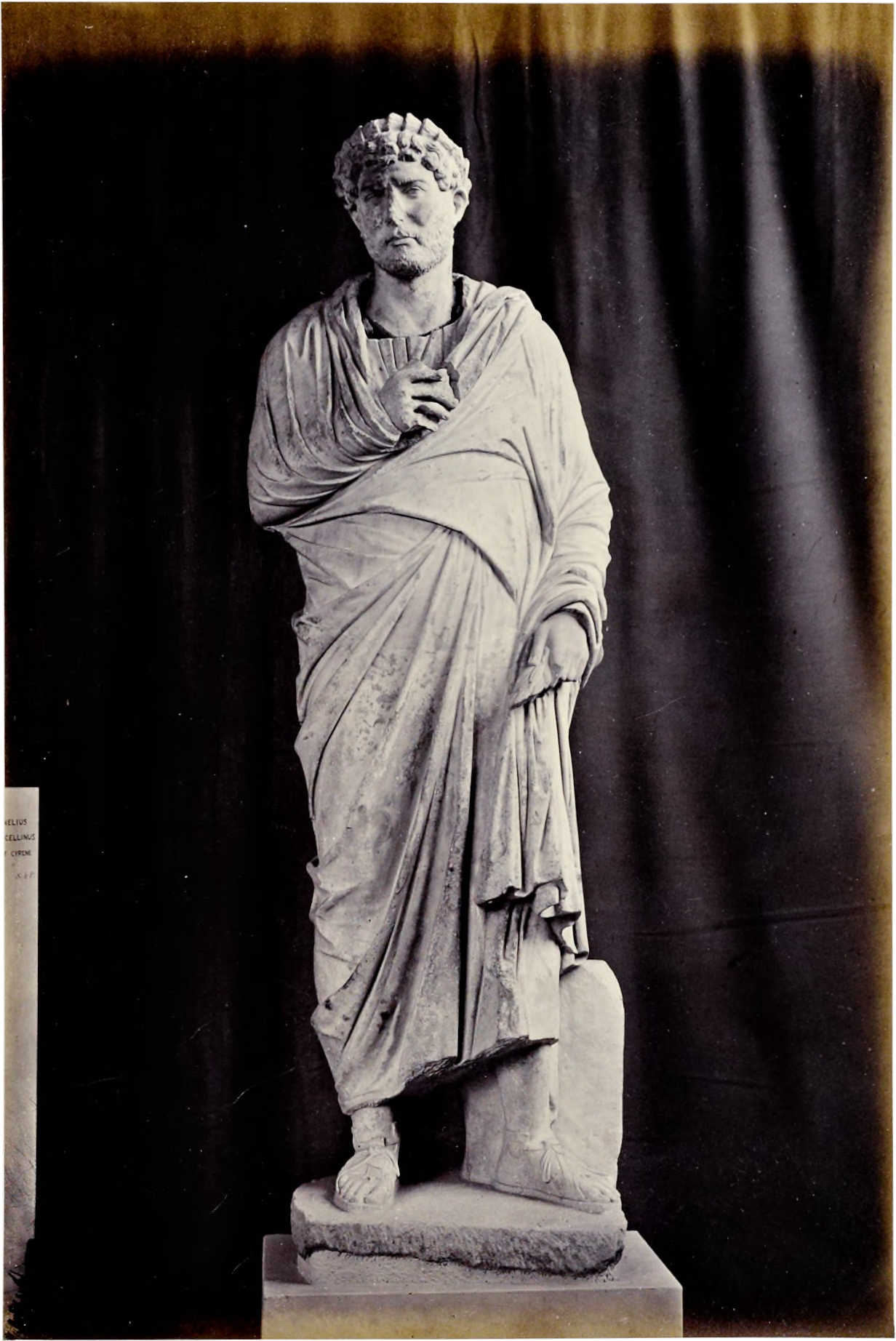
THE EMPEROR HADRIAN?
No. 63.
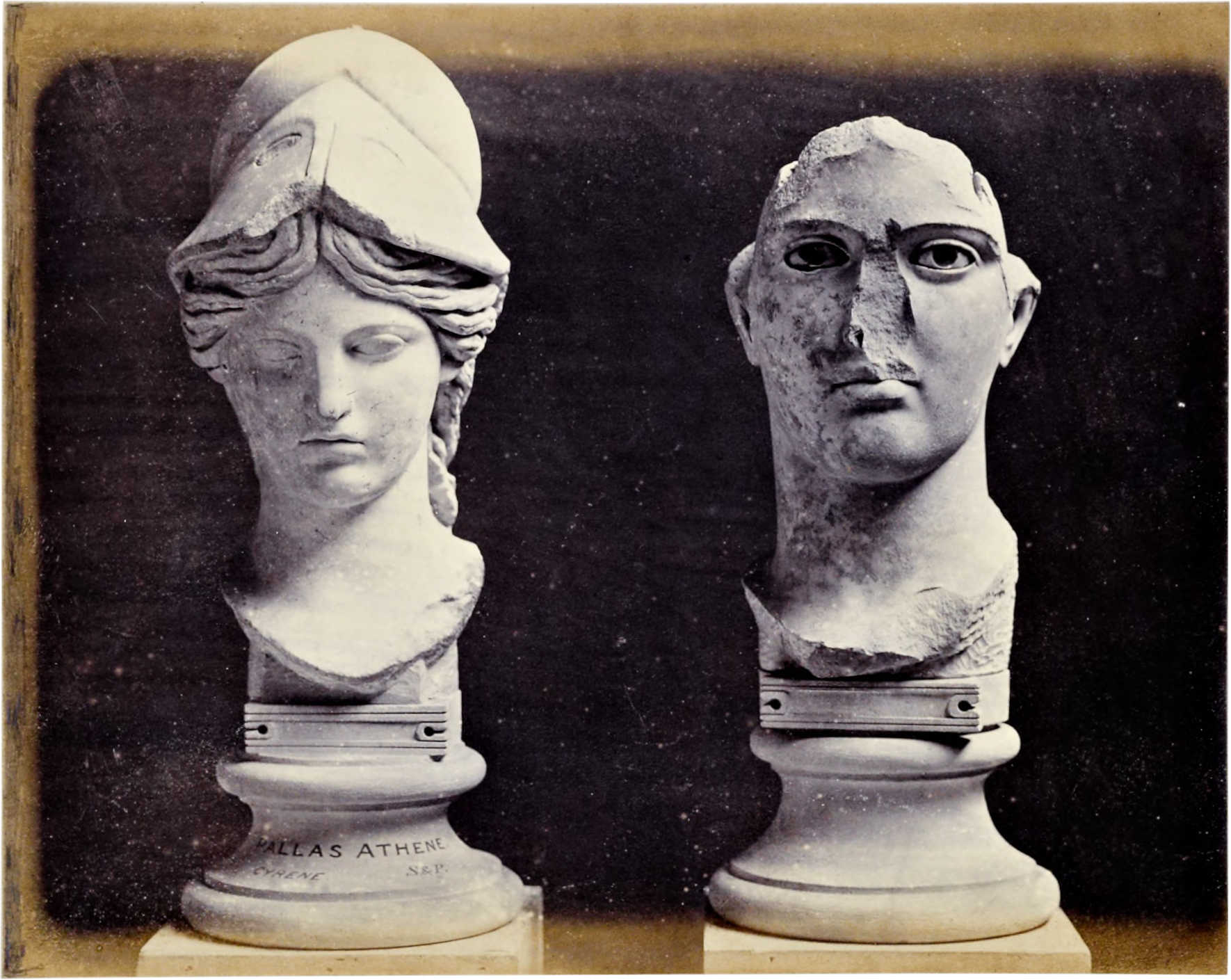
MINERVA & A MALE HEAD,
No. 64.
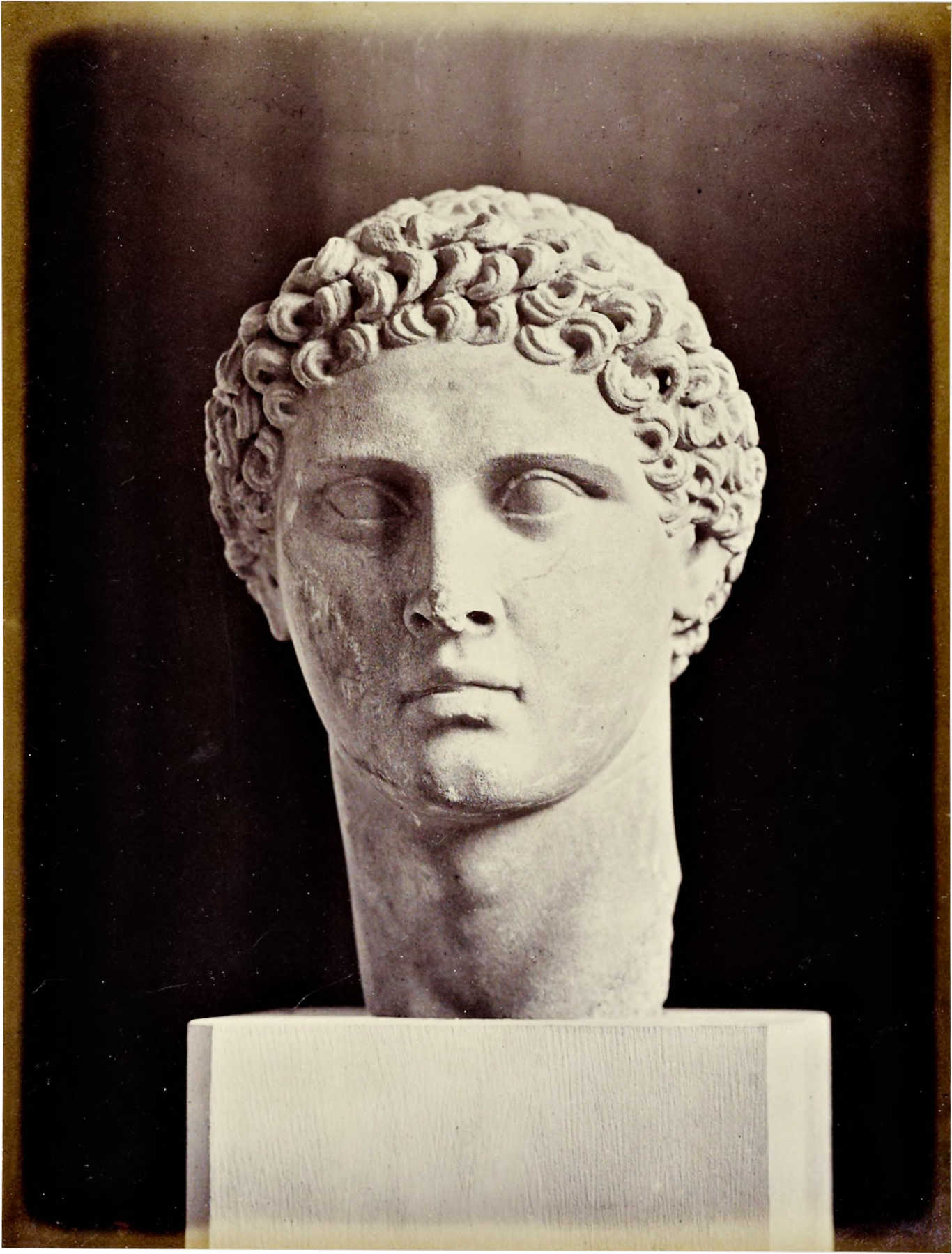
CNÆUS CORNELIUS LENTULUS MARCELLINUS,
(PROPRÆTOR OF CYRENE.)
No. 65.
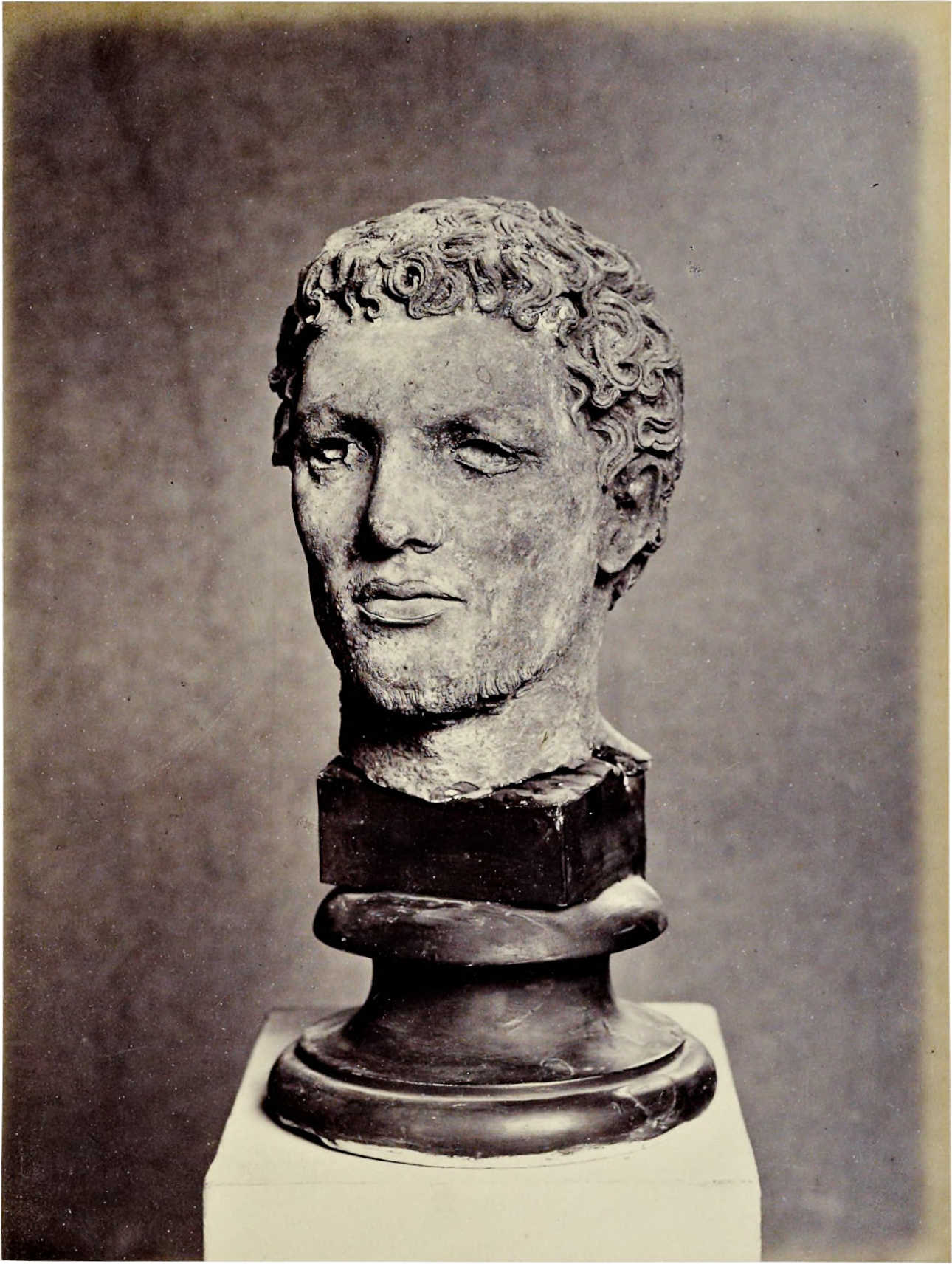
BRONZE ICONIC HEAD,
No. 66.
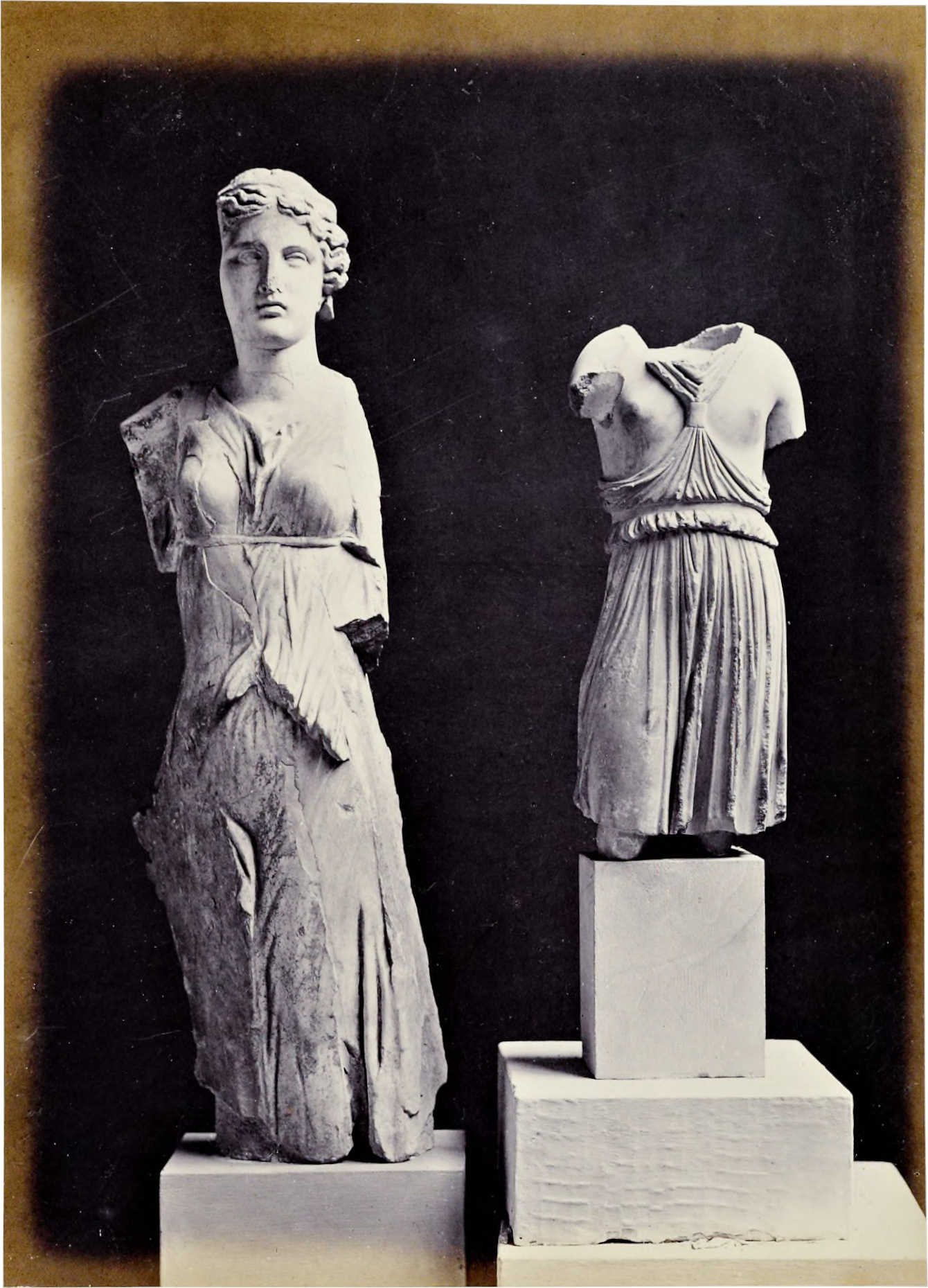
APHRODITE & FEMALE TORSO,
No. 67.
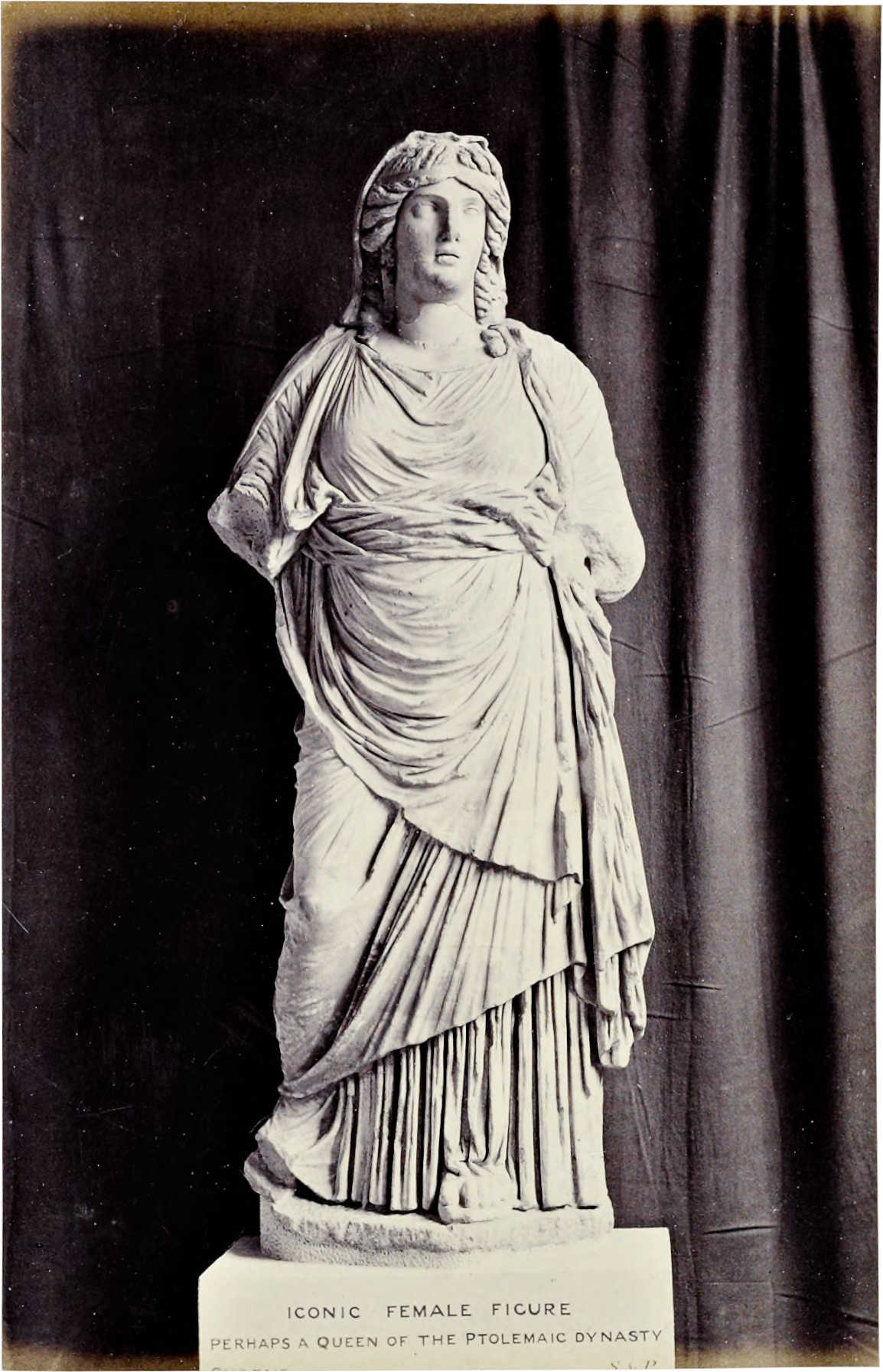
ICONIC FEMALE STATUE,
No. 68.
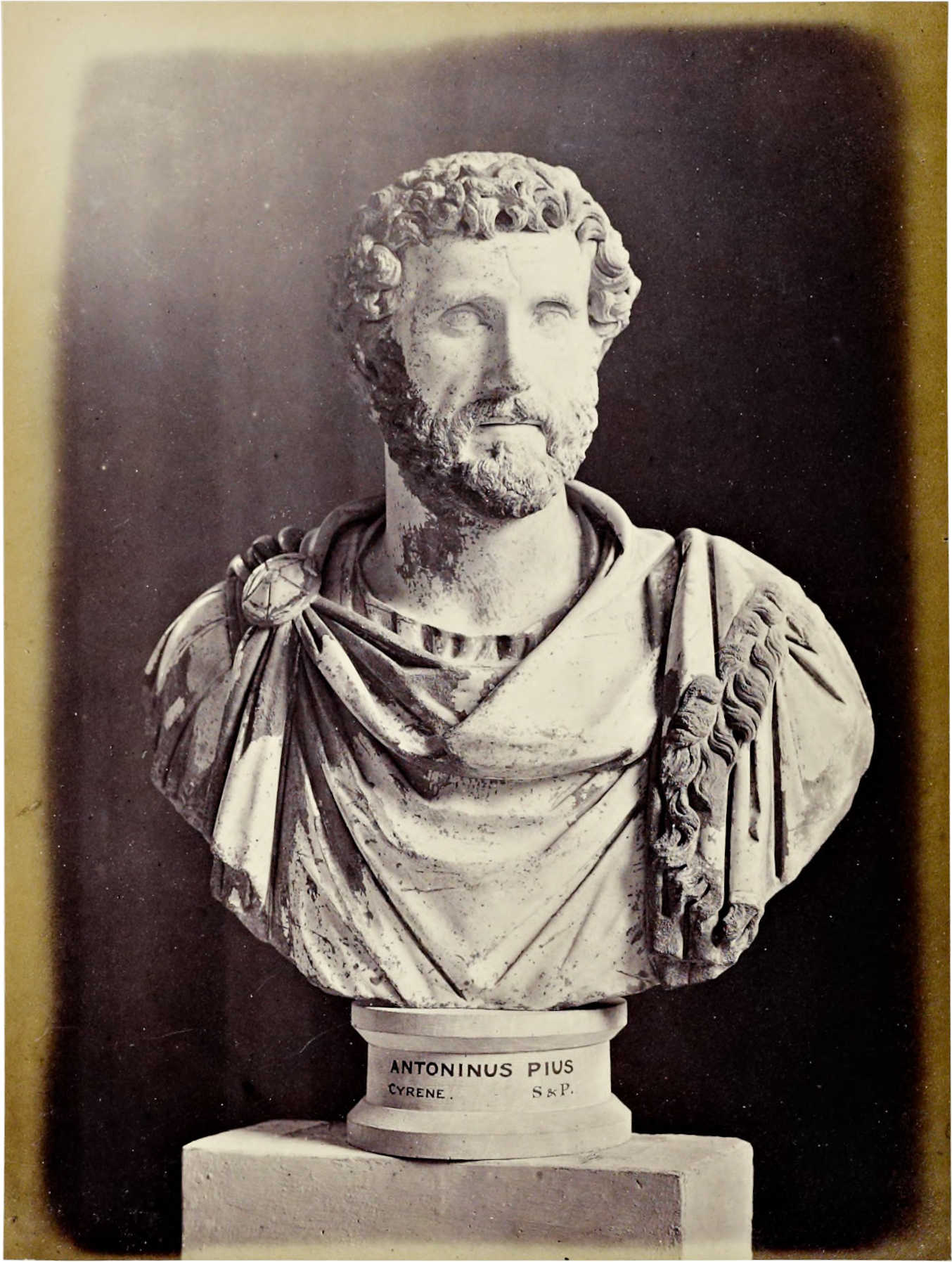
THE EMPEROR ANTONINUS PIUS,
No. 69.
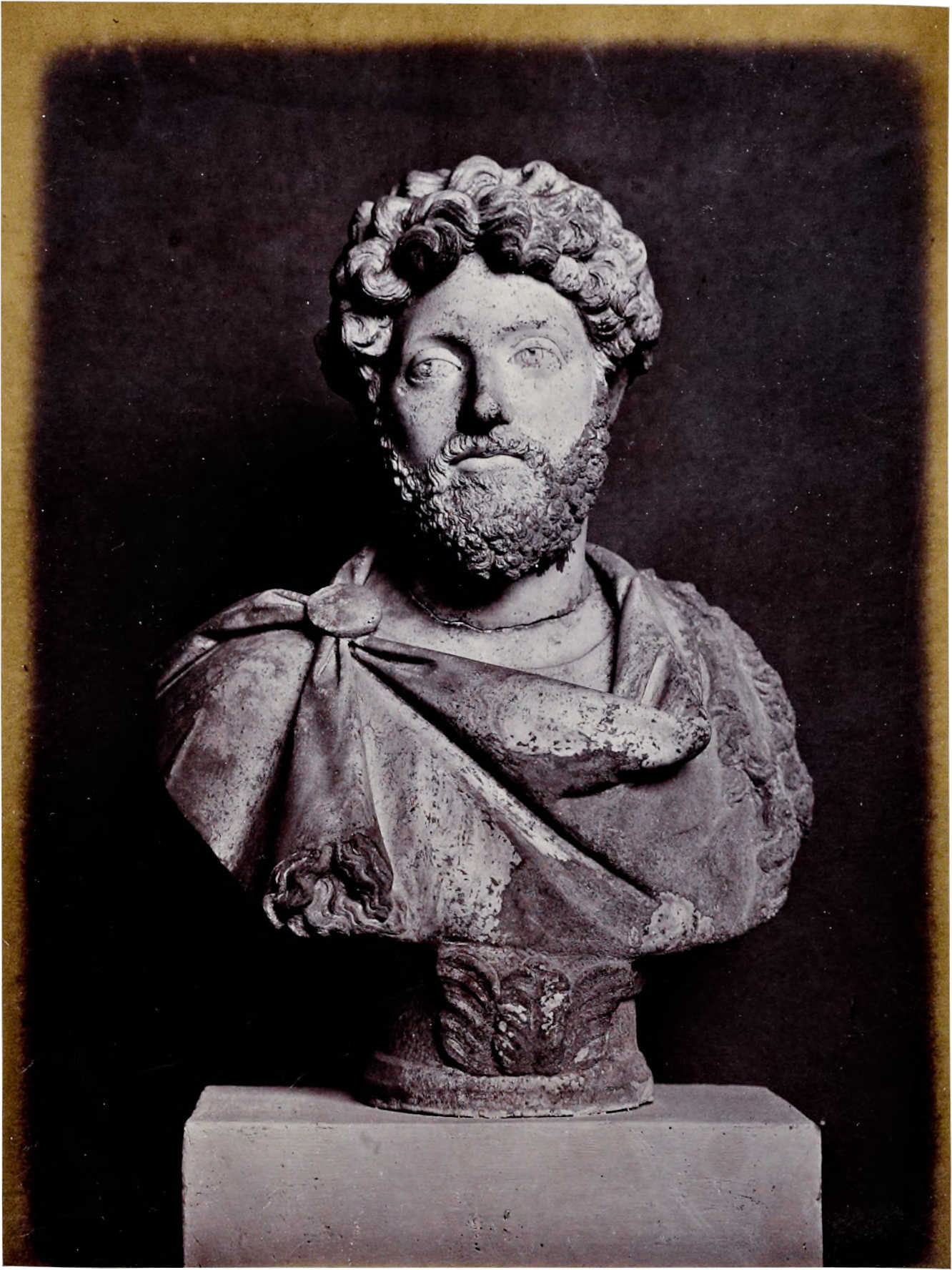
BUST OF A ROMAN EMPEROR,
No. 70.
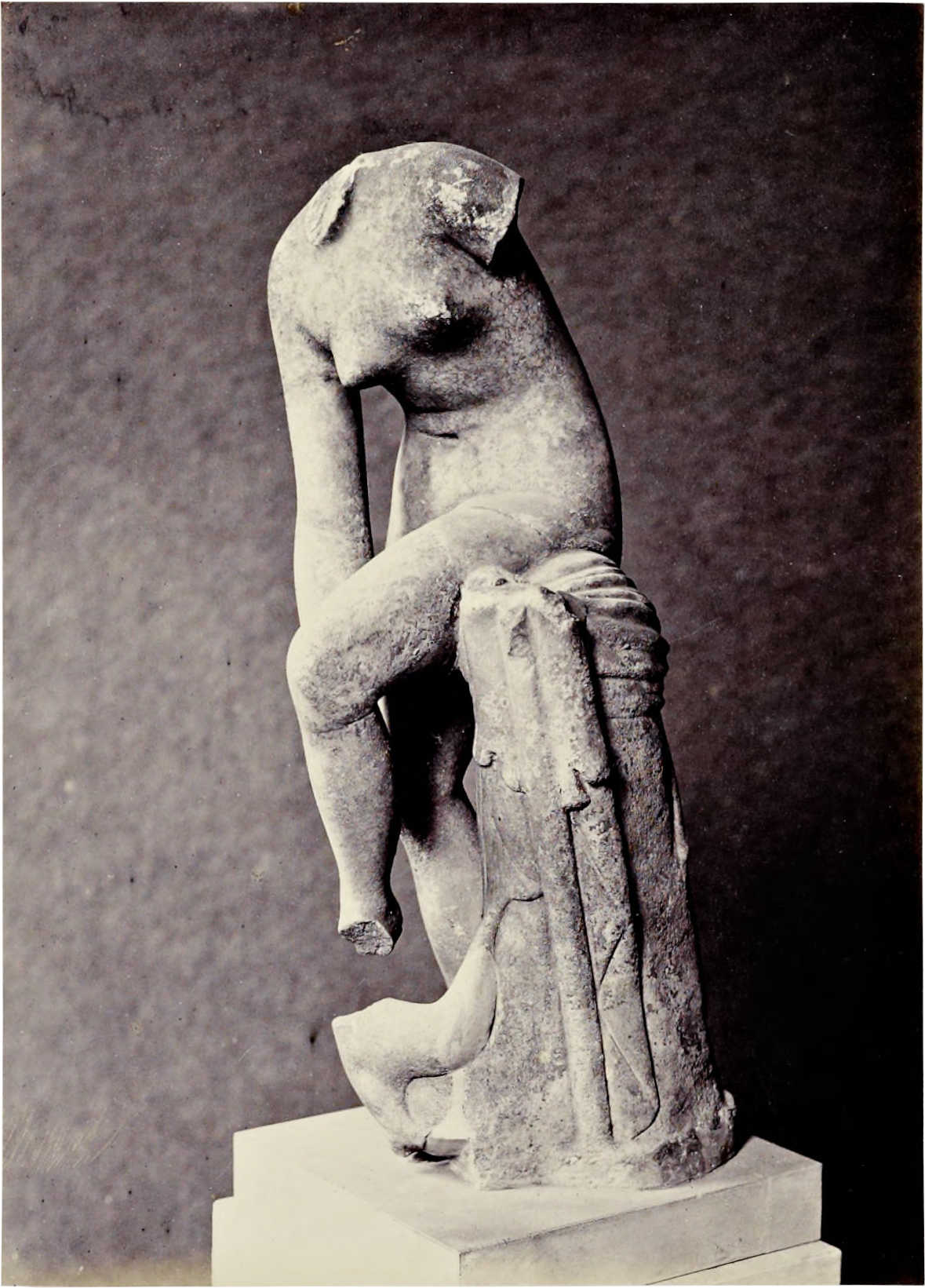
APHRODITE EUPLOIA,
No. 71.
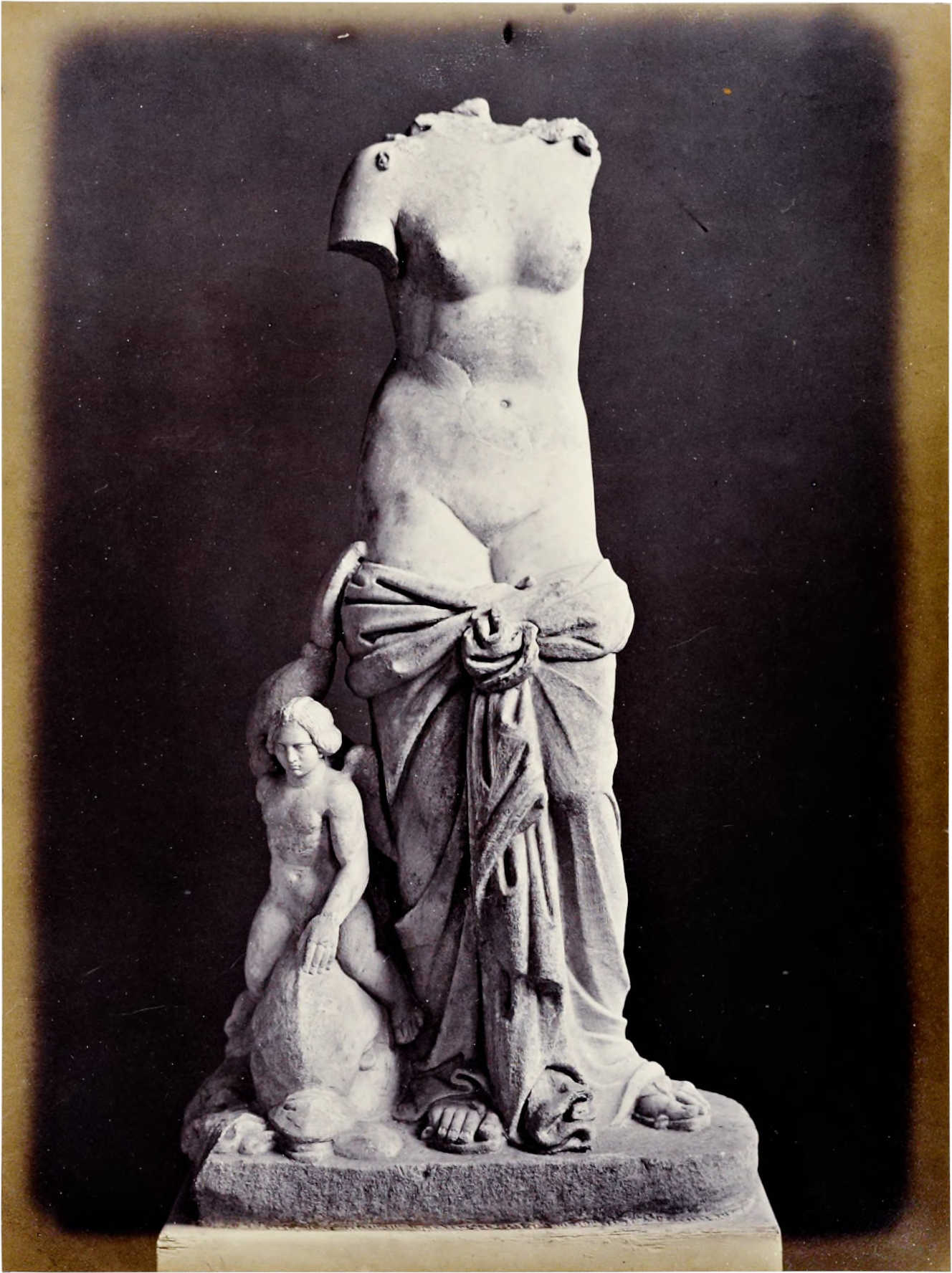
APHRODITE AND EROS,
No. 72.
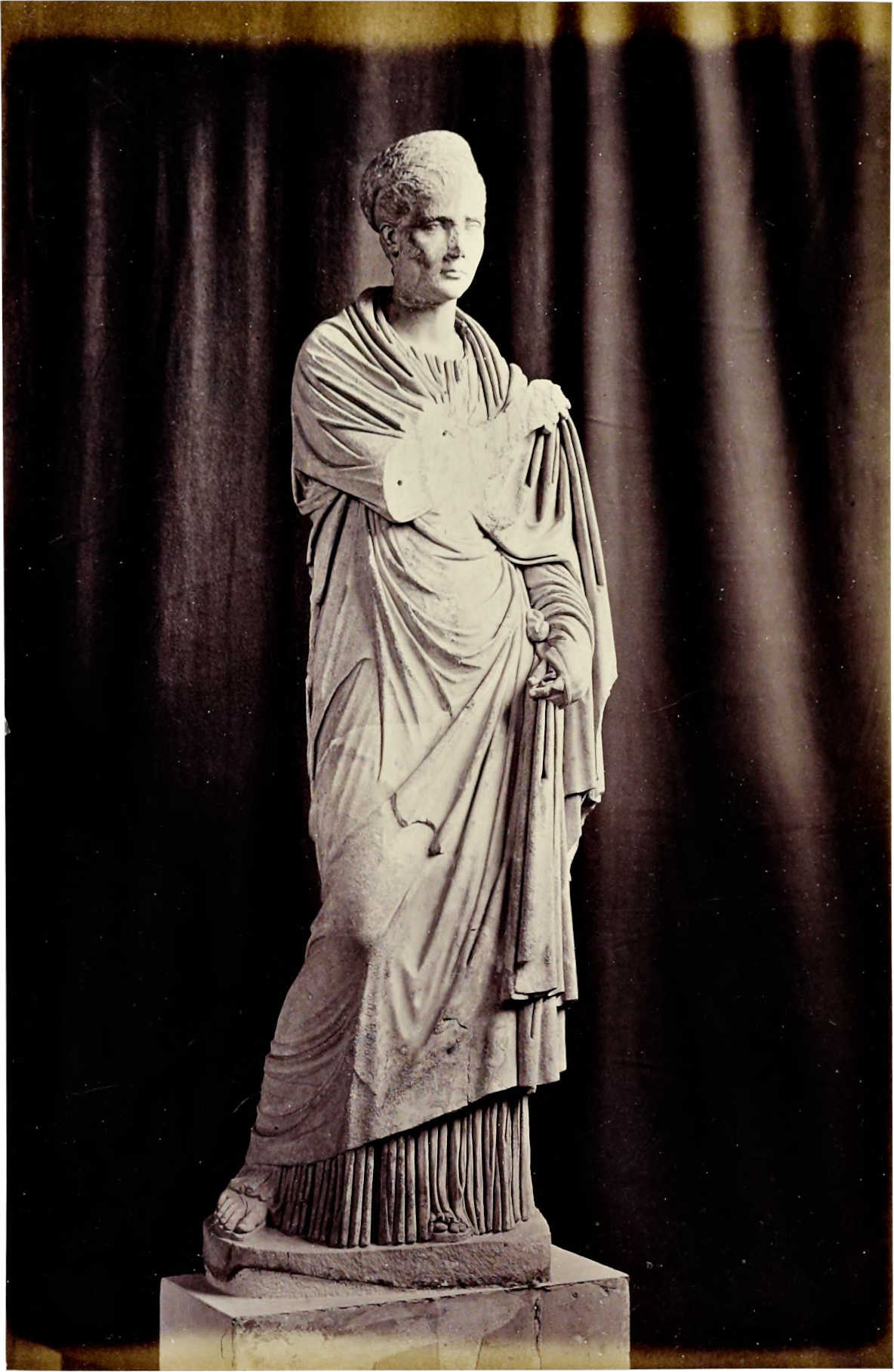
ICONIC FEMALE FIGURE,
No. 73.
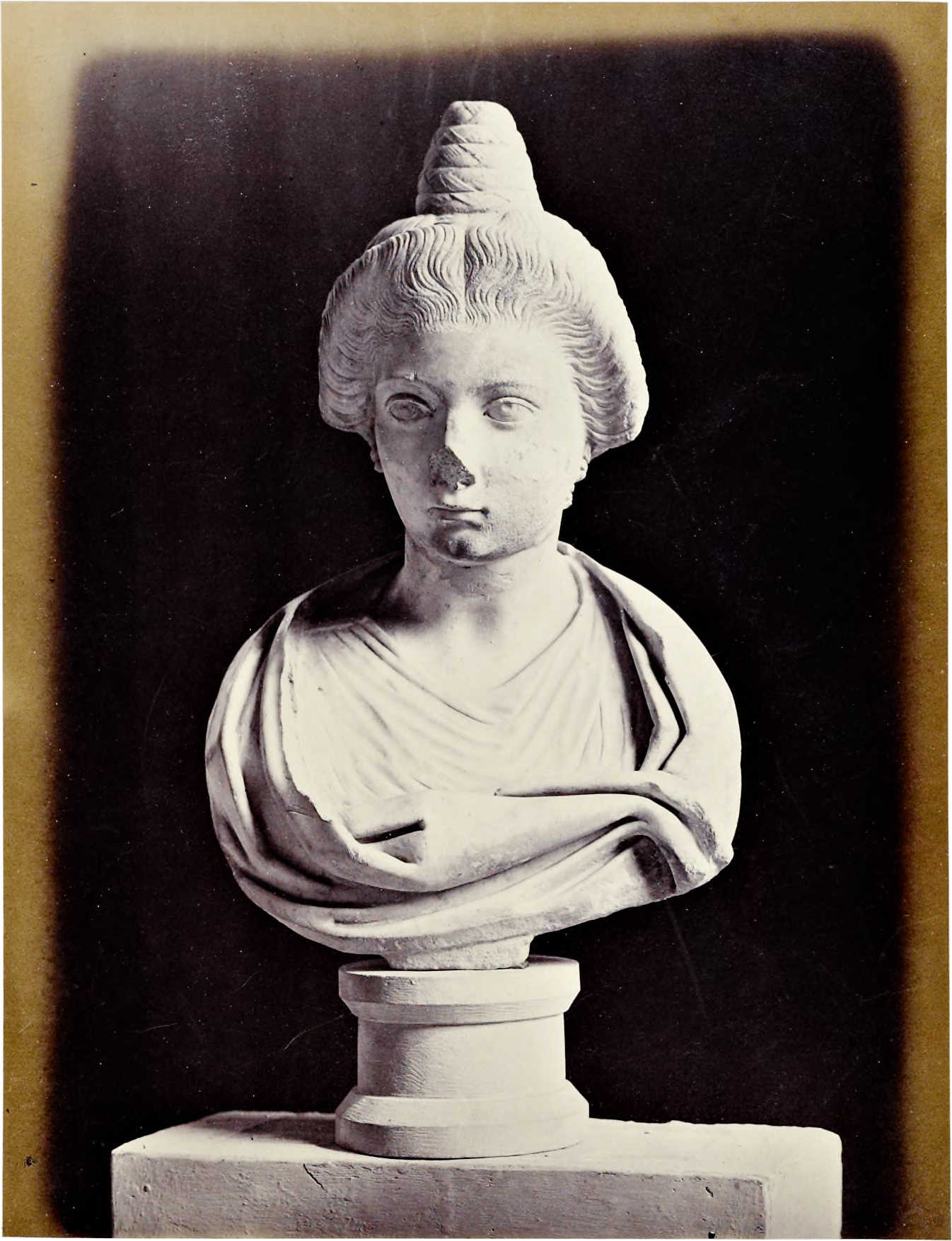
FEMALE BUST OF ROMAN PERIOD,
No. 74.
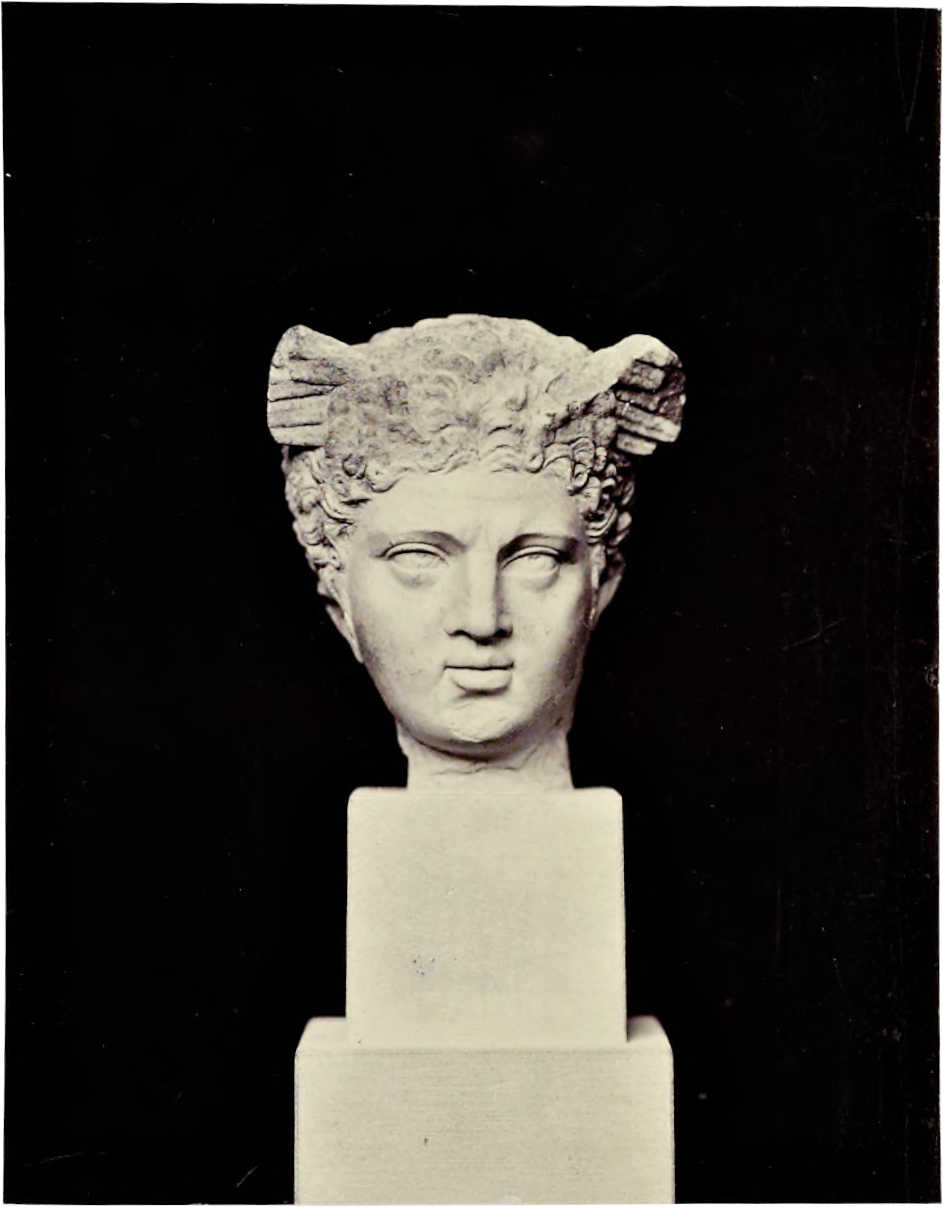
HEAD OF PERSEUS,
No. 75.
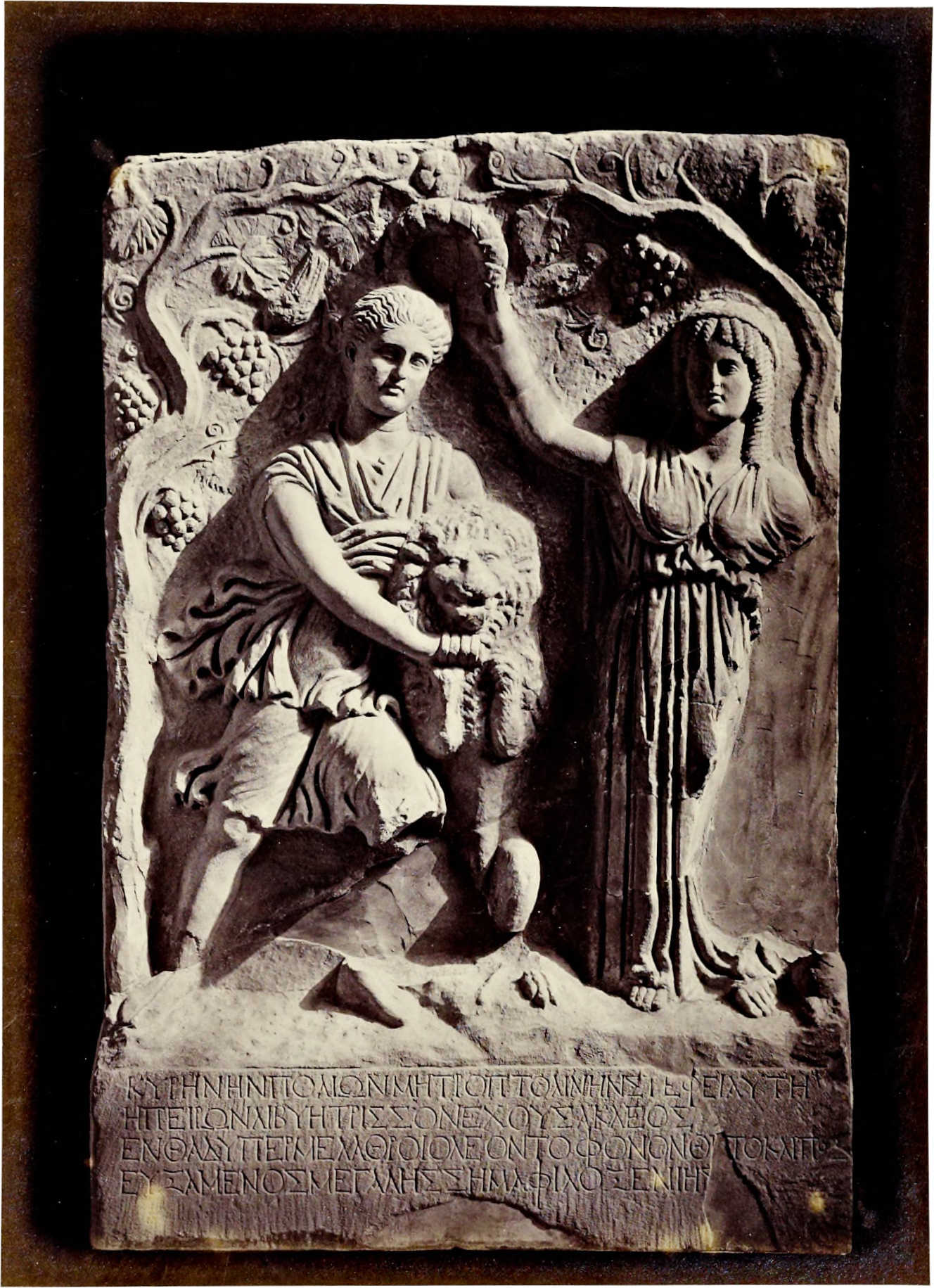
THE NYMPH CYRENE OVERCOMING A LION
& BEING CROWNED BY LYBYA,
No. 76.
[99]No. III.
LIST OF SCULPTURES FOUND ON VARIOUS SITES AT CYRENE.
Note.—The Nos. subjoined to each object are those now affixed to them in the British Museum.
TEMPLE OF APOLLO.
1. Apollo Citharœdus.—Pl. 62.
2. The Emperor Hadrian.—Pl. 63.
3. Bronze iconic head.—Pl. 66.
4. Head of Pallas Athene.—Pl. 64.
5. Head of Cnæus Lentulus Marcellinus.—Pl. 65.
6. Group of the nymph Cyrene overcoming a lion by strangling him. The nymph is attired like Diana for the chase. Her hair is bound with a diadem, and gathered into a club behind. Height, 2 ft. 10½ in. (3).
7. Jupiter Ammon; round his lower limbs a mantle; right hand broken away, left hand placed behind his back. On the face are traces of red colour.—Representations of Jupiter Ammon are rare in sculpture. The head of this deity is one of the principal types on the coins of Cyrene, and other towns in the Cyrenaica, and occurs on the cuirass of the Roman emperor. (See post, No. 107.) Height, 2 ft. 10 in. (7).
8. Youthful male figure, wearing a mantle, gathered round his waist and leaving the right side of his chest bare; his head bound with a twisted diadem. His left hand is placed behind his back; his right hand has been extended in front of him. The head, which is inserted in a socket, and may not belong to this figure, bears some resemblance to that of Alexander the Great. The right arm is wanting. At his feet, on the left, is a conical object, possibly intended to represent the Delphic omphalos: unfinished at the back. Height, 3 ft. 9 in. (26).
9. A beardless figure, wearing a chiton, a mantle, and sandals; his head laurelled; his right hand held across his breast; in his left hand a laurel-branch; at left side, some object, perhaps a case for rolls of MS. This figure looks up, and may represent either a priest or a poet taking part in the worship of the temple. Style very late and coarse. Height, 3 ft. (4).
10. A figure precisely similar. Height, 2 ft. 10½ in. (5).
11. Female figure, wearing talaric chiton and diploidion; over forehead, sphendone: head looks up. Arms wanting from the elbow; head and lower arms have been inserted in sockets. This figure may possibly be a Juno. Art late and bad. Height, 4 ft. 5 in. (6).
12. Female figure, probably Hygieia, clad in a talaric chiton and diploidion, over which is a peplos wound round the body. Round right arm a serpent twisted; the right hand wanting; the action of the left arm suggests that she has held a patera to feed the snake. Over the forehead is a radiated sphendone, in the centre of which a flower. Unfinished at the back. The head has been fitted to a socket on the neck, but it is doubtful whether that now adjusted belong to this figure. Art very late and coarse. Height, 3 ft. 8 in. (25).
13. Artemis moving rapidly forward: she wears a talaric chiton, a peplos, and sandals; her hair[100] is gathered up over her forehead like that of Apollo; her arms, which are wanting, and her feet, have been fitted on at a joint; her neck is let into a socket. Height, 3 ft. 3½ in. (8).
14. Female figure, wearing low sphendone, talaric chiton, girt at the waist, peplos, and shoes. Height, 2 ft. 8 in. (52).
15. Small winged figure in relief, broken off at hips, which probably represents Somnus reclining. Height, 8 in. (107).
16. Torso of small figure of Eros (?). Height, 5½ in. (109).
17. Right leg, broken off halfway up the thigh, from statue of youthful Bacchus. At side, trunk of tree, encircled with vine-bearing branches. Height, 1 ft. 6 in. (103).
18. Right leg from a colossal statue. This leg is broken off above the ancle, and terminates just above the knee, in a joint which has probably been concealed by drapery falling over it; it may, therefore, have belonged to an acrolithic statue. It is in a very fine style, and may have been executed in the Macedonian period. Height, 2 ft. 1 in. (15).
19. Archaic head of Apollo. The back hair long, and wound round the crown in a braid; in front short curls. The chin broken away. This head is copied from the same original as the Apollo of the Phygalian room. (Marbles in British Museum, vol. xi. Pl. 32.) In the Theseium at Athens is a similar figure. Height, 11 in. (53).
20. Youthful heroic head, looking to the right; the top of the head cut off flat. Roman art. Height, 10 in. (55).
21. Female head bound with diadem; broken away at back of head. Blue marble. Height, 5¼ in. (64).
22. Head of Ariadne (?); hair bound with ivy; crown cut off. Height, 6½ in. (127).
23. Head of Diana; hair gathered into a high topknot, and bound with diadem; eyes have been made of vitreous paste, which remains in one eye. Height, 7 in. (128).
24. Head of Diana; hair gathered into a high topknot, and bound with diadem. Height, 5½ in. (129).
25. Head of Diana; hair gathered into a high topknot, and bound with diadem. Late art. Height, 7 in. (131).
26. Youthful heroic head (Theseus?); hair bound with twisted diadem; back of head broken off flat. A fine type. Height, 5¼ in. (124).
27. Two fragments of a female head bound with a diadem. Blue marble; diadem painted black; eyes and hair red. Injured by fire. Height, 8½ in. (145).
28. Left side of a female head wearing a stephane and veil. Height, 5½ in. (143).
29. Female head, bound with low stephane. Much defaced. Height, 6 in. (137).
30. Female head looking up; hair slightly waved, a single ringlet falls on each side of neck; back of head and neck cut flat. Style mean and late. Height, 1 ft. 2½ in. (86).
31. Panther or lioness sitting on its haunches; hind-quarter broken away. Very rude. Height, 7½ in. (122).
RUINS NORTH OF TEMPLE OF APOLLO.
32. Female figure.—Pl. 68.
33. Diana Venatrix, wearing a succinct chiton, a chlamys hanging over left arm, and endromides; at her side a hound; her left hand is advanced, and probably held a bow; a quiver rests against her right leg. Art very late and bad. Height, 3 ft. 11 in. (159).
34. Male figure, clad in a chiton and mantle; broken away below the knees; hands and nose wanting; his right arm, muffled in his mantle, is passed across his breast. The countenance is[101] that of an aged person. The head being bound with a fillet, perhaps this figure may represent a poet. He is beardless. (See ante, p. 75.) Present height, 5 ft. 2 in. (37).
35. Seated female figure, clad in a talaric chiton, and a peplos covering the back of her head; her feet and forearms are wanting; she wears a girdle tied in a singular knot under her bosom, with ornamented ends hanging down; her peplos has a deep fringe at the edge. The edges of her girdle are painted in vermilion, which is still very fresh, and the same colour appears at the joints where the forearms are broken off. She is seated on an oblong seat with a cushion; her feet have rested on a footstool. This figure was found close to another female seated figure of colossal size, but in other respects resembling it very closely, which was inscribed with the name of Archippe, daughter of Ptolemaios, a priestess. It is therefore probable that the smaller seated figure may also be a priestess. (See ante, p. 75, where it is erroneously stated that Archippe is one of the Ptolemaic dynasty.) This statue is unfinished at the back, and the crown of the head has been cut away. It probably stood in a niche. Height, 4 ft. 2 in. (36).
36. Youthful Bacchus crowned with vine-leaves. The feet remain, but the legs are wanting from the knees. The right forearm and the nose are broken away; the left elbow rests on the trunk of a tree, round which is twined a vine. The right hand has hung down by the side, and has held some object, to support which two square projections are left on right hip and thigh. The proportions of this figure are good, and it is fairly modelled. Height, 3 ft. 2 in. (27).
37. Female figure, clad in a chiton and peplos; in right hand oinochoe. Head broken off at neck, which is let into a socket. Poor art. Height, 2 ft. 6 in. (41).
38. Legs from a male figure, life size, wearing hunting-boots; at the side a nebris, or fawn-skin, flung over the trunk of a tree. Height, 2 ft. 1 in. (150).
39. Head of Venus (?) bound with diadem; hair in deep waves, cut away at the back. Broken off, probably, from a statue. Height, 1 ft. 1½ in. (61).
40. Female head; hair gathered into a knot on the crown; probably meant for Artemis. Art late and bad. Height, 6 in. (132).
SMALL BUILDING TO THE WEST OF TEMPLE OF APOLLO.
41. Torso of seated female figure, wearing peplos and talaric chiton bound with girdle. Height, 1 ft. 4½ in. (93).
NEIGHBOURHOOD OF TEMPLE OF APOLLO.
42. Female head, cut off flat above the forehead, to receive the hair, which must have been sculptured on a different piece of marble. Height, 11½ in. (88).
43. Youthful male (?) head; traces of red colour in the eyes. The top of the head cut off flat to receive the hair, which must have been fitted on, as in the case of the head last described. Height, 8 in. (89).
44. Female head; hair waved. Style late and bad. Height, 8 in. (90).
45. Head of Bacchus wearing a diadem and a crown of vine-leaves, with bunches of grapes hanging down on each side of the cheek. Height, 7½ in. (92).
[102]TEMPLE OF VENUS.
46. Female bust.—Pl. 74.
47. Statue, probably of an empress.—Pl. 73.
48. Group of nymph Cyrene crowned by Libya.—Pl. 76.
49. Female bust.—The head-dress is similar to that of Faustina the Elder, whom this bust may therefore represent, though the features have little likeness to that empress. The shoulders are draped. The sculpture is mean, and deficient in style. The end of the nose is slightly injured, but in other respects this head is in good condition. Height, 1 ft. 11 in. (117).
50. Aphrodite Euploia.—Pl. 71.
51. Group of Venus, with Cupid on a dolphin.—Pl. 72.
52. Similar group.—The Venus wants arms and head. Her drapery falls over a stelé on left, in front of which is the Cupid. Sculpture late and coarse. Height, 1 ft. 1½ in. (75).
53. Fragment from similar group. Eros on dolphin, holding up part of the drapery with right hand; at his left hand part of left leg of Venus. Height, 8½ in. (71).
54. Fragment from similar group. No remains of the Venus. Height, 7 in. (72).
55. Venus; lower half draped; at left side dolphin. Head and right arm wanting. Height, 11 in. (66).
56. Draped statuette of Venus, from waist downwards. This fragment appears to be Greek marble, and the sculpture is of a fine period. Height, 1 ft. 2½ in. (22).
57. Torso of nude Venus. Headless; right leg broken off halfway up thigh, left leg below knee; right arm broken off above wrist, left below shoulder; on each arm, armlet. Right arm advanced, as if to cover pubes. Fair Roman sculpture. Height, 1 ft. 2 in. (104).
58. Head of Venus bound with opisthosphendone. Height, 6 in. (139).
59. Upper part of reclining figure of Somnus, in relief; in right hand two poppy-heads. Left hand supports head. Length, 6½ in. (74).
60. Dolphin from a group, placed head downwards; a female hand rests on his tail. Height, 1 ft. 1 in. (153).
61. Torso of Eros, with ringlets falling on either side of neck. Sculpture of a good period. Height, 6 in. (105).
62. Youthful male head, in conical cap, with flowing hair,—Atys (?). Height, 9½ in. (59).
63. Torso from knees to neck of statuette of Diana Polymammia. Wants arms; round neck two archaic bracelets. Height, 6 in. (20).
64. Torso of triple Hekate. Heads broken away; at the feet of one of the figures, a hound looking up. All these figures have their arms hanging down. One of them holds in her right hand an oinochoe; the others hold in the right hand some uncertain object. Height, 7½ in. (73).
65. Torso of female statuette, wearing short chiton and nebris. Artemis (?). Fair sculpture. Height, 1 ft. 1½ in. (111).
66. Within a fold of pendent drapery, perhaps broken off from a statue, a female term, clad in a panther’s skin, and placed on a base. Artemis (?). Broken off at neck. Height, 6 in. (154).
67. Demeter Dadophoros. Rudely sculptured in stone of the country. She wears a talaric chiton and a peplos thrown over the head; in her right hand she holds ears of corn, in her left a torch. Height, 1 ft. 11 in. (50).
68. Seated male figure, Jupiter (?), holding in right hand some twisted object, perhaps a distaff; lower half draped. Sculptured in freestone. Height, 1 ft. 8 in. (97).
69. Isis; bust in alabaster. Broken away below breasts. The bust clad in a chiton and fringed peplos, which is fastened by the nodus Isiacus. On the crown of the head is a hole for the attachment[103] of some ornament; the hair bound with a sphendone, and falling on the neck in long ringlets; at the back of the head a cluster either of curls or of fruit. Height, 11 in. (83).
70. Isis, clad in a talaric chiton and a mantle, which is fastened on the breast in the nodus Isiacus. The ends of a fringed veil hang down on her shoulders; wants head. Fair sculpture. Height, 1 ft. 9 in. (84).
71. Lower part of seated male statuette, of which the left leg and thigh, part of the right thigh, and the base of the lyre alone remain. At left side, gryphon. The proportions seem rather those of Hercules than of Apollo; but as the sculpture is of a late period, this deviation from the usual type may be only the result of ignorance in the artist. Height, 7 in. (101).
72. Relief representing the oracular shrine of Apollo. On right, Apollo seated, with right foot on omphalos, the lower part of his body draped; by his side a tripod. On left, gryphon seated, and bearded ithyphallic term, probably of Dionysos. On the plinth, the inscription No. 34. Sculpture very rude and in bad condition. Height, 10 in. by 8½ in. (77).
73. Pilaster in form of Pan: on his head a bracket. Round the body a mantle, in which his right hand and arm are muffled; in left hand, syrinx. The bracket is ornamented with palm-branches. Red colour is quite distinct on the drapery and bracket. Height, 3 ft. 6 in. (28).
74. Aristæus (?) Round the lower half of his body a mantle, falling over his left shoulder, his right hand on his hip; under left arm a staff, round which a snake is coiled. His hair is long; his head bound with a diadem, above which has been some kind of crown or upright head-dress; the crown of the head has been worked flat; his left hand, which has rested on his staff, is wanting. At the side of left foot, a conical object, which may be either a rude representation of the omphalos, or a mere support. In this figure, the features and attributes resemble those of Apollo, but the general type is rather heroic than divine. It may, therefore, be considered with probability a statue of Aristæus, the mythic founder of Cyrene, who, as the son of Apollo by the nymph Cyrene, was said to resemble him in features. Height, 4 ft. 6 in. (158).
75. Head of Athene in Corinthian helmet. Well preserved. Height, 10 in. (60).
76. Head of bearded Bacchus, from term. The hair falls in long tresses, and is clustered behind each temple in the archaic fashion. On the crown of the head a hole for the insertion of an ornament. Height, 8½ in. (81).
77. Torso of youthful satyr, naked; head, arms, and both legs wanting. Well sculptured, in Greek marble. Height, 8 in. (82).
78. Seated female figure, wearing a chiton girt at the waist, over which is a peplos; on each side of the chair, a sphinx. Head, both hands, and head of sphinx on right wanting. Height, 11½ in. (76).
79. Youthful male figure, wearing helmet, chiton exomis girt up above the knee and fastened over left shoulder; shoulder-belt and high boots,—endromides, as if attired for the chase. Both arms wanting; the back is unfinished, as if this statue had stood in a niche. The right arm has been raised and the head turned that way. At right side, trunk of tree. Sculpture very rude and coarse. Height, 6 ft. 4 in. (68).
80. Similar figure. Wants head; sculpture very rude and coarse. Height, 4 ft. 11 in. (149).
81. Fragment, probably of a group of a hunter and goat, of which all that remains is the goat standing on his hind legs, the hand which holds it, and one leg of the man, wearing a hunting-boot. Sculpture coarse and late. Height, 1 ft. ½ in. (116).
82. Fragment of relief; legs clad in endromides; from standing male figure, broken off at knees. Height, 10½ in. (99).
83. Draped term. Wanting head; the left hand placed across the breast, under the drapery, in an attitude similar to that of a female term in the Græco-Roman gallery at the British Museum, thought to be the Venus Architis. (See Museum Marbles, vol. ii. Pl. 37.) Height, 1 ft. 4½ in. (161).
[104]84. Torso of male figure, wearing cuirass and chlamys girt by a belt. Broken off at knees and neck; much worn. Height, 10½ in. (79).
85. Female figure, clad in talaric chiton and diploidion fastened on right shoulder. Wants head and arms. Height, 1 ft. 10 in. (120).
86. Youthful male torso; a peplos wound round his waist and over left forearm; right arm advanced across body. Height, 1 ft. (106).
87. Fragment of relief. Female figure seated, clad in a talaric chiton and peplos. This is probably a fragment of a votive tablet, as the figure seems looking round to the right. Height, 8½ in. by 4 in. (96).
88. Part of votive tablet in relief; a male and a female figure, standing side by side. The male figure wears a mantle round the lower part of his body; the female, a talaric chiton. Heads wanting. Height, 1 ft. by 10½ in. (78).
89. Female head, with conical head-dress; similar to that given Pl. 74.—The apex of the cone is pierced as if for suspension. It is possible, therefore, that this head was used as a weight, as the bronze weights of Roman steelyards were sometimes fashioned in the form of heads. This head, like that engraved Pl. 74, is evidently a portrait. Height, 11 in. (40).
90. Female head, bound with a sphendone and wreath of ears of corn. Height, 6 in. (140).
91. Female head; hair tied in a knot over the crown; face in bad condition. Height, 4 in. (130).
92. Female head, bound with stephane. Height, 5½ in. (133).
93. Heroic (?) head, bound with diadem; hair unfinished. Height, 4 in. (135).
94. Youthful heroic head, looking to right; hair in short curls. Height, 10 in. (56).
95. Head of boy; at back of head, drapery. Height, 9 in. (57).
96. Aged male head; portrait. Broken off at neck; nose slightly injured. Height, 7 in. (58).
97. Youthful male head, in conical cap. Atys (?). Hair long. Height, 9½ in. (59).
98. Female head, bound with diadem; the crown cut off. Traces of red colour in the hair. Height, 6 in. (144).
99. Vine branch round trunk from statue. Height, 6 in. (123).
100. Fragment of group representing lion on back of bull. Rude and late. Height, 8 in. (112).
101. Head of bull. Rude. Height, 5 in. (113).
102. Legs of standing figure, clad in talaric chiton and sandals; has been coloured red. Height, 9 in. (100).
103. Dog standing on hind legs, from group. Height, 9½ in. (121).
104. Head of Venus.—Hair covered with coif and bound with diadem. Badly preserved. Height, 4¼ in. (141).
AUGUSTEUM.
105. Bust of Antoninus Pius.—Pl. 69.
106. Bust of Marcus Aurelius.—Pl. 70.
107. Head of Lucius Verus, broken at the neck.—Nose broken off; sculpture good, but condition indifferent. Height, 1 ft. (16).
108. Torso of a Roman emperor in a cuirass.—This is the torso which was seen by Beechey lying on the ground, and which he supposes to have belonged to the statue of a Ptolemy. The building near which it was found (marked “Palace” on the plan of Cyrene,—see ante, p. 76) was, probably, an Augusteum, or temple dedicated to one or more Roman emperors, as several imperial[105] busts and statues were discovered here. This cuirass is very richly ornamented with reliefs. On the breastplate is a female figure, draped to the feet, representing Rome. On either side a Victory flies towards her to crown her; the Victory on the right carries a cornucopia and a sash, the one on the left a trumpet. The feet of Rome rest on the back of the wolf suckling the twins Romulus and Remus, whose figures have been broken away. On the lower part of the cuirass are, in the centre, the head of Jupiter Ammon, and on either side a winged youthful head, probably Perseus, between which and the head of Ammon is, on either side, an eagle with spreading wings. Under the cuirass is a jerkin, on which are two helmets and two swords in sheaths, arranged alternately with the reliefs already described. On either flank of the cuirass is an elephant’s head. This torso evidently belongs to the figure of a Roman emperor. As the reliefs are finely executed, it is probably a work of the Augustan age. Height, 4 ft. 6 in. (35).
109. A female figure, clad in a talaric chiton girt at the waist and looped on the sleeves, over which falls a peplos, gathered over left arm; on the feet, shoes. The head and forearms wanting. Art coarse and late. Height, 5 ft. 9½ in. (33).
110. Bust, perhaps intended to represent the Empress Faustina the Younger, as the hair is waved and gathered up behind like hers. The nose is broken away, which makes it very difficult to identify the person represented. The shoulders are covered with a peplos, under which is a tunic. Fair Roman art. Height, 1 ft. 10 in. (18).
111. A block tapering upwards, which has perhaps been fitted into a niche. On one face is represented in low relief a youthful male figure wearing the Phrygian cap (Atys); his body is naked: on either side is a sword pointed downwards. Two holes are drilled in the plane of the relief, one on each side of the figure, apparently for the attachment of some ornament. Height, 8 in. (102).
LARGE TEMPLE NEAR THE STADIUM. (See ante, p. 71.)
112. Part of a male head, rather larger than life; much injured by fire; the nose is destroyed, and the head broken in two pieces. This head is finely executed; the lips are painted red, the beard black. Height, 1 ft. 2½ in. (162).
113. Lower half of seated female figure, wearing a talaric chiton and peplos. Demeter (?). Coarsely sculptured in stone of the country. Height, 6 in. (98).
SMALL TEMPLE NEAR THE STADIUM. (See ante, p. 75.)
114. Female torso, perhaps the nymph Cyrene.—Pl. 67.
115. Aphrodite.—Pl. 67.
116. Fragment of face from colossal head; coarsely sculptured in blue marble. The nose, right cheek, and part of left eye, have been broken away; in the hair are traces of red colour. Height, 1 ft. 6 in. (54).
117. Fragment of a group representing a bull attacked by a lion. The bull is crouching; of the lion, who has sprung on him from behind, the fore paws only remain; the head of the bull is wanting. Height, 5¼ in. (115).
[106]TEMPLE OF BACCHUS.
118. Statue of Bacchus.—Pl. 61.
119. Panther, half couching; head to left; left paw raised; round neck wreath of ivy; right leg and lower jaw broken away. In the stone of the country. Height, 1 ft. 11 in. (156).
FROM NEAR COLONNADE WEST OF TEMPLE OF BACCHUS.
120. Female figure, draped in talaric chiton and diploidion, over which is a peplos wound round the body and left arm. The right hand rests on the hip; the head and left hand are wanting. The drapery is well composed, and from the goodness of the sculpture, this statue is, probably, of the Augustan age, and may represent some member of the imperial family. Height, 5 ft. 7 in. (39).
121. Pallas Athene, clad in a talaric chiton, over which a peplos is wound round the body. The ægis is shown on the bosom, apparently attached to the edge of the peplos, where it is doubled back between the breasts. The head and forearms are wanting. The drapery of this figure is well composed; the execution probably Roman. Height, 4 ft. 9½ in. (31).
122. Female figure, wearing a talaric chiton and a peplos drawn over the back of her head. The hair is waved in front, and bound with a stephane? Underneath the veil the hair is plaited, and twisted round the head, forming a sort of crown at the back. Red colour is very distinct on the chiton, over the left thigh. This figure is evidently a portrait, perhaps of a priestess. The execution is late and bad. The head-dress seems to be that of the time of Faustina the Elder. Height, 3 ft. 11 in. (24).
SCULPTURES OF WHICH THE PLACE OF DISCOVERY HAS NOT BEEN NOTED.
123. Torso of male figure wearing a chiton girt at the waist, over which is a chlamys fastened on the breast and falling over the left arm and side; on the neck traces of red colour. The drapery is well composed and delicately sculptured. This torso belongs to the finest period of Greek art. Head, right arm, and shoulder, left hand and legs, wanting. Height, 12 in. (163).
124. Naked male torso; the head, right leg and thigh, left leg, left arm, and nearly all the right arm, wanting. The figure is youthful, the right shoulder and arm advanced, as if he was bending a bow; at back of right shoulder a deep circular hole, and on the same shoulder a depression, showing that a quiver has been attached behind. The type of this figure suggests an Eros; but as there are no wings, it is probably an Apollo bending his bow. The marble has been much injured by fire; but the sculpture is superior to that of most of the Cyrene sculptures. Height, 1 ft. 1 in. (118).
125. Group of Aphrodite and Eros. The goddess wears a peplos, which falls from her left shoulder, covering the left arm and side, and is wound round the right leg and thigh, partially concealing the left thigh; the left arm is bent, and near the shoulder is a projection where the hand has probably been attached; the action of the right arm, now wanting, cannot be ascertained; the left knee is bent; the head is wanting. At her right side has stood an Eros, of whom all that remains is the right leg and left foot. The Aphrodite is fairly modelled. This group probably came from the Temple of Venus. (See ante, No. 51.) Height, 1 ft. 10½ in. (69).
126. Relief. Lower half of Aphrodite, holding a slight fold of drapery across the hips; at her[107] left side a dolphin, head downwards. Sculpture very late and coarse, in stone of the country. Probably from Temple of Venus, like No. 69. Height, 7½ in. (70).
127. Aristæus (?) Round the body a mantle which leaves the right arm and side bare to the waist, and is gathered up under left arm, being supported by the end of a long knotted staff on which this figure is leaning, and round which a serpent is twisted; at left side the omphalos of Apollo: the head and left hand are wanting. The attitude, arrangement of the drapery, and staff with serpent, suggest an Æsculapius; but the form is too youthful, and the omphalos connects the figure with Apollo. The name Aristæus seems, therefore, a probable attribution, as in the case of Nos. 158 and 65. Sculpture late and bad. Height, 2 ft. (85).
128. Male head, bearded; the nose wanting; probably a Roman emperor. It bears some resemblance to Pertinax. Art late and coarse. Height, 1 ft. ⁵⁄₁₀ in. (9).
129. Female figure seated in a chair, clad in a talaric chiton, girt at the waist, and a peplos thrown over her lower limbs; her feet on a footstool; right arm thrown back over rail of chair, left arm bent; head, part of left foot, and both hands, wanting. Composition good. Height, 11½ in. (94).
130. Dionysos; in his right hand, now broken away, he has held an amphora; by his left foot is a jar; his hair is bound with ivy; he wears a mantle which leaves the right shoulder and chest, as far as the waist, bare. Sculpture very coarse and late, in stone of the country. Height, 1 ft. 3½ in. (80).
131. Head of Ariadne (?) bound with an ivy wreath, and a diadem over the forehead; the hair hangs down the neck; the teeth are shown as the lips were smiling; broken off at neck. Fair sculpture. This head seems too feminine in type for Bacchus, and may therefore be called with probability Ariadne (cf. No. 127). Height, 8½ in. (125).
132. Cybele seated in a chair, clad in a talaric chiton and peplos; in right hand phiale, in lap a lion; on either side of chair, lion seated on his haunches. Height, 11½ in. (44).
133. Hermaphroditos; the body draped from the feet to below the hips; the left hand holds up drapery on the thigh; head and both arms wanting; hair has flowed down the back; the ends of a diadem hang down on each shoulder. Rudely sculptured. Height, 3 ft. 3½ in. (45).
134. Male head wearing pointed helmet, which appears to be covered with linen; the hair in thick and wavy masses over the forehead; the lower jaw broken away; the front teeth of the upper jaw are seen. Perhaps this head represents Atys; broken off at neck from statuette. Height, 4¼ in. (142).
135. Part of draped female statuette: with her right hand she is throwing a mantle over her shoulder, advancing left leg at the same time; head, left arm from shoulder, and both feet, wanting. Height, 1 ft. 8 in. (16).
136. Female bust, shoulders draped; hair waved and falling down on either side neck; inscribed on base with the name Nemesis, daughter of Orion, and the date 16. (See Inscription No. 35.) Obtained from the Arabs. Height, 9½ in. (91).
137. Female torso, wearing chiton and peplos; head, legs, right forearm, and left hand, wanting: the left hand has held a cornucopia. This figure may therefore represent the goddess Fortune. Height, 7¼ in. (152).
138. Fragment from high relief, probably votive. Upper portion of male and female figure bearing offerings, probably to a divinity; the male figure stoops forward, holding in right hand some object, perhaps a flower; he is naked and bearded; the female figure who follows him holds up in right hand a fruit, perhaps a pomegranate; she wears a chiton and peplos; her hair is gathered into a knot behind. Obtained from the Arabs. Height, 6 in. by 10 in. (95).
139. Male figure, right hand on hip; a mantle is wound round left shoulder and over right hip; head, right arm from shoulder to wrist, and left hand, wanting. Height, 9½ in. (63).
[108]140. Male figure, wearing a mantle, which passes over left arm and across the chest, being gathered up under the right arm. This figure stands on the left leg, the right knee being bent; the left arm is placed behind the back. From the attitude, and arrangement of the drapery, it is probable that the right side leant on a staff, as in No. 158. In that case, we may suppose this figure to be Aristæus. (See ante, No. 85.) The head and nearly all the right arm are wanting. Height, 1 ft. 2 in. (65).
141. Torso of female figure, wearing talaric chiton, girt at the waist, and peplos passing across the body and gathered over left arm; long hair falls over the shoulders behind. Coarsely sculptured in stone of the country. Height, 10 in. (108).
142. Female head, crowned with turreted stephanos, in front of which is a circular flower; hair in short curls. Broken off from statuette at neck. Height, 4½ in. (134).
143. Female head; hair gathered into a knot behind, and drawn back from the face; over the forehead a diadem; on the right-hand side of the head a projection, perhaps representing a mass of hair fastened over the diadem. Height, 4½ in. (138).
144. Upper portion of youthful male head; hair growing away from the face; broken off at the eyes; much damaged by fire; unfinished at the back. Probably from an heroic figure. Height, 3½ in. (147).
145. Iconic female bust; the hair drawn back from the face and gathered into a knot at the back of the head; a ringlet falls down each side of neck; shoulders draped. Sculpture late and bad. Height, 11 in. (148).
146. Lioness seated on hind legs. Very coarse and late. Height, 1 ft. 2 in. (155).
147. Bull’s head broken off at neck. Rudely sculptured in stone of the country. Height, 8¼ in. (114).
148. Relief, representing a votive ear. Coarse and late sculpture. Length, 10 in. by 6¾ in. (21).
[109]No. IV.
INSCRIPTIONS DISCOVERED OR FOUND AT CYRENE.
Most of the inscriptions which have been discovered at Cyrene are of the Roman period. In the following series those which are certainly of a date antecedent to the Roman annexation of Cyrene are indicated as belonging to “a good period.” In most of these inscriptions the Doric dialect is used, and appears to have prevailed at Cyrene till the Roman period, when the κοινή was gradually introduced.
A dedication by the people of Cyrene to Cnæus Cornelius Lentulus Marcellinus, son of Publius, here styled Ambassador, Proprætor, Patron, and Saviour. This inscription is engraved on a marble base found in the temple of Apollo, together with a pedestal, and a head representing the person to whom the dedication is made. (See ante, p. 42 and 93.) In the British Museum.
A dedication of a tenth to Apollo, by Agasikles, son of Philokles, and some one, son of Hippokles. On a slab of marble found in some ruins to the north of the temple of Apollo. The upper part of this slab has been broken away. The letters are of a good period.
A dedication of a statue of Anaxis, son of Xeuximachos, by his son Polianthes, as a tenth to Apollo. On a slab of marble found on the site of the temple of Apollo, before excavations were commenced there. The letters are of a good period. Published, Böckh, Corpus Inscriptionum, III. 5133, but incorrectly. See ibid. p. 1240.
On a marble base found in some ruins on the north of the temple of Apollo. The letters are of the best period of Greek art.
On a small slab of marble, 1 foot 7 inches by 6 inches by 4 inches, found under the mosaic pavement in the temple of Apollo. It is evidently part of a dedication to Apollo. In the British Museum.
| No. 6.—Pl. 78, 79. | |
| . . . . . . . . . . . . . . . . . . . . | |
| λ]οχαγοὶ τεθ[ρίππ]ων | |
| Μναστοκλῆς Βαθυκλεῦς | |
| Πίθακος Ἀριστωνύμω | |
| Ἀρισταγόρας Φιλοκώμω | |
| (5) | Ἀριστοφάνης Κλευγένευς |
| Δαμασίστρατος Καλλίππω | |
| Ἀριστόπολις Εὐρυπτολέμω. | |
| λοχαγοὶ μονίππων | |
| Αριστοκλῆς Στεφάνω | |
| (10) | Υξαν (sic) Εὐπτολέμω |
| Στράτων Κάρνιος | |
| Πρᾶξις θευχρήστω | |
| Πρατομήδης Φιλίππω. | |
| Τριακατιάρχαι | |
| (15) | Πολυκλῆς Μελανίππω τῶ Ἀριστάνδρω |
| Ἀριστοφάνης Παρα[ι]βάτα | |
| Καλλίμαχος Ἀνν[ικ]έριος | |
| Βαθυκλῆς Νικοστράτω | |
| Ἰάσων Δαιμένευς | |
| (20) | Πρῶρος Κύκνω |
| Θαλίαρχος Εὐρυπτολέμω | |
| Κλέων Χάρωνος | |
| Λύσις Ἐπικλεῦς | |
| Φίλων Ἀννικέριος | |
| (25) | Ἡρίλοχος Ἐ[πι]βάτα |
| Καλλίστρατος Χριστωνύμω | |
| Νίκανδρος Ἀλεσάνδρω | |
| Χάρων Ἰάσονος | |
| Νικόδαμος Θα . . . . | |
| (30) | Ὀνυμοκλῆς Πολυκλεῦς |
| Ἱππόδαμος Φιλο[δάμ]ω. | |
| λοχαγοὶ πεζῶν | |
| Πολυάρατος Παρατ . . ος | |
| Φιλοκλῆς Θεν . . . . | |
| (35) | Ἀντίπατρος Πολ . . . . . . ος |
| Πασίας Ἱπποδ[άμω | |
| Χαιρεσίλας Ἀν[αξ]αγόρας | |
| Ψάφων Ἀγλωμάχω | |
| Εὐκλῆς Θευχρήστω | |
| (40) | Σίφυρος Πιθάκω |
| Φίλων Θευχρήστω | |
| Τιμῶχος Πολυτίμω | |
| Περίανδρος Θρασυλλίωνος | |
| Θεύδωρος Καλλιμάχω | |
| [111](45) | Φρασσάμενος Ἀριστοτέλε[υς |
| Ἄναξις Δαμώνακτος | |
| Πράταρχος Ὀνυμάρχω | |
| Τιμόλας Πιθάκω | |
| Θεύμανδρος Λυσίππω | |
| (50) | Δαϊλέων Θευχρήστω. |
| λοχαγοὶ πελταστᾶν συμμ . . . . | |
| τοῖς τριακατίοις | |
| Ἀνδροκλῆς Κα[λλιμ]άχω | |
| Ἀριστομένης Α . . . . . . . . | |
| (55) | Πρῶρος Σωσία . . |
| Ἀριστοφ[ῶν . . . . . . . . | |
| Τελεσα . . . . . . | |
| Ευκ . . . . . . |
On a marble block, 4 feet 6 inches by 2 feet 1 inch by 1 foot, found in the Pronaos of the large temple near the Stadium. (See ante, p. 71.) This inscription gives a list of λοχαγοί, captains, of charioteers, τέθριπποι; of cavalry, μόνιπποι; of πεζοί, infantry; of πελτασταί, or light-armed infantry; and τριακατίαρχαι, or commanders of τριακάδες, which latter appear to have been divisions of the Ephebi in a tribe. L. 51, συμμ. This word appears to govern τοῖς τριακατίοις. After the second Μ has been Ν (see the fac-simile). For τριακάτιοι see Ahrens, Dial. Dor. p. 280; Müller, Dor. II. p. 304, ed. Germ. The letters are of a good period.
| No. 7.—Pl. 79. | ||
| Μελά]νιππος Λυσισβάτω | ||
| Πολύαρχος Παυσανία | ||
| . . . . Δα]μοκρίτω | Χάρων Φαυστίω | |
| . . . . Μελανίππω | Ξεῦξις Αἰταχίννω (sic) | |
| (5) | . . . . Ἐρυσίππω | Καλλίστρατος Νικαίω |
| . . . . αχος Ἀρτύλα | Ἑλικὰν Λεντίχω | |
| . . . . ατης Ὑπερόχω | Λύκος Εὐρυμάχω | |
| . . . . ρχος Ποδώκευς | Νίκιππος Εὐφρονίω | |
| . . . . καρτης Θράσωνο[ς | Ἀρίστων Λύκων [ος | |
| (10) | . . . . ος Φράσωνος | Φιλόξηνος Μελανίππω |
| . . νιππος Ἁγήμονος | Τελέσαρχος Κρησίλα | |
| . . Θάλωνος | Ἀντίμαχος Φιλοκώμω | |
| . . αν Πρώρω | Ἀντίφιλος Αὔσαν [ος | |
| . . λας Εὐκλείδα | Ἀλεξίβιος Σμυρναίω | |
| (15) | . . αμος Μνάσιος | Ἀμμώνιος Ξήνιος |
| . . της Ἀκέσωνος | Ἐπήρατος Πολυδώρω | |
| Ἀριστ]οτέλης Πράτιος | Ἄλεξις Λύγαντος | |
| . . αρχος Παυσανία | Ἀρίστ[α]ρχος Θράσυος | |
| . . οίδας Λυσάνορος | Ἀνάξανδρος Σχίδα | |
| (20) | . . . Ἀριστοβώλω | Βάραιβις Μοιρισθένευς |
| . . ενης Χαιριείδευς | Ἐξακέστας Ἀριστίππω | |
| . . . . . Πείσιος | Ἀλεξίμαχος Ἄλκιος | |
| . . . . ος Νέωνος | Προκλῆς Ἰάσονος | |
| . . . . . . άμιος | Εὐρυφῶν Ἀρίστιος. | |
| . . . . . . λύκω | ||
On a marble slab, 16 inches by 15 inches by 3 inches, found in the Pronaos of the large temple near the Stadium. (See ante, p. 71.) This inscription gives a list of names, probably Ephebi. (Compare No. 6, ante.) L. 10, col. 2, φιλόξηνος, Doricè for φιλόξενος. In L. 18, col. 2, ΑΡΙΣΤΡΟΧΣ is by mistake written for ΑΡΙΣΤΑΡΧΟΣ. The letters are of a good period. In the British Museum.
| [112]No. 8.—Pl. 80. | Νο. 9. | ||
| [Ὑπὲρ τῆς τοῦ Αὐτο- | κας . . . . . . . . . . | ||
| κράτορος Τρα- | χεριων . . . . . . . . | ||
| ϊανοῦ Γερ]μ[α- | μοιηα . . . . . . . . | ||
| νικοῦ] Δακικο[ῦ | τῇ (?) ἐκ το[ῦ. . . . | ||
| (5) | νίκης] καὶ δια- | (5) | νος ετο . . . . . . . . |
| μο]νῆς καὶ τοῦ | καὶ αὐ . . . . . . . . | ||
| σύμ] παντος [αὐ- | νε . . . . . . . . . . . . | ||
| τοῦ] οἴκου καὶ | . . . . . . . . . . . . . . | ||
| τῆς ἱερᾶς συν- | |||
| (10) | κλ]ήτου καὶ δήμ- | ||
| ου Ῥωμαίων | |||
| Ἀντωνία Μεγώ | |||
| Μ. Ἀντωνίο[υ ἱερατ- | |||
| εύ]σαντος [τοῦ δεῖνα | |||
| (15) | κ]αὶ . . . . . . . . | ||
| νίου Σω . . . . . . | |||
| καὶ Ἡγισαν . . . . | |||
| τοῦ Βωλακλέος Ἱ- | |||
| έρεια Ἀρτέμιδος | |||
| (20) | ἀριστιει τὰς τὴν | ||
| πόλιν καὶ τὴν χώρ- | |||
| αν κα]τοικούσας παρ- | |||
| [θένους . . . . . . . . . . |
On two fragments of a narrow slab of marble found in ruins to the north of the temple of Apollo. (See ante, p. 75.) No. 8 measures 1 foot 10 inches by 9½ inches; No. 9, 11 inches by 7½ inches. The first part of this inscription is probably a dedication in honour of the Emperor Trajan, identified here by the epithet ΔΑΚΙΚΟ[Υ. In the latter lines a priestess of Artemis is mentioned, who promises to give a breakfast, ἀριστιει, to all the virgins dwelling in the city and territory of Cyrene. The name Μεγώ, l. 12, occurs in a list of priestesses of Cyrene (Corpus Inscript. No. 5143). ἀριστιει would appear to be an error of the lapidary for ἀριστίζει, as there is no such form as ἀριστίω. The fragment No. 9 is too mutilated to admit of any conjectural restoration, but it belongs to the same slab. In the British Museum.
| No. 10.—Pl. 80. | |
| . . . . . . . . . . . . . . . . | |
| Ἀγκάρηνος . . . . | |
| Τι. Κλαύδιος Τορκο . . . . | |
| ἡ πόλις | |
| Τ. Φλάβιος Βαρκα[ῖος (?) | |
| (5) | ἡ πόλις |
| Τ. Φλάβιος Ἀγχιοτ . . . . | |
| Μ. Οὔλπιος Ἀριο . . . . . . | |
| δεγμος Κασκέλλ[ιος | |
| Τ]ι. Κλαύδιος Βατ . . . . | |
| (10) | Φιλιππο . . . . . . |
On a block of marble lying on the mosaic pavement in the temple of Apollo. This inscription contains a list of names, but it is too mutilated to admit of the purport being ascertained.
On a column of sandstone, 1 foot 5 inches in diameter, broken at the top, but present height 3 feet; found in ruins to the north of the temple of Apollo. (See ante, p. 75.) The inscription shows that the altar was dedicated to Zeus Soter.
On a block of blue marble, 2 feet 3½ inches by 2 feet 9½ inches by 12½ inches, found in some ruins north of the temple of Apollo. (See ante, p. 75.) This is a dedication to the Apollo Apobaterios, “the protector of persons landing,” offered by M. Antonius Gemellus, from the funds of the temple of Apollo, as a vow for the success and safety of the Emperor Nero and all his family. From the epithet ἀποβατήριος applied to Apollo in this inscription, it may be inferred that the emperor was then engaged in some voyage. The name ΝΕΡΩΝΟΣ, in l. 1, is nearly erased. In the British Museum.
On a block of blue limestone found in some ruins to the north of the temple of Apollo. (See ante, p. 75.) This is a dedication to the Myrtoan Apollo, offered by M. Antonius Gemellus, from the funds of the temple of Apollo, as a vow for the success and safety of the Emperor Nero and all his family. Published, Böckh, Corpus Inscript., III. No. 5138.
On a circular marble pedestal or altar, 2 feet 1 inch by 1 foot 10 inches, found near the north-east angle of the temple of Apollo. (See ante, p. 75.) A dedication by Philinos, son of Philinos, priest, probably, of Apollo.
On a block of sandstone found in the temple of Apollo. (See ante, p. 43.) This appears to be[114] the dedication, by the Proconsul of Cyrene, A. Minicius Rufus, to some emperor, in his third consulship and third tribuneship; but these dates do not serve to identify him. The dedication is made in the name of the people of Cyrene. The name A. Minicius Rufus does not occur in Gruter’s Corpus Inscript. Latin.
On a slab of marble built into the corner of a wall, in the restored part of the temple of Apollo, on the second story. As the inscribed face was turned inwards, this marble must have been taken from some earlier edifice. This is a dedication by some one, son of Lysiphanes. The letters are of a good period.
On a pedestal, 2 feet 9 inches by 1 foot 7½ inches by 1 foot 7 inches, ornamented with enriched mouldings, found between the temple of Venus and the building marked “Palace” on the Plan, but which is probably an Augusteum.
| No. 18.—Pl. 83. | |
| Εὐβάτας Ἀκεσάνδρω | Ἀλεξίμαχος Αἰγα . . . . |
| Ἡρίλοχος Στράτητος | Ἐτυμοκλῆς Ἀρις . . |
| Ἁγήσαρχος Κλέωνος | δαμοκοσμοθε . . . . |
| Τελεσφορέντες | τὰν θ[εόν (?) |
On a slab of marble found in a building near the temple of Bacchus, marked “Palace” on the Plan, but which is probably an Augusteum. (See ante, p. 76.) Ll. 3, 4 cannot be read satisfactorily. The Ο at the end of δαμο is quite clear in the rubbing, otherwise we might read Ἀρισ[τοδάμω κοσμοθ[έται]. Τελεσφορέντες is also perfectly clear, but how it can be formed from τελεσφορέω is not so clear. It may be either miswritten for τελεσφορεῦντες? or formed from τελεσφόρημι. In Hom. we have φορῆναι, φορήμεναι, &c.
At the foot of a bas-relief found on the site of the temple of Venus. (See ante, p. 77 and p. 97.) The inscription records the dedication of the relief, in token of great hospitality, by one Karpos, who, it may be presumed, had as a stranger been hospitably received by the people of Cyrene. The subject of the relief is stated to be the crowning of the lion-slaying nymph Cyrene by Libya, who has the triple glory of continents—ἠπείρων τρισσὸν ἔχουσα κλέος. This seems to refer to the threefold population of Libya, native Africans, and European and Asiatic colonists. The relief is to be placed ὑπὲρ μελάθροιο, which must be translated “above the architrave,” for the relief is evidently a metope.
On a marble pedestal found in the cella of the temple of Venus. (See ante, p. 77.) A statue must have stood on this pedestal, as part of the feet remained.
| [115]No. 21.—Pl. 83. | |
| . . . . . . | . . . . . . . . |
| . . . . . . σαγόρα φ | Ἀννικέρ[ιος |
| . . . . . . Ξούθω φ | Λυσι . . . . |
| . . . . Ἀ]λέξιος φ | Φιλοκώ[μω |
| . . . . Θευχρήστω φ | Σωσικράτευς |
| Βιάνδρω φ | Λυ . . . . |
| Ἀναξ. . . . | |
Fragment of a slab of marble found in the Augusteum. (See ante, p. 76.) This inscription seems to be part of a list of subscribers to some public contribution.
On a marble pedestal, 4 feet by 1 foot 6 inches by 1 foot, found in the pronaos of the temple of Venus. (See ante, p. 77.) The letters are of a good period.
Fragment of a slab of marble found in the Augusteum. (See ante, p. 76.) This appears to be part of a dedication to the Emperor Antoninus Pius, whose bust was found in the same building.
On a large marble slab, measuring 3 feet 1 inch by 2 feet 7 inches by 1 foot 1 inch, built into a partition wall in the temple of Apollo, the writing turned inwards. It contains a list of names of priests of Apollo. This is shown by the inscription from Cyrene (Corpus Inscript., III. No. 5144), where the name M. Antonius Kaskellios occurs with the same date. Λ is Λυκάβαντι, in the year . . . The two dates ρη and pθ refer to the era of Actium. (See Franz, Corpus Inscript., loc. cit. &c., p. 1241.) The four vertical strokes which precede the word υἱός, l. 2, probably indicate that the ancestors of M. Antonios Kereadis for four generations had been called Ptolemaios. The use of vertical strokes is peculiar here. The usual way of marking the successive generations is either by letters, α′ β′ γ′, or by the words δίς, τρίς, κ.τ.λ. (See Franz, Elementa Epigraphices Græcæ, p. 304.) So Μητρόδωρος Ι. τοῦ Μητροδώρου is Metrodoros, grandson of Metrodoros. The M. Antonius[116] Flamma mentioned in this inscription is probably the same as the Antonius Flamma mentioned by Tacitus, Hist. IV. 45.
On a slab of marble built into a rough modern wall about 20 yards to the westward of the temple of Apollo. Published, Böckh, Corpus Inscript., III. No. 5131, from a copy taken before the marble was broken at the edges, and which is therefore more complete; and Letronne, Journal des Savans, 1848, p. 372.
On the reverse of the same slab—
This is a dedication of a statue in honour of Asclapos, priest of Apollo, on account of his services to the city, the Romans, and the priests, and his piety to the gods. The dedication is made by the priests of Apollo. This records a dedication made out of a sixth part of the revenues of the temple of Apollo by T. Claudius Aristomenes Magnus, priest of Apollo. Published by Franz, Corpus Inscript., III. No. 5137, who reads ἐκ τᾶν τῶ Ἀπόλλωνος, and rejects the second ΤΑΝ as an erroneous repetition; but the reading is certain. (See Letronne, Journal des Savans, 1848, p. 371.)
In large letters over one of the recesses in a large tomb on the south-east side of the city, adjoining the path leading to Sassaf and Gheigheb. L. 4, ἐντίθη for ἐντίθει. Published, Böckh, Corpus Inscript., III. No. 5154.
| No. 28.—Pl. 85. | |
| Γάϊος Ἀπείσιος | Διονύσω |
| Νίγερ πρεσβύτερος | ἱερεὺς |
| σν | |
Over a compartment in the interior of a small tomb in the Eastern Necropolis. This inscription contains the name of Caius Apeisios Niger, a priest of Dionysos, a temple of which Deity was discovered in the course of the excavations.
Over a recess in the same tomb whence No. 27 is taken. Published, Corpus Inscript., III. No. 5166; and Pacho, tab. LXV. 10, where the first name is incorrectly read Χ]αρ[ι]κλῆος.
| No. 30.—Pl. 86. | No. 31.—Pl. 86. |
| Σίμων Σι . . . . . . . . | Στράτω- |
| Πευσάν- | ν Εὐπό- |
| δρου L δ′. | λιδος |
| L λ′. |
Nos. 30, 31, 32 are round the entrance of a small tomb in the Eastern Necropolis. The four last letters of l. 2 seem to be ΘΛ[υκάβαντι] λθ′, the year 38, recording probably the age at which Popelias died. The significance of the Θ which precedes the L must be left to conjecture; perhaps it stands for θεοῖς.
On a piece of architrave of sandstone, found in ruins to the north of the temple of Apollo. This appears to be part of the dedication of a temple to the Emperor Trajan.
THE END.
CYRENE.
PL. 77.
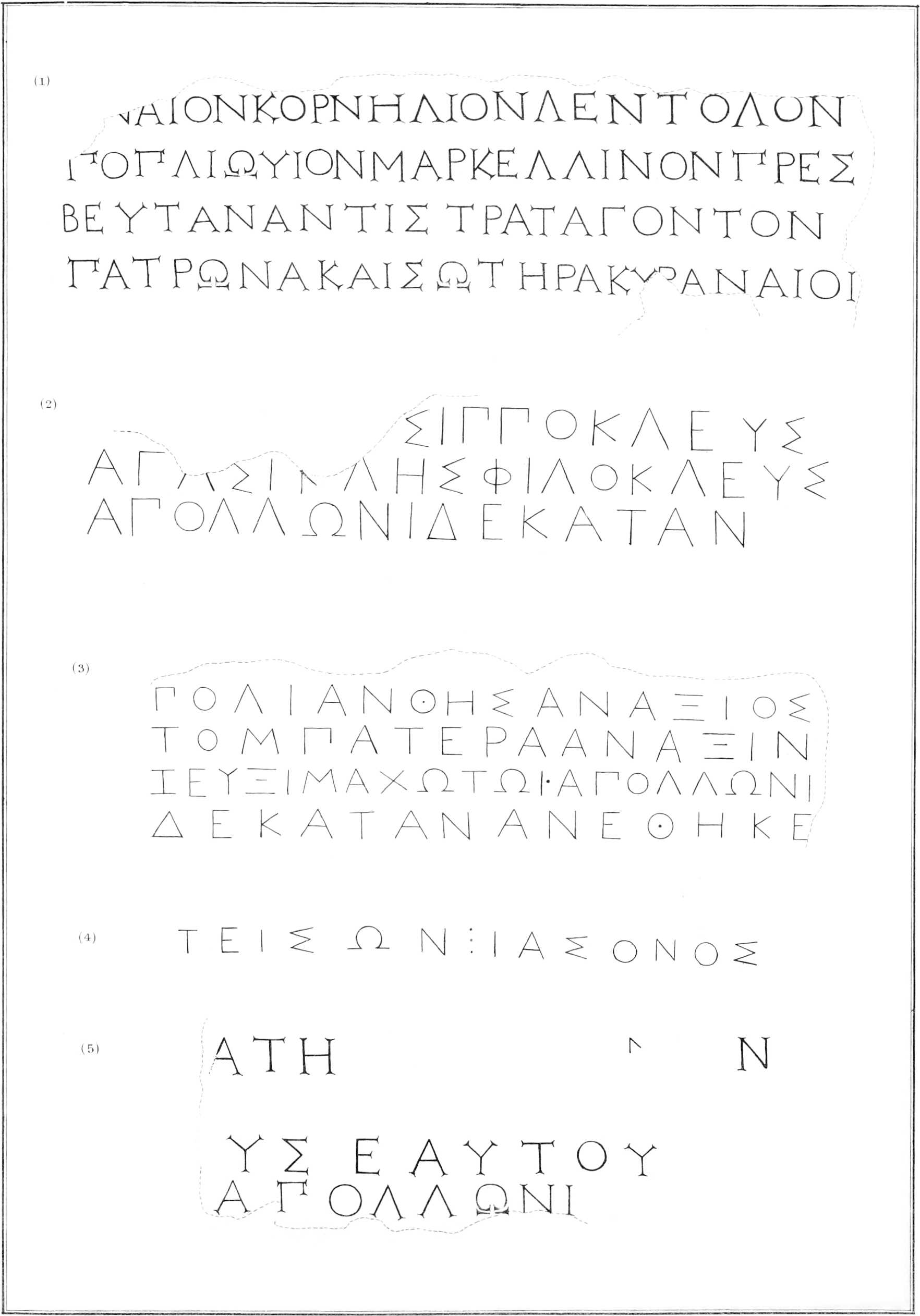
Day & Son, Lithrs. to the Queen
INSCRIPTIONS
CYRENE.
PL. 78.
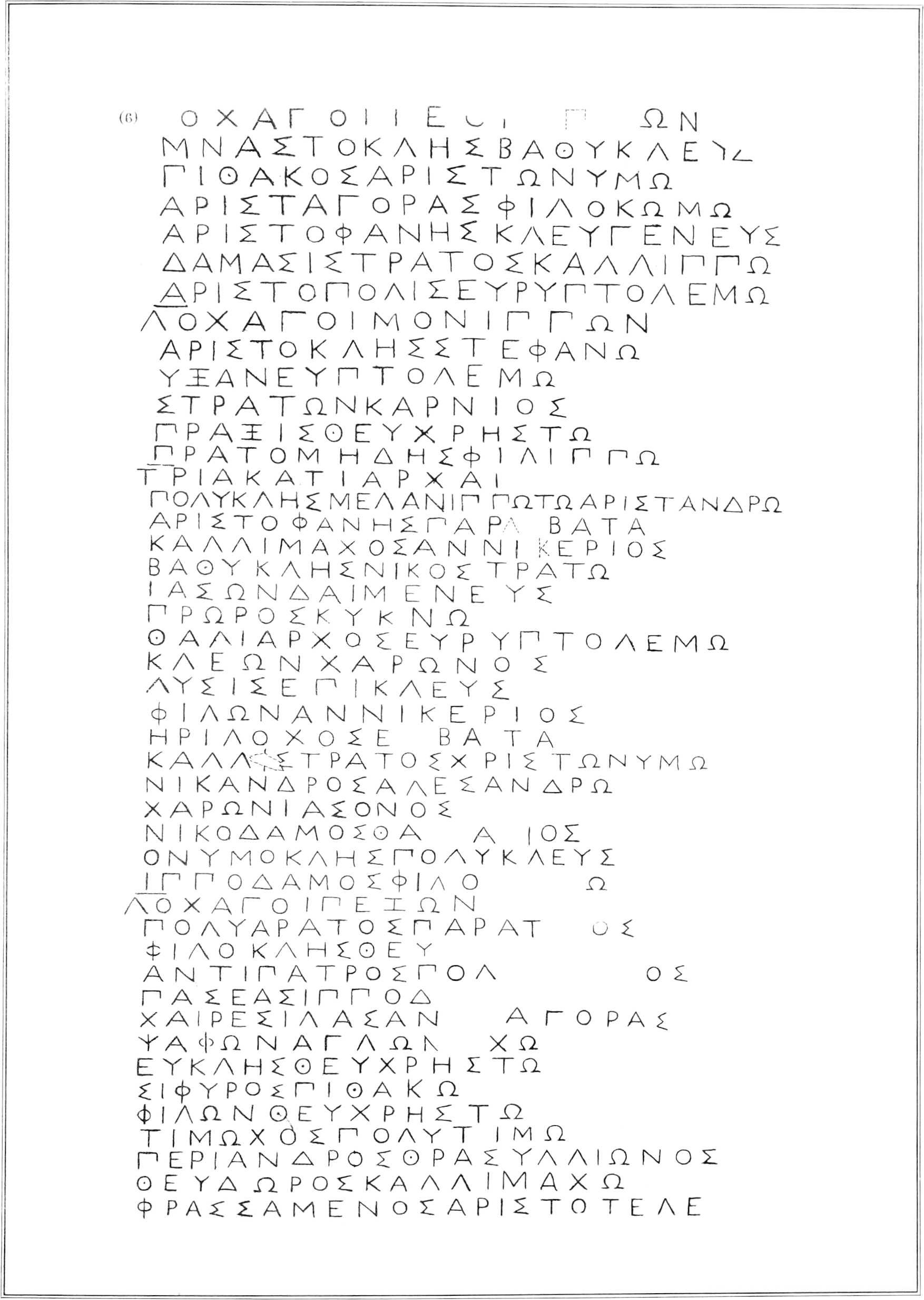
Day & Son, Lithrs. to the Queen
INSCRIPTIONS
CYRENE.
PL. 79.
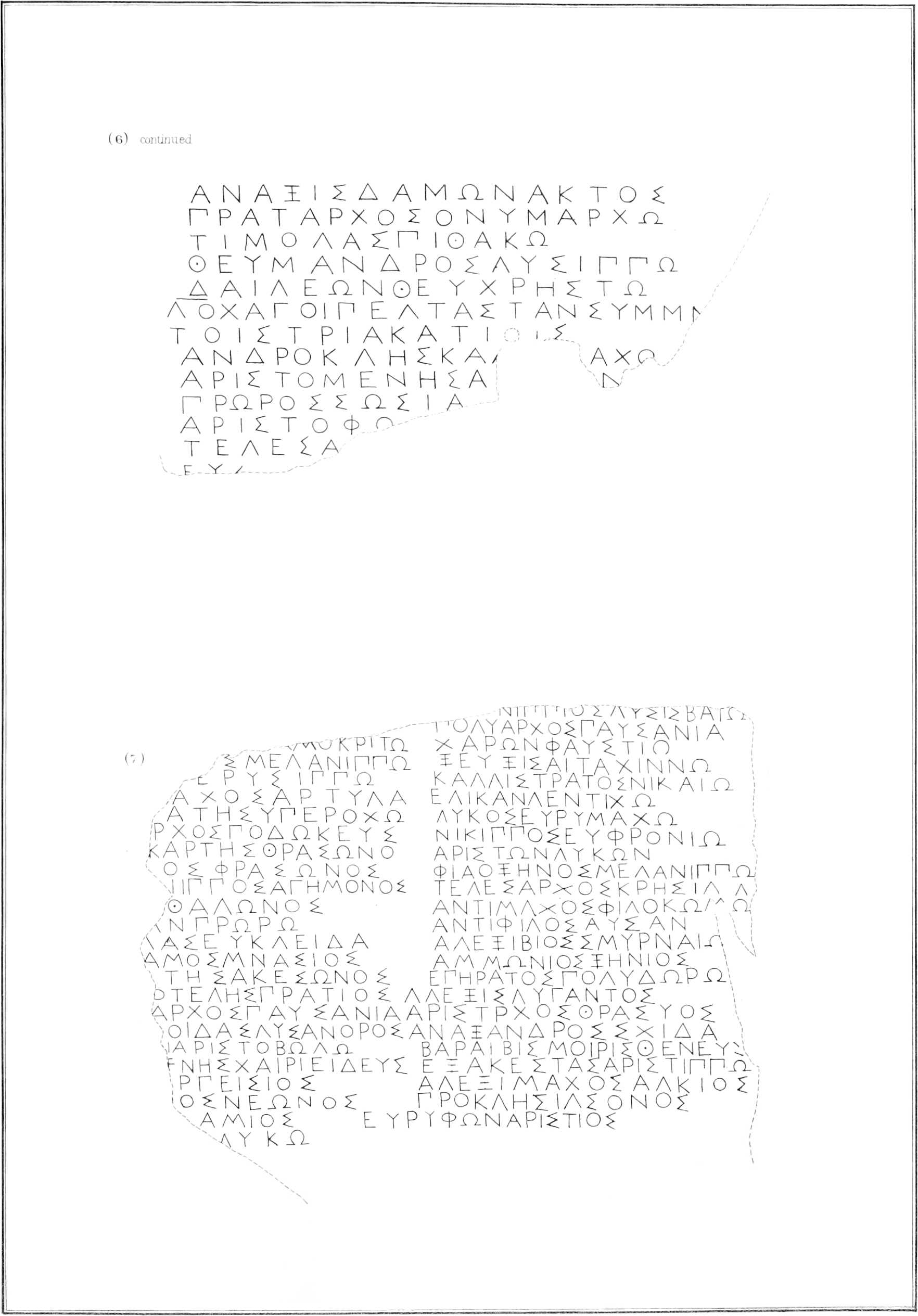
Day & Son, Lithrs. to the Queen
INSCRIPTIONS
CYRENE.
PL. 80.
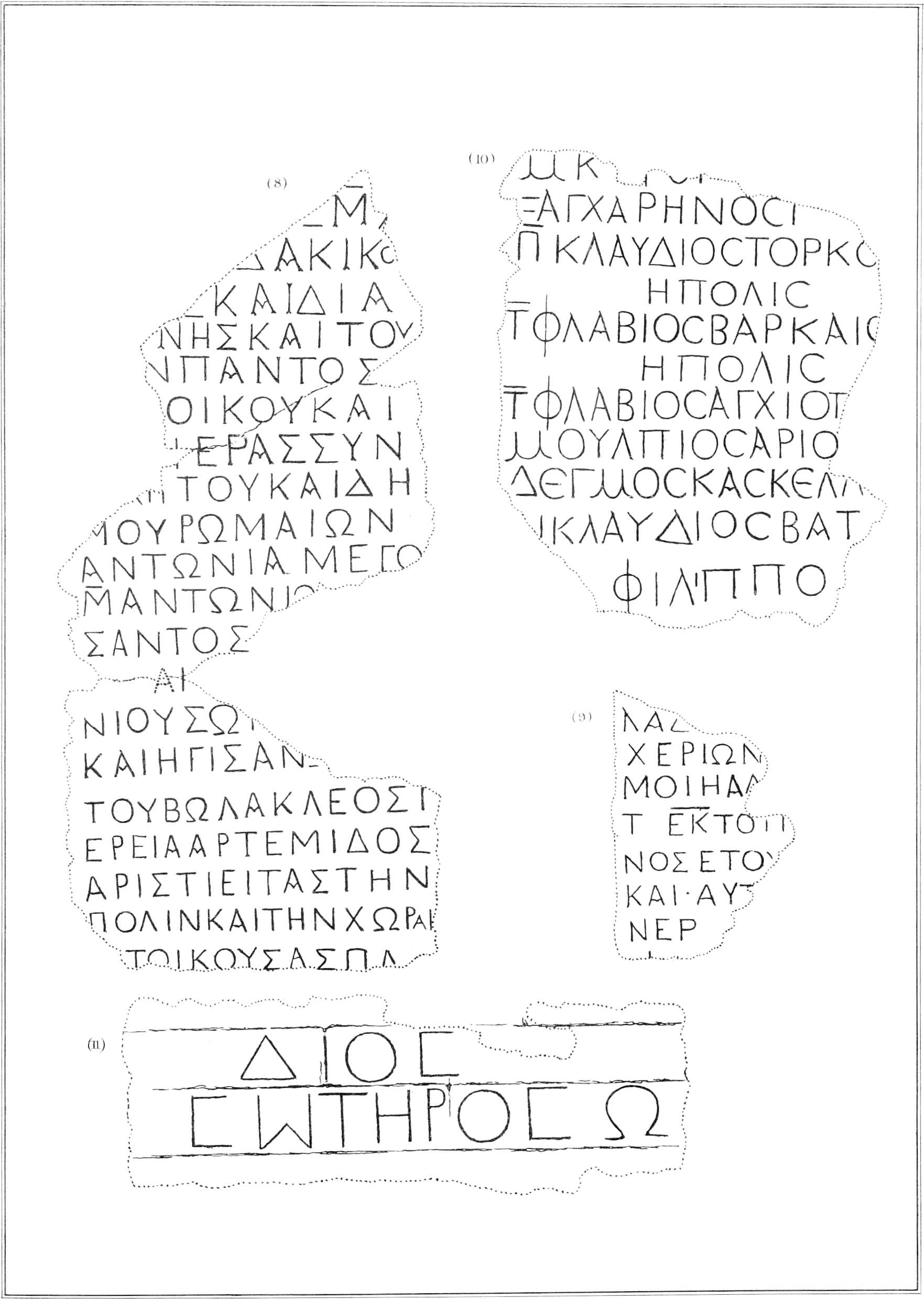
Day & Son, Lithrs. to the Queen
INSCRIPTIONS
CYRENE.
PL. 81.
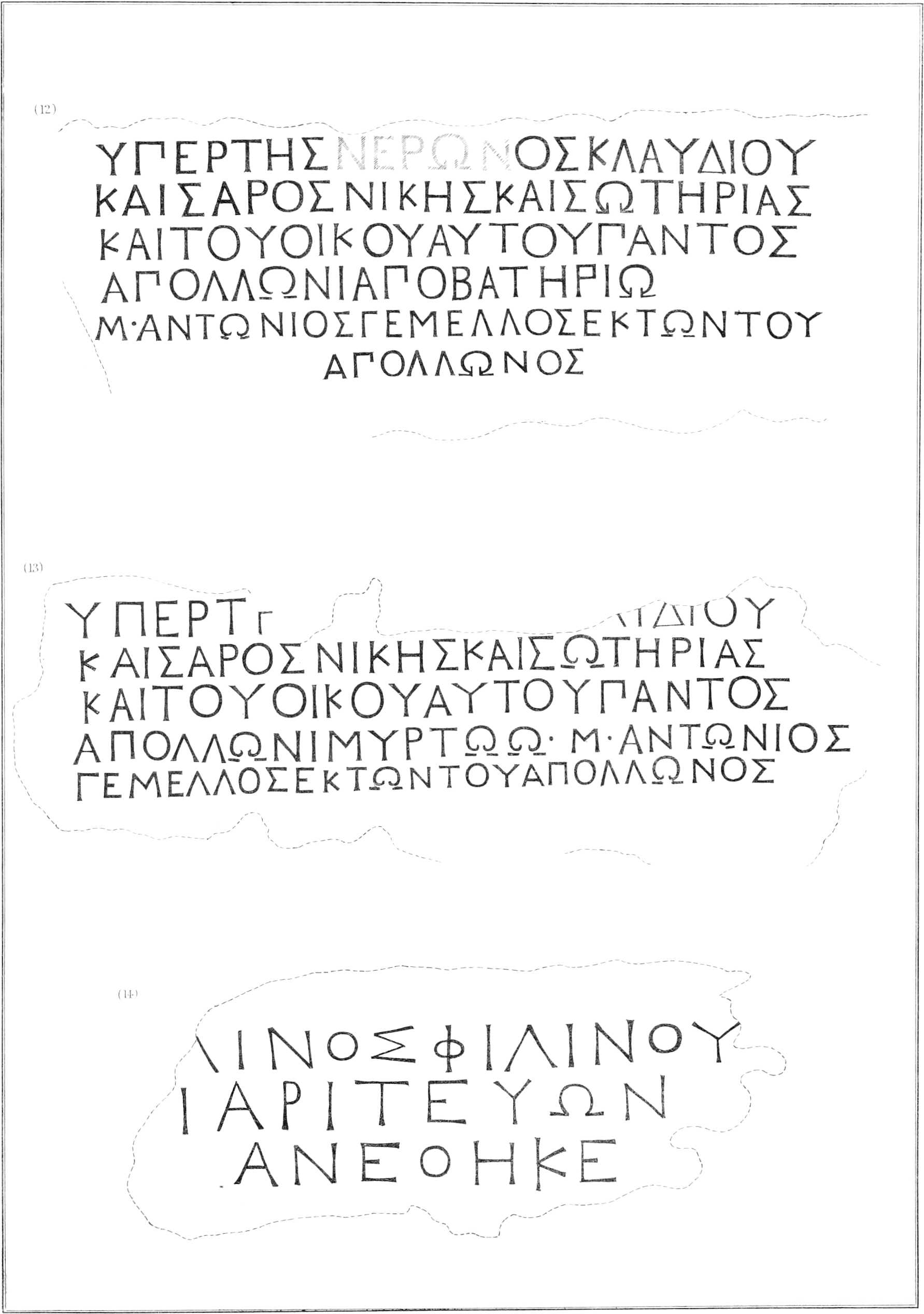
Day & Son, Lithrs. to the Queen
INSCRIPTIONS
CYRENE.
PL. 82.
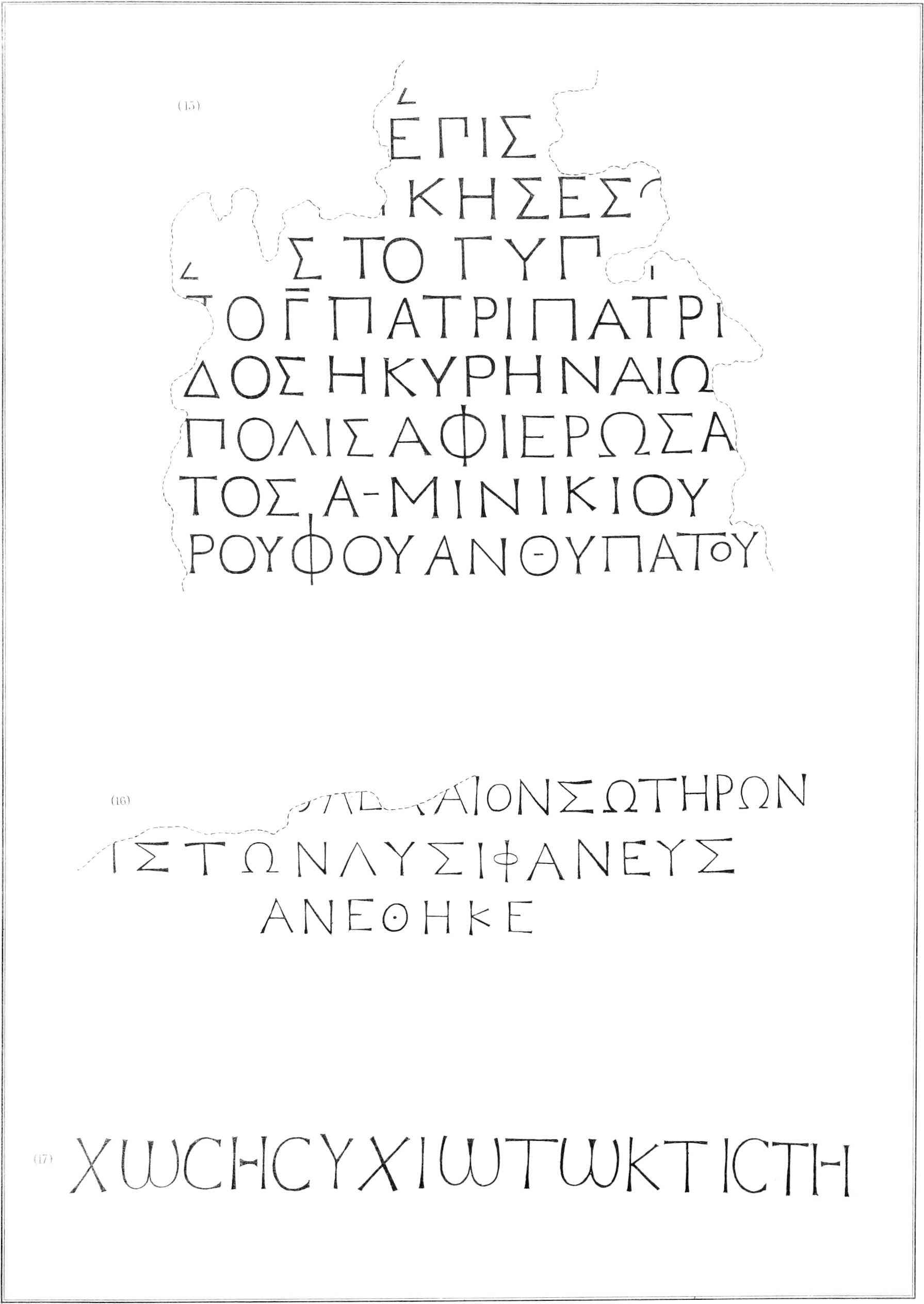
Day & Son, Lithrs. to the Queen
INSCRIPTIONS
CYRENE.
PL. 83.
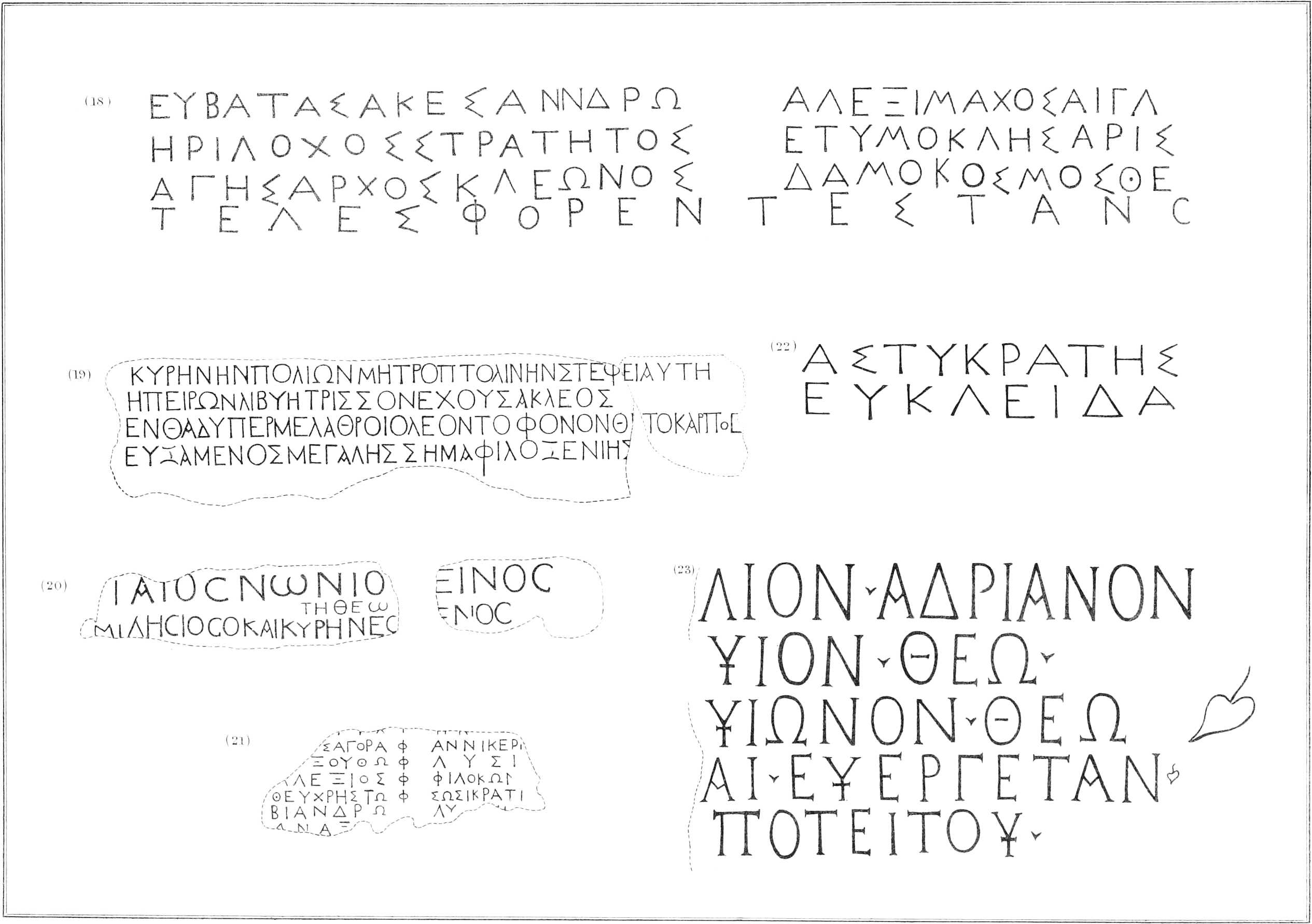
Day & Son, Lithrs. to the Queen
INSCRIPTIONS
CYRENE.
PL. 84.
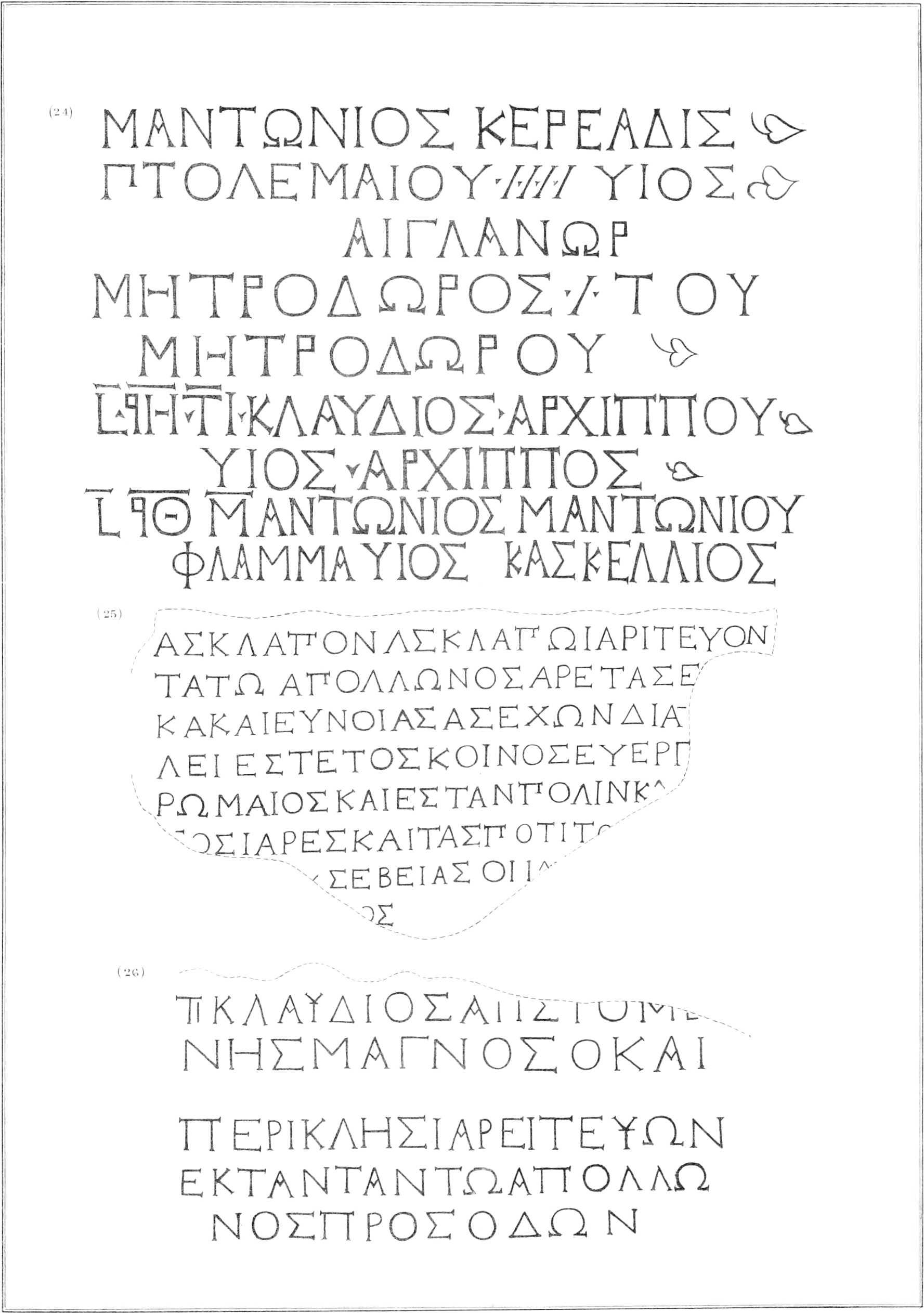
Day & Son, Lithrs. to the Queen
INSCRIPTIONS
CYRENE.
PL. 85.
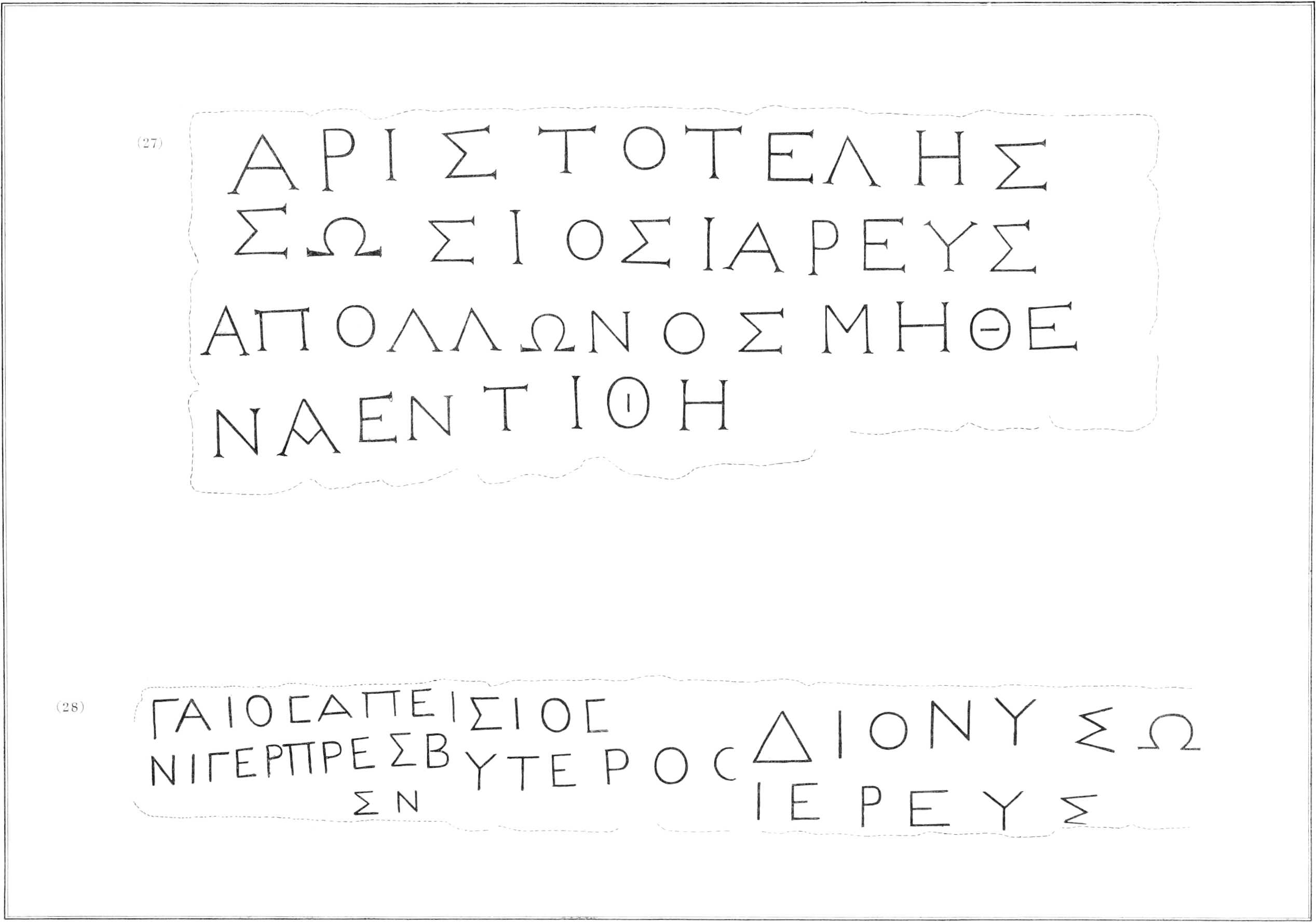
Day & Son, Lithrs. to the Queen
INSCRIPTIONS
CYRENE.
PL. 86.
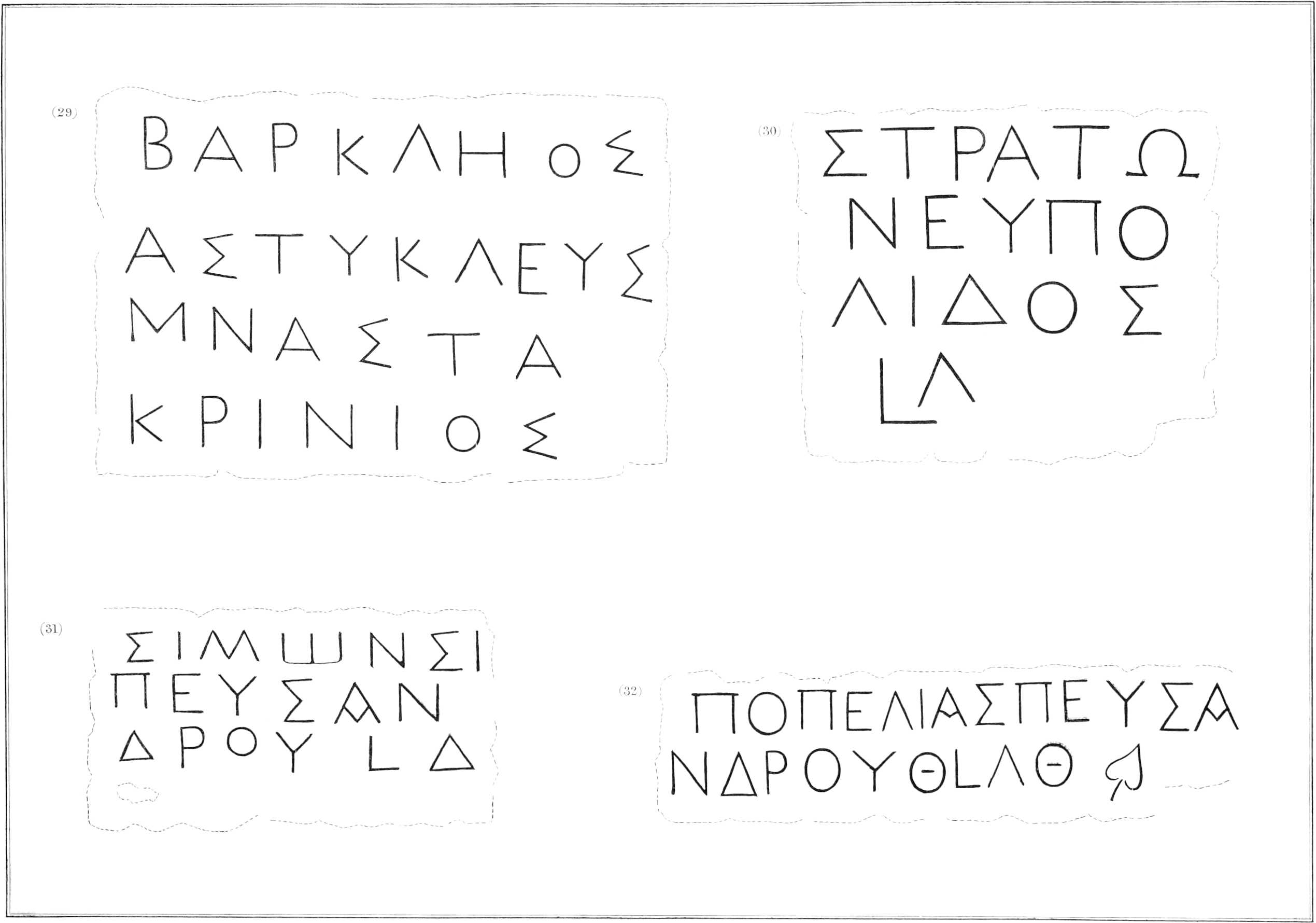
Day & Son, Lithrs. to the Queen
INSCRIPTIONS
FOOTNOTES:
[1]Thrige, p. 48.
[2]We were informed by some Arabs that these paintings were quarried out by M. Bourville.
[3]The plans of the Temples of Apollo and Bacchus, have unfortunately been lost.
[4]In the foreground, Plate 46, is shown a circular tomb, protected by an outer wall, with a passage left between. We did not meet with this type of tomb at Cyrene.
[5]Another place he had intended to make a stand and dispute our passage was at a range of tombs called by the Arabs the “Kenissieh.”
[6]The view opposite will show more clearly this locality, as well as the exterior of the tombs we lived in during our stay.
[7]Ueber eine in der Gegend der ehemaligen Kyrene gesammelte Wurzelrinde, und über das Silphium der alten Griechen.
Dr. Schroff gives the following references to modern literature of Silphium:—
- Link, Ueber das Kyrenäische Silphium. Akad. Berlin, 19 März, 1829.
- Böttiger, Ueber das Silphium oder Laser von Kyrene. Oken’s Osis. 1829, p. 317.
- Sprengel, Beiträge zur Geschichte der Medicin, i. pt. i. 1794; Geschichte der Botanik, i. 1817.
- Thrige, Res Cyrenensium, &c. Hafniæ, 1828.
- Eckhel, Doctrina Numorum veterum conscripta. Pt. i. vol. iv. Vindob. 1794.
- Müller, Numismatique de l’ancienne Afrique. Vol. i. Les Monnaies de la Cyrénaïque. Copenh. 1860.
- Macé, Rev. Archéologique, xiv. 1857.
- Beechey, Expedition, chap. xv.
- Pacho, Voy. dans la Cyrénaïque en 1825, ch. xviii.
- Cella, Viaggio da Tripoli, &c., Geneva, 1819, p. 127.
- Barth, Wanderungen, &c. Bd. i. 1849.
[8]“Es gibt nicht gar so viele Medicinalpflanzen der alten Welt, von denen man mit einer solchen Sicherheit behaupten kann, dass sie mit uns genau bekannten Pflanzen zusammen fallen, wie dies hier mit der Thapsia der Alten und mit Thapsia Silphium, und Th. garganica unserer Botaniker der Fall ist.”—(Thapsia Silphium, of Viviani, is a mere variety of T. Garganica.)
Transcriber's note:
- Changes in the ERRATA have been done.
- pg xi Changed: "led to the expediton being" to: "expedition"
- pg xii Changed: "suppposed statue of Hadrian" to: "supposed"
- pg 14 plate 4 Changed: "Amor Bon Adbi Seyat" to: "Abdi"
- pg 71 Changed: "were two feet in diamter" to: "diameter"
- caption plate 65 Changed: "CNŒUS CORNELIUS LENTULUS MARCELLINUS" to: "CNÆUS"
- pg 88 footnote 8 Changed: "Thapsia Silphium, of Vicrani" to: "Viviani"
- pg 89 Changed: "Thapsia Silphium, Vir." to: "Viv."
- Other spelling inconsistencies left unchanged.